
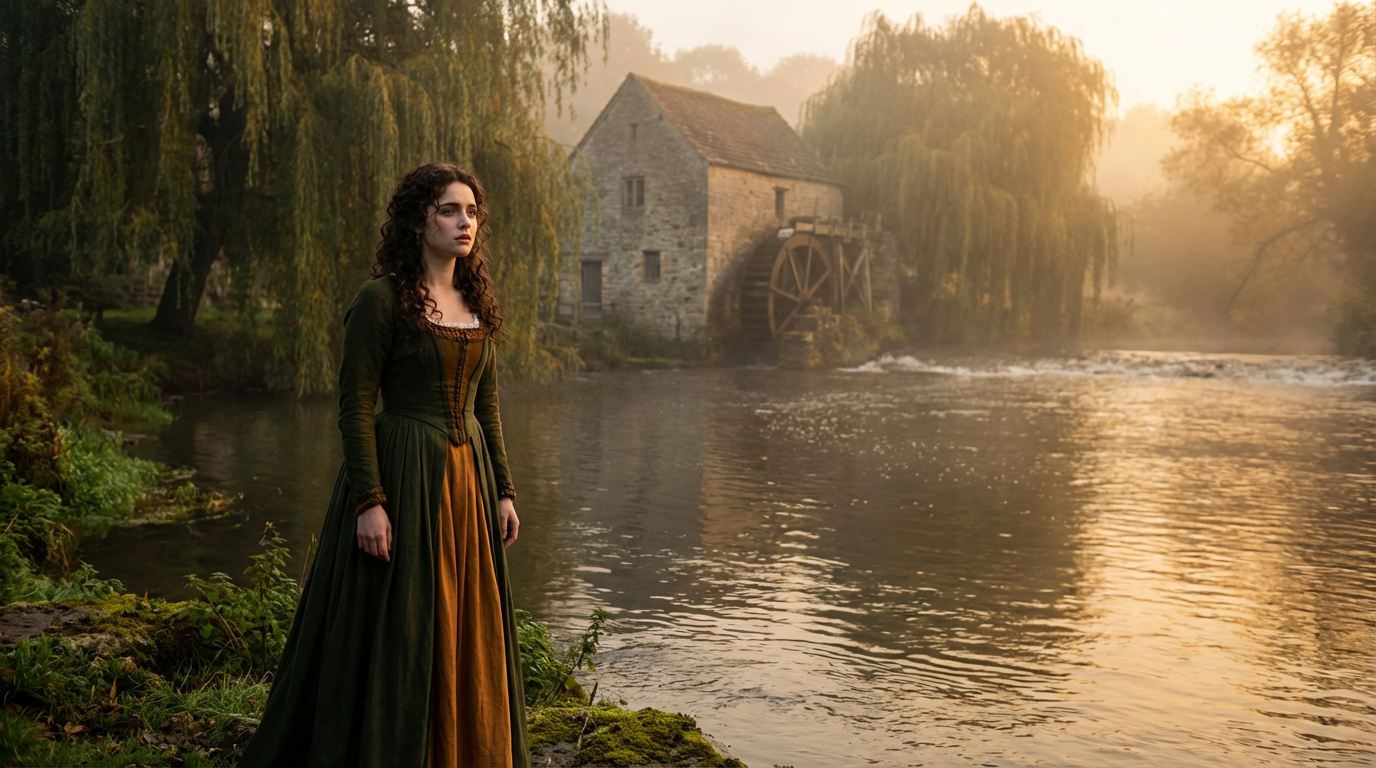
An excerpt from the original text.(complete · 2454 words)
Day of Reckoning
Mr Tulliver was an essentially sober man,—able to take his glass and
not averse to it, but never exceeding the bounds of moderation. He had
naturally an active Hotspur temperament, which did not crave liquid
fire to set it aglow; his impetuosity was usually equal to an exciting
occasion without any such reinforcements; and his desire for the
brandy-and-water implied that the too sudden joy had fallen with a
dangerous shock on a frame depressed by four years of gloom and
unaccustomed hard fare. But that first doubtful tottering moment
passed, he seemed to gather strength with his gathering excitement; and
the next day, when he was seated at table with his creditors, his eye
kindling and his cheek flushed with the consciousness that he was about
to make an honourable figure once more, he looked more like the proud,
confident, warm-hearted, and warm-tempered Tulliver of old times than
might have seemed possible to any one who had met him a week before,
riding along as had been his wont for the last four years since the
sense of failure and debt had been upon him,—with his head hanging
down, casting brief, unwilling looks on those who forced themselves on
his notice. He made his speech, asserting his honest principles with
his old confident eagerness, alluding to the rascals and the luck that
had been against him, but that he had triumphed over, to some extent,
by hard efforts and the aid of a good son; and winding up with the
story of how Tom had got the best part of the needful money. But the
streak of irritation and hostile triumph seemed to melt for a little
while into purer fatherly pride and pleasure, when, Tom’s health having
been proposed, and uncle Deane having taken occasion to say a few words
of eulogy on his general character and conduct, Tom himself got up and
made the single speech of his life. It could hardly have been briefer.
He thanked the gentlemen for the honour they had done him. He was glad
that he had been able to help his father in proving his integrity and
regaining his honest name; and, for his own part, he hoped he should
never undo that work and disgrace that name. But the applause that
followed was so great, and Tom looked so gentlemanly as well as tall
and straight, that Mr Tulliver remarked, in an explanatory manner, to
his friends on his right and left, that he had spent a deal of money on
his son’s education.
The party broke up in very sober fashion at five o’clock. Tom remained
in St Ogg’s to attend to some business, and Mr Tulliver mounted his
horse to go home, and describe the memorable things that had been said
and done, to “poor Bessy and the little wench.” The air of excitement
that hung about him was but faintly due to good cheer or any stimulus
but the potent wine of triumphant joy. He did not choose any back
street to-day, but rode slowly, with uplifted head and free glances,
along the principal street all the way to the bridge.
Why did he not happen to meet Wakem? The want of that coincidence vexed
him, and set his mind at work in an irritating way. Perhaps Wakem was
gone out of town to-day on purpose to avoid seeing or hearing anything
of an honourable action which might well cause him some unpleasant
twinges. If Wakem were to meet him then, Mr Tulliver would look
straight at him, and the rascal would perhaps be forsaken a little by
his cool, domineering impudence. He would know by and by that an honest
man was not going to serve him any longer, and lend his honesty to
fill a pocket already over-full of dishonest gains. Perhaps the luck
was beginning to turn; perhaps the Devil didn’t always hold the best
cards in this world.
Simmering in this way, Mr Tulliver approached the yardgates of Dorlcote
Mill, near enough to see a well-known figure coming out of them on a
fine black horse. They met about fifty yards from the gates, between
the great chestnuts and elms and the high bank.
“Tulliver,” said Wakem, abruptly, in a haughtier tone than usual, “what
a fool’s trick you did,—spreading those hard lumps on that Far Close! I
told you how it would be; but you men never learn to farm with any
method.”
“Oh!” said Tulliver, suddenly boiling up; “get somebody else to farm
for you, then, as’ll ask you to teach him.”
“You have been drinking, I suppose,” said Wakem, really believing that
this was the meaning of Tulliver’s flushed face and sparkling eyes.
“No, I’ve not been drinking,” said Tulliver; “I want no drinking to
help me make up my mind as I’ll serve no longer under a scoundrel.”
“Very well! you may leave my premises to-morrow, then; hold your
insolent tongue and let me pass.” (Tulliver was backing his horse
across the road to hem Wakem in.)
“No, I sha’n’t let you pass,” said Tulliver, getting fiercer. “I
shall tell you what I think of you first. You’re too big a raskill to
get hanged—you’re——”
“Let me pass, you ignorant brute, or I’ll ride over you.”
Mr Tulliver, spurring his horse and raising his whip, made a rush
forward; and Wakem’s horse, rearing and staggering backward, threw his
rider from the saddle and sent him sideways on the ground. Wakem had
had the presence of mind to loose the bridle at once, and as the horse
only staggered a few paces and then stood still, he might have risen
and remounted without more inconvenience than a bruise and a shake. But
before he could rise, Tulliver was off his horse too. The sight of the
long-hated predominant man down, and in his power, threw him into a
frenzy of triumphant vengeance, which seemed to give him preternatural
agility and strength. He rushed on Wakem, who was in the act of trying
to recover his feet, grasped him by the left arm so as to press Wakem’s
whole weight on the right arm, which rested on the ground, and flogged
him fiercely across the back with his riding-whip. Wakem shouted for
help, but no help came, until a woman’s scream was heard, and the cry
of “Father, father!”
Suddenly, Wakem felt, something had arrested Mr Tulliver’s arm; for the
flogging ceased, and the grasp on his own arm was relaxed.
“Get away with you—go!” said Tulliver, angrily. But it was not to Wakem
that he spoke. Slowly the lawyer rose, and, as he turned his head, saw
that Tulliver’s arms were being held by a girl, rather by the fear of
hurting the girl that clung to him with all her young might.
“Oh, Luke—mother—come and help Mr Wakem!” Maggie cried, as she heard
the longed-for footsteps.
“Help me on to that low horse,” said Wakem to Luke, “then I shall
perhaps manage; though—confound it—I think this arm is sprained.”
With some difficulty, Wakem was heaved on to Tulliver’s horse. Then he
turned toward the miller and said, with white rage, “You’ll suffer for
this, sir. Your daughter is a witness that you’ve assaulted me.”
“I don’t care,” said Mr Tulliver, in a thick, fierce voice; “go and
show your back, and tell ’em I thrashed you. Tell ’em I’ve made things
a bit more even i’ the world.”
“Ride my horse home with me,” said Wakem to Luke. “By the Tofton Ferry,
not through the town.”
“Father, come in!” said Maggie, imploringly. Then, seeing that Wakem
had ridden off, and that no further violence was possible, she
slackened her hold and burst into hysteric sobs, while poor Mrs
Tulliver stood by in silence, quivering with fear. But Maggie became
conscious that as she was slackening her hold her father was beginning
to grasp her and lean on her. The surprise checked her sobs.
“I feel ill—faintish,” he said. “Help me in, Bessy—I’m giddy—I’ve a
pain i’ the head.”
He walked in slowly, propped by his wife and daughter and tottered into
his arm-chair. The almost purple flush had given way to paleness, and
his hand was cold.
“Hadn’t we better send for the doctor?” said Mrs Tulliver.
He seemed to be too faint and suffering to hear her; but presently,
when she said to Maggie, “Go and seek for somebody to fetch the
doctor,” he looked up at her with full comprehension, and said,
“Doctor? No—no doctor. It’s my head, that’s all. Help me to bed.”
Sad ending to the day that had risen on them all like a beginning of
better times! But mingled seed must bear a mingled crop.
In half an hour after his father had lain down Tom came home. Bob Jakin
was with him, come to congratulate “the old master,” not without some
excusable pride that he had had his share in bringing about Mr Tom’s
good luck; and Tom had thought his father would like nothing better, as
a finish to the day, than a talk with Bob. But now Tom could only spend
the evening in gloomy expectation of the unpleasant consequences that
must follow on this mad outbreak of his father’s long-smothered hate.
After the painful news had been told, he sat in silence; he had not
spirit or inclination to tell his mother and sister anything about the
dinner; they hardly cared to ask it. Apparently the mingled thread in
the web of their life was so curiously twisted together that there
could be no joy without a sorrow coming close upon it. Tom was dejected
by the thought that his exemplary effort must always be baffled by the
wrong-doing of others; Maggie was living through, over and over again,
the agony of the moment in which she had rushed to throw herself on her
father’s arm, with a vague, shuddering foreboding of wretched scenes to
come. Not one of the three felt any particular alarm about Mr
Tulliver’s health; the symptoms did not recall his former dangerous
attack, and it seemed only a necessary consequence that his violent
passion and effort of strength, after many hours of unusual excitement,
should have made him feel ill. Rest would probably cure him.
Tom, tired out by his active day, fell asleep soon, and slept soundly;
it seemed to him as if he had only just come to bed, when he waked to
see his mother standing by him in the gray light of early morning.
“My boy, you must get up this minute; I’ve sent for the doctor, and
your father wants you and Maggie to come to him.”
“Is he worse, mother?”
“He’s been very ill all night with his head, but he doesn’t say it’s
worse; he only said suddenly, ‘Bessy, fetch the boy and girl. Tell ’em
to make haste.’”
Maggie and Tom threw on their clothes hastily in the chill gray light,
and reached their father’s room almost at the same moment. He was
watching for them with an expression of pain on his brow, but with
sharpened, anxious consciousness in his eyes. Mrs Tulliver stood at the
foot of the bed, frightened and trembling, looking worn and aged from
disturbed rest. Maggie was at the bedside first, but her father’s
glance was toward Tom, who came and stood next to her.
“Tom, my lad, it’s come upon me as I sha’n’t get up again. This world’s
been too many for me, my lad, but you’ve done what you could to make
things a bit even. Shake hands wi’ me again, my lad, before I go away
from you.”
The father and son clasped hands and looked at each other an instant.
Then Tom said, trying to speak firmly,—
“Have you any wish, father—that I can fulfil, when——”
“Ay, my lad—you’ll try and get the old mill back.”
“Yes, father.”
“And there’s your mother—you’ll try and make her amends, all you can,
for my bad luck—and there’s the little wench——”
The father turned his eyes on Maggie with a still more eager look,
while she, with a bursting heart, sank on her knees, to be closer to
the dear, time-worn face which had been present with her through long
years, as the sign of her deepest love and hardest trial.
“You must take care of her, Tom—don’t you fret, my wench—there’ll come
somebody as’ll love you and take your part—and you must be good to her,
my lad. I was good to my sister. Kiss me, Maggie.—Come, Bessy.—You’ll
manage to pay for a brick grave, Tom, so as your mother and me can lie
together.”
He looked away from them all when he had said this, and lay silent for
some minutes, while they stood watching him, not daring to move. The
morning light was growing clearer for them, and they could see the
heaviness gathering in his face, and the dulness in his eyes. But at
last he looked toward Tom and said,—
“I had my turn—I beat him. That was nothing but fair. I never wanted
anything but what was fair.”
“But, father, dear father,” said Maggie, an unspeakable anxiety
predominating over her grief, “you forgive him—you forgive every one
now?”
He did not move his eyes to look at her, but he said,—
“No, my wench. I don’t forgive him. What’s forgiving to do? I can’t
love a raskill——”
His voice had become thicker; but he wanted to say more, and moved his
lips again and again, struggling in vain to speak. At length the words
forced their way.
“Does God forgive raskills?—but if He does, He won’t be hard wi’ me.”
His hands moved uneasily, as if he wanted them to remove some
obstruction that weighed upon him. Two or three times there fell from
him some broken words,—
“This world’s—too many—honest man—puzzling——”
Soon they merged into mere mutterings; the eyes had ceased to discern;
and then came the final silence.
But not of death. For an hour or more the chest heaved, the loud, hard
breathing continued, getting gradually slower, as the cold dews
gathered on the brow.
At last there was total stillness, and poor Tulliver’s dimly lighted
soul had forever ceased to be vexed with the painful riddle of this
world.
Help was come now; Luke and his wife were there, and Mr Turnbull had
arrived, too late for everything but to say, “This is death.”
Tom and Maggie went downstairs together into the room where their
father’s place was empty. Their eyes turned to the same spot, and
Maggie spoke,—
“Tom, forgive me—let us always love each other”; and they clung and
wept together.
BOOK SIXTH
THE GREAT TEMPTATION.
Master this chapter. Complete your experience
Purchase the complete book to access all chapters and support classic literature
As an Amazon Associate, we earn a small commission from qualifying purchases at no additional cost to you.
Available in paperback, hardcover, and e-book formats
Let's Analyse the Pattern
The Victory Trap - When Winning Makes Us Dangerous
The tendency to use moments of success or power to settle old scores, often destroying the very thing we fought to achieve.
Why This Matters
Connect literature to life
This chapter teaches how success creates blind spots that make us dangerous to ourselves and others.
Practice This Today
This week, notice when good news makes you want to settle old scores—pause and ask if you're using your win to build something or destroy something.
Now let's explore the literary elements.
Key Quotes & Analysis
"He made his speech, asserting his honest principles with his old confident eagerness, alluding to the rascals and the luck that had been against him"
Context: Tulliver addresses his creditors as he pays off his debts
Shows Tulliver at his finest moment, restored to his old confidence and pride. The reference to 'rascals' foreshadows his inability to let go of grudges even in victory.
In Today's Words:
He gave his speech about being an honest man who got screwed over by bad people and bad luck
"I've got my breath again, and if I can't pay everything, I can pay in part, and I mean to"
Context: Speaking to his creditors about partial debt payment
Demonstrates Tulliver's integrity and determination to restore his honor through honest effort. This moment of dignity makes his later downfall more tragic.
In Today's Words:
I'm back on my feet, and even if I can't pay everything, I'll pay what I can because that's who I am
"Does God forgive rascals? If He does, He won't be hard on me"
Context: His dying words, wrestling with questions of justice and forgiveness
Reveals Tulliver's final struggle between his desire for justice and religious teachings about forgiveness. He dies unreconciled to his enemies.
In Today's Words:
If God forgives the bad guys, then maybe He'll go easy on me too
Thematic Threads
Pride
In This Chapter
Tulliver's pride in paying his debts transforms into deadly arrogance when facing Wakem, making him believe he can finally act without consequences
Development
Evolved from defensive pride protecting family reputation to aggressive pride demanding public vindication
In Your Life:
You might recognize this when a promotion at work makes you want to 'show' everyone who doubted you, potentially damaging relationships you'll need later.
Justice
In This Chapter
Tulliver's concept of justice requires not just clearing his debts but punishing those who wronged him, even as he lies dying
Development
Shifted from seeking fairness to demanding retribution, showing how justice can become indistinguishable from revenge
In Your Life:
You see this when you can't let go of wanting the person who hurt you to 'pay,' even when moving on would serve you better.
Family Loyalty
In This Chapter
The family finally unites in grief over Tulliver's death, but only after his actions have destroyed their hard-won stability
Development
Tragically fulfilled through loss—family bonds strengthen through shared trauma rather than shared success
In Your Life:
This appears when family members only come together during crises, suggesting relationships need cultivation during good times, not just bad ones.
Self-Destruction
In This Chapter
Tulliver literally destroys himself through his inability to walk away from confrontation, his body giving out from the violence he initiates
Development
Culmination of his pattern of choosing conflict over compromise, showing how self-destructive impulses compound over time
In Your Life:
You might see this in your own tendency to pick fights when you're stressed, knowing it will make everything worse but unable to stop yourself.
Forgiveness
In This Chapter
Tulliver dies questioning whether even God forgives 'rascals,' unable to find peace because he cannot release his hatred
Development
Introduced as his final struggle, showing how unforgiveness becomes a prison that follows us even to death
In Your Life:
This shows up when you realize that holding grudges hurts you more than the person you're angry with, but you still can't let go.
You now have the context. Time to form your own thoughts.
Discussion Questions
- 1
What sequence of events led from Mr. Tulliver's triumph in paying off his debts to his death that same night?
analysis • surface - 2
Why couldn't Mr. Tulliver simply enjoy his victory and walk away from the confrontation with Wakem?
analysis • medium - 3
Where have you seen people sabotage their own success by acting on old grudges when they finally gain power or advantage?
application • medium - 4
How would you help someone recognize when they're about to turn a victory into a disaster by settling old scores?
application • deep - 5
What does Mr. Tulliver's story reveal about the relationship between pride, power, and self-destruction?
reflection • deep
Critical Thinking Exercise
Design Your Victory Protocol
Think of a current goal you're working toward—paying off debt, getting promoted, resolving a conflict, recovering from illness. Imagine you achieve it tomorrow. Write down three specific actions you might be tempted to take in that moment of victory that could backfire. Then create your personal 'victory protocol'—three rules you'll follow to protect yourself from your own success.
Consider:
- •What old grievances might resurface when you feel powerful?
- •Who might you want to 'prove wrong' or confront once you're winning?
- •What spending, relationship, or career decisions might feel justified in victory but dangerous in reality?
Journaling Prompt
Write about a time when success went to your head, or when you watched someone else turn their victory into a defeat. What warning signs can you identify now that you missed then?
Coming Up Next...
Chapter 40: Love's Sweet Performance
With their father gone, Tom and Maggie must navigate their grief and their future. But the mill holds new complications, and Maggie will soon face temptations that will test everything she believes about duty, love, and loyalty.



