
An excerpt from the original text.(complete · 1785 words)
he Hard-Won Triumph
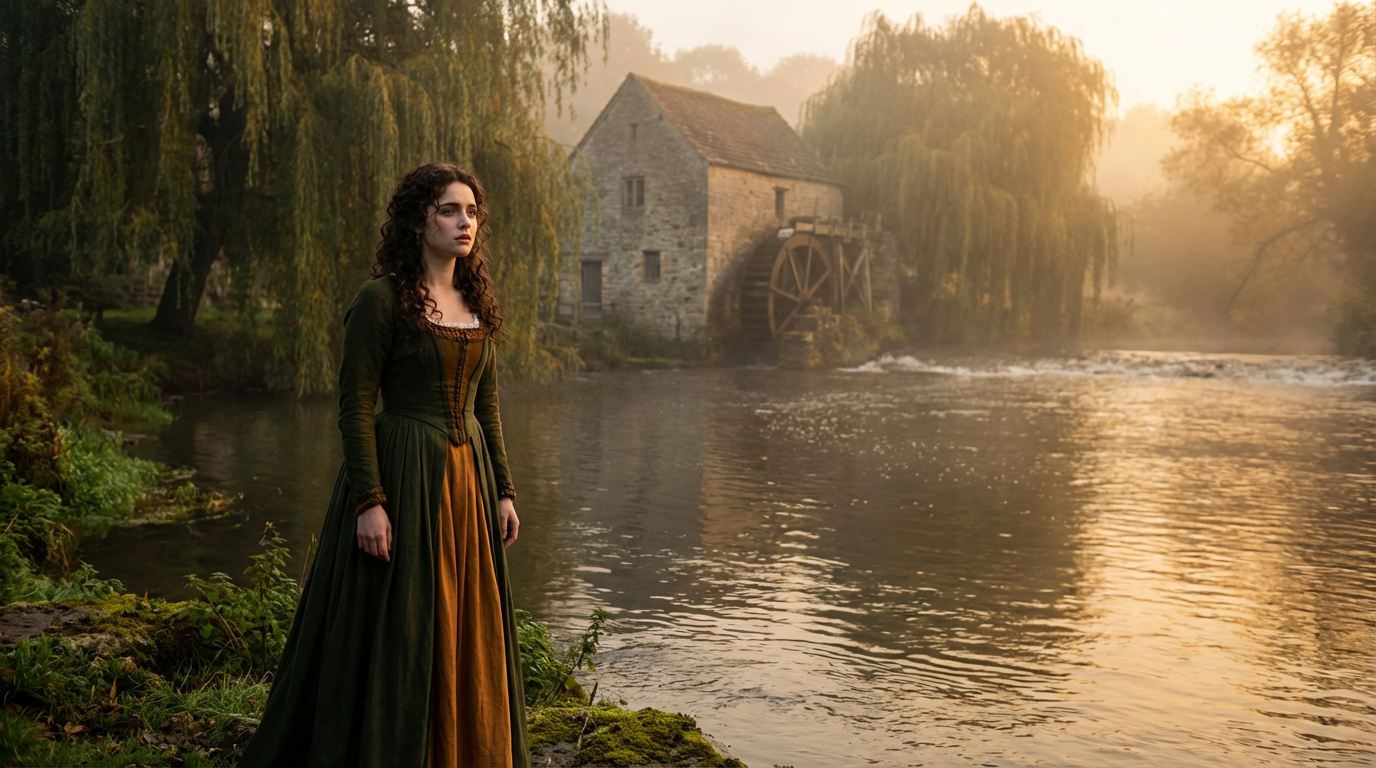
Three weeks later, when Dorlcote Mill was at its prettiest moment in
all the year,—the great chestnuts in blossom, and the grass all deep
and daisied,—Tom Tulliver came home to it earlier than usual in the
evening, and as he passed over the bridge, he looked with the old
deep-rooted affection at the respectable red brick house, which always
seemed cheerful and inviting outside, let the rooms be as bare and the
hearts as sad as they might inside. There is a very pleasant light in
Tom’s blue-gray eyes as he glances at the house-windows; that fold in
his brow never disappears, but it is not unbecoming; it seems to imply
a strength of will that may possibly be without harshness, when the
eyes and mouth have their gentlest expression. His firm step becomes
quicker, and the corners of his mouth rebel against the compression
which is meant to forbid a smile.
The eyes in the parlour were not turned toward the bridge just then,
and the group there was sitting in unexpectant silence,—Mr Tulliver in
his arm-chair, tired with a long ride, and ruminating with a worn look,
fixed chiefly on Maggie, who was bending over her sewing while her
mother was making the tea.
They all looked up with surprise when they heard the well-known foot.
“Why, what’s up now, Tom?” said his father. “You’re a bit earlier than
usual.”
“Oh, there was nothing more for me to do, so I came away. Well,
mother!”
Tom went up to his mother and kissed her, a sign of unusual good-humour
with him. Hardly a word or look had passed between him and Maggie in
all the three weeks; but his usual incommunicativeness at home
prevented this from being noticeable to their parents.
“Father,” said Tom, when they had finished tea, “do you know exactly
how much money there is in the tin box?”
“Only a hundred and ninety-three pound,” said Mr Tulliver. “You’ve
brought less o’ late; but young fellows like to have their own way with
their money. Though I didn’t do as I liked before I was of age.” He
spoke with rather timid discontent.
“Are you quite sure that’s the sum, father?” said Tom. “I wish you
would take the trouble to fetch the tin box down. I think you have
perhaps made a mistake.”
“How should I make a mistake?” said his father, sharply. “I’ve counted
it often enough; but I can fetch it, if you won’t believe me.”
It was always an incident Mr Tulliver liked, in his gloomy life, to
fetch the tin box and count the money.
“Don’t go out of the room, mother,” said Tom, as he saw her moving when
his father was gone upstairs.
“And isn’t Maggie to go?” said Mrs Tulliver; “because somebody must
take away the things.”
“Just as she likes,” said Tom indifferently.
That was a cutting word to Maggie. Her heart had leaped with the sudden
conviction that Tom was going to tell their father the debts could be
paid; and Tom would have let her be absent when that news was told! But
she carried away the tray and came back immediately. The feeling of
injury on her own behalf could not predominate at that moment.
Tom drew to the corner of the table near his father when the tin box
was set down and opened, and the red evening light falling on them made
conspicuous the worn, sour gloom of the dark-eyed father and the
suppressed joy in the face of the fair-complexioned son. The mother and
Maggie sat at the other end of the table, the one in blank patience,
the other in palpitating expectation.
Mr Tulliver counted out the money, setting it in order on the table,
and then said, glancing sharply at Tom:
“There now! you see I was right enough.”
He paused, looking at the money with bitter despondency.
“There’s more nor three hundred wanting; it’ll be a fine while before
I can save that. Losing that forty-two pound wi’ the corn was a sore
job. This world’s been too many for me. It’s took four year to lay
this by; it’s much if I’m above ground for another four year. I must
trusten to you to pay ’em,” he went on, with a trembling voice, “if you
keep i’ the same mind now you’re coming o’ age. But you’re like enough
to bury me first.”
He looked up in Tom’s face with a querulous desire for some assurance.
“No, father,” said Tom, speaking with energetic decision, though there
was tremor discernible in his voice too, “you will live to see the
debts all paid. You shall pay them with your own hand.”
His tone implied something more than mere hopefulness or resolution. A
slight electric shock seemed to pass through Mr Tulliver, and he kept
his eyes fixed on Tom with a look of eager inquiry, while Maggie,
unable to restrain herself, rushed to her father’s side and knelt down
by him. Tom was silent a little while before he went on.
“A good while ago, my uncle Glegg lent me a little money to trade with,
and that has answered. I have three hundred and twenty pounds in the
bank.”
His mother’s arms were round his neck as soon as the last words were
uttered, and she said, half crying:
“Oh, my boy, I knew you’d make iverything right again, when you got a
man.”
But his father was silent; the flood of emotion hemmed in all power of
speech. Both Tom and Maggie were struck with fear lest the shock of joy
might even be fatal. But the blessed relief of tears came. The broad
chest heaved, the muscles of the face gave way, and the gray-haired man
burst into loud sobs. The fit of weeping gradually subsided, and he sat
quiet, recovering the regularity of his breathing. At last he looked up
at his wife and said, in a gentle tone:
“Bessy, you must come and kiss me now—the lad has made you amends.
You’ll see a bit o’ comfort again, belike.”
When she had kissed him, and he had held her hand a minute, his
thoughts went back to the money.
“I wish you’d brought me the money to look at, Tom,” he said, fingering
the sovereigns on the table; “I should ha’ felt surer.”
“You shall see it to-morrow, father,” said Tom. “My uncle Deane has
appointed the creditors to meet to-morrow at the Golden Lion, and he
has ordered a dinner for them at two o’clock. My uncle Glegg and he
will both be there. It was advertised in the ‘Messenger’ on Saturday.”
“Then Wakem knows on’t!” said Mr Tulliver, his eye kindling with
triumphant fire. “Ah!” he went on, with a long-drawn guttural
enunciation, taking out his snuff-box, the only luxury he had left
himself, and tapping it with something of his old air of defiance.
“I’ll get from under his thumb now, though I must leave the old
mill. I thought I could ha’ held out to die here—but I can’t——we’ve got
a glass o’ nothing in the house, have we, Bessy?”
“Yes,” said Mrs Tulliver, drawing out her much-reduced bunch of keys,
“there’s some brandy sister Deane brought me when I was ill.”
“Get it me, then; get it me. I feel a bit weak.”
“Tom, my lad,” he said, in a stronger voice, when he had taken some
brandy-and-water, “you shall make a speech to ’em. I’ll tell ’em it’s
you as got the best part o’ the money. They’ll see I’m honest at last,
and ha’ got an honest son. Ah! Wakem ’ud be fine and glad to have a son
like mine,—a fine straight fellow,—i’stead o’ that poor crooked
creatur! You’ll prosper i’ the world, my lad; you’ll maybe see the day
when Wakem and his son ’ull be a round or two below you. You’ll like
enough be ta’en into partnership, as your uncle Deane was before
you,—you’re in the right way for’t; and then there’s nothing to hinder
your getting rich. And if ever you’re rich enough—mind this—try and get
th’ old mill again.”
Mr Tulliver threw himself back in his chair; his mind, which had so
long been the home of nothing but bitter discontent and foreboding,
suddenly filled, by the magic of joy, with visions of good fortune. But
some subtle influence prevented him from foreseeing the good fortune as
happening to himself.
“Shake hands wi’ me, my lad,” he said, suddenly putting out his hand.
“It’s a great thing when a man can be proud as he’s got a good son.
I’ve had that luck.”
Tom never lived to taste another moment so delicious as that; and
Maggie couldn’t help forgetting her own grievances. Tom was good; and
in the sweet humility that springs in us all in moments of true
admiration and gratitude, she felt that the faults he had to pardon in
her had never been redeemed, as his faults were. She felt no jealousy
this evening that, for the first time, she seemed to be thrown into the
background in her father’s mind.
There was much more talk before bedtime. Mr Tulliver naturally wanted
to hear all the particulars of Tom’s trading adventures, and he
listened with growing excitement and delight. He was curious to know
what had been said on every occasion; if possible, what had been
thought; and Bob Jakin’s part in the business threw him into peculiar
outbursts of sympathy with the triumphant knowingness of that
remarkable packman. Bob’s juvenile history, so far as it had come under
Mr Tulliver’s knowledge, was recalled with that sense of astonishing
promise it displayed, which is observable in all reminiscences of the
childhood of great men.
It was well that there was this interest of narrative to keep under the
vague but fierce sense of triumph over Wakem, which would otherwise
have been the channel his joy would have rushed into with dangerous
force. Even as it was, that feeling from time to time gave threats of
its ultimate mastery, in sudden bursts of irrelevant exclamation.
It was long before Mr Tulliver got to sleep that night; and the sleep,
when it came, was filled with vivid dreams. At half-past five o’clock
in the morning, when Mrs Tulliver was already rising, he alarmed her by
starting up with a sort of smothered shout, and looking round in a
bewildered way at the walls of the bedroom.
“What’s the matter, Mr Tulliver?” said his wife. He looked at her,
still with a puzzled expression, and said at last:
“Ah!—I was dreaming—did I make a noise?—I thought I’d got hold of him.”
Master this chapter. Complete your experience
Purchase the complete book to access all chapters and support classic literature
As an Amazon Associate, we earn a small commission from qualifying purchases at no additional cost to you.
Available in paperback, hardcover, and e-book formats
Let's Analyse the Pattern
Meaningful achievements often require private, unglamorous work that accumulates power through secrecy until the moment of revelation.
Why This Matters
Connect literature to life
This chapter teaches how the most significant achievements often happen through invisible daily work that others don't see or value.
Practice This Today
This week, notice when someone in your life might be quietly working toward a solution while others focus on the problem—and acknowledge their effort before they have to prove themselves.
Now let's explore the literary elements.
Key Quotes & Analysis
"Why, what's up now, Tom? You're a bit earlier than usual."
Context: When Tom arrives home unexpectedly with his secret news
This casual greeting shows how Mr. Tulliver has no idea his life is about to change completely. The ordinariness of the moment makes Tom's revelation even more dramatic and powerful.
In Today's Words:
What's going on? You're home early today.
"The fold in his brow never disappears, but it is not unbecoming; it seems to imply a strength of will that may possibly be without harshness."
Context: Describing Tom as he approaches the house with his secret
This shows how responsibility has aged Tom but also strengthened him. The permanent worry line suggests the weight he's carried, but his gentler expression hints at the good news he brings.
In Today's Words:
He always looks serious now, but in a strong way, not a mean way.
"There is a very pleasant light in Tom's blue-gray eyes as he glances at the house-windows."
Context: As Tom approaches home knowing he can save his family
This rare moment of joy for Tom shows how much the family's financial burden has weighed on him. His happiness comes not from personal success but from being able to restore his father's dignity.
In Today's Words:
His eyes lit up with happiness when he looked at the house.
Thematic Threads
Class
In This Chapter
Financial debt represents social shame and powerlessness; paying creditors restores dignity and standing
Development
Evolved from earlier chapters showing how debt trapped the family in social humiliation
In Your Life:
You might recognize how financial struggles affect not just your budget but your sense of worth in your community
Identity
In This Chapter
Tom proves himself as the family's financial savior, establishing his adult identity through practical achievement
Development
Builds on Tom's earlier struggles to find his place and prove his worth
In Your Life:
You might see this in moments when you finally prove yourself capable in ways others doubted
Recognition
In This Chapter
Mr. Tulliver's emotional breakdown shows how deeply he needed to see his son succeed and feel pride again
Development
Develops the ongoing theme of family members seeking acknowledgment from each other
In Your Life:
You might recognize your own need for family members to witness and celebrate your achievements
Sacrifice
In This Chapter
Tom's months of secret work represent sacrifice that goes unrecognized until the final revelation
Development
Continues the pattern of family members making unseen sacrifices for each other
In Your Life:
You might see this in your own quiet efforts to improve your family's situation without seeking daily credit
Power
In This Chapter
Financial independence transforms the family's position from powerless debtors to people who can hold their heads up
Development
Reverses the power dynamics established in earlier chapters about their financial helplessness
In Your Life:
You might recognize how financial stability changes not just your security but your confidence in all relationships
You now have the context. Time to form your own thoughts.
Discussion Questions
- 1
Why did Tom keep his trading and saving secret from his family for months?
analysis • surface - 2
What does Mr. Tulliver's emotional breakdown reveal about how financial shame had affected him?
analysis • medium - 3
Where do you see people today working quietly toward goals without seeking recognition or validation?
application • medium - 4
When would you choose to work in silence versus sharing your progress with others?
application • deep - 5
What does this scene teach us about the difference between dramatic gestures and steady progress?
reflection • deep
Critical Thinking Exercise
Map Your Silent Victory
Think of a goal you're currently working toward or want to achieve. Write down three specific actions you could take privately, without announcing them to others, that would move you closer to that goal. Then identify what the 'reveal moment' would look like—when would you share your progress and with whom?
Consider:
- •Consider who might interfere with or discourage your efforts if they knew too early
- •Think about what small wins you could celebrate privately to maintain motivation
- •Reflect on how protecting your work might actually protect your relationships too
Journaling Prompt
Write about a time when you accomplished something significant that others didn't see coming. How did their surprise or reaction affect you? What did you learn about the power of working quietly?
Coming Up Next...
Chapter 39: The Price of Pride and Revenge
The creditors' meeting arrives, and Mr. Tulliver prepares to face his debts—and his enemies—with his head held high for the first time in years. But will his newfound confidence lead to wisdom or recklessness?



