
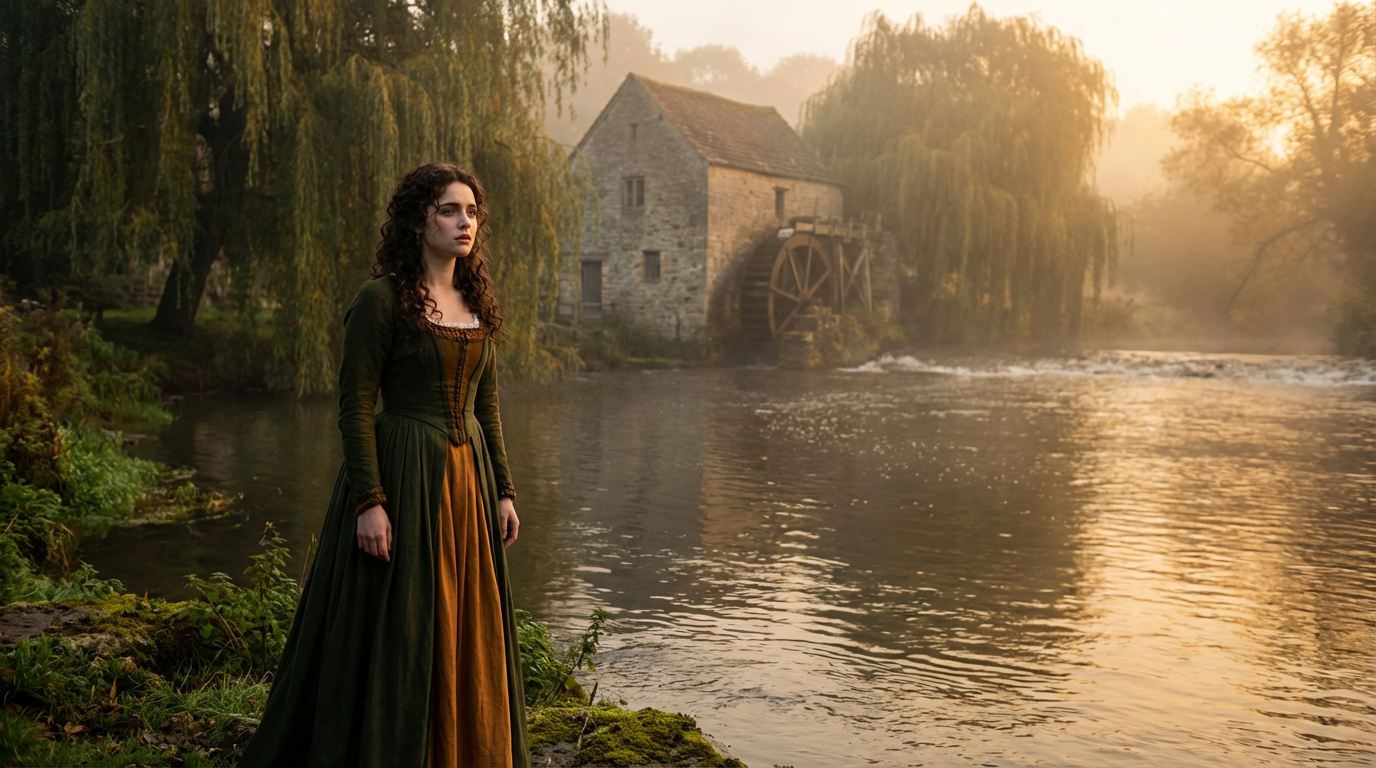
An excerpt from the original text.(complete · 2281 words)
nother Love-Scene
Early in the following April, nearly a year after that dubious parting
you have just witnessed, you may, if you like, again see Maggie
entering the Red Deeps through the group of Scotch firs. But it is
early afternoon and not evening, and the edge of sharpness in the
spring air makes her draw her large shawl close about her and trip
along rather quickly; though she looks round, as usual, that she may
take in the sight of her beloved trees. There is a more eager,
inquiring look in her eyes than there was last June, and a smile is
hovering about her lips, as if some playful speech were awaiting the
right hearer. The hearer was not long in appearing.
“Take back your Corinne,” said Maggie, drawing a book from under her
shawl. “You were right in telling me she would do me no good; but you
were wrong in thinking I should wish to be like her.”
“Wouldn’t you really like to be a tenth Muse, then, Maggie?” said
Philip looking up in her face as we look at a first parting in the
clouds that promises us a bright heaven once more.
“Not at all,” said Maggie, laughing. “The Muses were uncomfortable
goddesses, I think,—obliged always to carry rolls and musical
instruments about with them. If I carried a harp in this climate, you
know, I must have a green baize cover for it; and I should be sure to
leave it behind me by mistake.”
“You agree with me in not liking Corinne, then?”
“I didn’t finish the book,” said Maggie. “As soon as I came to the
blond-haired young lady reading in the park, I shut it up, and
determined to read no further. I foresaw that that light-complexioned
girl would win away all the love from Corinne and make her miserable.
I’m determined to read no more books where the blond-haired women carry
away all the happiness. I should begin to have a prejudice against
them. If you could give me some story, now, where the dark woman
triumphs, it would restore the balance. I want to avenge Rebecca and
Flora MacIvor and Minna, and all the rest of the dark unhappy ones.
Since you are my tutor, you ought to preserve my mind from prejudices;
you are always arguing against prejudices.”
“Well, perhaps you will avenge the dark women in your own person, and
carry away all the love from your cousin Lucy. She is sure to have some
handsome young man of St Ogg’s at her feet now; and you have only to
shine upon him—your fair little cousin will be quite quenched in your
beams.”
“Philip, that is not pretty of you, to apply my nonsense to anything
real,” said Maggie, looking hurt. “As if I, with my old gowns and want
of all accomplishments, could be a rival of dear little Lucy,—who knows
and does all sorts of charming things, and is ten times prettier than I
am,—even if I were odious and base enough to wish to be her rival.
Besides, I never go to aunt Deane’s when any one is there; it is only
because dear Lucy is good, and loves me, that she comes to see me, and
will have me go to see her sometimes.”
“Maggie,” said Philip, with surprise, “it is not like you to take
playfulness literally. You must have been in St Ogg’s this morning, and
brought away a slight infection of dulness.”
“Well,” said Maggie, smiling, “if you meant that for a joke, it was a
poor one; but I thought it was a very good reproof. I thought you
wanted to remind me that I am vain, and wish every one to admire me
most. But it isn’t for that that I’m jealous for the dark women,—not
because I’m dark myself; it’s because I always care the most about the
unhappy people. If the blond girl were forsaken, I should like her
best. I always take the side of the rejected lover in the stories.”
“Then you would never have the heart to reject one yourself, should
you, Maggie?” said Philip, flushing a little.
“I don’t know,” said Maggie, hesitatingly. Then with a bright smile, “I
think perhaps I could if he were very conceited; and yet, if he got
extremely humiliated afterward, I should relent.”
“I’ve often wondered, Maggie,” Philip said, with some effort, “whether
you wouldn’t really be more likely to love a man that other women were
not likely to love.”
“That would depend on what they didn’t like him for,” said Maggie,
laughing. “He might be very disagreeable. He might look at me through
an eye-glass stuck in his eye, making a hideous face, as young Torry
does. I should think other women are not fond of that; but I never felt
any pity for young Torry. I’ve never any pity for conceited people,
because I think they carry their comfort about with them.”
“But suppose, Maggie,—suppose it was a man who was not conceited, who
felt he had nothing to be conceited about; who had been marked from
childhood for a peculiar kind of suffering, and to whom you were the
day-star of his life; who loved you, worshipped you, so entirely that
he felt it happiness enough for him if you would let him see you at
rare moments——”
Philip paused with a pang of dread lest his confession should cut short
this very happiness,—a pang of the same dread that had kept his love
mute through long months. A rush of self-consciousness told him that he
was besotted to have said all this. Maggie’s manner this morning had
been as unconstrained and indifferent as ever.
But she was not looking indifferent now. Struck with the unusual
emotion in Philip’s tone, she had turned quickly to look at him; and as
he went on speaking, a great change came over her face,—a flush and
slight spasm of the features, such as we see in people who hear some
news that will require them to readjust their conceptions of the past.
She was quite silent, and walking on toward the trunk of a fallen tree,
she sat down, as if she had no strength to spare for her muscles. She
was trembling.
“Maggie,” said Philip, getting more and more alarmed in every fresh
moment of silence, “I was a fool to say it; forget that I’ve said it. I
shall be contented if things can be as they were.”
The distress with which he spoke urged Maggie to say something. “I am
so surprised, Philip; I had not thought of it.” And the effort to say
this brought the tears down too.
“Has it made you hate me, Maggie?” said Philip, impetuously. “Do you
think I’m a presumptuous fool?”
“Oh, Philip!” said Maggie, “how can you think I have such feelings? As
if I were not grateful for any love. But—but I had never thought of
your being my lover. It seemed so far off—like a dream—only like one of
the stories one imagines—that I should ever have a lover.”
“Then can you bear to think of me as your lover, Maggie?” said Philip,
seating himself by her, and taking her hand, in the elation of a sudden
hope. “Do you love me?”
Maggie turned rather pale; this direct question seemed not easy to
answer. But her eyes met Philip’s, which were in this moment liquid and
beautiful with beseeching love. She spoke with hesitation, yet with
sweet, simple, girlish tenderness.
“I think I could hardly love any one better; there is nothing but what
I love you for.” She paused a little while, and then added: “But it
will be better for us not to say any more about it, won’t it, dear
Philip? You know we couldn’t even be friends, if our friendship were
discovered. I have never felt that I was right in giving way about
seeing you, though it has been so precious to me in some ways; and now
the fear comes upon me strongly again, that it will lead to evil.”
“But no evil has come, Maggie; and if you had been guided by that fear
before, you would only have lived through another dreary, benumbing
year, instead of reviving into your real self.”
Maggie shook her head. “It has been very sweet, I know,—all the talking
together, and the books, and the feeling that I had the walk to look
forward to, when I could tell you the thoughts that had come into my
head while I was away from you. But it has made me restless; it has
made me think a great deal about the world; and I have impatient
thoughts again,—I get weary of my home; and then it cuts me to the
heart afterward, that I should ever have felt weary of my father and
mother. I think what you call being benumbed was better—better for
me—for then my selfish desires were benumbed.”
Philip had risen again, and was walking backward and forward
impatiently.
“No, Maggie, you have wrong ideas of self-conquest, as I’ve often told
you. What you call self-conquest—blinding and deafening yourself to all
but one train of impressions—is only the culture of monomania in a
nature like yours.”
He had spoken with some irritation, but now he sat down by her again
and took her hand.
“Don’t think of the past now, Maggie; think only of our love. If you
can really cling to me with all your heart, every obstacle will be
overcome in time; we need only wait. I can live on hope. Look at me,
Maggie; tell me again it is possible for you to love me. Don’t look
away from me to that cloven tree; it is a bad omen.”
She turned her large dark glance upon him with a sad smile.
“Come, Maggie, say one kind word, or else you were better to me at
Lorton. You asked me if I should like you to kiss me,—don’t you
remember?—and you promised to kiss me when you met me again. You never
kept the promise.”
The recollection of that childish time came as a sweet relief to
Maggie. It made the present moment less strange to her. She kissed him
almost as simply and quietly as she had done when she was twelve years
old. Philip’s eyes flashed with delight, but his next words were words
of discontent.
“You don’t seem happy enough, Maggie; you are forcing yourself to say
you love me, out of pity.”
“No, Philip,” said Maggie, shaking her head, in her old childish way;
“I’m telling you the truth. It is all new and strange to me; but I
don’t think I could love any one better than I love you. I should like
always to live with you—to make you happy. I have always been happy
when I have been with you. There is only one thing I will not do for
your sake; I will never do anything to wound my father. You must never
ask that from me.”
“No, Maggie, I will ask nothing; I will bear everything; I’ll wait
another year only for a kiss, if you will only give me the first place
in your heart.”
“No,” said Maggie, smiling, “I won’t make you wait so long as that.”
But then, looking serious again, she added, as she rose from her seat,—
“But what would your own father say, Philip? Oh, it is quite impossible
we can ever be more than friends,—brother and sister in secret, as we
have been. Let us give up thinking of everything else.”
“No, Maggie, I can’t give you up,—unless you are deceiving me; unless
you really only care for me as if I were your brother. Tell me the
truth.”
“Indeed I do, Philip. What happiness have I ever had so great as being
with you,—since I was a little girl,—the days Tom was good to me? And
your mind is a sort of world to me; you can tell me all I want to know.
I think I should never be tired of being with you.”
They were walking hand in hand, looking at each other; Maggie, indeed,
was hurrying along, for she felt it time to be gone. But the sense that
their parting was near made her more anxious lest she should have
unintentionally left some painful impression on Philip’s mind. It was
one of those dangerous moments when speech is at once sincere and
deceptive; when feeling, rising high above its average depth, leaves
floodmarks which are never reached again.
They stopped to part among the Scotch firs.
“Then my life will be filled with hope, Maggie, and I shall be happier
than other men, in spite of all? We do belong to each other—for
always—whether we are apart or together?”
“Yes, Philip; I should like never to part; I should like to make your
life very happy.”
“I am waiting for something else. I wonder whether it will come.”
Maggie smiled, with glistening tears, and then stooped her tall head to
kiss the pale face that was full of pleading, timid love,—like a
woman’s.
She had a moment of real happiness then,—a moment of belief that, if
there were sacrifice in this love, it was all the richer and more
satisfying.
She turned away and hurried home, feeling that in the hour since she
had trodden this road before, a new era had begun for her. The tissue
of vague dreams must now get narrower and narrower, and all the threads
of thought and emotion be gradually absorbed in the woof of her actual
daily life.
Master this chapter. Complete your experience
Purchase the complete book to access all chapters and support classic literature
As an Amazon Associate, we earn a small commission from qualifying purchases at no additional cost to you.
Available in paperback, hardcover, and e-book formats
Let's Analyse the Pattern
When someone sees worth in us that contradicts our self-limiting beliefs, creating both opportunity and identity crisis.
Why This Matters
Connect literature to life
This chapter teaches how to identify moments when someone's recognition of your value challenges your limiting beliefs about yourself.
Practice This Today
This week, notice when someone compliments a strength you don't think you have—pause before dismissing it and ask yourself what if they're seeing something real.
Now let's explore the literary elements.
Key Quotes & Analysis
"I had never thought of your being my lover. It seemed so far off—like a dream—only like one of the stories one imagines—that I should ever have a lover."
Context: Her response when Philip confesses his love
This reveals Maggie's deep insecurity and how she's never seen herself as worthy of romantic love. She's lived so much in books that real romance feels impossible for her personally.
In Today's Words:
I never imagined someone could actually want to be with me like that. That stuff only happens to other people, not me.
"I am waiting for something that will never come."
Context: Describing his hopeless love before his confession
Philip's words capture the agony of loving someone when you believe it's impossible. He's been torturing himself with hope while expecting disappointment.
In Today's Words:
I keep hoping for something I know will never happen.
"We can only be friends—brother and sister in secret, as we have been hitherto."
Context: Her attempt to maintain boundaries after Philip's confession
Even after admitting her feelings, Maggie immediately tries to put the relationship back in a 'safe' category. She's terrified of the consequences but can't bear to lose him entirely.
In Today's Words:
We have to keep this platonic. We can't let it go anywhere, but I can't lose you either.
Thematic Threads
Self-Worth
In This Chapter
Maggie genuinely shocked that someone could love her, revealing deep-seated belief in her own unworthiness
Development
Evolution from childhood sense of being 'wrong' to adult conviction she's unlovable
In Your Life:
You might recognize this when compliments feel impossible to believe or when good treatment feels suspicious.
Secret Relationships
In This Chapter
Their friendship becomes dangerous the moment it turns romantic, requiring more elaborate deception
Development
Escalation from innocent secret meetings to emotionally charged hidden romance
In Your Life:
You see this when any relationship that started innocently begins requiring lies to maintain.
Class Barriers
In This Chapter
Family feud makes their love practically impossible despite mutual affection
Development
Class differences now personally painful rather than abstract social fact
In Your Life:
You experience this when loving someone your family or community would never accept.
Duty vs Desire
In This Chapter
Maggie torn between genuine happiness with Philip and loyalty to family expectations
Development
First major test of whether she'll choose personal fulfillment over family duty
In Your Life:
You face this when what makes you happy conflicts with what others expect from you.
Vulnerability
In This Chapter
Philip's confession requires enormous emotional risk, describing himself as 'marked for suffering'
Development
His childhood isolation now becomes adult desperation for connection
In Your Life:
You know this feeling when you have to risk rejection to tell someone how much they mean to you.
You now have the context. Time to form your own thoughts.
Discussion Questions
- 1
Why is Maggie so shocked by Philip's confession of love? What does her reaction tell us about how she sees herself?
analysis • surface - 2
Philip describes himself as 'marked from childhood for suffering' while seeing Maggie as his source of joy. What makes this dynamic both powerful and potentially dangerous?
analysis • medium - 3
Think about a time when someone saw potential or worth in you that you couldn't see in yourself. How did that recognition change your behavior or self-perception?
application • medium - 4
Maggie feels torn between her happiness with Philip and her sense of duty to family loyalty. When someone's recognition of your worth conflicts with other obligations, how do you decide what to prioritize?
application • deep - 5
What does this chapter reveal about the difference between being loved for who you are versus being needed as someone's only source of happiness?
reflection • deep
Critical Thinking Exercise
Recognition Reality Check
Think of someone whose opinion you value who has told you something positive about yourself that you dismissed or couldn't accept. Write down what they said, then list three specific examples from your life that might support their view. Finally, consider what you'd lose and what you'd gain if you actually believed them.
Consider:
- •Notice whether you're quicker to believe criticism than praise about yourself
- •Consider how your self-limiting beliefs might be protecting you from risk or disappointment
- •Think about whether accepting this recognition would require you to change your behavior or take on new responsibilities
Journaling Prompt
Write about a time when someone's belief in you pushed you to attempt something you thought was beyond your abilities. What happened, and how did it change your relationship with your own potential?
Coming Up Next...
Chapter 37: When Secrets Explode
The title 'The Cloven Tree' suggests something split or broken lies ahead. Maggie's moment of happiness may be short-lived as the consequences of this confession begin to unfold, and the symbolic split tree Philip warned her not to look at may prove prophetic.



