
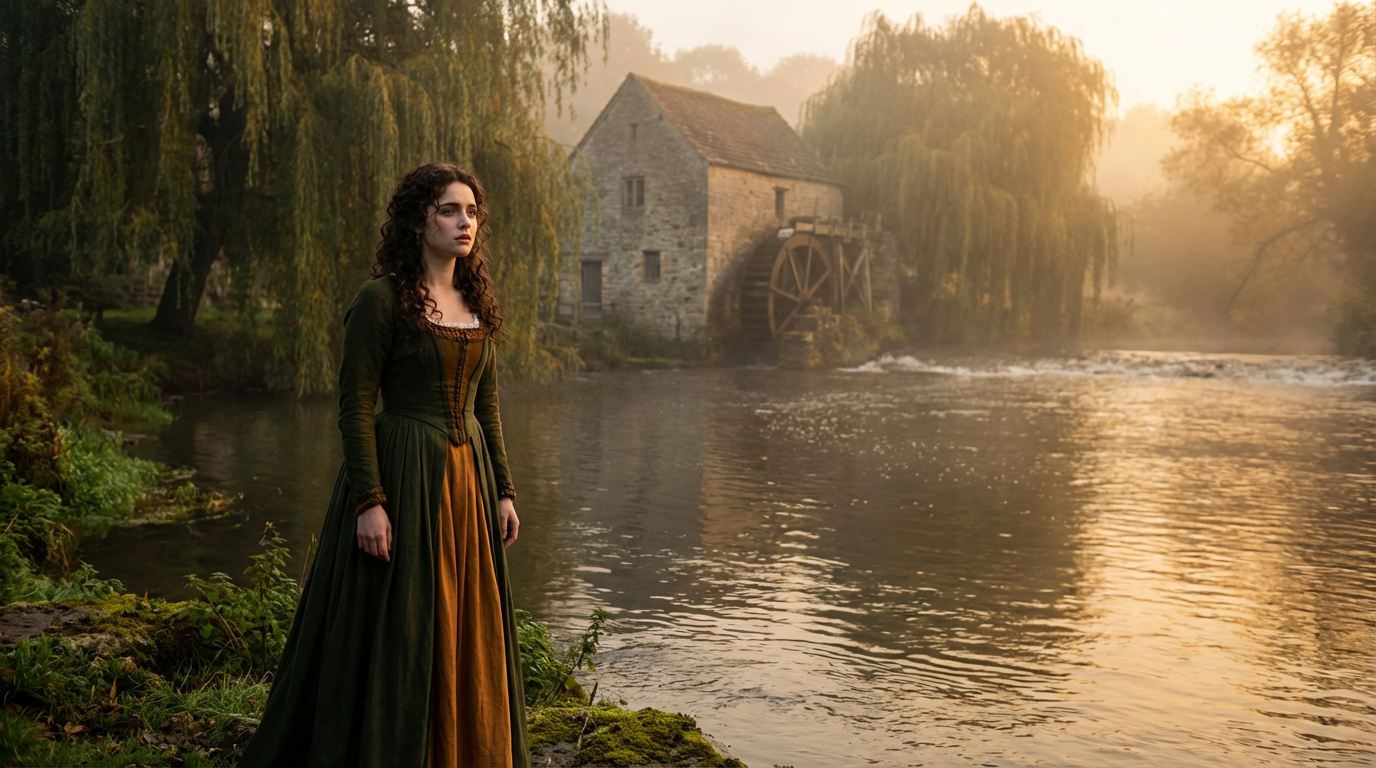
An excerpt from the original text.(complete · 2696 words)
he Wavering Balance
I said that Maggie went home that evening from the Red Deeps with a
mental conflict already begun. You have seen clearly enough, in her
interview with Philip, what that conflict was. Here suddenly was an
opening in the rocky wall which shut in the narrow valley of
humiliation, where all her prospect was the remote, unfathomed sky; and
some of the memory-haunting earthly delights were no longer out of her
reach. She might have books, converse, affection; she might hear
tidings of the world from which her mind had not yet lost its sense of
exile; and it would be a kindness to Philip too, who was
pitiable,—clearly not happy. And perhaps here was an opportunity
indicated for making her mind more worthy of its highest service;
perhaps the noblest, completest devoutness could hardly exist without
some width of knowledge; must she always live in this resigned
imprisonment? It was so blameless, so good a thing that there should be
friendship between her and Philip; the motives that forbade it were so
unreasonable, so unchristian! But the severe monotonous warning came
again and again,—that she was losing the simplicity and clearness of
her life by admitting a ground of concealment; and that, by forsaking
the simple rule of renunciation, she was throwing herself under the
seductive guidance of illimitable wants. She thought she had won
strength to obey the warning before she allowed herself the next week
to turn her steps in the evening to the Red Deeps. But while she was
resolved to say an affectionate farewell to Philip, how she looked
forward to that evening walk in the still, fleckered shade of the
hollows, away from all that was harsh and unlovely; to the
affectionate, admiring looks that would meet her; to the sense of
comradeship that childish memories would give to wiser, older talk; to
the certainty that Philip would care to hear everything she said, which
no one else cared for! It was a half-hour that it would be very hard to
turn her back upon, with the sense that there would be no other like
it. Yet she said what she meant to say; she looked firm as well as sad.
“Philip, I have made up my mind; it is right that we should give each
other up, in everything but memory. I could not see you without
concealment—stay, I know what you are going to say,—it is other
people’s wrong feelings that make concealment necessary; but
concealment is bad, however it may be caused. I feel that it would be
bad for me, for us both. And then, if our secret were discovered, there
would be nothing but misery,—dreadful anger; and then we must part
after all, and it would be harder, when we were used to seeing each
other.”
Philip’s face had flushed, and there was a momentary eagerness of
expression, as if he had been about to resist this decision with all
his might.
But he controlled himself, and said, with assumed calmness: “Well,
Maggie, if we must part, let us try and forget it for one half hour;
let us talk together a little while, for the last time.”
He took her hand, and Maggie felt no reason to withdraw it; his
quietness made her all the more sure she had given him great pain, and
she wanted to show him how unwillingly she had given it. They walked
together hand in hand in silence.
“Let us sit down in the hollow,” said Philip, “where we stood the last
time. See how the dog-roses have strewed the ground, and spread their
opal petals over it.”
They sat down at the roots of the slanting ash.
“I’ve begun my picture of you among the Scotch firs, Maggie,” said
Philip, “so you must let me study your face a little, while you
stay,—since I am not to see it again. Please turn your head this way.”
This was said in an entreating voice, and it would have been very hard
of Maggie to refuse. The full, lustrous face, with the bright black
coronet, looked down like that of a divinity well pleased to be
worshipped, on the pale-hued, small-featured face that was turned up to
it.
“I shall be sitting for my second portrait then,” she said, smiling.
“Will it be larger than the other?”
“Oh yes, much larger. It is an oil-painting. You will look like a tall
Hamadryad, dark and strong and noble, just issued from one of the
fir-trees, when the stems are casting their afternoon shadows on the
grass.”
“You seem to think more of painting than of anything now, Philip?”
“Perhaps I do,” said Philip, rather sadly; “but I think of too many
things,—sow all sorts of seeds, and get no great harvest from any one
of them. I’m cursed with susceptibility in every direction, and
effective faculty in none. I care for painting and music; I care for
classic literature, and mediæval literature, and modern literature; I
flutter all ways, and fly in none.”
“But surely that is a happiness to have so many tastes,—to enjoy so
many beautiful things, when they are within your reach,” said Maggie,
musingly. “It always seemed to me a sort of clever stupidity only to
have one sort of talent,—almost like a carrier-pigeon.”
“It might be a happiness to have many tastes if I were like other men,”
said Philip, bitterly. “I might get some power and distinction by mere
mediocrity, as they do; at least I should get those middling
satisfactions which make men contented to do without great ones. I
might think society at St Ogg’s agreeable then. But nothing could make
life worth the purchase-money of pain to me, but some faculty that
would lift me above the dead level of provincial existence. Yes, there
is one thing,—a passion answers as well as a faculty.”
Maggie did not hear the last words; she was struggling against the
consciousness that Philip’s words had set her own discontent vibrating
again as it used to do.
“I understand what you mean,” she said, “though I know so much less
than you do. I used to think I could never bear life if it kept on
being the same every day, and I must always be doing things of no
consequence, and never know anything greater. But, dear Philip, I think
we are only like children that some one who is wiser is taking care of.
Is it not right to resign ourselves entirely, whatever may be denied
us? I have found great peace in that for the last two or three years,
even joy in subduing my own will.”
“Yes, Maggie,” said Philip, vehemently; “and you are shutting yourself
up in a narrow, self-delusive fanaticism, which is only a way of
escaping pain by starving into dulness all the highest powers of your
nature. Joy and peace are not resignation; resignation is the willing
endurance of a pain that is not allayed, that you don’t expect to be
allayed. Stupefaction is not resignation; and it is stupefaction to
remain in ignorance,—to shut up all the avenues by which the life of
your fellow-men might become known to you. I am not resigned; I am not
sure that life is long enough to learn that lesson. You are not
resigned; you are only trying to stupefy yourself.”
Maggie’s lips trembled; she felt there was some truth in what Philip
said, and yet there was a deeper consciousness that, for any immediate
application it had to her conduct, it was no better than falsity. Her
double impression corresponded to the double impulse of the speaker.
Philip seriously believed what he said, but he said it with vehemence
because it made an argument against the resolution that opposed his
wishes. But Maggie’s face, made more childlike by the gathering tears,
touched him with a tenderer, less egotistic feeling. He took her hand
and said gently:
“Don’t let us think of such things in this short half-hour, Maggie. Let
us only care about being together. We shall be friends in spite of
separation. We shall always think of each other. I shall be glad to
live as long as you are alive, because I shall think there may always
come a time when I can—when you will let me help you in some way.”
“What a dear, good brother you would have been, Philip,” said Maggie,
smiling through the haze of tears. “I think you would have made as much
fuss about me, and been as pleased for me to love you, as would have
satisfied even me. You would have loved me well enough to bear with me,
and forgive me everything. That was what I always longed that Tom
should do. I was never satisfied with a little of anything. That is
why it is better for me to do without earthly happiness altogether. I
never felt that I had enough music,—I wanted more instruments playing
together; I wanted voices to be fuller and deeper. Do you ever sing
now, Philip?” she added abruptly, as if she had forgotten what went
before.
“Yes,” he said, “every day, almost. But my voice is only middling, like
everything else in me.”
“Oh, sing me something,—just one song. I may listen to that before I
go,—something you used to sing at Lorton on a Saturday afternoon, when
we had the drawing-room all to ourselves, and I put my apron over my
head to listen.”
“I know,” said Philip; and Maggie buried her face in her hands while
he sang sotto voce, “Love in her eyes sits playing,” and then said,
“That’s it, isn’t it?”
“Oh no, I won’t stay,” said Maggie, starting up. “It will only haunt
me. Let us walk, Philip. I must go home.”
She moved away, so that he was obliged to rise and follow her.
“Maggie,” he said, in a tone of remonstrance, “don’t persist in this
wilful, senseless privation. It makes me wretched to see you benumbing
and cramping your nature in this way. You were so full of life when you
were a child; I thought you would be a brilliant woman,—all wit and
bright imagination. And it flashes out in your face still, until you
draw that veil of dull quiescence over it.”
“Why do you speak so bitterly to me, Philip?” said Maggie.
“Because I foresee it will not end well; you can never carry on this
self-torture.”
“I shall have strength given me,” said Maggie, tremulously.
“No, you will not, Maggie; no one has strength given to do what is
unnatural. It is mere cowardice to seek safety in negations. No
character becomes strong in that way. You will be thrown into the world
some day, and then every rational satisfaction of your nature that you
deny now will assault you like a savage appetite.”
Maggie started and paused, looking at Philip with alarm in her face.
“Philip, how dare you shake me in this way? You are a tempter.”
“No, I am not; but love gives insight, Maggie, and insight often gives
foreboding. Listen to me,—let me supply you with books; do let me
see you sometimes,—be your brother and teacher, as you said at Lorton.
It is less wrong that you should see me than that you should be
committing this long suicide.”
Maggie felt unable to speak. She shook her head and walked on in
silence, till they came to the end of the Scotch firs, and she put out
her hand in sign of parting.
“Do you banish me from this place forever, then, Maggie? Surely I may
come and walk in it sometimes? If I meet you by chance, there is no
concealment in that?”
It is the moment when our resolution seems about to become
irrevocable—when the fatal iron gates are about to close upon us—that
tests our strength. Then, after hours of clear reasoning and firm
conviction, we snatch at any sophistry that will nullify our long
struggles, and bring us the defeat that we love better than victory.
Maggie felt her heart leap at this subterfuge of Philip’s, and there
passed over her face that almost imperceptible shock which accompanies
any relief. He saw it, and they parted in silence.
Philip’s sense of the situation was too complete for him not to be
visited with glancing fears lest he had been intervening too
presumptuously in the action of Maggie’s conscience, perhaps for a
selfish end. But no!—he persuaded himself his end was not selfish. He
had little hope that Maggie would ever return the strong feeling he had
for her; and it must be better for Maggie’s future life, when these
petty family obstacles to her freedom had disappeared, that the present
should not be entirely sacrificed, and that she should have some
opportunity of culture,—some interchange with a mind above the vulgar
level of those she was now condemned to live with. If we only look far
enough off for the consequence of our actions, we can always find some
point in the combination of results by which those actions can be
justified; by adopting the point of view of a Providence who arranges
results, or of a philosopher who traces them, we shall find it possible
to obtain perfect complacency in choosing to do what is most agreeable
to us in the present moment. And it was in this way that Philip
justified his subtle efforts to overcome Maggie’s true prompting
against a concealment that would introduce doubleness into her own
mind, and might cause new misery to those who had the primary natural
claim on her. But there was a surplus of passion in him that made him
half independent of justifying motives. His longing to see Maggie, and
make an element in her life, had in it some of that savage impulse to
snatch an offered joy which springs from a life in which the mental and
bodily constitution have made pain predominate. He had not his full
share in the common good of men; he could not even pass muster with the
insignificant, but must be singled out for pity, and excepted from what
was a matter of course with others. Even to Maggie he was an exception;
it was clear that the thought of his being her lover had never entered
her mind.
Do not think too hardly of Philip. Ugly and deformed people have great
need of unusual virtues, because they are likely to be extremely
uncomfortable without them; but the theory that unusual virtues spring
by a direct consequence out of personal disadvantages, as animals get
thicker wool in severe climates, is perhaps a little overstrained. The
temptations of beauty are much dwelt upon, but I fancy they only bear
the same relation to those of ugliness, as the temptation to excess at
a feast, where the delights are varied for eye and ear as well as
palate, bears to the temptations that assail the desperation of hunger.
Does not the Hunger Tower stand as the type of the utmost trial to what
is human in us?
Philip had never been soothed by that mother’s love which flows out to
us in the greater abundance because our need is greater, which clings
to us the more tenderly because we are the less likely to be winners in
the game of life; and the sense of his father’s affection and
indulgence toward him was marred by the keener perception of his
father’s faults. Kept aloof from all practical life as Philip had been,
and by nature half feminine in sensitiveness, he had some of the
woman’s intolerant repulsion toward worldliness and the deliberate
pursuit of sensual enjoyment; and this one strong natural tie in his
life,—his relation as a son,—was like an aching limb to him. Perhaps
there is inevitably something morbid in a human being who is in any way
unfavourably excepted from ordinary conditions, until the good force
has had time to triumph; and it has rarely had time for that at
two-and-twenty. That force was present in Philip in much strength, but
the sun himself looks feeble through the morning mists.
Master this chapter. Complete your experience
Purchase the complete book to access all chapters and support classic literature
As an Amazon Associate, we earn a small commission from qualifying purchases at no additional cost to you.
Available in paperback, hardcover, and e-book formats
Let's Analyse the Pattern
Using partial truths and emotional leverage to serve personal desires while genuinely believing you're helping the other person.
Why This Matters
Connect literature to life
This chapter teaches how to recognize when someone uses your vulnerabilities against you while claiming to help.
Practice This Today
This week, notice when someone dismisses your concerns as character flaws or positions themselves as your savior from a problem they're highlighting.
Now let's explore the literary elements.
Key Quotes & Analysis
"Here suddenly was an opening in the rocky wall which shut in the narrow valley of humiliation, where all her prospect was the remote, unfathomed sky"
Context: Describing Maggie's feelings when she realizes Philip could offer her books, conversation, and connection to the wider world
This metaphor shows how trapped and limited Maggie's life has become. The 'rocky wall' represents the constraints of poverty and family duty, while the 'remote sky' suggests her dreams feel impossibly distant. Philip represents a potential escape route.
In Today's Words:
Suddenly she saw a way out of the dead-end life she'd been stuck in, where her only hope was some vague future that might never come
"She was losing the simplicity and clearness of her life by admitting a ground of concealment"
Context: Maggie's internal warning about the danger of keeping her friendship with Philip secret
This captures the Victorian belief that moral purity required complete transparency. Maggie instinctively knows that secrecy corrupts relationships and decision-making, even when the secret itself might be innocent.
In Today's Words:
She knew that having to hide this relationship would complicate everything and mess with her ability to make good choices
"You are shutting yourself up in a narrow, self-delusive fanaticism, which is only a way of escaping pain by starving into dullness all the highest powers of your nature"
Context: Philip's argument that Maggie's self-denial is actually harmful rather than virtuous
Philip presents a sophisticated counter-argument to traditional religious self-sacrifice, suggesting that Maggie is damaging herself rather than growing spiritually. He's not entirely wrong, but he's also serving his own interests by undermining her resolve.
In Today's Words:
You're just numbing yourself instead of dealing with real life - you're wasting your potential and calling it virtue
Thematic Threads
Deception
In This Chapter
Philip deceives himself about his motives, convincing himself he's saving Maggie rather than pursuing his own desires
Development
Evolved from Tom's direct deceptions to this more complex self-deception that feels noble
In Your Life:
You might catch yourself justifying questionable choices by focusing on how they help others.
Manipulation
In This Chapter
Philip uses Maggie's intellectual hunger and isolation to keep her emotionally dependent on their meetings
Development
Introduced here as sophisticated emotional manipulation disguised as care
In Your Life:
You might recognize when someone makes you feel guilty for having boundaries or saying no.
Vulnerability
In This Chapter
Maggie's intellectual starvation makes her susceptible to Philip's arguments despite sensing something false
Development
Deepened from earlier chapters showing how unmet needs create dangerous blind spots
In Your Life:
You might notice how your own unmet needs make certain people's offers hard to refuse.
Rationalization
In This Chapter
Both characters create elaborate justifications—Philip for pursuing Maggie, Maggie for continuing to meet him
Development
Building on earlier themes of characters justifying their choices to avoid guilt
In Your Life:
You might catch yourself creating complex reasons for doing what you wanted to do anyway.
Isolation
In This Chapter
Maggie's intellectual and emotional isolation makes Philip's companionship irresistibly appealing
Development
Consistent theme showing how isolation creates desperation that clouds judgment
In Your Life:
You might recognize how loneliness makes you more vulnerable to people who offer what you're missing.
You now have the context. Time to form your own thoughts.
Discussion Questions
- 1
What tactics does Philip use to convince Maggie to keep meeting him, and how does he frame his arguments?
analysis • surface - 2
Why is Maggie vulnerable to Philip's reasoning about 'stupefying herself' through self-denial?
analysis • medium - 3
Where do you see this pattern of 'noble manipulation' in modern relationships—someone positioning themselves as your savior while serving their own needs?
application • medium - 4
How can you tell the difference between someone who genuinely cares about your growth and someone who's using your vulnerabilities to get what they want?
application • deep - 5
What does this chapter reveal about how we convince ourselves our selfish desires are actually noble acts?
reflection • deep
Critical Thinking Exercise
Decode the Noble Manipulation
Think of a time when someone convinced you to do something by making you feel guilty about your boundaries or concerns. Write down their exact arguments, then rewrite them honestly—what were they really asking for? What need of theirs was being served? Practice recognizing the pattern so you can spot it faster next time.
Consider:
- •Notice how they made your concerns sound like character flaws
- •Look for how they positioned themselves as the solution to a problem they highlighted
- •Pay attention to whose needs were actually being served
Journaling Prompt
Write about a current situation where someone might be using noble language to pressure you. What would honoring your instincts look like, even if their reasoning sounds good?
Coming Up Next...
Chapter 36: Love's Dangerous Confession
The seeds of deception have been planted. As Maggie and Philip continue their secret meetings, the emotional stakes rise and new complications emerge that will test the boundaries of their carefully rationalized arrangement.



