
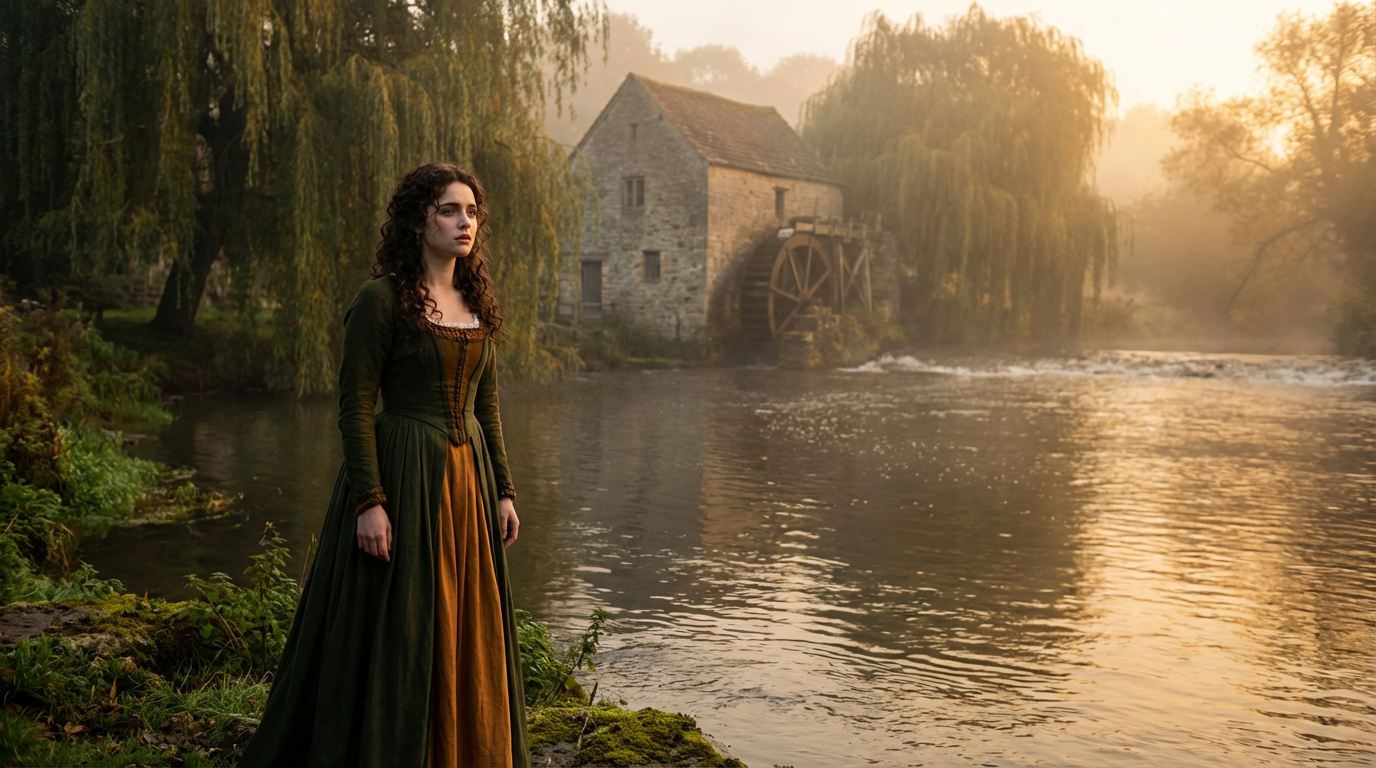
An excerpt from the original text.(complete · 1919 words)
Variation of Protestantism Unknown to Bossuet
Journeying down the Rhone on a summer’s day, you have perhaps felt the
sunshine made dreary by those ruined villages which stud the banks in
certain parts of its course, telling how the swift river once rose,
like an angry, destroying god, sweeping down the feeble generations
whose breath is in their nostrils, and making their dwellings a
desolation. Strange contrast, you may have thought, between the effect
produced on us by these dismal remnants of commonplace houses, which in
their best days were but the sign of a sordid life, belonging in all
its details to our own vulgar era, and the effect produced by those
ruins on the castled Rhine, which have crumbled and mellowed into such
harmony with the green and rocky steeps that they seem to have a
natural fitness, like the mountain-pine; nay, even in the day when they
were built they must have had this fitness, as if they had been raised
by an earth-born race, who had inherited from their mighty parent a
sublime instinct of form. And that was a day of romance; If those
robber-barons were somewhat grim and drunken ogres, they had a certain
grandeur of the wild beast in them,—they were forest boars with tusks,
tearing and rending, not the ordinary domestic grunter; they
represented the demon forces forever in collision with beauty, virtue,
and the gentle uses of life; they made a fine contrast in the picture
with the wandering minstrel, the soft-lipped princess, the pious
recluse, and the timid Israelite. That was a time of colour, when the
sunlight fell on glancing steel and floating banners; a time of
adventure and fierce struggle,—nay, of living, religious art and
religious enthusiasm; for were not cathedrals built in those days, and
did not great emperors leave their Western palaces to die before the
infidel strongholds in the sacred East? Therefore it is that these
Rhine castles thrill me with a sense of poetry; they belong to the
grand historic life of humanity, and raise up for me the vision of an
echo. But these dead-tinted, hollow-eyed, angular skeletons of villages
on the Rhone oppress me with the feeling that human life—very much of
it—is a narrow, ugly, grovelling existence, which even calamity does
not elevate, but rather tends to exhibit in all its bare vulgarity of
conception; and I have a cruel conviction that the lives these ruins
are the traces of were part of a gross sum of obscure vitality, that
will be swept into the same oblivion with the generations of ants and
beavers.
Perhaps something akin to this oppressive feeling may have weighed upon
you in watching this old-fashioned family life on the banks of the
Floss, which even sorrow hardly suffices to lift above the level of the
tragi-comic. It is a sordid life, you say, this of the Tullivers and
Dodsons, irradiated by no sublime principles, no romantic visions, no
active, self-renouncing faith; moved by none of those wild,
uncontrollable passions which create the dark shadows of misery and
crime; without that primitive, rough simplicity of wants, that hard,
submissive, ill-paid toil, that childlike spelling-out of what nature
has written, which gives its poetry to peasant life. Here one has
conventional worldly notions and habits without instruction and without
polish, surely the most prosaic form of human life; proud
respectability in a gig of unfashionable build; worldliness without
side-dishes. Observing these people narrowly, even when the iron hand
of misfortune has shaken them from their unquestioning hold on the
world, one sees little trace of religion, still less of a distinctively
Christian creed. Their belief in the Unseen, so far as it manifests
itself at all, seems to be rather a pagan kind; their moral notions,
though held with strong tenacity, seem to have no standard beyond
hereditary custom. You could not live among such people; you are
stifled for want of an outlet toward something beautiful, great, or
noble; you are irritated with these dull men and women, as a kind of
population out of keeping with the earth on which they live,—with this
rich plain where the great river flows forever onward, and links the
small pulse of the old English town with the beatings of the world’s
mighty heart. A vigorous superstition, that lashes its gods or lashes
its own back, seems to be more congruous with the mystery of the human
lot, than the mental condition of these emmet-like Dodsons and
Tullivers.
I share with you this sense of oppressive narrowness; but it is
necessary that we should feel it, if we care to understand how it acted
on the lives of Tom and Maggie,—how it has acted on young natures in
many generations, that in the onward tendency of human things have
risen above the mental level of the generation before them, to which
they have been nevertheless tied by the strongest fibres of their
hearts. The suffering, whether of martyr or victim, which belongs to
every historical advance of mankind, is represented in this way in
every town, and by hundreds of obscure hearths; and we need not shrink
from this comparison of small things with great; for does not science
tell us that its highest striving is after the ascertainment of a unity
which shall bind the smallest things with the greatest? In natural
science, I have understood, there is nothing petty to the mind that has
a large vision of relations, and to which every single object suggests
a vast sum of conditions. It is surely the same with the observation of
human life.
Certainly the religious and moral ideas of the Dodsons and Tullivers
were of too specific a kind to be arrived at deductively, from the
statement that they were part of the Protestant population of Great
Britain. Their theory of life had its core of soundness, as all
theories must have on which decent and prosperous families have been
reared and have flourished; but it had the very slightest tincture of
theology. If, in the maiden days of the Dodson sisters, their Bibles
opened more easily at some parts than others, it was because of dried
tulip-petals, which had been distributed quite impartially, without
preference for the historical, devotional, or doctrinal. Their religion
was of a simple, semi-pagan kind, but there was no heresy in it,—if
heresy properly means choice,—for they didn’t know there was any other
religion, except that of chapel-goers, which appeared to run in
families, like asthma. How should they know? The vicar of their
pleasant rural parish was not a controversialist, but a good hand at
whist, and one who had a joke always ready for a blooming female
parishioner. The religion of the Dodsons consisted in revering whatever
was customary and respectable; it was necessary to be baptised, else
one could not be buried in the church-yard, and to take the sacrament
before death, as a security against more dimly understood perils; but
it was of equal necessity to have the proper pall-bearers and
well-cured hams at one’s funeral, and to leave an unimpeachable will. A
Dodson would not be taxed with the omission of anything that was
becoming, or that belonged to that eternal fitness of things which was
plainly indicated in the practice of the most substantial parishioners,
and in the family traditions,—such as obedience to parents,
faithfulness to kindred, industry, rigid honesty, thrift, the thorough
scouring of wooden and copper utensils, the hoarding of coins likely to
disappear from the currency, the production of first-rate commodities
for the market, and the general preference of whatever was home-made.
The Dodsons were a very proud race, and their pride lay in the utter
frustration of all desire to tax them with a breach of traditional duty
or propriety. A wholesome pride in many respects, since it identified
honour with perfect integrity, thoroughness of work, and faithfulness
to admitted rules; and society owes some worthy qualities in many of
her members to mothers of the Dodson class, who made their butter and
their fromenty well, and would have felt disgraced to make it
otherwise. To be honest and poor was never a Dodson motto, still less
to seem rich though being poor; rather, the family badge was to be
honest and rich, and not only rich, but richer than was supposed. To
live respected, and have the proper bearers at your funeral, was an
achievement of the ends of existence that would be entirely nullified
if, on the reading of your will, you sank in the opinion of your
fellow-men, either by turning out to be poorer than they expected, or
by leaving your money in a capricious manner, without strict regard to
degrees of kin. The right thing must always be done toward kindred. The
right thing was to correct them severely, if they were other than a
credit to the family, but still not to alienate from them the smallest
rightful share in the family shoebuckles and other property. A
conspicuous quality in the Dodson character was its genuineness; its
vices and virtues alike were phases of a proud honest egoism, which had
a hearty dislike to whatever made against its own credit and interest,
and would be frankly hard of speech to inconvenient “kin,” but would
never forsake or ignore them,—would not let them want bread, but only
require them to eat it with bitter herbs.
The same sort of traditional belief ran in the Tulliver veins, but it
was carried in richer blood, having elements of generous imprudence,
warm affection, and hot-tempered rashness. Mr Tulliver’s grandfather
had been heard to say that he was descended from one Ralph Tulliver, a
wonderfully clever fellow, who had ruined himself. It is likely enough
that the clever Ralph was a high liver, rode spirited horses, and was
very decidedly of his own opinion. On the other hand, nobody had ever
heard of a Dodson who had ruined himself; it was not the way of that
family.
If such were the views of life on which the Dodsons and Tullivers had
been reared in the praiseworthy past of Pitt and high prices, you will
infer from what you already know concerning the state of society in St
Ogg’s, that there had been no highly modifying influence to act on them
in their maturer life. It was still possible, even in that later time
of anti-Catholic preaching, for people to hold many pagan ideas, and
believe themselves good church-people, notwithstanding; so we need
hardly feel any surprise at the fact that Mr Tulliver, though a regular
church-goer, recorded his vindictiveness on the fly-leaf of his Bible.
It was not that any harm could be said concerning the vicar of that
charming rural parish to which Dorlcote Mill belonged; he was a man of
excellent family, an irreproachable bachelor, of elegant pursuits,—had
taken honours, and held a fellowship. Mr Tulliver regarded him with
dutiful respect, as he did everything else belonging to the
church-service; but he considered that church was one thing and
common-sense another, and he wanted nobody to tell him what
commonsense was. Certain seeds which are required to find a nidus for
themselves under unfavourable circumstances have been supplied by
nature with an apparatus of hooks, so that they will get a hold on very
unreceptive surfaces. The spiritual seed which had been scattered over
Mr Tulliver had apparently been destitute of any corresponding
provision, and had slipped off to the winds again, from a total absence
of hooks.
Master this chapter. Complete your experience
Purchase the complete book to access all chapters and support classic literature
As an Amazon Associate, we earn a small commission from qualifying purchases at no additional cost to you.
Available in paperback, hardcover, and e-book formats
Let's Analyse the Pattern
The invisible pull of family and social expectations that both nurtures and constrains individual potential.
Why This Matters
Connect literature to life
This chapter teaches how family and cultural expectations create invisible pressure that shapes our choices before we realize we're being shaped.
Practice This Today
This week, notice when you make decisions based on what your family would think rather than what you actually want, then ask yourself what bridges you could build between both worlds.
Now let's explore the literary elements.
Key Quotes & Analysis
"It is a sordid life, say they, this of the Tullivers and Dodsons—irradiated by no sublime principles, no romantic visions, no active, self-renouncing faith"
Context: Eliot acknowledging that her characters might seem boring compared to romantic heroes
Eliot defends ordinary people's stories as worthy of attention. She's arguing that middle-class struggles matter as much as grand historical dramas, even if they lack obvious drama or nobility.
In Today's Words:
Sure, these aren't glamorous people with exciting lives, but their struggles still matter and deserve our attention.
"The suffering, whether of martyr or victim, which belongs to every historical advance of mankind, is represented in this way in every town, and by hundreds of obscure hearths"
Context: Explaining why ordinary family conflicts matter in the bigger picture
Every generation produces young people who suffer from being mentally ahead of their time while emotionally bound to it. Personal growth often requires painful separation from loved ones.
In Today's Words:
Every family has someone who outgrows their environment but pays an emotional price for it—that's just how progress happens.
"The religion of the Dodsons consisted in revering whatever was customary and respectable"
Context: Describing how the family approaches faith and morality
Their religion is more about social conformity than spiritual depth. They follow religious practices because it's expected and maintains their social standing, not from genuine faith.
In Today's Words:
They went to church because that's what respectable people did, not because they actually believed deeply.
Thematic Threads
Class
In This Chapter
Eliot examines how middle-class respectability creates its own prison of expectations and limitations
Development
Deepened from earlier focus on economic struggle to psychological constraints of social position
In Your Life:
You might recognize this when family members question your ambitions or when you feel guilty for wanting more than your parents had.
Identity
In This Chapter
Tom and Maggie struggle between their individual potential and their inherited family identity
Development
Evolved from childhood confusion to adolescent tension between personal growth and family loyalty
In Your Life:
This appears when you feel torn between who you're becoming and who your family expects you to remain.
Social Expectations
In This Chapter
The Dodson family system prioritizes appearances and conformity over individual expression or growth
Development
Expanded from individual character traits to reveal the systematic nature of social pressure
In Your Life:
You see this in workplace cultures that punish innovation or family dynamics that discourage risk-taking.
Personal Growth
In This Chapter
Young people with expanding minds remain emotionally bound to narrow family traditions
Development
Introduced as the central tension that will drive future conflicts
In Your Life:
This manifests when your education or experiences outpace your family's understanding, creating isolation within intimacy.
You now have the context. Time to form your own thoughts.
Discussion Questions
- 1
What does Eliot mean when she compares the Tulliver family to flood-damaged villages rather than romantic castle ruins?
analysis • surface - 2
Why do the Dodsons prioritize respectability and appearances over individual desires or authentic feelings?
analysis • medium - 3
Where do you see this 'background gravity' of family expectations limiting people's choices in your own community or workplace?
application • medium - 4
If you were advising someone torn between family loyalty and personal growth, what strategies would you suggest for honoring both?
application • deep - 5
What does this chapter reveal about the tension between belonging and becoming in human development?
reflection • deep
Critical Thinking Exercise
Map Your Background Gravity
Draw a simple diagram with yourself in the center and the major influences around you - family, community, workplace, social groups. For each influence, write one expectation they have for you and one way that expectation either supports or limits your growth. Look for patterns in what gets praised versus what gets discouraged.
Consider:
- •Notice which expectations feel protective versus restrictive
- •Identify areas where you might be self-limiting to maintain belonging
- •Consider how you could expand while still honoring your roots
Journaling Prompt
Write about a time when you felt caught between what your family or community expected and what you wanted for yourself. How did you handle it, and what would you do differently now?
Coming Up Next...
Chapter 31: When Life Becomes a Grinding Routine
The metaphor of a 'torn nest pierced by thorns' suggests that the Tulliver family's fragile security is about to face sharp new challenges. The protective shell of their world may finally crack completely.



