
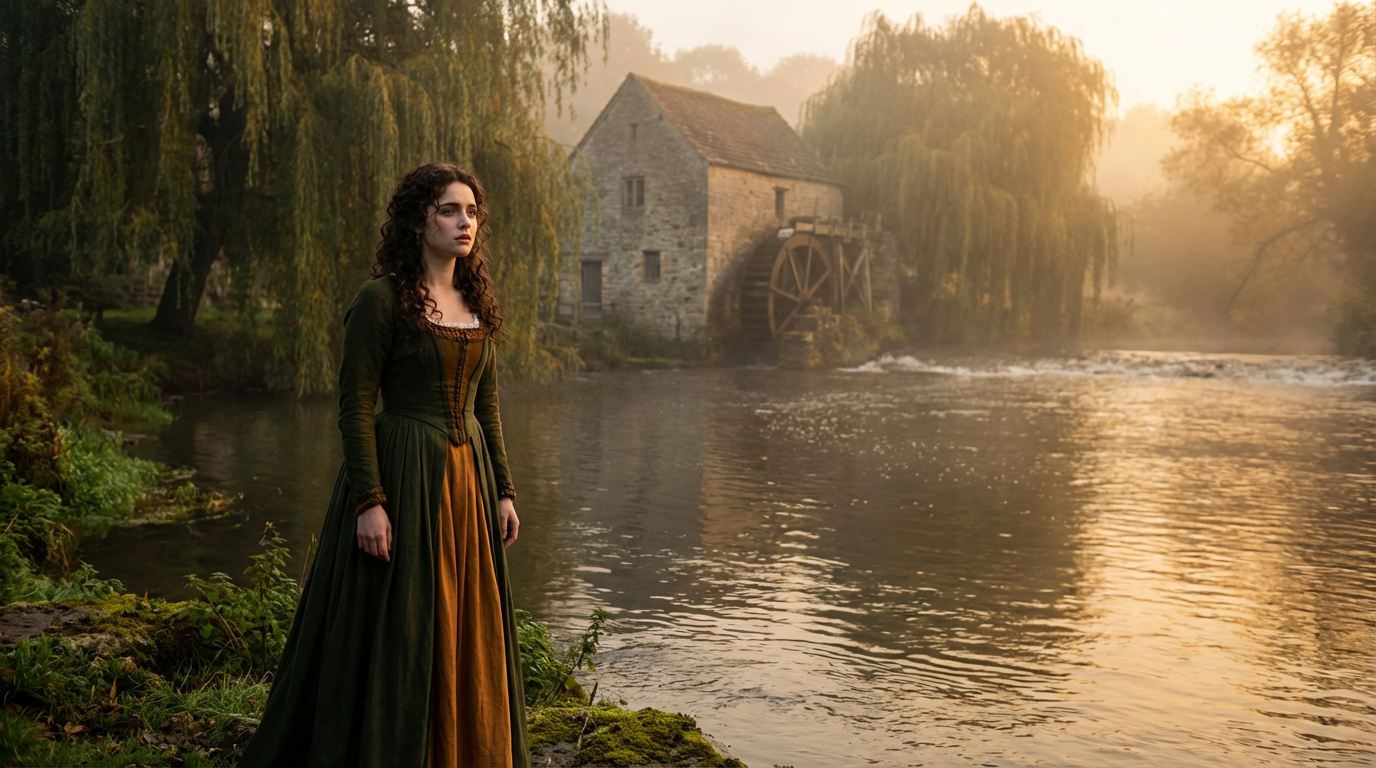
An excerpt from the original text.(complete · 2313 words)
n Item Added to the Family Register
That first moment of renunciation and submission was followed by days
of violent struggle in the miller’s mind, as the gradual access of
bodily strength brought with it increasing ability to embrace in one
view all the conflicting conditions under which he found himself.
Feeble limbs easily resign themselves to be tethered, and when we are
subdued by sickness it seems possible to us to fulfil pledges which the
old vigor comes back and breaks. There were times when poor Tulliver
thought the fulfilment of his promise to Bessy was something quite too
hard for human nature; he had promised her without knowing what she was
going to say,—she might as well have asked him to carry a ton weight on
his back. But again, there were many feelings arguing on her side,
besides the sense that life had been made hard to her by having married
him. He saw a possibility, by much pinching, of saving money out of his
salary toward paying a second dividend to his creditors, and it would
not be easy elsewhere to get a situation such as he could fill.
He had led an easy life, ordering much and working little, and had no
aptitude for any new business. He must perhaps take to day-labour, and
his wife must have help from her sisters,—a prospect doubly bitter to
him, now they had let all Bessy’s precious things be sold, probably
because they liked to set her against him, by making her feel that he
had brought her to that pass. He listened to their admonitory talk,
when they came to urge on him what he was bound to do for poor Bessy’s
sake, with averted eyes, that every now and then flashed on them
furtively when their backs were turned. Nothing but the dread of
needing their help could have made it an easier alternative to take
their advice.
But the strongest influence of all was the love of the old premises
where he had run about when he was a boy, just as Tom had done after
him. The Tullivers had lived on this spot for generations, and he had
sat listening on a low stool on winter evenings while his father talked
of the old half-timbered mill that had been there before the last great
floods which damaged it so that his grandfather pulled it down and
built the new one. It was when he got able to walk about and look at
all the old objects that he felt the strain of his clinging affection
for the old home as part of his life, part of himself. He couldn’t bear
to think of himself living on any other spot than this, where he knew
the sound of every gate door, and felt that the shape and colour of
every roof and weather-stain and broken hillock was good, because his
growing senses had been fed on them. Our instructed vagrancy, which has
hardly time to linger by the hedgerows, but runs away early to the
tropics, and is at home with palms and banyans,—which is nourished on
books of travel and stretches the theatre of its imagination to the
Zambesi,—can hardly get a dim notion of what an old-fashioned man like
Tulliver felt for this spot, where all his memories centred, and where
life seemed like a familiar smooth-handled tool that the fingers clutch
with loving ease. And just now he was living in that freshened memory
of the far-off time which comes to us in the passive hours of recovery
from sickness.
“Ay, Luke,” he said one afternoon, as he stood looking over the orchard
gate, “I remember the day they planted those apple-trees. My father was
a huge man for planting,—it was like a merry-making to him to get a
cart full o’ young trees; and I used to stand i’ the cold with him, and
follow him about like a dog.”
Then he turned round, and leaning against the gate-post, looked at the
opposite buildings.
“The old mill ’ud miss me, I think, Luke. There’s a story as when the
mill changes hands, the river’s angry; I’ve heard my father say it many
a time. There’s no telling whether there mayn’t be summat in the
story, for this is a puzzling world, and Old Harry’s got a finger in
it—it’s been too many for me, I know.”
“Ay, sir,” said Luke, with soothing sympathy, “what wi’ the rust on the
wheat, an’ the firin’ o’ the ricks an’ that, as I’ve seen i’ my
time,—things often looks comical; there’s the bacon fat wi’ our last
pig run away like butter,—it leaves nought but a scratchin’.”
“It’s just as if it was yesterday, now,” Mr Tulliver went on, “when my
father began the malting. I remember, the day they finished the
malt-house, I thought summat great was to come of it; for we’d a
plum-pudding that day and a bit of a feast, and I said to my
mother,—she was a fine dark-eyed woman, my mother was,—the little wench
’ull be as like her as two peas.” Here Mr Tulliver put his stick
between his legs, and took out his snuff-box, for the greater enjoyment
of this anecdote, which dropped from him in fragments, as if he every
other moment lost narration in vision. “I was a little chap no higher
much than my mother’s knee,—she was sore fond of us children, Gritty
and me,—and so I said to her, ‘Mother,’ I said, ‘shall we have
plum-pudding every day because o’ the malt-house? She used to tell me
o’ that till her dying day. She was but a young woman when she died, my
mother was. But it’s forty good year since they finished the
malt-house, and it isn’t many days out of ’em all as I haven’t looked
out into the yard there, the first thing in the morning,—all weathers,
from year’s end to year’s end. I should go off my head in a new place.
I should be like as if I’d lost my way. It’s all hard, whichever way I
look at it,—the harness ’ull gall me, but it ’ud be summat to draw
along the old road, instead of a new un.”
“Ay, sir,” said Luke, “you’d be a deal better here nor in some new
place. I can’t abide new places mysen: things is allays
awk’ard,—narrow-wheeled waggins, belike, and the stiles all another
sort, an’ oat-cake i’ some places, tow’rt th’ head o’ the Floss, there.
It’s poor work, changing your country-side.”
“But I doubt, Luke, they’ll be for getting rid o’ Ben, and making you
do with a lad; and I must help a bit wi’ the mill. You’ll have a worse
place.”
“Ne’er mind, sir,” said Luke, “I sha’n’t plague mysen. I’n been wi’ you
twenty year, an’ you can’t get twenty year wi’ whistlin’ for ’em, no
more nor you can make the trees grow: you mun wait till God A’mighty
sends ’em. I can’t abide new victual nor new faces, I can’t,—you
niver know but what they’ll gripe you.”
The walk was finished in silence after this, for Luke had disburthened
himself of thoughts to an extent that left his conversational resources
quite barren, and Mr Tulliver had relapsed from his recollections into
a painful meditation on the choice of hardships before him. Maggie
noticed that he was unusually absent that evening at tea; and afterward
he sat leaning forward in his chair, looking at the ground, moving his
lips, and shaking his head from time to time. Then he looked hard at
Mrs Tulliver, who was knitting opposite him, then at Maggie, who, as
she bent over her sewing, was intensely conscious of some drama going
forward in her father’s mind. Suddenly he took up the poker and broke
the large coal fiercely.
“Dear heart, Mr Tulliver, what can you be thinking of?” said his wife,
looking up in alarm; “it’s very wasteful, breaking the coal, and we’ve
got hardly any large coal left, and I don’t know where the rest is to
come from.”
“I don’t think you’re quite so well to-night, are you, father?” said
Maggie; “you seem uneasy.”
“Why, how is it Tom doesn’t come?” said Mr Tulliver, impatiently.
“Dear heart! is it time? I must go and get his supper,” said Mrs
Tulliver, laying down her knitting, and leaving the room.
“It’s nigh upon half-past eight,” said Mr Tulliver. “He’ll be here
soon. Go, go and get the big Bible, and open it at the beginning, where
everything’s set down. And get the pen and ink.”
Maggie obeyed, wondering; but her father gave no further orders, and
only sat listening for Tom’s footfall on the gravel, apparently
irritated by the wind, which had risen, and was roaring so as to drown
all other sounds. There was a strange light in his eyes that rather
frightened Maggie; she began to wish that Tom would come, too.
“There he is, then,” said Mr Tulliver, in an excited way, when the
knock came at last. Maggie went to open the door, but her mother came
out of the kitchen hurriedly, saying, “Stop a bit, Maggie; I’ll open
it.”
Mrs Tulliver had begun to be a little frightened at her boy, but she
was jealous of every office others did for him.
“Your supper’s ready by the kitchen-fire, my boy,” she said, as he took
off his hat and coat. “You shall have it by yourself, just as you like,
and I won’t speak to you.”
“I think my father wants Tom, mother,” said Maggie; “he must come into
the parlour first.”
Tom entered with his usual saddened evening face, but his eyes fell
immediately on the open Bible and the inkstand, and he glanced with a
look of anxious surprise at his father, who was saying,—
“Come, come, you’re late; I want you.”
“Is there anything the matter, father?” said Tom.
“You sit down, all of you,” said Mr Tulliver, peremptorily.
“And, Tom, sit down here; I’ve got something for you to write i’ the
Bible.”
They all three sat down, looking at him. He began to speak slowly,
looking first at his wife.
“I’ve made up my mind, Bessy, and I’ll be as good as my word to you.
There’ll be the same grave made for us to lie down in, and we mustn’t
be bearing one another ill-will. I’ll stop in the old place, and I’ll
serve under Wakem, and I’ll serve him like an honest man; there’s no
Tulliver but what’s honest, mind that, Tom,”—here his voice
rose,—“they’ll have it to throw up against me as I paid a dividend, but
it wasn’t my fault; it was because there’s raskills in the world.
They’ve been too many for me, and I must give in. I’ll put my neck in
harness,—for you’ve a right to say as I’ve brought you into trouble,
Bessy,—and I’ll serve him as honest as if he was no raskill; I’m an
honest man, though I shall never hold my head up no more. I’m a tree as
is broke—a tree as is broke.”
He paused and looked on the ground. Then suddenly raising his head, he
said, in a louder yet deeper tone:
“But I won’t forgive him! I know what they say, he never meant me any
harm. That’s the way Old Harry props up the rascals. He’s been at the
bottom of everything; but he’s a fine gentleman,—I know, I know. I
shouldn’t ha’ gone to law, they say. But who made it so as there was no
arbitratin’, and no justice to be got? It signifies nothing to him, I
know that; he’s one o’ them fine gentlemen as get money by doing
business for poorer folks, and when he’s made beggars of ’em he’ll give
’em charity. I won’t forgive him! I wish he might be punished with
shame till his own son ’ud like to forget him. I wish he may do summat
as they’d make him work at the treadmill! But he won’t,—he’s too big a
raskill to let the law lay hold on him. And you mind this, Tom,—you
never forgive him neither, if you mean to be my son. There’ll maybe
come a time when you may make him feel; it’ll never come to me; I’n got
my head under the yoke. Now write—write it i’ the Bible.”
“Oh, father, what?” said Maggie, sinking down by his knee, pale and
trembling. “It’s wicked to curse and bear malice.”
“It isn’t wicked, I tell you,” said her father, fiercely. “It’s wicked
as the raskills should prosper; it’s the Devil’s doing. Do as I tell
you, Tom. Write.”
“What am I to write?” said Tom, with gloomy submission.
“Write as your father, Edward Tulliver, took service under John Wakem,
the man as had helped to ruin him, because I’d promised my wife to make
her what amends I could for her trouble, and because I wanted to die in
th’ old place where I was born and my father was born. Put that i’ the
right words—you know how—and then write, as I don’t forgive Wakem for
all that; and for all I’ll serve him honest, I wish evil may befall
him. Write that.”
There was a dead silence as Tom’s pen moved along the paper; Mrs
Tulliver looked scared, and Maggie trembled like a leaf.
“Now let me hear what you’ve wrote,” said Mr Tulliver. Tom read aloud
slowly.
“Now write—write as you’ll remember what Wakem’s done to your father,
and you’ll make him and his feel it, if ever the day comes. And sign
your name Thomas Tulliver.”
“Oh no, father, dear father!” said Maggie, almost choked with fear.
“You shouldn’t make Tom write that.”
“Be quiet, Maggie!” said Tom. “I shall write it.”
BOOK FOURTH
THE VALLEY OF HUMILIATION.
Master this chapter. Complete your experience
Purchase the complete book to access all chapters and support classic literature
As an Amazon Associate, we earn a small commission from qualifying purchases at no additional cost to you.
Available in paperback, hardcover, and e-book formats
Let's Analyse the Pattern
When people transform personal trauma into a family mission, ensuring their pain outlives them through inherited hatred and grudges.
Why This Matters
Connect literature to life
This chapter teaches how to recognize when someone is trying to recruit you into their personal war by making their enemies your enemies.
Practice This Today
This week, notice when someone wants you to automatically dislike or distrust someone based solely on their negative experience—pause and ask yourself if you're being recruited into someone else's battle.
Now let's explore the literary elements.
Key Quotes & Analysis
"He had promised her without knowing what she was going to say,—she might as well have asked him to carry a ton weight on his back."
Context: Describing Tulliver's regret about promising his wife he'd keep the peace with Wakem
Shows how promises made in desperation can feel impossible to keep when reality sets in. Tulliver realizes he agreed to something that goes against his very nature - suppressing his rage for revenge.
In Today's Words:
He said yes without knowing what he was getting into - she might as well have asked him to move a mountain.
"Now write—write it i' the Bible."
Context: Ordering Tom to record their hatred of Wakem in the family Bible
Transforms private anger into sacred family duty by putting it in writing in the holiest book. This makes the curse official and binding, ensuring the conflict will continue beyond Tulliver's lifetime.
In Today's Words:
Put it in writing - make it official so everyone knows where we stand.
"I've made up my mind ... I'll serve under him."
Context: Deciding to stay at the mill and work for Wakem despite his hatred
Shows the painful choice between pride and survival. Tulliver chooses his family's security over his own dignity, but the decision comes with a terrible emotional cost that he'll pass on to his children.
In Today's Words:
I've decided - I'll work for the guy who destroyed me because I have no choice.
Thematic Threads
Identity
In This Chapter
Tulliver's identity is so tied to the mill that losing ownership feels like losing himself—he'd rather work for his enemy than leave
Development
Evolved from earlier class pride to desperate clinging to place-based identity
In Your Life:
You might feel this when a job title, neighborhood, or role becomes so central that losing it feels like losing yourself.
Trauma
In This Chapter
Tulliver turns his financial humiliation into a sacred family mission by making Tom write a curse in the Bible
Development
Introduced here as the mechanism for passing pain to the next generation
In Your Life:
You might see this when family members expect you to hate their enemies or carry their grudges forward.
Class
In This Chapter
The devastating loss of property ownership forces Tulliver into the working class, but he clings to the physical place
Development
Deepened from earlier social climbing to the harsh reality of downward mobility
In Your Life:
You might experience this when economic setbacks threaten not just your finances but your sense of social belonging.
Relationships
In This Chapter
Maggie pleads against the bitterness while Tom becomes complicit, showing how trauma divides families
Development
Continues the pattern of Maggie's moral sensitivity versus family loyalty demands
In Your Life:
You might face this when family members pressure you to take sides in conflicts you didn't create.
Justice
In This Chapter
Tulliver believes his hatred is righteous justice rather than destructive bitterness, sanctifying his revenge
Development
Introduced here as the justification for passing trauma forward
In Your Life:
You might use this reasoning when holding grudges feels morally justified rather than personally harmful.
You now have the context. Time to form your own thoughts.
Discussion Questions
- 1
Why does Tulliver choose to stay at the mill and work for Wakem instead of leaving and starting fresh somewhere else?
analysis • surface - 2
What does the Bible ceremony reveal about how Tulliver is processing his financial ruin and humiliation?
analysis • medium - 3
Where do you see parents or authority figures today recruiting others into their personal conflicts or grudges?
application • medium - 4
How would you respond if someone tried to make you inherit their enemy or carry forward their resentment?
application • deep - 5
What does Tulliver's choice teach us about the difference between processing pain and passing it down to the next generation?
reflection • deep
Critical Thinking Exercise
Spot the Recruitment
Think about your workplace, family, or social circles. Identify one situation where someone tried to recruit you into their conflict with another person. Write down what they said, how they framed the other person as the villain, and what they wanted you to do or believe. Then analyze: what was their real goal in telling you this?
Consider:
- •Notice the language they used - did they present facts or interpretations?
- •Consider what they gained by making you an ally in their conflict
- •Think about whether you got the full story or just one side
Journaling Prompt
Write about a time when you realized you had been carrying someone else's grudge or fighting someone else's battle. How did you recognize it, and what did you do to step back from that inherited conflict?
Coming Up Next...
Chapter 30: The Weight of Small Lives
As the Tullivers settle into their new reality as servants in their own home, the family must navigate the daily humiliations of their changed circumstances. How do you maintain dignity when every day reminds you of your fall?



