
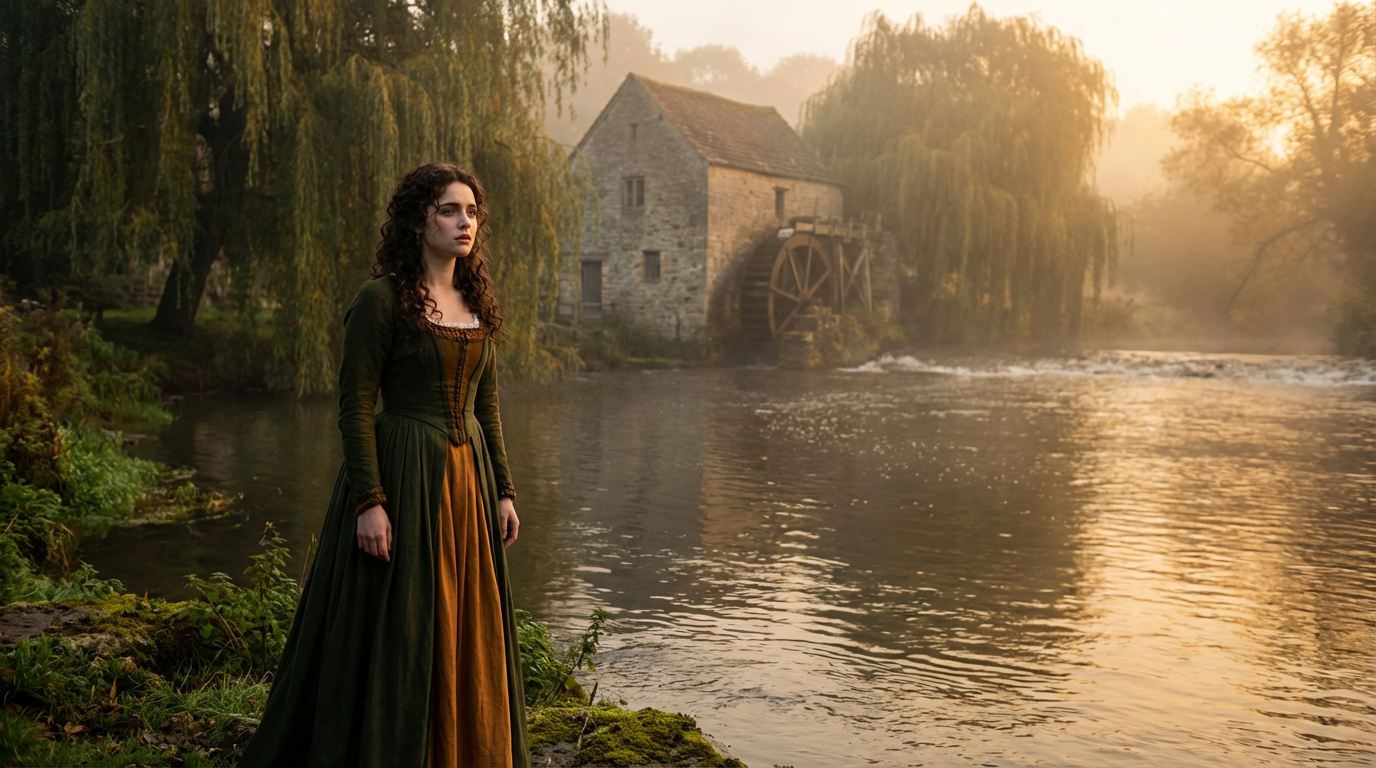
An excerpt from the original text.(complete · 2297 words)
he New Schoolfellow
It was a cold, wet January day on which Tom went back to school; a day
quite in keeping with this severe phase of his destiny. If he had not
carried in his pocket a parcel of sugar-candy and a small Dutch doll
for little Laura, there would have been no ray of expected pleasure to
enliven the general gloom. But he liked to think how Laura would put
out her lips and her tiny hands for the bits of sugarcandy; and to give
the greater keenness to these pleasures of imagination, he took out the
parcel, made a small hole in the paper, and bit off a crystal or two,
which had so solacing an effect under the confined prospect and damp
odors of the gig-umbrella, that he repeated the process more than once
on his way.
“Well, Tulliver, we’re glad to see you again,” said Mr Stelling,
heartily. “Take off your wrappings and come into the study till dinner.
You’ll find a bright fire there, and a new companion.”
Tom felt in an uncomfortable flutter as he took off his woollen
comforter and other wrappings. He had seen Philip Wakem at St Ogg’s,
but had always turned his eyes away from him as quickly as possible. He
would have disliked having a deformed boy for his companion, even if
Philip had not been the son of a bad man. And Tom did not see how a bad
man’s son could be very good. His own father was a good man, and he
would readily have fought any one who said the contrary. He was in a
state of mingled embarrassment and defiance as he followed Mr Stelling
to the study.
“Here is a new companion for you to shake hands with, Tulliver,” said
that gentleman on entering the study,—“Master Philip Wakem. I shall
leave you to make acquaintance by yourselves. You already know
something of each other, I imagine; for you are neighbours at home.”
Tom looked confused and awkward, while Philip rose and glanced at him
timidly. Tom did not like to go up and put out his hand, and he was not
prepared to say, “How do you do?” on so short a notice.
Mr Stelling wisely turned away, and closed the door behind him; boys’
shyness only wears off in the absence of their elders.
Philip was at once too proud and too timid to walk toward Tom. He
thought, or rather felt, that Tom had an aversion to looking at him;
every one, almost, disliked looking at him; and his deformity was more
conspicuous when he walked. So they remained without shaking hands or
even speaking, while Tom went to the fire and warmed himself, every now
and then casting furtive glances at Philip, who seemed to be drawing
absently first one object and then another on a piece of paper he had
before him. He had seated himself again, and as he drew, was thinking
what he could say to Tom, and trying to overcome his own repugnance to
making the first advances.
Tom began to look oftener and longer at Philip’s face, for he could see
it without noticing the hump, and it was really not a disagreeable
face,—very old-looking, Tom thought. He wondered how much older Philip
was than himself. An anatomist—even a mere physiognomist—would have
seen that the deformity of Philip’s spine was not a congenital hump,
but the result of an accident in infancy; but you do not expect from
Tom any acquaintance with such distinctions; to him, Philip was simply
a humpback. He had a vague notion that the deformity of Wakem’s son had
some relation to the lawyer’s rascality, of which he had so often heard
his father talk with hot emphasis; and he felt, too, a half-admitted
fear of him as probably a spiteful fellow, who, not being able to fight
you, had cunning ways of doing you a mischief by the sly. There was a
humpbacked tailor in the neighbourhood of Mr Jacobs’s academy, who was
considered a very unamiable character, and was much hooted after by
public-spirited boys solely on the ground of his unsatisfactory moral
qualities; so that Tom was not without a basis of fact to go upon.
Still, no face could be more unlike that ugly tailor’s than this
melancholy boy’s face,—the brown hair round it waved and curled at the
ends like a girl’s: Tom thought that truly pitiable. This Wakem was a
pale, puny fellow, and it was quite clear he would not be able to play
at anything worth speaking of; but he handled his pencil in an enviable
manner, and was apparently making one thing after another without any
trouble. What was he drawing? Tom was quite warm now, and wanted
something new to be going forward. It was certainly more agreeable to
have an ill-natured humpback as a companion than to stand looking out
of the study window at the rain, and kicking his foot against the
washboard in solitude; something would happen every day,—“a quarrel or
something”; and Tom thought he should rather like to show Philip that
he had better not try his spiteful tricks on him. He suddenly walked
across the hearth and looked over Philip’s paper.
“Why, that’s a donkey with panniers, and a spaniel, and partridges in
the corn!” he exclaimed, his tongue being completely loosed by surprise
and admiration. “Oh my buttons! I wish I could draw like that. I’m to
learn drawing this half; I wonder if I shall learn to make dogs and
donkeys!”
“Oh, you can do them without learning,” said Philip; “I never learned
drawing.”
“Never learned?” said Tom, in amazement. “Why, when I make dogs and
horses, and those things, the heads and the legs won’t come right;
though I can see how they ought to be very well. I can make houses, and
all sorts of chimneys,—chimneys going all down the wall,—and windows in
the roof, and all that. But I dare say I could do dogs and horses if I
was to try more,” he added, reflecting that Philip might falsely
suppose that he was going to “knock under,” if he were too frank about
the imperfection of his accomplishments.
“Oh, yes,” said Philip, “it’s very easy. You’ve only to look well at
things, and draw them over and over again. What you do wrong once, you
can alter the next time.”
“But haven’t you been taught anything?” said Tom, beginning to have a
puzzled suspicion that Philip’s crooked back might be the source of
remarkable faculties. “I thought you’d been to school a long while.”
“Yes,” said Philip, smiling; “I’ve been taught Latin and Greek and
mathematics, and writing and such things.”
“Oh, but I say, you don’t like Latin, though, do you?” said Tom,
lowering his voice confidentially.
“Pretty well; I don’t care much about it,” said Philip.
“Ah, but perhaps you haven’t got into the Propria quæ maribus,” said
Tom, nodding his head sideways, as much as to say, “that was the test;
it was easy talking till you came to that.”
Philip felt some bitter complacency in the promising stupidity of this
well-made, active-looking boy; but made polite by his own extreme
sensitiveness, as well as by his desire to conciliate, he checked his
inclination to laugh, and said quietly,—
“I’ve done with the grammar; I don’t learn that any more.”
“Then you won’t have the same lessons as I shall?” said Tom, with a
sense of disappointment.
“No; but I dare say I can help you. I shall be very glad to help you if
I can.”
Tom did not say “Thank you,” for he was quite absorbed in the thought
that Wakem’s son did not seem so spiteful a fellow as might have been
expected.
“I say,” he said presently, “do you love your father?”
“Yes,” said Philip, colouring deeply; “don’t you love yours?”
“Oh yes—I only wanted to know,” said Tom, rather ashamed of himself,
now he saw Philip colouring and looking uncomfortable. He found much
difficulty in adjusting his attitude of mind toward the son of Lawyer
Wakem, and it had occurred to him that if Philip disliked his father,
that fact might go some way toward clearing up his perplexity.
“Shall you learn drawing now?” he said, by way of changing the subject.
“No,” said Philip. “My father wishes me to give all my time to other
things now.”
“What! Latin and Euclid, and those things?” said Tom.
“Yes,” said Philip, who had left off using his pencil, and was resting
his head on one hand, while Tom was learning forward on both elbows,
and looking with increasing admiration at the dog and the donkey.
“And you don’t mind that?” said Tom, with strong curiosity.
“No; I like to know what everybody else knows. I can study what I like
by-and-by.”
“I can’t think why anybody should learn Latin,” said Tom. “It’s no
good.”
“It’s part of the education of a gentleman,” said Philip. “All
gentlemen learn the same things.”
“What! do you think Sir John Crake, the master of the harriers, knows
Latin?” said Tom, who had often thought he should like to resemble Sir
John Crake.
“He learned it when he was a boy, of course,” said Philip. “But I dare
say he’s forgotten it.”
“Oh, well, I can do that, then,” said Tom, not with any epigrammatic
intention, but with serious satisfaction at the idea that, as far as
Latin was concerned, there was no hindrance to his resembling Sir John
Crake. “Only you’re obliged to remember it while you’re at school, else
you’ve got to learn ever so many lines of ‘Speaker.’ Mr Stelling’s very
particular—did you know? He’ll have you up ten times if you say ‘nam’
for ‘jam,’—he won’t let you go a letter wrong, I can tell you.”
“Oh, I don’t mind,” said Philip, unable to choke a laugh; “I can
remember things easily. And there are some lessons I’m very fond of.
I’m very fond of Greek history, and everything about the Greeks. I
should like to have been a Greek and fought the Persians, and then have
come home and have written tragedies, or else have been listened to by
everybody for my wisdom, like Socrates, and have died a grand death.”
(Philip, you perceive, was not without a wish to impress the well-made
barbarian with a sense of his mental superiority.)
“Why, were the Greeks great fighters?” said Tom, who saw a vista in
this direction. “Is there anything like David and Goliath and Samson in
the Greek history? Those are the only bits I like in the history of the
Jews.”
“Oh, there are very fine stories of that sort about the Greeks,—about
the heroes of early times who killed the wild beasts, as Samson did.
And in the Odyssey—that’s a beautiful poem—there’s a more wonderful
giant than Goliath,—Polypheme, who had only one eye in the middle of
his forehead; and Ulysses, a little fellow, but very wise and cunning,
got a red-hot pine-tree and stuck it into this one eye, and made him
roar like a thousand bulls.”
“Oh, what fun!” said Tom, jumping away from the table, and stamping
first with one leg and then the other. “I say, can you tell me all
about those stories? Because I sha’n’t learn Greek, you know. Shall I?”
he added, pausing in his stamping with a sudden alarm, lest the
contrary might be possible. “Does every gentleman learn Greek? Will Mr
Stelling make me begin with it, do you think?”
“No, I should think not, very likely not,” said Philip. “But you may
read those stories without knowing Greek. I’ve got them in English.”
“Oh, but I don’t like reading; I’d sooner have you tell them me. But
only the fighting ones, you know. My sister Maggie is always wanting to
tell me stories, but they’re stupid things. Girls’ stories always are.
Can you tell a good many fighting stories?”
“Oh yes,” said Philip; “lots of them, besides the Greek stories. I can
tell you about Richard Cœur-de-Lion and Saladin, and about William
Wallace and Robert Bruce and James Douglas,—I know no end.”
“You’re older than I am, aren’t you?” said Tom.
“Why, how old are you? I’m fifteen.”
“I’m only going in fourteen,” said Tom. “But I thrashed all the fellows
at Jacob’s—that’s where I was before I came here. And I beat ’em all at
bandy and climbing. And I wish Mr Stelling would let us go fishing. I
could show you how to fish. You could fish, couldn’t you? It’s only
standing, and sitting still, you know.”
Tom, in his turn, wished to make the balance dip in his favour. This
hunchback must not suppose that his acquaintance with fighting stories
put him on a par with an actual fighting hero, like Tom Tulliver.
Philip winced under this allusion to his unfitness for active sports,
and he answered almost peevishly,—
“I can’t bear fishing. I think people look like fools sitting watching
a line hour after hour, or else throwing and throwing, and catching
nothing.”
“Ah, but you wouldn’t say they looked like fools when they landed a big
pike, I can tell you,” said Tom, who had never caught anything that was
“big” in his life, but whose imagination was on the stretch with
indignant zeal for the honour of sport. Wakem’s son, it was plain, had
his disagreeable points, and must be kept in due check. Happily for the
harmony of this first interview, they were now called to dinner, and
Philip was not allowed to develop farther his unsound views on the
subject of fishing. But Tom said to himself, that was just what he
should have expected from a hunchback.
Master this chapter. Complete your experience
Purchase the complete book to access all chapters and support classic literature
As an Amazon Associate, we earn a small commission from qualifying purchases at no additional cost to you.
Available in paperback, hardcover, and e-book formats
Let's Analyse the Pattern
Prejudice dissolves when we engage with individuals rather than the categories we've been taught to fear.
Why This Matters
Connect literature to life
This chapter teaches how to separate individuals from family reputations and inherited conflicts that may no longer serve anyone.
Practice This Today
This week, notice when you avoid someone based on stories you've heard—then create one genuine interaction to test your assumptions against reality.
Now let's explore the literary elements.
Key Quotes & Analysis
"He would have disliked having a deformed boy for his companion, even if Philip had not been the son of a bad man."
Context: Describing Tom's prejudiced thoughts before meeting Philip
This reveals Tom's double prejudice - against Philip's physical disability and his family name. Eliot shows how children absorb society's biases about both physical differences and family reputations.
In Today's Words:
He already didn't want to room with a disabled kid, and the family drama made it even worse.
"And Tom did not see how a bad man's son could be very good."
Context: Explaining Tom's inherited prejudice against Philip
Shows how children inherit their parents' feuds and prejudices without question. Tom assumes moral character is genetic, a common Victorian belief that Eliot challenges.
In Today's Words:
If your dad's a jerk, you must be a jerk too - that's what Tom figured.
"Well, Tulliver, we're glad to see you again."
Context: Greeting Tom warmly upon his return to school
The headmaster's cheerful welcome contrasts with Tom's inner dread, showing how adults often miss children's emotional struggles. His casual introduction of a 'new companion' doesn't acknowledge the complexity of the situation.
In Today's Words:
Hey Tom, good to have you back! You've got a new roommate, no big deal.
Thematic Threads
Inherited Prejudice
In This Chapter
Tom arrives carrying his father's hatred of the Wakem family, expecting Philip to embody all the negative traits he's been told about
Development
Introduced here - shows how family conflicts pass to the next generation
In Your Life:
You might find yourself disliking coworkers or neighbors based on stories you've heard rather than your own experience.
Talent Recognition
In This Chapter
Tom's amazement at Philip's artistic ability breaks through his prejudice and creates genuine curiosity
Development
Introduced here - establishes how skill and talent can bridge social divides
In Your Life:
You might discover that someone you dismissed actually has abilities that could help you or earn your respect.
Social Barriers
In This Chapter
The boys' initial awkwardness stems from class differences and family feuds, not personal dislike
Development
Continues from earlier chapters showing how social expectations shape relationships
In Your Life:
You might avoid connecting with people because of perceived social differences rather than actual incompatibility.
Mutual Benefit
In This Chapter
Philip offers to help Tom with studies while Tom could offer physical protection - their weaknesses complement each other's strengths
Development
Introduced here - shows how unlikely partnerships can be mutually beneficial
In Your Life:
You might find that people you initially avoided could actually help you with your own challenges.
Individual vs. Category
In This Chapter
Tom begins to see Philip as a person rather than just 'a Wakem' or 'the deformed boy'
Development
Introduced here - establishes the theme of seeing people as individuals
In Your Life:
You might catch yourself judging people by their group membership rather than their individual character and actions.
You now have the context. Time to form your own thoughts.
Discussion Questions
- 1
What changed Tom's mind about Philip - was it seeing him draw, learning about his academic skills, or Philip's offer to help with studies?
analysis • surface - 2
Why do you think Tom was so ready to hate Philip before they even met? What role did his father's opinions play in shaping Tom's expectations?
analysis • medium - 3
Where do you see this 'inherited enemy' pattern in modern workplaces, neighborhoods, or families - people disliking others based on stories they've heard rather than personal experience?
application • medium - 4
If you were Tom, how would you handle the conflict between your father's hatred of the Wakem family and your growing respect for Philip as an individual?
application • deep - 5
What does this chapter reveal about how prejudice actually works - and why direct human contact is so powerful at breaking it down?
reflection • deep
Critical Thinking Exercise
Test Your Inherited Opinions
Think of someone you've been taught to dislike or distrust - maybe through family stories, workplace gossip, or community reputation. Write down what you've heard about them versus what you've actually experienced. Then imagine meeting them for the first time with no background information. What would you notice about their actual behavior, skills, or character?
Consider:
- •Separate secondhand stories from firsthand experience
- •Consider what interests or talents they might have that you've never heard about
- •Think about whether your current opinion serves you or limits your opportunities
Journaling Prompt
Write about a time when you discovered someone was completely different from their reputation. What changed your mind, and how did it affect your approach to judging others?
Coming Up Next...
Chapter 17: The Complicated Dance of Friendship
As Tom and Philip's unlikely friendship begins to take shape, their different worlds and values will create both connection and conflict. The next chapter explores how these two boys navigate their growing bond while carrying the weight of their families' expectations.



