
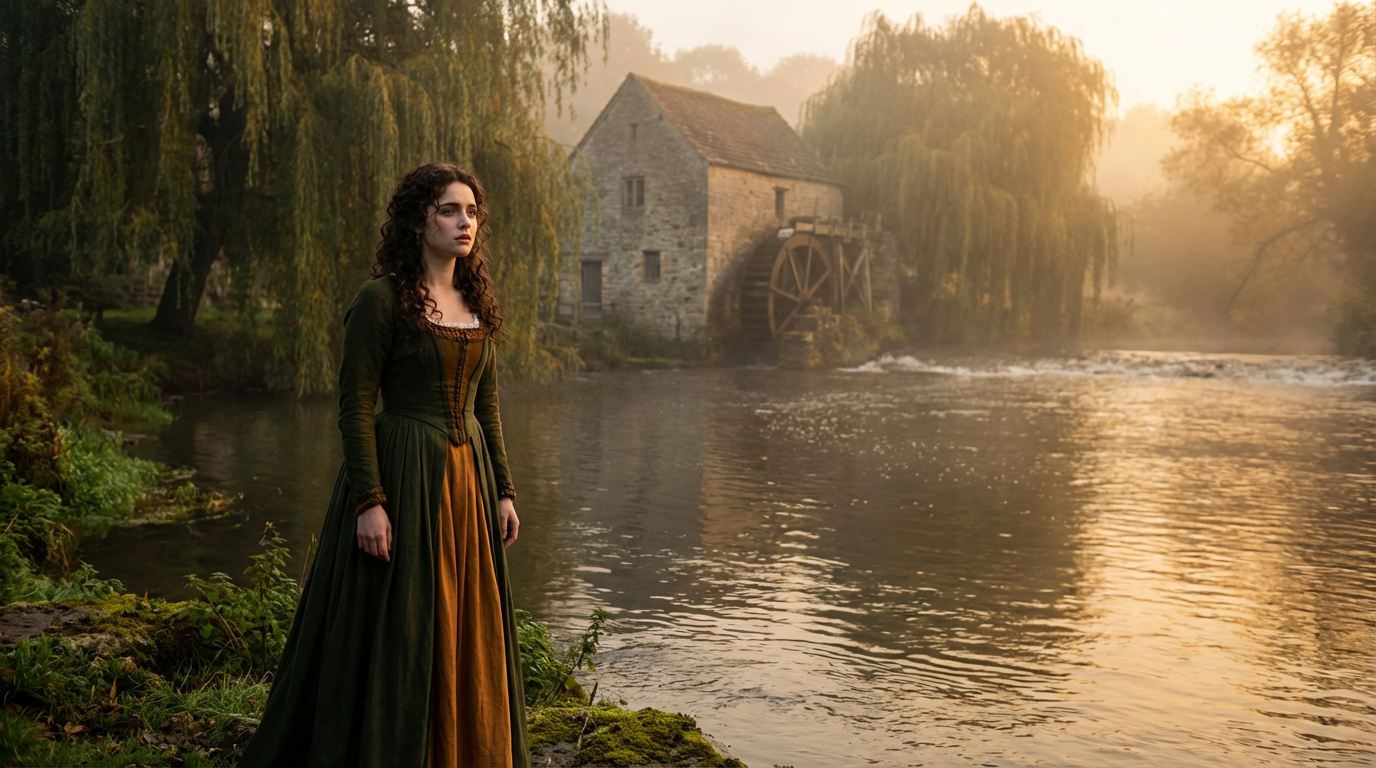
An excerpt from the original text.(complete · 3063 words)
he Christmas Holidays
Fine old Christmas, with the snowy hair and ruddy face, had done his
duty that year in the noblest fashion, and had set off his rich gifts
of warmth and colour with all the heightening contrast of frost and
snow.
Snow lay on the croft and river-bank in undulations softer than the
limbs of infancy; it lay with the neatliest finished border on every
sloping roof, making the dark-red gables stand out with a new depth of
colour; it weighed heavily on the laurels and fir-trees, till it fell
from them with a shuddering sound; it clothed the rough turnip-field
with whiteness, and made the sheep look like dark blotches; the gates
were all blocked up with the sloping drifts, and here and there a
disregarded four-footed beast stood as if petrified “in unrecumbent
sadness”; there was no gleam, no shadow, for the heavens, too, were one
still, pale cloud; no sound or motion in anything but the dark river
that flowed and moaned like an unresting sorrow. But old Christmas
smiled as he laid this cruel-seeming spell on the outdoor world, for he
meant to light up home with new brightness, to deepen all the richness
of indoor colour, and give a keener edge of delight to the warm
fragrance of food; he meant to prepare a sweet imprisonment that would
strengthen the primitive fellowship of kindred, and make the sunshine
of familiar human faces as welcome as the hidden day-star. His kindness
fell but hardly on the homeless,—fell but hardly on the homes where the
hearth was not very warm, and where the food had little fragrance;
where the human faces had had no sunshine in them, but rather the
leaden, blank-eyed gaze of unexpectant want. But the fine old season
meant well; and if he has not learned the secret how to bless men
impartially, it is because his father Time, with ever-unrelenting
purpose, still hides that secret in his own mighty, slow-beating heart.
And yet this Christmas day, in spite of Tom’s fresh delight in home,
was not, he thought, somehow or other, quite so happy as it had always
been before. The red berries were just as abundant on the holly, and he
and Maggie had dressed all the windows and mantlepieces and
picture-frames on Christmas eve with as much taste as ever, wedding the
thick-set scarlet clusters with branches of the black-berried ivy.
There had been singing under the windows after midnight,—supernatural
singing, Maggie always felt, in spite of Tom’s contemptuous insistence
that the singers were old Patch, the parish clerk, and the rest of the
church choir; she trembled with awe when their carolling broke in upon
her dreams, and the image of men in fustian clothes was always thrust
away by the vision of angels resting on the parted cloud. The midnight
chant had helped as usual to lift the morning above the level of common
days; and then there were the smell of hot toast and ale from the
kitchen, at the breakfast hour; the favourite anthem, the green boughs,
and the short sermon gave the appropriate festal character to the
church-going; and aunt and uncle Moss, with all their seven children,
were looking like so many reflectors of the bright parlour-fire, when
the church-goers came back, stamping the snow from their feet. The
plum-pudding was of the same handsome roundness as ever, and came in
with the symbolic blue flames around it, as if it had been heroically
snatched from the nether fires, into which it had been thrown by
dyspeptic Puritans; the dessert was as splendid as ever, with its
golden oranges, brown nuts, and the crystalline light and dark of
apple-jelly and damson cheese; in all these things Christmas was as it
had always been since Tom could remember; it was only distinguished, if
by anything, by superior sliding and snowballs.
Christmas was cheery, but not so Mr Tulliver. He was irate and defiant;
and Tom, though he espoused his father’s quarrels and shared his
father’s sense of injury, was not without some of the feeling that
oppressed Maggie when Mr Tulliver got louder and more angry in
narration and assertion with the increased leisure of dessert. The
attention that Tom might have concentrated on his nuts and wine was
distracted by a sense that there were rascally enemies in the world,
and that the business of grown-up life could hardly be conducted
without a good deal of quarrelling. Now, Tom was not fond of
quarrelling, unless it could soon be put an end to by a fair stand-up
fight with an adversary whom he had every chance of thrashing; and his
father’s irritable talk made him uncomfortable, though he never
accounted to himself for the feeling, or conceived the notion that his
father was faulty in this respect.
The particular embodiment of the evil principle now exciting Mr
Tulliver’s determined resistance was Mr Pivart, who, having lands
higher up the Ripple, was taking measures for their irrigation, which
either were, or would be, or were bound to be (on the principle that
water was water), an infringement on Mr Tulliver’s legitimate share of
water-power. Dix, who had a mill on the stream, was a feeble auxiliary
of Old Harry compared with Pivart. Dix had been brought to his senses
by arbitration, and Wakem’s advice had not carried him far. No; Dix,
Mr Tulliver considered, had been as good as nowhere in point of law;
and in the intensity of his indignation against Pivart, his contempt
for a baffled adversary like Dix began to wear the air of a friendly
attachment. He had no male audience to-day except Mr Moss, who knew
nothing, as he said, of the “natur’ o’ mills,” and could only assent to
Mr Tulliver’s arguments on the a priori ground of family relationship
and monetary obligation; but Mr Tulliver did not talk with the futile
intention of convincing his audience, he talked to relieve himself;
while good Mr Moss made strong efforts to keep his eyes wide open, in
spite of the sleepiness which an unusually good dinner produced in his
hard-worked frame. Mrs Moss, more alive to the subject, and interested
in everything that affected her brother, listened and put in a word as
often as maternal preoccupations allowed.
“Why, Pivart’s a new name hereabout, brother, isn’t it?” she said; “he
didn’t own the land in father’s time, nor yours either, before I was
married.”
“New name? Yes, I should think it is a new name,” said Mr Tulliver,
with angry emphasis. “Dorlcote Mill’s been in our family a hundred year
and better, and nobody ever heard of a Pivart meddling with the river,
till this fellow came and bought Bincome’s farm out of hand, before
anybody else could so much as say ‘snap.’ But I’ll Pivart him!” added
Mr Tulliver, lifting his glass with a sense that he had defined his
resolution in an unmistakable manner.
“You won’t be forced to go to law with him, I hope, brother?” said Mrs
Moss, with some anxiety.
“I don’t know what I shall be forced to; but I know what I shall force
him to, with his dikes and erigations, if there’s any law to be
brought to bear o’ the right side. I know well enough who’s at the
bottom of it; he’s got Wakem to back him and egg him on. I know Wakem
tells him the law can’t touch him for it, but there’s folks can handle
the law besides Wakem. It takes a big raskil to beat him; but there’s
bigger to be found, as know more o’ th’ ins and outs o’ the law, else
how came Wakem to lose Brumley’s suit for him?”
Mr Tulliver was a strictly honest man, and proud of being honest, but
he considered that in law the ends of justice could only be achieved by
employing a stronger knave to frustrate a weaker. Law was a sort of
cock-fight, in which it was the business of injured honesty to get a
game bird with the best pluck and the strongest spurs.
“Gore’s no fool; you needn’t tell me that,” he observed presently, in a
pugnacious tone, as if poor Gritty had been urging that lawyer’s
capabilities; “but, you see, he isn’t up to the law as Wakem is. And
water’s a very particular thing; you can’t pick it up with a pitchfork.
That’s why it’s been nuts to Old Harry and the lawyers. It’s plain
enough what’s the rights and the wrongs of water, if you look at it
straight-forrard; for a river’s a river, and if you’ve got a mill, you
must have water to turn it; and it’s no use telling me Pivart’s
erigation and nonsense won’t stop my wheel; I know what belongs to
water better than that. Talk to me o’ what th’ engineers say! I say
it’s common sense, as Pivart’s dikes must do me an injury. But if
that’s their engineering, I’ll put Tom to it by-and-by, and he shall
see if he can’t find a bit more sense in th’ engineering business than
what that comes to.”
Tom, looking round with some anxiety at this announcement of his
prospects, unthinkingly withdrew a small rattle he was amusing baby
Moss with, whereupon she, being a baby that knew her own mind with
remarkable clearness, instantaneously expressed her sentiments in a
piercing yell, and was not to be appeased even by the restoration of
the rattle, feeling apparently that the original wrong of having it
taken from her remained in all its force. Mrs Moss hurried away with
her into another room, and expressed to Mrs Tulliver, who accompanied
her, the conviction that the dear child had good reasons for crying;
implying that if it was supposed to be the rattle that baby clamored
for, she was a misunderstood baby. The thoroughly justifiable yell
being quieted, Mrs Moss looked at her sister-in-law and said,—
“I’m sorry to see brother so put out about this water work.”
“It’s your brother’s way, Mrs Moss; I’d never anything o’ that sort
before I was married,” said Mrs Tulliver, with a half-implied reproach.
She always spoke of her husband as “your brother” to Mrs Moss in any
case when his line of conduct was not matter of pure admiration.
Amiable Mrs Tulliver, who was never angry in her life, had yet her mild
share of that spirit without which she could hardly have been at once a
Dodson and a woman. Being always on the defensive toward her own
sisters, it was natural that she should be keenly conscious of her
superiority, even as the weakest Dodson, over a husband’s sister, who,
besides being poorly off, and inclined to “hang on” her brother, had
the good-natured submissiveness of a large, easy-tempered, untidy,
prolific woman, with affection enough in her not only for her own
husband and abundant children, but for any number of collateral
relations.
“I hope and pray he won’t go to law,” said Mrs Moss, “for there’s never
any knowing where that’ll end. And the right doesn’t allays win. This
Mr Pivart’s a rich man, by what I can make out, and the rich mostly get
things their own way.”
“As to that,” said Mrs Tulliver, stroking her dress down, “I’ve seen
what riches are in my own family; for my sisters have got husbands as
can afford to do pretty much what they like. But I think sometimes I
shall be drove off my head with the talk about this law and erigation;
and my sisters lay all the fault to me, for they don’t know what it is
to marry a man like your brother; how should they? Sister Pullet has
her own way from morning till night.”
“Well,” said Mrs Moss, “I don’t think I should like my husband if he
hadn’t got any wits of his own, and I had to find head-piece for him.
It’s a deal easier to do what pleases one’s husband, than to be
puzzling what else one should do.”
“If people come to talk o’ doing what pleases their husbands,” said Mrs
Tulliver, with a faint imitation of her sister Glegg, “I’m sure your
brother might have waited a long while before he’d have found a wife
that ’ud have let him have his say in everything, as I do. It’s nothing
but law and erigation now, from when we first get up in the morning
till we go to bed at night; and I never contradict him; I only say,
‘Well, Mr Tulliver, do as you like; but whativer you do, don’t go to
law.”
Mrs Tulliver, as we have seen, was not without influence over her
husband. No woman is; she can always incline him to do either what she
wishes, or the reverse; and on the composite impulses that were
threatening to hurry Mr Tulliver into “law,” Mrs Tulliver’s monotonous
pleading had doubtless its share of force; it might even be comparable
to that proverbial feather which has the credit or discredit of
breaking the camel’s back; though, on a strictly impartial view, the
blame ought rather to lie with the previous weight of feathers which
had already placed the back in such imminent peril that an otherwise
innocent feather could not settle on it without mischief. Not that Mrs
Tulliver’s feeble beseeching could have had this feather’s weight in
virtue of her single personality; but whenever she departed from entire
assent to her husband, he saw in her the representative of the Dodson
family; and it was a guiding principle with Mr Tulliver to let the
Dodsons know that they were not to domineer over him, or—more
specifically—that a male Tulliver was far more than equal to four
female Dodsons, even though one of them was Mrs Glegg.
But not even a direct argument from that typical Dodson female herself
against his going to law could have heightened his disposition toward
it so much as the mere thought of Wakem, continually freshened by the
sight of the too able attorney on market-days. Wakem, to his certain
knowledge, was (metaphorically speaking) at the bottom of Pivart’s
irrigation; Wakem had tried to make Dix stand out, and go to law about
the dam; it was unquestionably Wakem who had caused Mr Tulliver to lose
the suit about the right of road and the bridge that made a
thoroughfare of his land for every vagabond who preferred an
opportunity of damaging private property to walking like an honest man
along the highroad; all lawyers were more or less rascals, but Wakem’s
rascality was of that peculiarly aggravated kind which placed itself in
opposition to that form of right embodied in Mr Tulliver’s interests
and opinions. And as an extra touch of bitterness, the injured miller
had recently, in borrowing the five hundred pounds, been obliged to
carry a little business to Wakem’s office on his own account. A
hook-nosed glib fellow! as cool as a cucumber,—always looking so sure
of his game! And it was vexatious that Lawyer Gore was not more like
him, but was a bald, round-featured man, with bland manners and fat
hands; a game-cock that you would be rash to bet upon against Wakem.
Gore was a sly fellow. His weakness did not lie on the side of
scrupulosity; but the largest amount of winking, however significant,
is not equivalent to seeing through a stone wall; and confident as Mr
Tulliver was in his principle that water was water, and in the direct
inference that Pivart had not a leg to stand on in this affair of
irrigation, he had an uncomfortable suspicion that Wakem had more law
to show against this (rationally) irrefragable inference than Gore
could show for it. But then, if they went to law, there was a chance
for Mr Tulliver to employ Counsellor Wylde on his side, instead of
having that admirable bully against him; and the prospect of seeing a
witness of Wakem’s made to perspire and become confounded, as Mr
Tulliver’s witness had once been, was alluring to the love of
retributive justice.
Much rumination had Mr Tulliver on these puzzling subjects during his
rides on the gray horse; much turning of the head from side to side, as
the scales dipped alternately; but the probable result was still out of
sight, only to be reached through much hot argument and iteration in
domestic and social life. That initial stage of the dispute which
consisted in the narration of the case and the enforcement of Mr
Tulliver’s views concerning it throughout the entire circle of his
connections would necessarily take time; and at the beginning of
February, when Tom was going to school again, there were scarcely any
new items to be detected in his father’s statement of the case against
Pivart, or any more specific indication of the measures he was bent on
taking against that rash contravener of the principle that water was
water. Iteration, like friction, is likely to generate heat instead of
progress, and Mr Tulliver’s heat was certainly more and more palpable.
If there had been no new evidence on any other point, there had been
new evidence that Pivart was as “thick as mud” with Wakem.
“Father,” said Tom, one evening near the end of the holidays, “uncle
Glegg says Lawyer Wakem is going to send his son to Mr Stelling. It
isn’t true, what they said about his going to be sent to France. You
won’t like me to go to school with Wakem’s son, shall you?”
“It’s no matter for that, my boy,” said Mr Tulliver; “don’t you learn
anything bad of him, that’s all. The lad’s a poor deformed creatur, and
takes after his mother in the face; I think there isn’t much of his
father in him. It’s a sign Wakem thinks high o’ Mr Sterling, as he
sends his son to him, and Wakem knows meal from bran.”
Mr Tulliver in his heart was rather proud of the fact that his son was
to have the same advantages as Wakem’s; but Tom was not at all easy on
the point. It would have been much clearer if the lawyer’s son had not
been deformed, for then Tom would have had the prospect of pitching
into him with all that freedom which is derived from a high moral
sanction.
Master this chapter. Complete your experience
Purchase the complete book to access all chapters and support classic literature
As an Amazon Associate, we earn a small commission from qualifying purchases at no additional cost to you.
Available in paperback, hardcover, and e-book formats
Let's Analyse the Pattern
When moral certainty becomes more important than the people we claim to be protecting, causing harm in service of being right.
Why This Matters
Connect literature to life
This chapter teaches how to recognize when moral certainty becomes destructive to the people it claims to protect.
Practice This Today
This week, notice when someone says 'I'm doing this for you' while you're clearly suffering—including when you say it yourself.
Now let's explore the literary elements.
Key Quotes & Analysis
"His kindness fell but hardly on the homeless—fell but hardly on the homes where the hearth was not very warm, and where the food had little fragrance"
Context: Describing how Christmas joy depends on having money and security
Eliot reminds us that holiday magic only works if you can afford it. Christmas warmth is literally about having heat and good food - luxuries the poor can't take for granted.
In Today's Words:
Christmas is great if you've got money, but pretty rough if you're struggling to pay the bills
"I wish you'd leave off talking about law and erigation - it makes me feel quite uncomfortable"
Context: Trying to get her husband to stop obsessing over his lawsuit during Christmas
Shows how one person's obsession can poison everyone else's peace. Mrs. Tulliver just wants a normal holiday but her husband can't let go of his anger.
In Today's Words:
Can we please talk about something else? You're bringing down the whole mood
"It's a fine thing when a man can afford to make enemies"
Context: Warning about the financial dangers of Mr. Tulliver's legal battles
Practical wisdom about picking your fights. Making enemies is expensive - in legal fees, lost business, and stress. Most people can't afford that luxury.
In Today's Words:
You better have deep pockets if you're going to keep starting fights with people
Thematic Threads
Class Conflict
In This Chapter
Tulliver's battle with Wakem represents working-class resentment against educated legal manipulation
Development
Escalating from business dispute to personal vendetta, now involving the children
In Your Life:
When you feel the system is rigged against you, the anger can consume more energy than solving the actual problem.
Family Loyalty
In This Chapter
Mrs. Tulliver torn between supporting her husband and protecting her family's peace
Development
Her quiet resistance growing stronger as his obsession deepens
In Your Life:
Sometimes loving someone means refusing to enable their destructive choices, even when they call it betrayal.
Childhood Innocence
In This Chapter
Tom forced to inherit his father's enemies before understanding the conflict
Development
Children increasingly burdened by adult conflicts they didn't choose
In Your Life:
Adult problems have a way of seeping into children's lives whether we intend it or not.
Social Expectations
In This Chapter
Holiday traditions continuing despite underlying family tension
Development
Surface normalcy masking deeper dysfunction
In Your Life:
Going through the motions of celebration while real problems go unaddressed only deepens the strain.
Pride
In This Chapter
Tulliver's need to be right overwhelming his judgment and family relationships
Development
Pride evolving from self-respect to self-destruction
In Your Life:
The moment your need to be right becomes more important than your relationships, you've lost the plot.
You now have the context. Time to form your own thoughts.
Discussion Questions
- 1
How does Mr. Tulliver's obsession with his lawsuit affect his family's Christmas celebration?
analysis • surface - 2
Why does Mr. Tulliver see his wife's concerns as opposition rather than care? What drives this misinterpretation?
analysis • medium - 3
Where have you seen someone become so focused on being 'right' that they damaged relationships with people they claimed to protect?
application • medium - 4
If you were Mrs. Tulliver, how would you try to reach your husband without triggering his defensiveness?
application • deep - 5
What does this chapter reveal about how moral certainty can blind us to the harm we're causing?
reflection • deep
Critical Thinking Exercise
The Righteous Poison Audit
Think of a situation where you felt strongly that you were right about something important. Write down your original goal, then honestly assess what actually happened to the people involved. Map the gap between your intention and the real-world impact on others.
Consider:
- •Notice when your need to be right became more important than solving the actual problem
- •Look for moments when you dismissed others' concerns as weakness or ignorance
- •Identify whether you were fighting for the principle or just fighting
Journaling Prompt
Write about a time when someone you cared about told you that your 'righteous' behavior was hurting them. How did you respond? What would you do differently now?
Coming Up Next...
Chapter 16: When Prejudice Meets Possibility
Tom returns to school to meet his new classmate—Philip Wakem, son of his father's greatest enemy. This encounter will test everything Tom believes about loyalty, justice, and friendship.



