
An excerpt from the original text.(complete · 2571 words)
rs. Pontellier was not a woman given to confidences, a characteristic
hitherto contrary to her nature. Even as a child she had lived her own
small life all within herself. At a very early period she had
apprehended instinctively the dual life—that outward existence which
conforms, the inward life which questions.
That summer at Grand Isle she began to loosen a little the mantle of
reserve that had always enveloped her. There may have been—there must
have been—influences, both subtle and apparent, working in their
several ways to induce her to do this; but the most obvious was the
influence of Adèle Ratignolle. The excessive physical charm of the
Creole had first attracted her, for Edna had a sensuous susceptibility
to beauty. Then the candor of the woman’s whole existence, which every
one might read, and which formed so striking a contrast to her own
habitual reserve—this might have furnished a link. Who can tell what
metals the gods use in forging the subtle bond which we call sympathy,
which we might as well call love.
The two women went away one morning to the beach together, arm in arm,
under the huge white sunshade. Edna had prevailed upon Madame
Ratignolle to leave the children behind, though she could not induce
her to relinquish a diminutive roll of needlework, which Adèle begged
to be allowed to slip into the depths of her pocket. In some
unaccountable way they had escaped from Robert.
The walk to the beach was no inconsiderable one, consisting as it did
of a long, sandy path, upon which a sporadic and tangled growth that
bordered it on either side made frequent and unexpected inroads. There
were acres of yellow camomile reaching out on either hand. Further away
still, vegetable gardens abounded, with frequent small plantations of
orange or lemon trees intervening. The dark green clusters glistened
from afar in the sun.
The women were both of goodly height, Madame Ratignolle possessing the
more feminine and matronly figure. The charm of Edna Pontellier’s
physique stole insensibly upon you. The lines of her body were long,
clean and symmetrical; it was a body which occasionally fell into
splendid poses; there was no suggestion of the trim, stereotyped
fashion-plate about it. A casual and indiscriminating observer, in
passing, might not cast a second glance upon the figure. But with more
feeling and discernment he would have recognized the noble beauty of
its modeling, and the graceful severity of poise and movement, which
made Edna Pontellier different from the crowd.
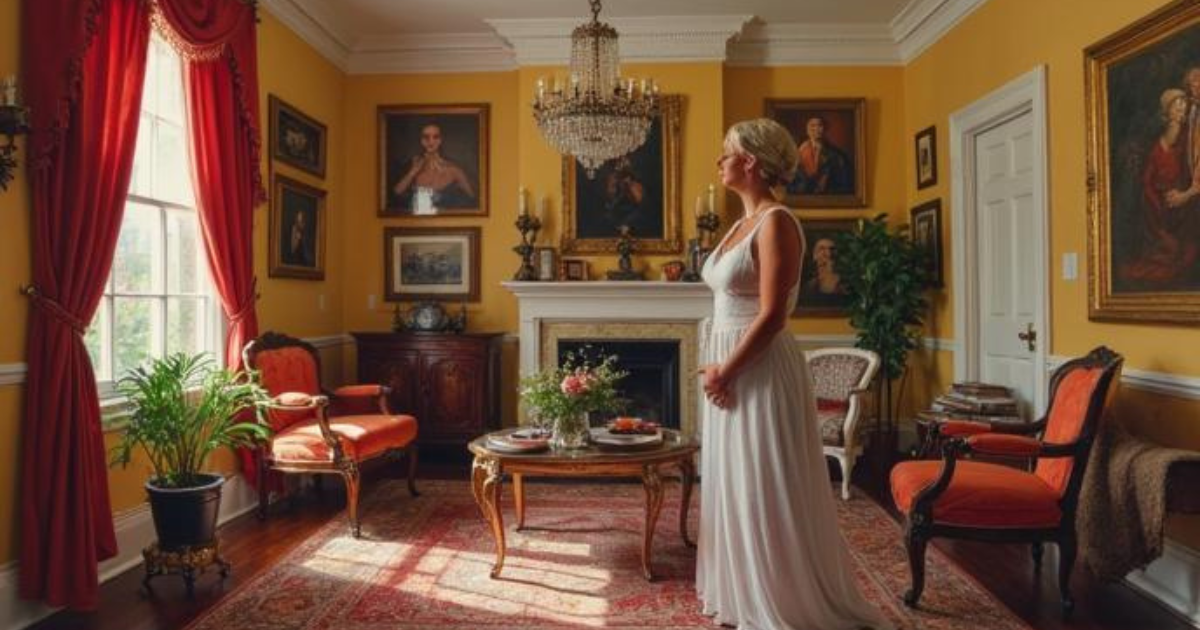
She wore a cool muslin that morning—white, with a waving vertical line
of brown running through it; also a white linen collar and the big
straw hat which she had taken from the peg outside the door. The hat
rested any way on her yellow-brown hair, that waved a little, was
heavy, and clung close to her head.
Madame Ratignolle, more careful of her complexion, had twined a gauze
veil about her head. She wore dogskin gloves, with gauntlets that
protected her wrists. She was dressed in pure white, with a fluffiness
of ruffles that became her. The draperies and fluttering things which
she wore suited her rich, luxuriant beauty as a greater severity of
line could not have done.
There were a number of bath-houses along the beach, of rough but solid
construction, built with small, protecting galleries facing the water.
Each house consisted of two compartments, and each family at Lebrun’s
possessed a compartment for itself, fitted out with all the essential
paraphernalia of the bath and whatever other conveniences the owners
might desire. The two women had no intention of bathing; they had just
strolled down to the beach for a walk and to be alone and near the
water. The Pontellier and Ratignolle compartments adjoined one another
under the same roof.
Mrs. Pontellier had brought down her key through force of habit.
Unlocking the door of her bath-room she went inside, and soon emerged,
bringing a rug, which she spread upon the floor of the gallery, and two
huge hair pillows covered with crash, which she placed against the
front of the building.
The two seated themselves there in the shade of the porch, side by
side, with their backs against the pillows and their feet extended.
Madame Ratignolle removed her veil, wiped her face with a rather
delicate handkerchief, and fanned herself with the fan which she always
carried suspended somewhere about her person by a long, narrow ribbon.
Edna removed her collar and opened her dress at the throat. She took
the fan from Madame Ratignolle and began to fan both herself and her
companion. It was very warm, and for a while they did nothing but
exchange remarks about the heat, the sun, the glare. But there was a
breeze blowing, a choppy, stiff wind that whipped the water into froth.
It fluttered the skirts of the two women and kept them for a while
engaged in adjusting, readjusting, tucking in, securing hair-pins and
hat-pins. A few persons were sporting some distance away in the water.
The beach was very still of human sound at that hour. The lady in black
was reading her morning devotions on the porch of a neighboring
bath-house. Two young lovers were exchanging their hearts’ yearnings
beneath the children’s tent, which they had found unoccupied.
Edna Pontellier, casting her eyes about, had finally kept them at rest
upon the sea. The day was clear and carried the gaze out as far as the
blue sky went; there were a few white clouds suspended idly over the
horizon. A lateen sail was visible in the direction of Cat Island, and
others to the south seemed almost motionless in the far distance.
“Of whom—of what are you thinking?” asked Adèle of her companion, whose
countenance she had been watching with a little amused attention,
arrested by the absorbed expression which seemed to have seized and
fixed every feature into a statuesque repose.
“Nothing,” returned Mrs. Pontellier, with a start, adding at once: “How
stupid! But it seems to me it is the reply we make instinctively to
such a question. Let me see,” she went on, throwing back her head and
narrowing her fine eyes till they shone like two vivid points of light.
“Let me see. I was really not conscious of thinking of anything; but
perhaps I can retrace my thoughts.”
“Oh! never mind!” laughed Madame Ratignolle. “I am not quite so
exacting. I will let you off this time. It is really too hot to think,
especially to think about thinking.”
“But for the fun of it,” persisted Edna. “First of all, the sight of
the water stretching so far away, those motionless sails against the
blue sky, made a delicious picture that I just wanted to sit and look
at. The hot wind beating in my face made me think—without any
connection that I can trace of a summer day in Kentucky, of a meadow
that seemed as big as the ocean to the very little girl walking through
the grass, which was higher than her waist. She threw out her arms as
if swimming when she walked, beating the tall grass as one strikes out
in the water. Oh, I see the connection now!”
“Where were you going that day in Kentucky, walking through the grass?”
“I don’t remember now. I was just walking diagonally across a big
field. My sun-bonnet obstructed the view. I could see only the stretch
of green before me, and I felt as if I must walk on forever, without
coming to the end of it. I don’t remember whether I was frightened or
pleased. I must have been entertained.
“Likely as not it was Sunday,” she laughed; “and I was running away
from prayers, from the Presbyterian service, read in a spirit of gloom
by my father that chills me yet to think of.”
“And have you been running away from prayers ever since, ma chère?”
asked Madame Ratignolle, amused.
“No! oh, no!” Edna hastened to say. “I was a little unthinking child in
those days, just following a misleading impulse without question. On
the contrary, during one period of my life religion took a firm hold
upon me; after I was twelve and until—until—why, I suppose until now,
though I never thought much about it—just driven along by habit. But do
you know,” she broke off, turning her quick eyes upon Madame Ratignolle
and leaning forward a little so as to bring her face quite close to
that of her companion, “sometimes I feel this summer as if I were
walking through the green meadow again; idly, aimlessly, unthinking and
unguided.”
Madame Ratignolle laid her hand over that of Mrs. Pontellier, which was
near her. Seeing that the hand was not withdrawn, she clasped it firmly
and warmly. She even stroked it a little, fondly, with the other hand,
murmuring in an undertone, “Pauvre chérie.”
The action was at first a little confusing to Edna, but she soon lent
herself readily to the Creole’s gentle caress. She was not accustomed
to an outward and spoken expression of affection, either in herself or
in others. She and her younger sister, Janet, had quarreled a good deal
through force of unfortunate habit. Her older sister, Margaret, was
matronly and dignified, probably from having assumed matronly and
housewifely responsibilities too early in life, their mother having
died when they were quite young. Margaret was not effusive; she was
practical. Edna had had an occasional girl friend, but whether
accidentally or not, they seemed to have been all of one type—the
self-contained. She never realized that the reserve of her own
character had much, perhaps everything, to do with this. Her most
intimate friend at school had been one of rather exceptional
intellectual gifts, who wrote fine-sounding essays, which Edna admired
and strove to imitate; and with her she talked and glowed over the
English classics, and sometimes held religious and political
controversies.
Edna often wondered at one propensity which sometimes had inwardly
disturbed her without causing any outward show or manifestation on her
part. At a very early age—perhaps it was when she traversed the ocean
of waving grass—she remembered that she had been passionately enamored
of a dignified and sad-eyed cavalry officer who visited her father in
Kentucky. She could not leave his presence when he was there, nor
remove her eyes from his face, which was something like Napoleon’s,
with a lock of black hair failing across the forehead. But the cavalry
officer melted imperceptibly out of her existence.
At another time her affections were deeply engaged by a young gentleman
who visited a lady on a neighboring plantation. It was after they went
to Mississippi to live. The young man was engaged to be married to the
young lady, and they sometimes called upon Margaret, driving over of
afternoons in a buggy. Edna was a little miss, just merging into her
teens; and the realization that she herself was nothing, nothing,
nothing to the engaged young man was a bitter affliction to her. But
he, too, went the way of dreams.
She was a grown young woman when she was overtaken by what she supposed
to be the climax of her fate. It was when the face and figure of a
great tragedian began to haunt her imagination and stir her senses. The
persistence of the infatuation lent it an aspect of genuineness. The
hopelessness of it colored it with the lofty tones of a great passion.
The picture of the tragedian stood enframed upon her desk. Any one may
possess the portrait of a tragedian without exciting suspicion or
comment. (This was a sinister reflection which she cherished.) In the
presence of others she expressed admiration for his exalted gifts, as
she handed the photograph around and dwelt upon the fidelity of the
likeness. When alone she sometimes picked it up and kissed the cold
glass passionately.
Her marriage to Léonce Pontellier was purely an accident, in this
respect resembling many other marriages which masquerade as the decrees
of Fate. It was in the midst of her secret great passion that she met
him. He fell in love, as men are in the habit of doing, and pressed his
suit with an earnestness and an ardor which left nothing to be desired.
He pleased her; his absolute devotion flattered her. She fancied there
was a sympathy of thought and taste between them, in which fancy she
was mistaken. Add to this the violent opposition of her father and her
sister Margaret to her marriage with a Catholic, and we need seek no
further for the motives which led her to accept Monsieur Pontellier for
her husband.
The acme of bliss, which would have been a marriage with the tragedian,
was not for her in this world. As the devoted wife of a man who
worshiped her, she felt she would take her place with a certain dignity
in the world of reality, closing the portals forever behind her upon
the realm of romance and dreams.
But it was not long before the tragedian had gone to join the cavalry
officer and the engaged young man and a few others; and Edna found
herself face to face with the realities. She grew fond of her husband,
realizing with some unaccountable satisfaction that no trace of passion
or excessive and fictitious warmth colored her affection, thereby
threatening its dissolution.
She was fond of her children in an uneven, impulsive way. She would
sometimes gather them passionately to her heart; she would sometimes
forget them. The year before they had spent part of the summer with
their grandmother Pontellier in Iberville. Feeling secure regarding
their happiness and welfare, she did not miss them except with an
occasional intense longing. Their absence was a sort of relief, though
she did not admit this, even to herself. It seemed to free her of a
responsibility which she had blindly assumed and for which Fate had not
fitted her.
Edna did not reveal so much as all this to Madame Ratignolle that
summer day when they sat with faces turned to the sea. But a good part
of it escaped her. She had put her head down on Madame Ratignolle’s
shoulder. She was flushed and felt intoxicated with the sound of her
own voice and the unaccustomed taste of candor. It muddled her like
wine, or like a first breath of freedom.
There was the sound of approaching voices. It was Robert, surrounded by
a troop of children, searching for them. The two little Pontelliers
were with him, and he carried Madame Ratignolle’s little girl in his
arms. There were other children beside, and two nurse-maids followed,
looking disagreeable and resigned.
The women at once rose and began to shake out their draperies and relax
their muscles. Mrs. Pontellier threw the cushions and rug into the
bath-house. The children all scampered off to the awning, and they
stood there in a line, gazing upon the intruding lovers, still
exchanging their vows and sighs. The lovers got up, with only a silent
protest, and walked slowly away somewhere else.
The children possessed themselves of the tent, and Mrs. Pontellier went
over to join them.
Madame Ratignolle begged Robert to accompany her to the house; she
complained of cramp in her limbs and stiffness of the joints. She
leaned draggingly upon his arm as they walked.
Master this chapter. Complete your experience
Purchase the complete book to access all chapters and support classic literature
As an Amazon Associate, we earn a small commission from qualifying purchases at no additional cost to you.
Available in paperback, hardcover, and e-book formats
Let's Analyse the Pattern
A recurring theme explored in this chapter.
Why This Matters
Connect literature to life
This chapter teaches how to identify when someone is creating a genuinely safe space for vulnerability versus when they're just being nosy or collecting information.
Practice This Today
This week, notice the difference between people who listen to understand versus those who listen to respond or judge—safe people sit with your feelings without immediately trying to fix or change them.
Now let's explore the literary elements.
Key Quotes & Analysis
"Even as a child she had lived her own small life all within herself."
Context: Describing Edna's lifelong pattern of emotional isolation
This shows that Edna's current awakening isn't just about her marriage or situation - she's been disconnected from others her whole life. Her reserve has been both protection and prison.
In Today's Words:
She'd always been the type to keep everything to herself.
"That outward existence which conforms, the inward life which questions."
Context: Explaining the dual life Edna has always lived
This captures the exhausting split many people experience between who they appear to be and who they really are. Edna's awakening is about closing this gap.
In Today's Words:
Going through the motions on the outside while your mind is asking 'Is this really it?'
"The voice of the sea is seductive, never ceasing, whispering, clamoring, murmuring, inviting the soul to wander for a spell in abysses of solitude."
Context: As Edna sits by the ocean during this intimate conversation
The sea becomes a symbol of freedom and escape, calling to something deep in Edna's soul. It represents the vast unknown she's beginning to crave after years of confinement.
In Today's Words:
The ocean was like that friend who whispers 'Come on, let's just drive and see where we end up.'
"I would give up the unessential; I would give my money, I would give my life for my children; but I wouldn't give myself."
Context: Explaining her complicated feelings about motherhood to Adèle
This reveals Edna's growing understanding that she has an identity separate from her roles as wife and mother. She's willing to sacrifice for her children but not to disappear completely.
In Today's Words:
I'd do anything for my kids, but I refuse to completely lose who I am in the process.
Thematic Threads
Identity
In This Chapter
Edna discovers her true self through honest conversation, realizing she's been performing rather than being
Development
Evolved from earlier swimming lessons - she's learning to navigate emotional depths as well as water
In Your Life:
You might recognize this when you catch yourself saying 'I never told anyone this before' in the right conversation
Social Expectations
In This Chapter
Edna admits her marriage was driven by family opposition and social convention rather than love
Development
Building on earlier hints about her detachment from traditional wife/mother roles
In Your Life:
You might see this in choices you made because they looked right to others, not because they felt right to you
Personal Growth
In This Chapter
The conversation intoxicates Edna 'like wine' - she tastes what authentic connection feels like
Development
Her awakening accelerates through relationship rather than solitary reflection
In Your Life:
You might recognize this feeling when someone really sees you and you realize how long you've been hiding
Human Relationships
In This Chapter
Adèle's warmth creates the safe space that allows Edna's breakthrough vulnerability
Development
Shows how genuine intimacy requires both parties to create emotional safety
In Your Life:
You might notice this pattern in which relationships feel truly safe versus which ones keep you guarded
Class
In This Chapter
Edna's romantic fantasies focused on unattainable men, while she settled for practical marriage
Development
Introduced here - shows how class expectations shaped her romantic choices
In Your Life:
You might see this in how social expectations influence who you think you 'should' be with versus who you actually want
You now have the context. Time to form your own thoughts.
Discussion Questions
- 1
What specific conditions allowed Edna to open up to Adèle when she had never shared so deeply with anyone before?
analysis • surface - 2
Why does Edna describe her past romantic attachments as a pattern of 'impossible' loves, and how did this pattern lead to her marriage?
analysis • medium - 3
Where do you see this same pattern today—people needing specific conditions to feel safe enough to share their real thoughts and feelings?
application • medium - 4
How can you tell the difference between someone creating a genuinely safe space for vulnerability versus someone who might use your openness against you?
application • deep - 5
What does Edna's experience teach us about the relationship between isolation and personal growth?
reflection • deep
Critical Thinking Exercise
Create Your Vulnerability Safety Checklist
Think about a time when you felt completely safe sharing something personal with someone. Write down the specific conditions that made that conversation feel safe—the setting, the person's behavior, what they said or didn't say, how they responded. Then create a checklist you could use to recognize when someone is creating genuine safety for you, versus when they're not.
Consider:
- •Notice both verbal and non-verbal cues that signal safety or danger
- •Consider how the person has handled others' private information in the past
- •Pay attention to whether they share something vulnerable about themselves first
Journaling Prompt
Write about a relationship where you wish you felt safe enough to be more open. What specific changes would need to happen for you to feel that safety?
Coming Up Next...
Chapter 8: Warning Signs and Social Rules
Robert's arrival interrupts this moment of intimacy, but the effects of Edna's newfound openness will ripple outward. As the group returns to daily life, the contrast between her inner awakening and outer expectations becomes more pronounced.



