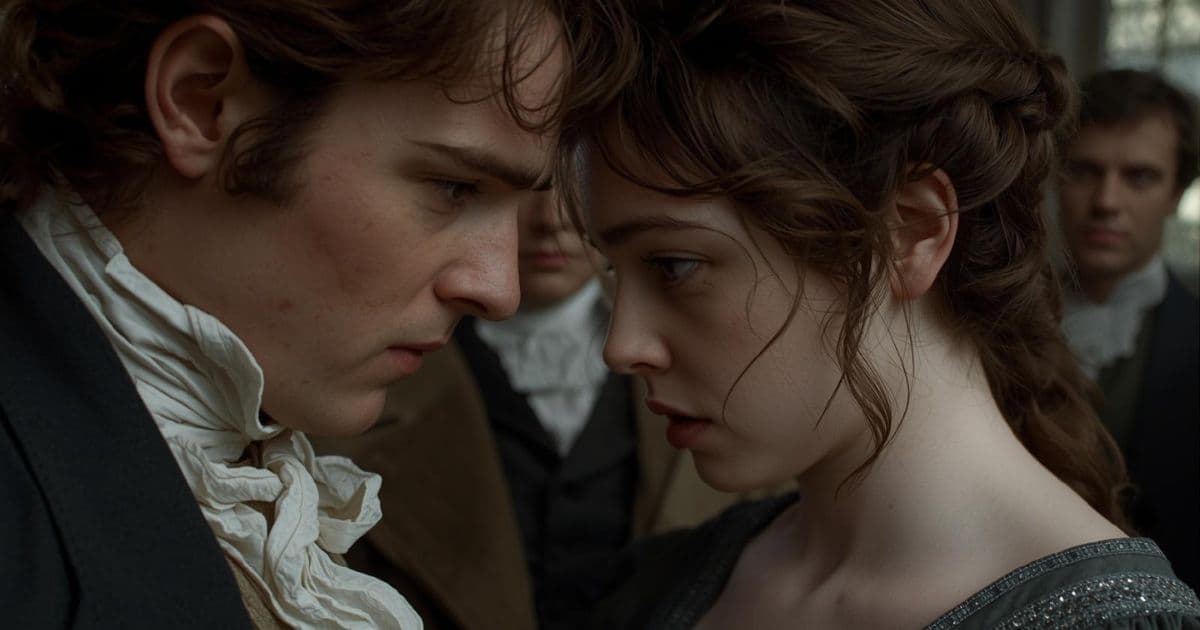
An excerpt from the original text.(complete · 5383 words)
IV.
Elinor, starting back with a look of horror at the sight of him, obeyed
the first impulse of her heart in turning instantly to quit the room,
and her hand was already on the lock, when its action was suspended by
his hastily advancing, and saying, in a voice rather of command than
supplication,
“Miss Dashwood, for half an hour—for ten minutes—I entreat you to
stay.”
“No, sir,” she replied with firmness, “I shall not stay. Your
business cannot be with me. The servants, I suppose, forgot to tell
you that Mr. Palmer was not in the house.”
“Had they told me,” he cried with vehemence, “that Mr. Palmer and all
his relations were at the devil, it would not have turned me from the
door. My business is with you, and only you.”
“With me!”—in the utmost amazement—“well, sir,—be quick—and if you
can—less violent.”
“Sit down, and I will be both.”
She hesitated; she knew not what to do. The possibility of Colonel
Brandon’s arriving and finding her there, came across her. But she had
promised to hear him, and her curiosity no less than her honor was
engaged. After a moment’s recollection, therefore, concluding that
prudence required dispatch, and that her acquiescence would best
promote it, she walked silently towards the table, and sat down. He
took the opposite chair, and for half a minute not a word was said by
either.
“Pray be quick, sir,”—said Elinor, impatiently;—“I have no time to
spare.”
He was sitting in an attitude of deep meditation, and seemed not to
hear her.
“Your sister,” said he, with abruptness, a moment afterwards—“is out of
danger. I heard it from the servant. God be praised!—But is it true? is
it really true?”
Elinor would not speak. He repeated the inquiry with yet greater
eagerness.
“For God’s sake tell me, is she out of danger, or is she not?”
“We hope she is.”
He rose up, and walked across the room.
“Had I known as much half an hour ago;—but since I am here,” speaking
with a forced vivacity as he returned to his seat,—“what does it
signify? For once, Miss Dashwood—it will be the last time, perhaps—let
us be cheerful together. I am in a fine mood for gaiety. Tell me
honestly” a deeper glow overspreading his cheeks, “do you think me most
a knave or a fool?”
Elinor looked at him with greater astonishment than ever. She began to
think that he must be in liquor;—the strangeness of such a visit, and
of such manners, seemed no otherwise intelligible; and with this
impression she immediately rose, saying,
“Mr. Willoughby, I advise you at present to return to Combe. I am not
at leisure to remain with you longer. Whatever your business may be
with me, it will be better recollected and explained to-morrow.”
“I understand you,” he replied, with an expressive smile, and a voice
perfectly calm; “yes, I am very drunk. A pint of porter with my cold
beef at Marlborough was enough to over-set me.”
“At Marlborough!”—cried Elinor, more and more at a loss to understand
what he would be at.
“Yes,—I left London this morning at eight o’clock, and the only ten
minutes I have spent out of my chaise since that time procured me a
nuncheon at Marlborough.”
The steadiness of his manner, and the intelligence of his eye as he
spoke, convincing Elinor, that whatever other unpardonable folly might
bring him to Cleveland, he was not brought there by intoxication, she
said, after a moment’s recollection,
“Mr. Willoughby, you ought to feel, and I certainly do, that after
what has passed, your coming here in this manner, and forcing yourself
upon my notice, requires a very particular excuse. What is it, that you
mean by it?”
“I mean,” said he, with serious energy, “if I can, to make you hate me
one degree less than you do now. I mean to offer some kind of
explanation, some kind of apology, for the past; to open my whole heart
to you, and by convincing you, that though I have been always a
blockhead, I have not been always a rascal, to obtain something like
forgiveness from Ma— from your sister.”
“Is this the real reason of your coming?”
“Upon my soul it is,”—was his answer, with a warmth which brought all
the former Willoughby to her remembrance, and in spite of herself made
her think him sincere.
“If that is all, you may be satisfied already; for Marianne does, she
has long forgiven you.”
“Has she?” he cried, in the same eager tone. “Then she has forgiven me
before she ought to have done it. But she shall forgive me again, and
on more reasonable grounds. Now will you listen to me?”
Elinor bowed her assent.
“I do not know,” said he, after a pause of expectation on her side, and
thoughtfulness on his own, “how you may have accounted for my
behaviour to your sister, or what diabolical motive you may have
imputed to me. Perhaps you will hardly think the better of me,—it is
worth the trial however, and you shall hear every thing. When I first
became intimate in your family, I had no other intention, no other view
in the acquaintance than to pass my time pleasantly while I was obliged
to remain in Devonshire, more pleasantly than I had ever done before.
Your sister’s lovely person and interesting manners could not but
please me; and her behaviour to me almost from the first, was of a
kind—it is astonishing, when I reflect on what it was, and what she
was, that my heart should have been so insensible! But at first I must
confess, my vanity only was elevated by it. Careless of her happiness,
thinking only of my own amusement, giving way to feelings which I had
always been too much in the habit of indulging, I endeavoured, by every
means in my power, to make myself pleasing to her, without any design
of returning her affection.”
Miss Dashwood, at this point, turning her eyes on him with the most
angry contempt, stopped him, by saying,
“It is hardly worth while, Mr. Willoughby, for you to relate, or for me
to listen any longer. Such a beginning as this cannot be followed by
any thing. Do not let me be pained by hearing any thing more on the
subject.”
“I insist on you hearing the whole of it,” he replied, “My fortune was
never large, and I had always been expensive, always in the habit of
associating with people of better income than myself. Every year since
my coming of age, or even before, I believe, had added to my debts; and
though the death of my old cousin, Mrs. Smith, was to set me free; yet
that event being uncertain, and possibly far distant, it had been for
some time my intention to re-establish my circumstances by marrying a
woman of fortune. To attach myself to your sister, therefore, was not a
thing to be thought of; and with a meanness, selfishness, cruelty,
which no indignant, no contemptuous look, even of yours, Miss Dashwood,
can ever reprobate too much,—I was acting in this manner, trying to
engage her regard, without a thought of returning it. But one thing may
be said for me: even in that horrid state of selfish vanity, I did not
know the extent of the injury I meditated, because I did not then
know what it was to love. But have I ever known it? Well may it be
doubted; for, had I really loved, could I have sacrificed my feelings
to vanity, to avarice? or, what is more, could I have sacrificed hers?
But I have done it. To avoid a comparative poverty, which her affection
and her society would have deprived of all its horrors, I have, by
raising myself to affluence, lost every thing that could make it a
blessing.”
“You did then,” said Elinor, a little softened, “believe yourself at
one time attached to her?”
“To have resisted such attractions, to have withstood such tenderness!
Is there a man on earth who could have done it? Yes, I found myself, by
insensible degrees, sincerely fond of her; and the happiest hours of my
life were what I spent with her when I felt my intentions were strictly
honourable, and my feelings blameless. Even then, however, when fully
determined on paying my addresses to her, I allowed myself most
improperly to put off, from day to day, the moment of doing it, from an
unwillingness to enter into an engagement while my circumstances were
so greatly embarrassed. I will not reason here—nor will I stop for
you to expatiate on the absurdity, and the worse than absurdity, of
scrupling to engage my faith where my honour was already bound. The
event has proved, that I was a cunning fool, providing with great
circumspection for a possible opportunity of making myself contemptible
and wretched for ever. At last, however, my resolution was taken, and I
had determined, as soon as I could engage her alone, to justify the
attentions I had so invariably paid her, and openly assure her of an
affection which I had already taken such pains to display. But in the
interim—in the interim of the very few hours that were to pass, before
I could have an opportunity of speaking with her in private—a
circumstance occurred—an unlucky circumstance, to ruin all my
resolution, and with it all my comfort. A discovery took place,”—here
he hesitated and looked down. “Mrs. Smith had somehow or other been
informed, I imagine by some distant relation, whose interest it was to
deprive me of her favour, of an affair, a connection—but I need not
explain myself farther,” he added, looking at her with an heightened
colour and an enquiring eye,—“your particular intimacy—you have
probably heard the whole story long ago.”
“I have,” returned Elinor, colouring likewise, and hardening her heart
anew against any compassion for him, “I have heard it all. And how you
will explain away any part of your guilt in that dreadful business, I
confess is beyond my comprehension.”
“Remember,” cried Willoughby, “from whom you received the account.
Could it be an impartial one? I acknowledge that her situation and her
character ought to have been respected by me. I do not mean to justify
myself, but at the same time cannot leave you to suppose that I have
nothing to urge—that because she was injured she was irreproachable,
and because I was a libertine, she must be a saint. If the violence
of her passions, the weakness of her understanding—I do not mean,
however, to defend myself. Her affection for me deserved better
treatment, and I often, with great self-reproach, recall the tenderness
which, for a very short time, had the power of creating any return. I
wish—I heartily wish it had never been. But I have injured more than
herself; and I have injured one, whose affection for me (may I say it?)
was scarcely less warm than hers; and whose mind—Oh! how infinitely
superior!”
“Your indifference, however, towards that unfortunate girl—I must say
it, unpleasant to me as the discussion of such a subject may well
be—your indifference is no apology for your cruel neglect of her. Do
not think yourself excused by any weakness, any natural defect of
understanding on her side, in the wanton cruelty so evident on yours.
You must have known, that while you were enjoying yourself in
Devonshire pursuing fresh schemes, always gay, always happy, she was
reduced to the extremest indigence.”
“But, upon my soul, I did not know it,” he warmly replied; “I did not
recollect that I had omitted to give her my direction; and common sense
might have told her how to find it out.”
“Well, sir, and what said Mrs. Smith?”
“She taxed me with the offence at once, and my confusion may be
guessed. The purity of her life, the formality of her notions, her
ignorance of the world—every thing was against me. The matter itself I
could not deny, and vain was every endeavour to soften it. She was
previously disposed, I believe, to doubt the morality of my conduct in
general, and was moreover discontented with the very little attention,
the very little portion of my time that I had bestowed on her, in my
present visit. In short, it ended in a total breach. By one measure I
might have saved myself. In the height of her morality, good woman! she
offered to forgive the past, if I would marry Eliza. That could not
be—and I was formally dismissed from her favour and her house. The
night following this affair—I was to go the next morning—was spent by
me in deliberating on what my future conduct should be. The struggle
was great—but it ended too soon. My affection for Marianne, my thorough
conviction of her attachment to me—it was all insufficient to outweigh
that dread of poverty, or get the better of those false ideas of the
necessity of riches, which I was naturally inclined to feel, and
expensive society had increased. I had reason to believe myself secure
of my present wife, if I chose to address her, and I persuaded myself
to think that nothing else in common prudence remained for me to do. A
heavy scene however awaited me, before I could leave Devonshire;—I was
engaged to dine with you on that very day; some apology was therefore
necessary for my breaking this engagement. But whether I should write
this apology, or deliver it in person, was a point of long debate. To
see Marianne, I felt, would be dreadful, and I even doubted whether I
could see her again, and keep to my resolution. In that point, however,
I undervalued my own magnanimity, as the event declared; for I went, I
saw her, and saw her miserable, and left her miserable—and left her
hoping never to see her again.”
“Why did you call, Mr. Willoughby?” said Elinor, reproachfully; “a note
would have answered every purpose. Why was it necessary to call?”
“It was necessary to my own pride. I could not bear to leave the
country in a manner that might lead you, or the rest of the
neighbourhood, to suspect any part of what had really passed between
Mrs. Smith and myself—and I resolved therefore on calling at the
cottage, in my way to Honiton. The sight of your dear sister, however,
was really dreadful; and, to heighten the matter, I found her alone.
You were all gone I do not know where. I had left her only the evening
before, so fully, so firmly resolved within my self on doing right! A
few hours were to have engaged her to me for ever; and I remember how
happy, how gay were my spirits, as I walked from the cottage to
Allenham, satisfied with myself, delighted with every body! But in
this, our last interview of friendship, I approached her with a sense
of guilt that almost took from me the power of dissembling. Her sorrow,
her disappointment, her deep regret, when I told her that I was obliged
to leave Devonshire so immediately—I never shall forget it—united too
with such reliance, such confidence in me!—Oh, God!—what a hard-hearted
rascal I was!”
They were both silent for a few moments. Elinor first spoke.
“Did you tell her that you should soon return?”
“I do not know what I told her,” he replied, impatiently; “less than
was due to the past, beyond a doubt, and in all likelihood much more
than was justified by the future. I cannot think of it.—It won’t
do.—Then came your dear mother to torture me farther, with all her
kindness and confidence. Thank Heaven! it did torture me. I was
miserable. Miss Dashwood, you cannot have an idea of the comfort it
gives me to look back on my own misery. I owe such a grudge to myself
for the stupid, rascally folly of my own heart, that all my past
sufferings under it are only triumph and exultation to me now. Well, I
went, left all that I loved, and went to those to whom, at best, I was
only indifferent. My journey to town—travelling with my own horses, and
therefore so tediously—no creature to speak to—my own reflections so
cheerful—when I looked forward every thing so inviting!—when I looked
back at Barton, the picture so soothing!—oh, it was a blessed journey!”
He stopped.
“Well, sir,” said Elinor, who, though pitying him, grew impatient for
his departure, “and this is all?”
“All!—no:—have you forgot what passed in town? That infamous letter?
Did she show it you?”
“Yes, I saw every note that passed.”
“When the first of hers reached me (as it immediately did, for I was in
town the whole time,) what I felt is—in the common phrase, not to be
expressed; in a more simple one—perhaps too simple to raise any
emotion—my feelings were very, very painful.—Every line, every word
was—in the hackneyed metaphor which their dear writer, were she here,
would forbid—a dagger to my heart. To know that Marianne was in town
was—in the same language—a thunderbolt.—Thunderbolts and daggers!—what
a reproof would she have given me!—her taste, her opinions—I believe
they are better known to me than my own,—and I am sure they are
dearer.”
Elinor’s heart, which had undergone many changes in the course of this
extraordinary conversation, was now softened again;—yet she felt it her
duty to check such ideas in her companion as the last.
“This is not right, Mr. Willoughby.—Remember that you are married.
Relate only what in your conscience you think necessary for me to
hear.”
“Marianne’s note, by assuring me that I was still as dear to her as in
former days,—that in spite of the many, many weeks we had been
separated, she was as constant in her own feelings, and as full of
faith in the constancy of mine as ever,—awakened all my remorse. I say
awakened, because time and London, business and dissipation, had in
some measure quieted it, and I had been growing a fine hardened
villain, fancying myself indifferent to her, and chusing to fancy that
she too must have become indifferent to me; talking to myself of our
past attachment as a mere idle, trifling business, shrugging up my
shoulders in proof of its being so, and silencing every reproach,
overcoming every scruple, by secretly saying now and then, ‘I shall be
heartily glad to hear she is well married.’ But this note made me know
myself better. I felt that she was infinitely dearer to me than any
other woman in the world, and that I was using her infamously. But
every thing was then just settled between Miss Grey and me. To retreat
was impossible. All that I had to do, was to avoid you both. I sent no
answer to Marianne, intending by that to preserve myself from her
farther notice; and for some time I was even determined not to call in
Berkeley Street;—but at last, judging it wiser to affect the air of a
cool, common acquaintance than anything else, I watched you all safely
out of the house one morning, and left my name.”
“Watched us out of the house!”
“Even so. You would be surprised to hear how often I watched you, how
often I was on the point of falling in with you. I have entered many a
shop to avoid your sight, as the carriage drove by. Lodging as I did in
Bond Street, there was hardly a day in which I did not catch a glimpse
of one or other of you; and nothing but the most constant watchfulness
on my side, a most invariably prevailing desire to keep out of your
sight, could have separated us so long. I avoided the Middletons as
much as possible, as well as everybody else who was likely to prove an
acquaintance in common. Not aware of their being in town, however, I
blundered on Sir John, I believe, the first day of his coming, and the
day after I had called at Mrs. Jennings’s. He asked me to a party, a
dance at his house in the evening. Had he not told me as an
inducement that you and your sister were to be there, I should have
felt it too certain a thing, to trust myself near him. The next morning
brought another short note from Marianne—still affectionate, open,
artless, confiding—everything that could make my conduct most
hateful. I could not answer it. I tried—but could not frame a sentence.
But I thought of her, I believe, every moment of the day. If you can
pity me, Miss Dashwood, pity my situation as it was then. With my
head and heart full of your sister, I was forced to play the happy
lover to another woman! Those three or four weeks were worse than all.
Well, at last, as I need not tell you, you were forced on me; and what
a sweet figure I cut! what an evening of agony it was! Marianne,
beautiful as an angel on one side, calling me Willoughby in such a
tone! Oh, God! holding out her hand to me, asking me for an
explanation, with those bewitching eyes fixed in such speaking
solicitude on my face! and Sophia, jealous as the devil on the other
hand, looking all that was—Well, it does not signify; it is over now.
Such an evening! I ran away from you all as soon as I could; but not
before I had seen Marianne’s sweet face as white as death. That was
the last, last look I ever had of her; the last manner in which she
appeared to me. It was a horrid sight! yet when I thought of her to-day
as really dying, it was a kind of comfort to me to imagine that I knew
exactly how she would appear to those, who saw her last in this world.
She was before me, constantly before me, as I travelled, in the same
look and hue.”
A short pause of mutual thoughtfulness succeeded. Willoughby first
rousing himself, broke it thus:
“Well, let me make haste and be gone. Your sister is certainly better,
certainly out of danger?”
“We are assured of it.”
“Your poor mother, too!—doting on Marianne.”
“But the letter, Mr. Willoughby, your own letter; have you any thing to
say about that?”
“Yes, yes, that in particular. Your sister wrote to me again, you
know, the very next morning. You saw what she said. I was breakfasting
at the Ellisons,—and her letter, with some others, was brought to me
there from my lodgings. It happened to catch Sophia’s eye before it
caught mine—and its size, the elegance of the paper, the hand-writing
altogether, immediately gave her a suspicion. Some vague report had
reached her before of my attachment to some young lady in Devonshire,
and what had passed within her observation the preceding evening had
marked who the young lady was, and made her more jealous than ever.
Affecting that air of playfulness, therefore, which is delightful in a
woman one loves, she opened the letter directly, and read its contents.
She was well paid for her impudence. She read what made her wretched.
Her wretchedness I could have borne, but her passion—her malice—At all
events it must be appeased. And, in short—what do you think of my
wife’s style of letter-writing?—delicate—tender—truly feminine—was it
not?”
“Your wife!—The letter was in your own hand-writing.”
“Yes, but I had only the credit of servilely copying such sentences as
I was ashamed to put my name to. The original was all her own—her own
happy thoughts and gentle diction. But what could I do!—we were
engaged, every thing in preparation, the day almost fixed—But I am
talking like a fool. Preparation! Day! In honest words, her money was
necessary to me, and in a situation like mine, any thing was to be done
to prevent a rupture. And after all, what did it signify to my
character in the opinion of Marianne and her friends, in what language
my answer was couched? It must have been only to one end. My business
was to declare myself a scoundrel, and whether I did it with a bow or a
bluster was of little importance. ‘I am ruined for ever in their
opinion,’ said I to myself: ‘I am shut out for ever from their society,
they already think me an unprincipled fellow, this letter will only
make them think me a blackguard one.’ Such were my reasonings, as, in a
sort of desperate carelessness, I copied my wife’s words, and parted
with the last relics of Marianne. Her three notes,—unluckily they were
all in my pocketbook, or I should have denied their existence, and
hoarded them for ever,—I was forced to put them up, and could not even
kiss them. And the lock of hair—that too I had always carried about me
in the same pocket-book, which was now searched by Madam with the most
ingratiating virulence,—the dear lock,—all, every memento was torn from
me.”
“You are very wrong, Mr. Willoughby, very blamable,” said Elinor, while
her voice, in spite of herself, betrayed her compassionate emotion;
“you ought not to speak in this way, either of Mrs. Willoughby or my
sister. You had made your own choice. It was not forced on you. Your
wife has a claim to your politeness, to your respect, at least. She
must be attached to you, or she would not have married you. To treat
her with unkindness, to speak of her slightingly is no atonement to
Marianne—nor can I suppose it a relief to your own conscience.”
“Do not talk to me of my wife,” said he with a heavy sigh; “she does
not deserve your compassion. She knew I had no regard for her when we
married. Well, married we were, and came down to Combe Magna to be
happy, and afterwards returned to town to be gay. And now do you pity
me, Miss Dashwood? Or have I said all this to no purpose? Am I,—be it
only one degree,—am I less guilty in your opinion than I was before? My
intentions were not always wrong. Have I explained away any part of my
guilt?”
“Yes, you have certainly removed something—a little. You have proved
yourself, on the whole, less faulty than I had believed you. You have
proved your heart less wicked, much less wicked. But I hardly know—the
misery that you have inflicted—I hardly know what could have made it
worse.”
“Will you repeat to your sister when she is recovered, what I have been
telling you?—Let me be a little lightened too in her opinion as well as
in yours. You tell me that she has forgiven me already. Let me be able
to fancy that a better knowledge of my heart, and of my present
feelings, will draw from her a more spontaneous, more natural, more
gentle, less dignified, forgiveness. Tell her of my misery and my
penitence—tell her that my heart was never inconstant to her, and if
you will, that at this moment she is dearer to me than ever.”
“I will tell her all that is necessary to what may comparatively be
called, your justification. But you have not explained to me the
particular reason of your coming now, nor how you heard of her
illness.”
“Last night, in Drury Lane lobby, I ran against Sir John Middleton, and
when he saw who I was, for the first time these two months, he spoke to
me. That he had cut me ever since my marriage, I had seen without
surprise or resentment. Now, however, his good-natured, honest, stupid
soul, full of indignation against me, and concern for your sister,
could not resist the temptation of telling me what he knew ought to,
though probably he did not think it would, vex me horridly. As
bluntly as he could speak it, therefore, he told me that Marianne
Dashwood was dying of a putrid fever at Cleveland—a letter that morning
received from Mrs. Jennings declared her danger most imminent—the
Palmers are all gone off in a fright, &c. I was too much shocked to be
able to pass myself off as insensible even to the undiscerning Sir
John. His heart was softened in seeing mine suffer; and so much of his
ill-will was done away, that when we parted, he almost shook me by the
hand while he reminded me of an old promise about a pointer puppy. What
I felt on hearing that your sister was dying, and dying too, believing
me the greatest villain upon earth, scorning, hating me in her latest
moments—for how could I tell what horrid projects might not have been
imputed? One person I was sure would represent me as capable of
anything—What I felt was dreadful! My resolution was soon made, and at
eight o’clock this morning I was in my carriage. Now you know all.”
Elinor made no answer. Her thoughts were silently fixed on the
irreparable injury which too early an independence and its consequent
habits of idleness, dissipation, and luxury, had made in the mind, the
character, the happiness, of a man who, to every advantage of person
and talents, united a disposition naturally open and honest, and a
feeling, affectionate temper. The world had made him extravagant and
vain—Extravagance and vanity had made him cold-hearted and selfish.
Vanity, while seeking its own guilty triumph at the expense of another,
had involved him in a real attachment, which extravagance, or at least
its offspring, necessity, had required to be sacrificed. Each faulty
propensity in leading him to evil, had led him likewise to punishment.
The attachment, from which against honour, against feeling, against
every better interest he had outwardly torn himself, now, when no
longer allowable, governed every thought; and the connection, for the
sake of which he had, with little scruple, left her sister to misery,
was likely to prove a source of unhappiness to himself of a far more
incurable nature. From a reverie of this kind she was recalled at the
end of some minutes by Willoughby, who, rousing himself from a reverie
at least equally painful, started up in preparation for going, and
said—
“There is no use in staying here; I must be off.”
“Are you going back to town?”
“No—to Combe Magna. I have business there; from thence to town in a day
or two. Good bye.”
He held out his hand. She could not refuse to give him hers;—he pressed
it with affection.
“And you do think something better of me than you did?” said he,
letting it fall, and leaning against the mantel-piece as if forgetting
he was to go.
Elinor assured him that she did;—that she forgave, pitied, wished him
well—was even interested in his happiness—and added some gentle counsel
as to the behaviour most likely to promote it. His answer was not very
encouraging.
“As to that,” said he, “I must rub through the world as well as I can.
Domestic happiness is out of the question. If, however, I am allowed to
think that you and yours feel an interest in my fate and actions, it
may be the means—it may put me on my guard—at least, it may be
something to live for. Marianne to be sure is lost to me for ever. Were
I even by any blessed chance at liberty again—”
Elinor stopped him with a reproof.
“Well,”—he replied—“once more good bye. I shall now go away and live in
dread of one event.”
“What do you mean?”
“Your sister’s marriage.”
“You are very wrong. She can never be more lost to you than she is
now.”
“But she will be gained by some one else. And if that some one should
be the very he whom, of all others, I could least bear—but I will not
stay to rob myself of all your compassionate goodwill, by showing that
where I have most injured I can least forgive. Good bye,—God bless
you!”
And with these words, he almost ran out of the room.
Master this chapter. Complete your experience
Purchase the complete book to access all chapters and support classic literature
As an Amazon Associate, we earn a small commission from qualifying purchases at no additional cost to you.
Available in paperback, hardcover, and e-book formats
Let's Analyse the Pattern
Maintaining integrity and patience during difficult circumstances often leads to better outcomes than forcing or manipulating situations.
Why This Matters
Connect literature to life
This chapter teaches how to identify when someone uses guilt or obligation to control relationships rather than genuine care.
Practice This Today
Next time someone makes you feel guilty for having boundaries or pursuing your own happiness, ask yourself: are they concerned about your wellbeing, or protecting their own interests?
Now let's explore the literary elements.
Key Quotes & Analysis
"Her heart was now at ease, her mind at peace."
Context: When Elinor learns that Lucy has married Robert instead of Edward
This simple sentence captures the enormous relief Elinor feels after months of emotional torture. The parallel structure emphasizes how completely her suffering has ended.
In Today's Words:
She could finally breathe again - the weight was completely off her shoulders.
"I never was so astonished in my life."
Context: Elinor's reaction to learning about Lucy's elopement with Robert
This rare display of strong emotion from the usually composed Elinor shows how completely unexpected this news is. It's one of the few times we see her guard drop completely.
In Today's Words:
I literally cannot believe this just happened.
"I have been acting with a falsehood, and you must hate me."
Context: Edward's humble apology to Elinor when he visits after being freed from his engagement
Edward's guilt and self-deprecation show his genuine character. He takes full responsibility for the pain his secret engagement caused, even though he was trapped by youthful foolishness.
In Today's Words:
I know I messed up big time and you probably can't stand me now.
Thematic Threads
Emotional Restraint
In This Chapter
Elinor finally allows herself to feel joy and hope after months of suppressing her emotions for duty's sake
Development
Culmination of Elinor's journey from the beginning—her restraint is finally rewarded
In Your Life:
You might recognize this when you've been holding back your true feelings to avoid complicating a situation
Social Mobility
In This Chapter
Lucy abandons Edward for Robert because Robert has the money and status she actually wanted
Development
Reveals Lucy's true motivations that were hinted at throughout the novel
In Your Life:
You see this when someone drops their current relationship for a 'better' opportunity that offers more security or status
Moral Integrity
In This Chapter
Elinor's consistent moral behavior throughout her trials is finally rewarded with freedom to pursue happiness
Development
Validates the moral framework Elinor has maintained since Chapter 1
In Your Life:
You experience this when doing the right thing consistently, even when it's hard, eventually leads to better outcomes
Hidden Information
In This Chapter
The truth about Lucy's elopement comes through servant gossip, showing how secrets eventually surface
Development
Continues the theme of secrets and their consequences that has run throughout the book
In Your Life:
You encounter this when workplace or family secrets finally come to light through unexpected channels
Class Expectations
In This Chapter
Edward, now poor but free, can finally pursue love over financial obligation
Development
Completes Edward's arc from being trapped by class expectations to choosing personal happiness
In Your Life:
You face this when you have to choose between what your family or society expects and what actually makes you happy
You now have the context. Time to form your own thoughts.
Discussion Questions
- 1
What shocking news does Elinor receive about Lucy Steele, and how does it change everything for Edward?
analysis • surface - 2
Why do you think Lucy chose to marry Robert Ferrars instead of staying with Edward, and what does this reveal about her true motivations?
analysis • medium - 3
Where have you seen the 'patient endurance' pattern play out in your own workplace or family - someone who waited and stayed true to their values while others schemed or manipulated?
application • medium - 4
If you were in Elinor's position - having feelings for someone who seemed unavailable - how would you handle the waiting period without compromising your self-respect?
application • deep - 5
What does Lucy's last-minute switch from Edward to Robert teach us about people who view relationships as transactions rather than genuine connections?
reflection • deep
Critical Thinking Exercise
Map Your Patience Strategy
Think of a current situation where you're waiting for something to change - a job opportunity, a relationship situation, or a family conflict. Map out what you can control versus what you can't control in this situation. Then identify three specific actions you can take that maintain your integrity while you wait, just like Elinor did.
Consider:
- •Focus on your own behavior and responses rather than trying to change others
- •Consider how maintaining your values now might position you better when circumstances shift
- •Think about what 'patient endurance' looks like practically in your specific situation
Journaling Prompt
Write about a time when your patience and integrity were tested by a difficult waiting period. What did you learn about yourself, and how did the situation eventually resolve?
Coming Up Next...
Chapter 45: Robert and Lucy
With Edward finally free and standing in her parlor, Elinor must navigate the delicate conversation that will determine both their futures. Meanwhile, the family reacts to this stunning reversal of fortune with characteristic differences in perspective.