An excerpt from the original text.(complete · 3146 words)
rs. Jennings was very warm in her praise of Edward’s conduct, but only
Elinor and Marianne understood its true merit. They only knew how
little he had had to tempt him to be disobedient, and how small was the
consolation, beyond the consciousness of doing right, that could remain
to him in the loss of friends and fortune. Elinor gloried in his
integrity; and Marianne forgave all his offences in compassion for his
punishment. But though confidence between them was, by this public
discovery, restored to its proper state, it was not a subject on which
either of them were fond of dwelling when alone. Elinor avoided it upon
principle, as tending to fix still more upon her thoughts, by the too
warm, too positive assurances of Marianne, that belief of Edward’s
continued affection for herself which she rather wished to do away; and
Marianne’s courage soon failed her, in trying to converse upon a topic
which always left her more dissatisfied with herself than ever, by the
comparison it necessarily produced between Elinor’s conduct and her
own.
She felt all the force of that comparison; but not as her sister had
hoped, to urge her to exertion now; she felt it with all the pain of
continual self-reproach, regretted most bitterly that she had never
exerted herself before; but it brought only the torture of penitence,
without the hope of amendment. Her mind was so much weakened that she
still fancied present exertion impossible, and therefore it only
dispirited her more.
Nothing new was heard by them, for a day or two afterwards, of affairs
in Harley Street, or Bartlett’s Buildings. But though so much of the
matter was known to them already, that Mrs. Jennings might have had
enough to do in spreading that knowledge farther, without seeking after
more, she had resolved from the first to pay a visit of comfort and
inquiry to her cousins as soon as she could; and nothing but the
hindrance of more visitors than usual, had prevented her going to them
within that time.
The third day succeeding their knowledge of the particulars, was so
fine, so beautiful a Sunday as to draw many to Kensington Gardens,
though it was only the second week in March. Mrs. Jennings and Elinor
were of the number; but Marianne, who knew that the Willoughbys were
again in town, and had a constant dread of meeting them, chose rather
to stay at home, than venture into so public a place.
An intimate acquaintance of Mrs. Jennings joined them soon after they
entered the Gardens, and Elinor was not sorry that by her continuing
with them, and engaging all Mrs. Jennings’s conversation, she was
herself left to quiet reflection. She saw nothing of the Willoughbys,
nothing of Edward, and for some time nothing of anybody who could by
any chance whether grave or gay, be interesting to her. But at last she
found herself with some surprise, accosted by Miss Steele, who, though
looking rather shy, expressed great satisfaction in meeting them, and
on receiving encouragement from the particular kindness of Mrs.
Jennings, left her own party for a short time, to join their’s. Mrs.
Jennings immediately whispered to Elinor,
“Get it all out of her, my dear. She will tell you any thing if you
ask. You see I cannot leave Mrs. Clarke.”
It was lucky, however, for Mrs. Jennings’s curiosity and Elinor’s too,
that she would tell any thing without being asked; for nothing would
otherwise have been learnt.
“I am so glad to meet you;” said Miss Steele, taking her familiarly by
the arm—“for I wanted to see you of all things in the world.” And then
lowering her voice, “I suppose Mrs. Jennings has heard all about it. Is
she angry?”
“Not at all, I believe, with you.”
“That is a good thing. And Lady Middleton, is she angry?”
“I cannot suppose it possible that she should be.”
“I am monstrous glad of it. Good gracious! I have had such a time of
it! I never saw Lucy in such a rage in my life. She vowed at first she
would never trim me up a new bonnet, nor do any thing else for me
again, so long as she lived; but now she is quite come to, and we are
as good friends as ever. Look, she made me this bow to my hat, and put
in the feather last night. There now, you are going to laugh at me
too. But why should not I wear pink ribbons? I do not care if it is
the Doctor’s favourite colour. I am sure, for my part, I should never
have known he did like it better than any other colour, if he had not
happened to say so. My cousins have been so plaguing me! I declare
sometimes I do not know which way to look before them.”
She had wandered away to a subject on which Elinor had nothing to say,
and therefore soon judged it expedient to find her way back again to
the first.
“Well, but Miss Dashwood,” speaking triumphantly, “people may say what
they chuse about Mr. Ferrars’s declaring he would not have Lucy, for it
is no such thing I can tell you; and it is quite a shame for such
ill-natured reports to be spread abroad. Whatever Lucy might think
about it herself, you know, it was no business of other people to set
it down for certain.”
“I never heard any thing of the kind hinted at before, I assure you,”
said Elinor.
“Oh, did not you? But it was said, I know, very well, and by more
than one; for Miss Godby told Miss Sparks, that nobody in their senses
could expect Mr. Ferrars to give up a woman like Miss Morton, with
thirty thousand pounds to her fortune, for Lucy Steele that had nothing
at all; and I had it from Miss Sparks myself. And besides that, my
cousin Richard said himself, that when it came to the point he was
afraid Mr. Ferrars would be off; and when Edward did not come near us
for three days, I could not tell what to think myself; and I believe in
my heart Lucy gave it up all for lost; for we came away from your
brother’s Wednesday, and we saw nothing of him not all Thursday,
Friday, and Saturday, and did not know what was become of him. Once
Lucy thought to write to him, but then her spirits rose against that.
However this morning he came just as we came home from church; and then
it all came out, how he had been sent for Wednesday to Harley Street,
and been talked to by his mother and all of them, and how he had
declared before them all that he loved nobody but Lucy, and nobody but
Lucy would he have. And how he had been so worried by what passed, that
as soon as he had went away from his mother’s house, he had got upon
his horse, and rid into the country, some where or other; and how he
had stayed about at an inn all Thursday and Friday, on purpose to get
the better of it. And after thinking it all over and over again, he
said, it seemed to him as if, now he had no fortune, and no nothing at
all, it would be quite unkind to keep her on to the engagement, because
it must be for her loss, for he had nothing but two thousand pounds,
and no hope of any thing else; and if he was to go into orders, as he
had some thoughts, he could get nothing but a curacy, and how was they
to live upon that?—He could not bear to think of her doing no better,
and so he begged, if she had the least mind for it, to put an end to
the matter directly, and leave him shift for himself. I heard him say
all this as plain as could possibly be. And it was entirely for her
sake, and upon her account, that he said a word about being off, and
not upon his own. I will take my oath he never dropt a syllable of
being tired of her, or of wishing to marry Miss Morton, or any thing
like it. But, to be sure, Lucy would not give ear to such kind of
talking; so she told him directly (with a great deal about sweet and
love, you know, and all that—Oh, la! one can’t repeat such kind of
things you know)—she told him directly, she had not the least mind in
the world to be off, for she could live with him upon a trifle, and how
little so ever he might have, she should be very glad to have it all,
you know, or something of the kind. So then he was monstrous happy, and
talked on some time about what they should do, and they agreed he
should take orders directly, and they must wait to be married till he
got a living. And just then I could not hear any more, for my cousin
called from below to tell me Mrs. Richardson was come in her coach, and
would take one of us to Kensington Gardens; so I was forced to go into
the room and interrupt them, to ask Lucy if she would like to go, but
she did not care to leave Edward; so I just run up stairs and put on a
pair of silk stockings and came off with the Richardsons.”
“I do not understand what you mean by interrupting them,” said Elinor;
“you were all in the same room together, were not you?”
“No, indeed, not us. La! Miss Dashwood, do you think people make love
when any body else is by? Oh, for shame!—To be sure you must know
better than that. (Laughing affectedly.)—No, no; they were shut up in
the drawing-room together, and all I heard was only by listening at the
door.”
“How!” cried Elinor; “have you been repeating to me what you only
learnt yourself by listening at the door? I am sorry I did not know it
before; for I certainly would not have suffered you to give me
particulars of a conversation which you ought not to have known
yourself. How could you behave so unfairly by your sister?”
“Oh, la! there is nothing in that. I only stood at the door, and
heard what I could. And I am sure Lucy would have done just the same by
me; for a year or two back, when Martha Sharpe and I had so many
secrets together, she never made any bones of hiding in a closet, or
behind a chimney-board, on purpose to hear what we said.”
Elinor tried to talk of something else; but Miss Steele could not be
kept beyond a couple of minutes, from what was uppermost in her mind.
“Edward talks of going to Oxford soon,” said she; “but now he is
lodging at No.—, Pall Mall. What an ill-natured woman his mother is,
an’t she? And your brother and sister were not very kind! However, I
shan’t say anything against them to you; and to be sure they did send
us home in their own chariot, which was more than I looked for. And for
my part, I was all in a fright for fear your sister should ask us for
the huswifes she had gave us a day or two before; but, however, nothing
was said about them, and I took care to keep mine out of sight. Edward
have got some business at Oxford, he says; so he must go there for a
time; and after that, as soon as he can light upon a Bishop, he will
be ordained. I wonder what curacy he will get! Good gracious! (giggling
as she spoke) I’d lay my life I know what my cousins will say, when
they hear of it. They will tell me I should write to the Doctor, to get
Edward the curacy of his new living. I know they will; but I am sure I
would not do such a thing for all the world. ‘La!’ I shall say
directly, ‘I wonder how you could think of such a thing? I write to
the Doctor, indeed!’”
“Well,” said Elinor, “it is a comfort to be prepared against the worst.
You have got your answer ready.”
Miss Steele was going to reply on the same subject, but the approach of
her own party made another more necessary.
“Oh, la! here come the Richardsons. I had a vast deal more to say to
you, but I must not stay away from them not any longer. I assure you
they are very genteel people. He makes a monstrous deal of money, and
they keep their own coach. I have not time to speak to Mrs. Jennings
about it myself, but pray tell her I am quite happy to hear she is not
in anger against us, and Lady Middleton the same; and if anything
should happen to take you and your sister away, and Mrs. Jennings
should want company, I am sure we should be very glad to come and stay
with her for as long a time as she likes. I suppose Lady Middleton
won’t ask us any more this bout. Good-by; I am sorry Miss Marianne was
not here. Remember me kindly to her. La! if you have not got your
spotted muslin on!—I wonder you was not afraid of its being torn.”
Such was her parting concern; for after this, she had time only to pay
her farewell compliments to Mrs. Jennings, before her company was
claimed by Mrs. Richardson; and Elinor was left in possession of
knowledge which might feed her powers of reflection some time, though
she had learnt very little more than what had been already foreseen and
foreplanned in her own mind. Edward’s marriage with Lucy was as firmly
determined on, and the time of its taking place remained as absolutely
uncertain, as she had concluded it would be;—every thing depended,
exactly after her expectation, on his getting that preferment, of
which, at present, there seemed not the smallest chance.
As soon as they returned to the carriage, Mrs. Jennings was eager for
information; but as Elinor wished to spread as little as possible
intelligence that had in the first place been so unfairly obtained, she
confined herself to the brief repetition of such simple particulars, as
she felt assured that Lucy, for the sake of her own consequence, would
choose to have known. The continuance of their engagement, and the
means that were able to be taken for promoting its end, was all her
communication; and this produced from Mrs. Jennings the following
natural remark.
“Wait for his having a living!—ay, we all know how that will
end:—they will wait a twelvemonth, and finding no good comes of it,
will set down upon a curacy of fifty pounds a-year, with the interest
of his two thousand pounds, and what little matter Mr. Steele and Mr.
Pratt can give her. Then they will have a child every year! and Lord
help ’em! how poor they will be! I must see what I can give them
towards furnishing their house. Two maids and two men, indeed! as I
talked of t’ other day. No, no, they must get a stout girl of all
works. Betty’s sister would never do for them now.”
The next morning brought Elinor a letter by the two-penny post from
Lucy herself. It was as follows:
“Bartlett’s Building, March.
“I hope my dear Miss Dashwood will excuse the liberty I take of writing
to her; but I know your friendship for me will make you pleased to hear
such a good account of myself and my dear Edward, after all the
troubles we have went through lately, therefore will make no more
apologies, but proceed to say that, thank God! though we have suffered
dreadfully, we are both quite well now, and as happy as we must always
be in one another’s love. We have had great trials, and great
persecutions, but however, at the same time, gratefully acknowledge
many friends, yourself not the least among them, whose great kindness I
shall always thankfully remember, as will Edward too, who I have told
of it. I am sure you will be glad to hear, as likewise dear Mrs.
Jennings, I spent two happy hours with him yesterday afternoon, he
would not hear of our parting, though earnestly did I, as I thought my
duty required, urge him to it for prudence sake, and would have parted
for ever on the spot, would he consent to it; but he said it should
never be, he did not regard his mother’s anger, while he could have my
affections; our prospects are not very bright, to be sure, but we must
wait, and hope for the best; he will be ordained shortly; and should it
ever be in your power to recommend him to any body that has a living to
bestow, am very sure you will not forget us, and dear Mrs. Jennings
too, trust she will speak a good word for us to Sir John, or Mr.
Palmer, or any friend that may be able to assist us.—Poor Anne was much
to blame for what she did, but she did it for the best, so I say
nothing; hope Mrs. Jennings won’t think it too much trouble to give us
a call, should she come this way any morning, ’twould be a great
kindness, and my cousins would be proud to know her.—My paper reminds
me to conclude; and begging to be most gratefully and respectfully
remembered to her, and to Sir John, and Lady Middleton, and the dear
children, when you chance to see them, and love to Miss Marianne,
“I am, &c.”
As soon as Elinor had finished it, she performed what she concluded to
be its writer’s real design, by placing it in the hands of Mrs.
Jennings, who read it aloud with many comments of satisfaction and
praise.
“Very well indeed!—how prettily she writes!—aye, that was quite proper
to let him be off if he would. That was just like Lucy. Poor soul! I
wish I could get him a living, with all my heart. She calls me dear
Mrs. Jennings, you see. She is a good-hearted girl as ever lived. Very
well upon my word. That sentence is very prettily turned. Yes, yes, I
will go and see her, sure enough. How attentive she is, to think of
every body!—Thank you, my dear, for showing it me. It is as pretty a
letter as ever I saw, and does Lucy’s head and heart great credit.”
Master this chapter. Complete your experience
Purchase the complete book to access all chapters and support classic literature
As an Amazon Associate, we earn a small commission from qualifying purchases at no additional cost to you.
Available in paperback, hardcover, and e-book formats
Let's Analyse the Pattern
When social expectations require us to perform normalcy while experiencing deep pain, the performance itself intensifies the suffering.
Why This Matters
Connect literature to life
This chapter teaches how to recognize when surface conversations are loaded with unspoken pain and tension.
Practice This Today
This week, notice when someone's words say one thing but their body language and energy say something completely different—practice reading the real story underneath polite conversation.
Now let's explore the literary elements.
Key Quotes & Analysis
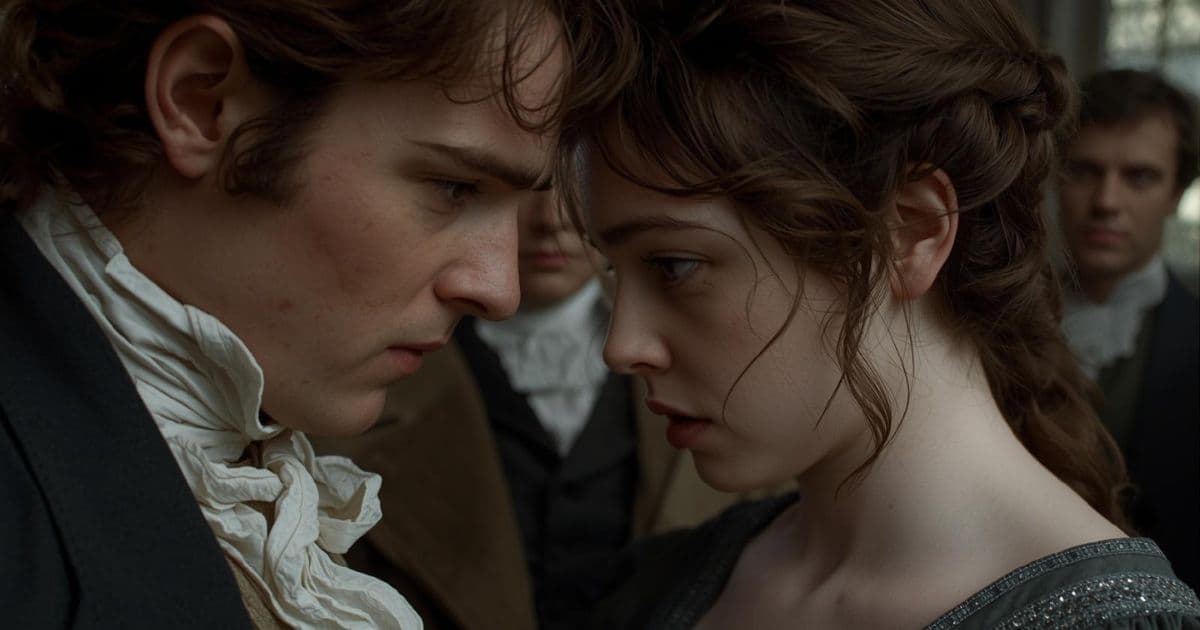
"His complexion became pale, his manner constrained; his sense of her regard, tortured into an avowal of indifference."
Context: Describing Edward's appearance and behavior during the uncomfortable visit
This shows how emotional pain manifests physically. Edward looks terrible because he's trapped between his feelings for Elinor and his obligation to Lucy. The word 'tortured' reveals how much this situation is costing him.
In Today's Words:
He looked awful and acted weird because he had to pretend he didn't care about her when he obviously did.
"Elinor's security sunk; but her self-command did not sink with it."
Context: When Elinor realizes how much has changed between her and Edward
This captures Elinor's emotional strength - even as her hope dies, she maintains her composure. It shows the difference between feeling pain and letting that pain control your behavior.
In Today's Words:
Her heart was breaking but she didn't let it show.
"They were both more miserable than before; the visit had only served to make their separation more painful."
Context: Describing the aftermath of Edward's visit
This reveals the cruel irony of their situation - sometimes seeing someone you love makes losing them hurt worse. The visit that should have brought comfort only increased their suffering.
In Today's Words:
Seeing each other just made everything hurt more than it already did.
Thematic Threads
Social Expectations
In This Chapter
Edward and Elinor must follow proper visiting protocols despite their emotional devastation
Development
Evolved from earlier subtle constraints to now openly torturing the characters
In Your Life:
You might feel this when forced to be 'professional' during personal crisis or maintain family harmony while hurting
Emotional Suppression
In This Chapter
Both characters hide their true feelings behind polite conversation about trivial matters
Development
Intensified from Elinor's private restraint to mutual public performance
In Your Life:
You experience this when you can't express authentic emotions due to workplace rules or family dynamics
Class Constraints
In This Chapter
Proper behavior codes prevent honest communication between people who care about each other
Development
Continues the theme of how social rules limit authentic human connection
In Your Life:
You might see this in professional settings where hierarchy prevents genuine conversation about real issues
Trapped Circumstances
In This Chapter
Edward is bound by his engagement, Elinor by propriety—neither can act on their feelings
Development
Deepened from earlier hints to full recognition of their impossible situation
In Your Life:
You know this feeling when obligations or circumstances prevent you from pursuing what you really want
Unspoken Communication
In This Chapter
Both characters understand each other's pain without being able to acknowledge it directly
Development
Built from their earlier easy friendship to this painful mutual recognition
In Your Life:
You experience this when you and someone else both know the truth but can't say it out loud
You now have the context. Time to form your own thoughts.
Discussion Questions
- 1
Why is the conversation between Edward and Elinor so awkward and painful when they clearly care about each other?
analysis • surface - 2
How does Edward's engagement to Lucy trap both him and Elinor in this uncomfortable performance of politeness?
analysis • medium - 3
When have you had to act normal or professional while dealing with personal pain? How did that forced performance affect you?
application • medium - 4
What strategies could Edward and Elinor use to protect themselves emotionally while still meeting social expectations?
application • deep - 5
What does this scene reveal about how social rules can sometimes amplify suffering rather than prevent it?
reflection • deep
Critical Thinking Exercise
Map Your Performance Moments
Think about your typical week and identify three situations where you have to perform emotional normalcy when you might be struggling internally. For each situation, write down what you're really feeling versus what you have to show, and brainstorm one small way you could make that performance less draining.
Consider:
- •Consider both work and personal situations where authentic emotion isn't welcome
- •Notice how some performances are necessary (like staying professional) while others might be optional
- •Think about who in your life gets to see the real you, not the performance
Journaling Prompt
Write about a time when you had to smile and act fine while your heart was breaking. What did that cost you emotionally, and how could you handle a similar situation differently now?
Coming Up Next...
Chapter 39: Marianne Reformed
Edward's visit leaves everyone unsettled, but bigger revelations are coming that will shake the foundations of everything Elinor thought she knew. Sometimes the most shocking news arrives in the most ordinary moments.