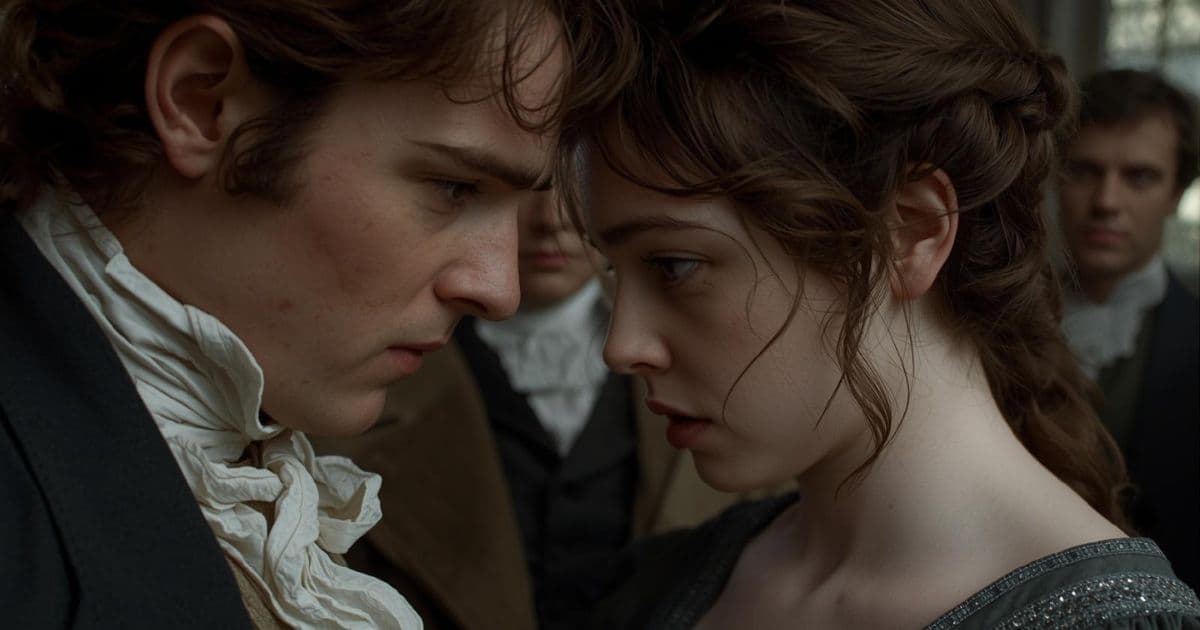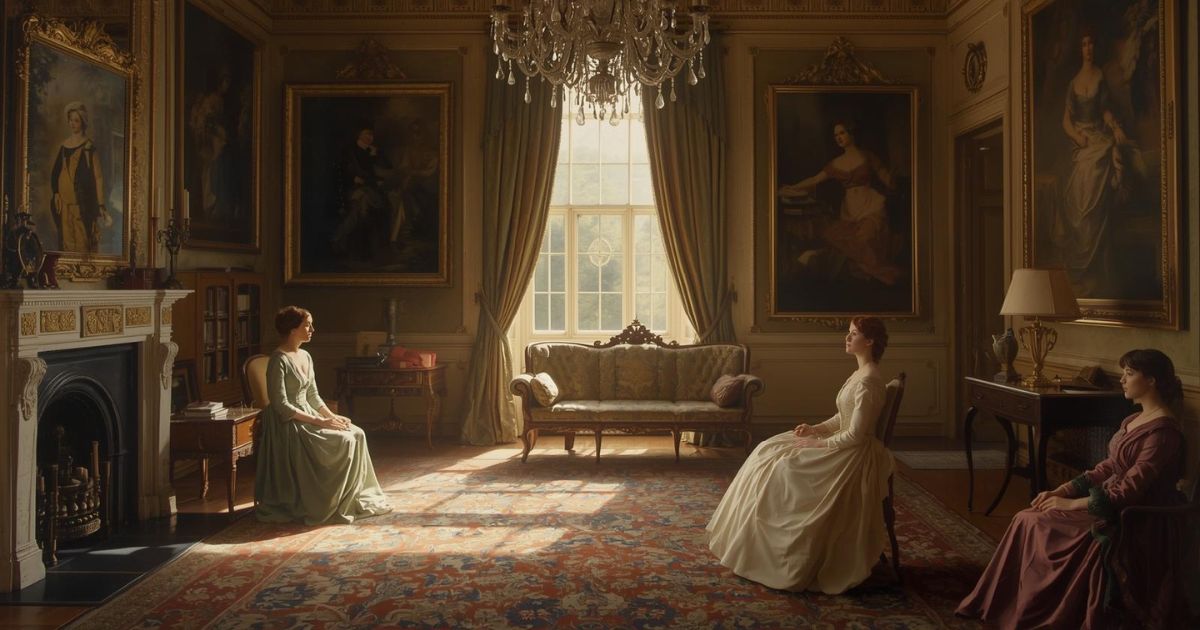
An excerpt from the original text.(complete · 2805 words)
arianne, who had never much toleration for any thing like
impertinence, vulgarity, inferiority of parts, or even difference of
taste from herself, was at this time particularly ill-disposed, from
the state of her spirits, to be pleased with the Miss Steeles, or to
encourage their advances; and to the invariable coldness of her
behaviour towards them, which checked every endeavour at intimacy on
their side, Elinor principally attributed that preference of herself
which soon became evident in the manners of both, but especially of
Lucy, who missed no opportunity of engaging her in conversation, or of
striving to improve their acquaintance by an easy and frank
communication of her sentiments.
Lucy was naturally clever; her remarks were often just and amusing; and
as a companion for half an hour Elinor frequently found her agreeable;
but her powers had received no aid from education: she was ignorant and
illiterate; and her deficiency of all mental improvement, her want of
information in the most common particulars, could not be concealed from
Miss Dashwood, in spite of her constant endeavour to appear to
advantage. Elinor saw, and pitied her for, the neglect of abilities
which education might have rendered so respectable; but she saw, with
less tenderness of feeling, the thorough want of delicacy, of
rectitude, and integrity of mind, which her attentions, her
assiduities, her flatteries at the Park betrayed; and she could have no
lasting satisfaction in the company of a person who joined insincerity
with ignorance; whose want of instruction prevented their meeting in
conversation on terms of equality, and whose conduct toward others made
every show of attention and deference towards herself perfectly
valueless.
“You will think my question an odd one, I dare say,” said Lucy to her
one day, as they were walking together from the park to the
cottage—“but pray, are you personally acquainted with your
sister-in-law’s mother, Mrs. Ferrars?”
Elinor did think the question a very odd one, and her countenance
expressed it, as she answered that she had never seen Mrs. Ferrars.
“Indeed!” replied Lucy; “I wonder at that, for I thought you must have
seen her at Norland sometimes. Then, perhaps, you cannot tell me what
sort of a woman she is?”
“No,” returned Elinor, cautious of giving her real opinion of Edward’s
mother, and not very desirous of satisfying what seemed impertinent
curiosity; “I know nothing of her.”
“I am sure you think me very strange, for enquiring about her in such a
way,” said Lucy, eyeing Elinor attentively as she spoke; “but perhaps
there may be reasons—I wish I might venture; but however I hope you
will do me the justice of believing that I do not mean to be
impertinent.”
Elinor made her a civil reply, and they walked on for a few minutes in
silence. It was broken by Lucy, who renewed the subject again by
saying, with some hesitation,
“I cannot bear to have you think me impertinently curious. I am sure I
would rather do any thing in the world than be thought so by a person
whose good opinion is so well worth having as yours. And I am sure I
should not have the smallest fear of trusting you; indeed, I should
be very glad of your advice how to manage in such an uncomfortable
situation as I am; but, however, there is no occasion to trouble you.
I am sorry you do not happen to know Mrs. Ferrars.”
“I am sorry I do not,” said Elinor, in great astonishment, “if it
could be of any use to YOU to know my opinion of her. But really I
never understood that you were at all connected with that family, and
therefore I am a little surprised, I confess, at so serious an inquiry
into her character.”
“I dare say you are, and I am sure I do not at all wonder at it. But if
I dared tell you all, you would not be so much surprised. Mrs. Ferrars
is certainly nothing to me at present—but the time may come—how soon
it will come must depend upon herself—when we may be very intimately
connected.”
She looked down as she said this, amiably bashful, with only one side
glance at her companion to observe its effect on her.
“Good heavens!” cried Elinor, “what do you mean? Are you acquainted
with Mr. Robert Ferrars? Can you be?” And she did not feel much
delighted with the idea of such a sister-in-law.
“No,” replied Lucy, “not to Mr. Robert Ferrars—I never saw him in my
life; but,” fixing her eyes upon Elinor, “to his eldest brother.”
What felt Elinor at that moment? Astonishment, that would have been as
painful as it was strong, had not an immediate disbelief of the
assertion attended it. She turned towards Lucy in silent amazement,
unable to divine the reason or object of such a declaration; and though
her complexion varied, she stood firm in incredulity, and felt in no
danger of an hysterical fit, or a swoon.
“You may well be surprised,” continued Lucy; “for to be sure you could
have had no idea of it before; for I dare say he never dropped the
smallest hint of it to you or any of your family; because it was always
meant to be a great secret, and I am sure has been faithfully kept so
by me to this hour. Not a soul of all my relations know of it but Anne,
and I never should have mentioned it to you, if I had not felt the
greatest dependence in the world upon your secrecy; and I really
thought my behaviour in asking so many questions about Mrs. Ferrars
must seem so odd, that it ought to be explained. And I do not think Mr.
Ferrars can be displeased, when he knows I have trusted you, because I
know he has the highest opinion in the world of all your family, and
looks upon yourself and the other Miss Dashwoods quite as his own
sisters.”—She paused.
Elinor for a few moments remained silent. Her astonishment at what she
heard was at first too great for words; but at length forcing herself
to speak, and to speak cautiously, she said, with calmness of manner,
which tolerably well concealed her surprise and solicitude—“May I ask
if your engagement is of long standing?”
“We have been engaged these four years.”
“Four years!”
“Yes.”
Elinor, though greatly shocked, still felt unable to believe it.
“I did not know,” said she, “that you were even acquainted till the
other day.”
“Our acquaintance, however, is of many years date. He was under my
uncle’s care, you know, a considerable while.”
“Your uncle!”
“Yes; Mr. Pratt. Did you never hear him talk of Mr. Pratt?”
“I think I have,” replied Elinor, with an exertion of spirits, which
increased with her increase of emotion.
“He was four years with my uncle, who lives at Longstaple, near
Plymouth. It was there our acquaintance begun, for my sister and me was
often staying with my uncle, and it was there our engagement was
formed, though not till a year after he had quitted as a pupil; but he
was almost always with us afterwards. I was very unwilling to enter
into it, as you may imagine, without the knowledge and approbation of
his mother; but I was too young, and loved him too well, to be so
prudent as I ought to have been. Though you do not know him so well as
me, Miss Dashwood, you must have seen enough of him to be sensible he
is very capable of making a woman sincerely attached to him.”
“Certainly,” answered Elinor, without knowing what she said; but after
a moment’s reflection, she added, with revived security of Edward’s
honour and love, and her companion’s falsehood—“Engaged to Mr. Edward
Ferrars!—I confess myself so totally surprised at what you tell me,
that really—I beg your pardon; but surely there must be some mistake of
person or name. We cannot mean the same Mr. Ferrars.”
“We can mean no other,” cried Lucy, smiling. “Mr. Edward Ferrars, the
eldest son of Mrs. Ferrars, of Park Street, and brother of your
sister-in-law, Mrs. John Dashwood, is the person I mean; you must allow
that I am not likely to be deceived as to the name of the man on who
all my happiness depends.”
“It is strange,” replied Elinor, in a most painful perplexity, “that I
should never have heard him even mention your name.”
“No; considering our situation, it was not strange. Our first care has
been to keep the matter secret. You knew nothing of me, or my family,
and, therefore, there could be no occasion for ever mentioning my
name to you; and, as he was always particularly afraid of his sister’s
suspecting any thing, that was reason enough for his not mentioning
it.”
She was silent.—Elinor’s security sunk; but her self-command did not
sink with it.
“Four years you have been engaged,” said she with a firm voice.
“Yes; and heaven knows how much longer we may have to wait. Poor
Edward! It puts him quite out of heart.” Then taking a small miniature
from her pocket, she added, “To prevent the possibility of mistake, be
so good as to look at this face. It does not do him justice, to be
sure, but yet I think you cannot be deceived as to the person it was
drew for.—I have had it above these three years.”
She put it into her hands as she spoke; and when Elinor saw the
painting, whatever other doubts her fear of a too hasty decision, or
her wish of detecting falsehood might suffer to linger in her mind, she
could have none of its being Edward’s face. She returned it almost
instantly, acknowledging the likeness.
“I have never been able,” continued Lucy, “to give him my picture in
return, which I am very much vexed at, for he has been always so
anxious to get it! But I am determined to set for it the very first
opportunity.”
“You are quite in the right,” replied Elinor calmly. They then
proceeded a few paces in silence. Lucy spoke first.
“I am sure,” said she, “I have no doubt in the world of your faithfully
keeping this secret, because you must know of what importance it is to
us, not to have it reach his mother; for she would never approve of it,
I dare say. I shall have no fortune, and I fancy she is an exceeding
proud woman.”
“I certainly did not seek your confidence,” said Elinor; “but you do me
no more than justice in imagining that I may be depended on. Your
secret is safe with me; but pardon me if I express some surprise at so
unnecessary a communication. You must at least have felt that my being
acquainted with it could not add to its safety.”
As she said this, she looked earnestly at Lucy, hoping to discover
something in her countenance; perhaps the falsehood of the greatest
part of what she had been saying; but Lucy’s countenance suffered no
change.
“I was afraid you would think I was taking a great liberty with you,”
said she, “in telling you all this. I have not known you long to be
sure, personally at least, but I have known you and all your family by
description a great while; and as soon as I saw you, I felt almost as
if you was an old acquaintance. Besides in the present case, I really
thought some explanation was due to you after my making such particular
inquiries about Edward’s mother; and I am so unfortunate, that I have
not a creature whose advice I can ask. Anne is the only person that
knows of it, and she has no judgment at all; indeed, she does me a
great deal more harm than good, for I am in constant fear of her
betraying me. She does not know how to hold her tongue, as you must
perceive, and I am sure I was in the greatest fright in the world
t’other day, when Edward’s name was mentioned by Sir John, lest she
should out with it all. You can’t think how much I go through in my
mind from it altogether. I only wonder that I am alive after what I
have suffered for Edward’s sake these last four years. Every thing in
such suspense and uncertainty; and seeing him so seldom—we can hardly
meet above twice a-year. I am sure I wonder my heart is not quite
broke.”
Here she took out her handkerchief; but Elinor did not feel very
compassionate.
“Sometimes.” continued Lucy, after wiping her eyes, “I think whether it
would not be better for us both to break off the matter entirely.” As
she said this, she looked directly at her companion. “But then at other
times I have not resolution enough for it. I cannot bear the thoughts
of making him so miserable, as I know the very mention of such a thing
would do. And on my own account too—so dear as he is to me—I don’t
think I could be equal to it. What would you advise me to do in such a
case, Miss Dashwood? What would you do yourself?”
“Pardon me,” replied Elinor, startled by the question; “but I can give
you no advice under such circumstances. Your own judgment must direct
you.”
“To be sure,” continued Lucy, after a few minutes silence on both
sides, “his mother must provide for him sometime or other; but poor
Edward is so cast down by it! Did you not think him dreadful
low-spirited when he was at Barton? He was so miserable when he left us
at Longstaple, to go to you, that I was afraid you would think him
quite ill.”
“Did he come from your uncle’s, then, when he visited us?”
“Oh, yes; he had been staying a fortnight with us. Did you think he
came directly from town?”
“No,” replied Elinor, most feelingly sensible of every fresh
circumstance in favour of Lucy’s veracity; “I remember he told us, that
he had been staying a fortnight with some friends near Plymouth.” She
remembered too, her own surprise at the time, at his mentioning nothing
farther of those friends, at his total silence with respect even to
their names.
“Did not you think him sadly out of spirits?” repeated Lucy.
“We did, indeed, particularly so when he first arrived.”
“I begged him to exert himself for fear you should suspect what was the
matter; but it made him so melancholy, not being able to stay more than
a fortnight with us, and seeing me so much affected. Poor fellow! I am
afraid it is just the same with him now; for he writes in wretched
spirits. I heard from him just before I left Exeter;” taking a letter
from her pocket and carelessly showing the direction to Elinor. “You
know his hand, I dare say,—a charming one it is; but that is not
written so well as usual. He was tired, I dare say, for he had just
filled the sheet to me as full as possible.”
Elinor saw that it was his hand, and she could doubt no longer. This
picture, she had allowed herself to believe, might have been
accidentally obtained; it might not have been Edward’s gift; but a
correspondence between them by letter, could subsist only under a
positive engagement, could be authorised by nothing else; for a few
moments, she was almost overcome—her heart sunk within her, and she
could hardly stand; but exertion was indispensably necessary; and she
struggled so resolutely against the oppression of her feelings, that
her success was speedy, and for the time complete.
“Writing to each other,” said Lucy, returning the letter into her
pocket, “is the only comfort we have in such long separations. Yes, I
have one other comfort in his picture, but poor Edward has not even
that. If he had but my picture, he says he should be easy. I gave him
a lock of my hair set in a ring when he was at Longstaple last, and
that was some comfort to him, he said, but not equal to a picture.
Perhaps you might notice the ring when you saw him?”
“I did,” said Elinor, with a composure of voice, under which was
concealed an emotion and distress beyond any thing she had ever felt
before. She was mortified, shocked, confounded.
Fortunately for her, they had now reached the cottage, and the
conversation could be continued no farther. After sitting with them a
few minutes, the Miss Steeles returned to the Park, and Elinor was then
at liberty to think and be wretched.
END OF THE FIRST VOLUME
Master this chapter. Complete your experience
Purchase the complete book to access all chapters and support classic literature
As an Amazon Associate, we earn a small commission from qualifying purchases at no additional cost to you.
Available in paperback, hardcover, and e-book formats
Let's Analyse the Pattern
Mistaking the heat of attraction or attention for the substance of genuine connection and commitment.
Why This Matters
Connect literature to life
This chapter teaches how to recognize when someone is using your emotional investment against you, showing up intensely at first then pulling back once you're hooked.
Practice This Today
This week, notice when someone's attention feels intoxicating - then track whether their actions match that energy consistently over time, not just in the exciting moments.
Now let's explore the literary elements.
Key Quotes & Analysis
"My esteem for your whole family is very sincere; but if I have been so unfortunate as to give rise to a belief of more than I felt, or meant to express, I shall reproach myself for not having been more guarded in my professions of that esteem."
Context: His formal, cold response to Marianne's passionate letters
This is gaslighting at its finest - he's rewriting history to make it seem like she imagined their entire relationship. The formal language is deliberately cruel after their intimate connection.
In Today's Words:
I was just being friendly and you read way too much into it. That's on you for misunderstanding.
"Every line, every word was—in the hackneyed metaphor which their dear writer, were she here, would forbid—a dagger to her heart."
Context: Describing the devastating effect of Willoughby's letter on Marianne
Austen acknowledges she's using a cliché but does it anyway because sometimes clichés exist because they're true. The letter truly is destroying Marianne emotionally.
In Today's Words:
Every word felt like a knife twisting in her chest - yeah, it's a cliché, but that's exactly how it felt.
"I will not trust to it, giving way to all the misery of my heart, before so kind a witness as yourself."
Context: She's trying to compose herself in front of Mrs. Jennings
Even in her devastation, Marianne recognizes she needs to maintain some dignity. This shows her growth - she's learning that not every emotion needs to be displayed publicly.
In Today's Words:
I'm not going to completely fall apart in front of you, even though I'm dying inside.
Thematic Threads
Reality vs Fantasy
In This Chapter
Marianne's romantic fantasy crashes into Willoughby's calculated reality
Development
Building from earlier hints that Marianne lives in her imagination
In Your Life:
You might catch yourself building elaborate futures with someone based on limited interactions
Communication Breakdown
In This Chapter
Marianne's passionate letters meet Willoughby's cold, formal rejection
Development
Shows how the sisters' different communication styles play out in crisis
In Your Life:
You might realize you and someone important are having completely different conversations
Class and Money
In This Chapter
Willoughby chooses financial security over emotional connection
Development
Reinforces how economic pressures shape romantic choices
In Your Life:
You might face decisions where practical needs conflict with emotional desires
Sisterly Support
In This Chapter
Elinor immediately comforts devastated Marianne despite their differences
Development
Deepens the contrast between their personalities while showing their bond
In Your Life:
You might find that family shows up for you even when they don't understand your choices
Emotional Maturity
In This Chapter
Marianne's complete breakdown versus Elinor's composed strength
Development
Continues exploring different ways of processing pain and disappointment
In Your Life:
You might question whether your way of handling emotions is serving you well
You now have the context. Time to form your own thoughts.
Discussion Questions
- 1
What specific details in Willoughby's letter reveal his true character, and how do they contrast with Marianne's expectations?
analysis • surface - 2
Why did Marianne misread the signals so completely - what made her believe Willoughby was as invested as she was?
analysis • medium - 3
Where do you see this pattern of mistaking intensity for commitment in modern relationships - romantic, workplace, or friendships?
application • medium - 4
How could Marianne have protected herself while still staying open to genuine connection?
application • deep - 5
What does this chapter reveal about the difference between how we experience feelings versus how others might experience the same interactions?
reflection • deep
Critical Thinking Exercise
The Two-Track Reality Check
Think of a current relationship where you feel uncertain about the other person's level of investment. Create two columns: 'My Feelings/Interpretations' and 'Their Actual Words/Actions.' Fill in both sides honestly. Look for gaps between what you're feeling and what they're actually demonstrating through consistent behavior.
Consider:
- •Focus on patterns over time, not isolated incidents
- •Distinguish between what they say and what they consistently do
- •Notice if you're doing most of the emotional work or initiating contact
Journaling Prompt
Write about a time when you realized you were more invested in a relationship than the other person. What warning signs did you miss, and what would you do differently now?
Coming Up Next...
Chapter 23: The Secret Told
As Marianne spirals deeper into despair, refusing food and barely able to function, Elinor discovers shocking details about Willoughby's past that make his betrayal even more disturbing. The truth about what he's been hiding will change everything the Dashwood sisters thought they knew about him.