An excerpt from the original text.(complete · 1503 words)
linor saw, with great uneasiness the low spirits of her friend. His
visit afforded her but a very partial satisfaction, while his own
enjoyment in it appeared so imperfect. It was evident that he was
unhappy; she wished it were equally evident that he still distinguished
her by the same affection which once she had felt no doubt of
inspiring; but hitherto the continuance of his preference seemed very
uncertain; and the reservedness of his manner towards her contradicted
one moment what a more animated look had intimated the preceding one.
He joined her and Marianne in the breakfast-room the next morning
before the others were down; and Marianne, who was always eager to
promote their happiness as far as she could, soon left them to
themselves. But before she was half way upstairs she heard the parlour
door open, and, turning round, was astonished to see Edward himself
come out.
“I am going into the village to see my horses,” said he, “as you are
not yet ready for breakfast; I shall be back again presently.”
Edward returned to them with fresh admiration of the surrounding
country; in his walk to the village, he had seen many parts of the
valley to advantage; and the village itself, in a much higher situation
than the cottage, afforded a general view of the whole, which had
exceedingly pleased him. This was a subject which ensured Marianne’s
attention, and she was beginning to describe her own admiration of
these scenes, and to question him more minutely on the objects that had
particularly struck him, when Edward interrupted her by saying, “You
must not enquire too far, Marianne—remember I have no knowledge in the
picturesque, and I shall offend you by my ignorance and want of taste
if we come to particulars. I shall call hills steep, which ought to be
bold; surfaces strange and uncouth, which ought to be irregular and
rugged; and distant objects out of sight, which ought only to be
indistinct through the soft medium of a hazy atmosphere. You must be
satisfied with such admiration as I can honestly give. I call it a very
fine country—the hills are steep, the woods seem full of fine timber,
and the valley looks comfortable and snug—with rich meadows and several
neat farm houses scattered here and there. It exactly answers my idea
of a fine country, because it unites beauty with utility—and I dare say
it is a picturesque one too, because you admire it; I can easily
believe it to be full of rocks and promontories, grey moss and brush
wood, but these are all lost on me. I know nothing of the picturesque.”
“I am afraid it is but too true,” said Marianne; “but why should you
boast of it?”
“I suspect,” said Elinor, “that to avoid one kind of affectation,
Edward here falls into another. Because he believes many people pretend
to more admiration of the beauties of nature than they really feel, and
is disgusted with such pretensions, he affects greater indifference and
less discrimination in viewing them himself than he possesses. He is
fastidious and will have an affectation of his own.”
“It is very true,” said Marianne, “that admiration of landscape scenery
is become a mere jargon. Every body pretends to feel and tries to
describe with the taste and elegance of him who first defined what
picturesque beauty was. I detest jargon of every kind, and sometimes I
have kept my feelings to myself, because I could find no language to
describe them in but what was worn and hackneyed out of all sense and
meaning.”
“I am convinced,” said Edward, “that you really feel all the delight in
a fine prospect which you profess to feel. But, in return, your sister
must allow me to feel no more than I profess. I like a fine prospect,
but not on picturesque principles. I do not like crooked, twisted,
blasted trees. I admire them much more if they are tall, straight, and
flourishing. I do not like ruined, tattered cottages. I am not fond of
nettles or thistles, or heath blossoms. I have more pleasure in a snug
farm-house than a watch-tower—and a troop of tidy, happy villagers
please me better than the finest banditti in the world.”
Marianne looked with amazement at Edward, with compassion at her
sister. Elinor only laughed.
The subject was continued no farther; and Marianne remained
thoughtfully silent, till a new object suddenly engaged her attention.
She was sitting by Edward, and in taking his tea from Mrs. Dashwood,
his hand passed so directly before her, as to make a ring, with a plait
of hair in the centre, very conspicuous on one of his fingers.
“I never saw you wear a ring before, Edward,” she cried. “Is that
Fanny’s hair? I remember her promising to give you some. But I should
have thought her hair had been darker.”
Marianne spoke inconsiderately what she really felt—but when she saw
how much she had pained Edward, her own vexation at her want of thought
could not be surpassed by his. He coloured very deeply, and giving a
momentary glance at Elinor, replied, “Yes; it is my sister’s hair. The
setting always casts a different shade on it, you know.”
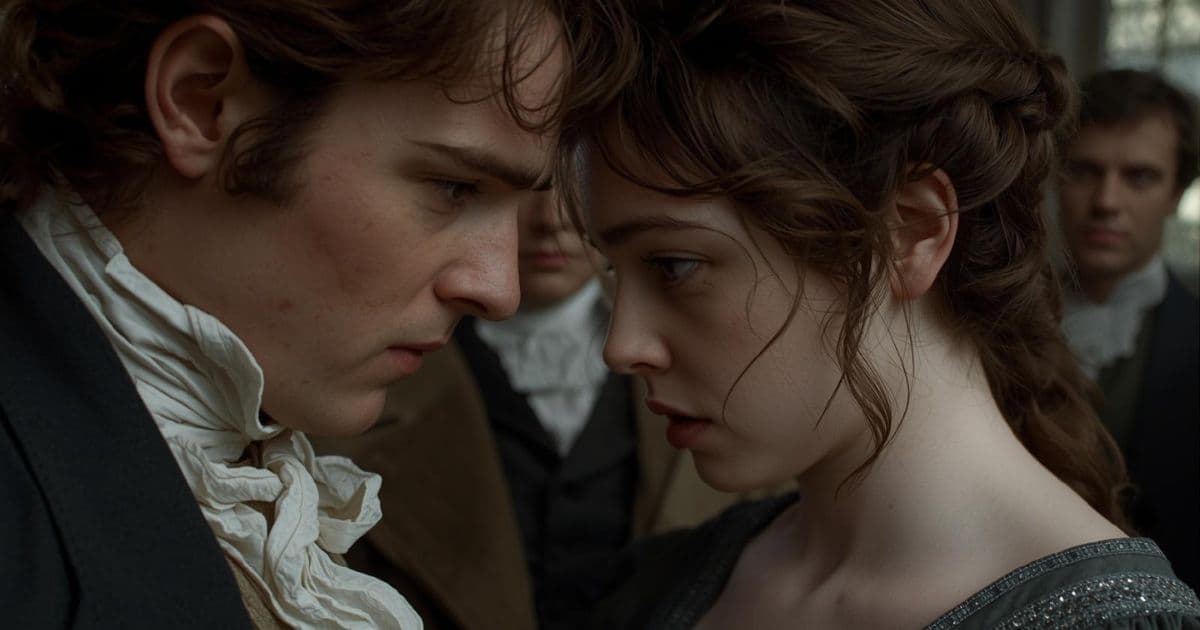
Elinor had met his eye, and looked conscious likewise. That the hair
was her own, she instantaneously felt as well satisfied as Marianne;
the only difference in their conclusions was, that what Marianne
considered as a free gift from her sister, Elinor was conscious must
have been procured by some theft or contrivance unknown to herself. She
was not in a humour, however, to regard it as an affront, and affecting
to take no notice of what passed, by instantly talking of something
else, she internally resolved henceforward to catch every opportunity
of eyeing the hair and of satisfying herself, beyond all doubt, that it
was exactly the shade of her own.
Edward’s embarrassment lasted some time, and it ended in an absence of
mind still more settled. He was particularly grave the whole morning.
Marianne severely censured herself for what she had said; but her own
forgiveness might have been more speedy, had she known how little
offence it had given her sister.
Before the middle of the day, they were visited by Sir John and Mrs.
Jennings, who, having heard of the arrival of a gentleman at the
cottage, came to take a survey of the guest. With the assistance of his
mother-in-law, Sir John was not long in discovering that the name of
Ferrars began with an F. and this prepared a future mine of raillery
against the devoted Elinor, which nothing but the newness of their
acquaintance with Edward could have prevented from being immediately
sprung. But, as it was, she only learned, from some very significant
looks, how far their penetration, founded on Margaret’s instructions,
extended.
Sir John never came to the Dashwoods without either inviting them to
dine at the park the next day, or to drink tea with them that evening.
On the present occasion, for the better entertainment of their visitor,
towards whose amusement he felt himself bound to contribute, he wished
to engage them for both.
“You must drink tea with us to night,” said he, “for we shall be
quite alone—and tomorrow you must absolutely dine with us, for we shall
be a large party.”
Mrs. Jennings enforced the necessity. “And who knows but you may raise
a dance,” said she. “And that will tempt you, Miss Marianne.”
“A dance!” cried Marianne. “Impossible! Who is to dance?”
“Who! why yourselves, and the Careys, and Whitakers to be sure.—What!
you thought nobody could dance because a certain person that shall be
nameless is gone!”
“I wish with all my soul,” cried Sir John, “that Willoughby were among
us again.”
This, and Marianne’s blushing, gave new suspicions to Edward. “And who
is Willoughby?” said he, in a low voice, to Miss Dashwood, by whom he
was sitting.
She gave him a brief reply. Marianne’s countenance was more
communicative. Edward saw enough to comprehend, not only the meaning of
others, but such of Marianne’s expressions as had puzzled him before;
and when their visitors left them, he went immediately round her, and
said, in a whisper, “I have been guessing. Shall I tell you my guess?”
“What do you mean?”
“Shall I tell you?”
“Certainly.”
“Well then; I guess that Mr. Willoughby hunts.”
Marianne was surprised and confused, yet she could not help smiling at
the quiet archness of his manner, and after a moment’s silence, said,
“Oh, Edward! How can you?—But the time will come I hope...I am sure you
will like him.”
“I do not doubt it,” replied he, rather astonished at her earnestness
and warmth; for had he not imagined it to be a joke for the good of her
acquaintance in general, founded only on a something or a nothing
between Mr. Willoughby and herself, he would not have ventured to
mention it.
Master this chapter. Complete your experience
Purchase the complete book to access all chapters and support classic literature
As an Amazon Associate, we earn a small commission from qualifying purchases at no additional cost to you.
Available in paperback, hardcover, and e-book formats
Let's Analyse the Pattern
The tendency to ignore or rationalize away evidence that contradicts what we emotionally need to believe.
Why This Matters
Connect literature to life
This chapter teaches how to notice and interpret the small, concrete details that reveal relationship truths when words might mislead.
Practice This Today
This week, notice when someone's actions don't match their words—new jewelry, changed phone habits, different schedules—and trust what you observe over what you want to believe.
Now let's explore the literary elements.
Key Quotes & Analysis
"He was not in spirits, however; he praised their house, admired their view, was attentive, and kind; but still he was not in spirits."
Context: Describing Edward's behavior during his visit to Barton Cottage
This shows how someone can go through all the right motions but still feel completely wrong. Edward's doing everything he should do socially, but his heart isn't in it, and everyone can tell.
In Today's Words:
He was being polite and saying all the right things, but you could tell something was really bothering him.
"The hair was her own, she instantaneously knew it to be her own; but on closer examination, she perceived that it was not her own."
Context: When Elinor examines the hair in Edward's ring
This moment captures the shock of discovering something that completely changes your understanding of a situation. Elinor's initial certainty followed by crushing realization shows how we can be wrong about the most important things.
In Today's Words:
At first she thought 'That's definitely my hair,' but when she looked closer, she realized it wasn't hers at all.
"Edward's embarrassment lasted some time, and it ended in an absence of mind still more settled."
Context: After the awkward moment with viewing Elinor's drawings
This shows how guilt and secrets eat away at people. Edward can't shake off his discomfort because he's carrying the weight of something he can't share, making him even more distracted and distant.
In Today's Words:
He stayed embarrassed for a while, and then just seemed completely lost in his own thoughts.
Thematic Threads
Deception
In This Chapter
Edward is clearly hiding something, evidenced by the mysterious ring and his uncomfortable behavior around Elinor
Development
Builds on earlier hints about Edward's secretiveness and adds concrete evidence of his divided loyalties
In Your Life:
You might recognize this when someone close to you becomes evasive about their activities or relationships
Self-Awareness
In This Chapter
Elinor's analytical nature helps her notice the warning signs, even though she struggles to accept their implications
Development
Shows how even self-aware people can be blind to uncomfortable truths about their own situations
In Your Life:
You might notice yourself making excuses for behavior you'd immediately call out in others
Social Expectations
In This Chapter
Edward's awkwardness suggests he's trapped between social obligations and personal desires
Development
Continues the theme of characters struggling between what they want and what society expects
In Your Life:
You might feel this tension when your personal choices conflict with family or professional expectations
Communication
In This Chapter
Edward's inability to be honest with Elinor creates confusion and pain for both of them
Development
Demonstrates how avoiding difficult conversations often makes situations worse
In Your Life:
You might recognize this pattern when important conversations keep getting postponed or avoided
Trust
In This Chapter
The ring revelation forces Elinor to question everything she thought she knew about Edward
Development
Shows how trust, once shaken, requires active rebuilding rather than just time
In Your Life:
You might experience this when small inconsistencies in someone's story make you question larger truths
You now have the context. Time to form your own thoughts.
Discussion Questions
- 1
What specific behaviors and details made Elinor realize something was wrong with Edward during his visit?
analysis • surface - 2
Why do you think Elinor kept making excuses for Edward's strange behavior instead of confronting him directly about what she observed?
analysis • medium - 3
Where have you seen people ignore obvious warning signs because they didn't want to face an uncomfortable truth?
application • medium - 4
What strategies could Elinor have used to get clearer information about Edward's situation without damaging their relationship?
application • deep - 5
What does this chapter reveal about how our emotions can literally change what we allow ourselves to see and acknowledge?
reflection • deep
Critical Thinking Exercise
Create Your Reality-Check System
Think of a current situation where you might be emotionally invested in a particular outcome. Design a simple system to help you see the situation more clearly, including specific questions you'd ask a trusted friend and warning signs you'd document objectively.
Consider:
- •What evidence would convince someone with no emotional investment?
- •Which trusted person in your life gives you honest feedback, even when it's hard to hear?
- •What would you tell a friend if they described your exact situation happening to them?
Journaling Prompt
Write about a time when you ignored warning signs because you didn't want to face what they meant. What did you eventually learn, and how might you handle a similar situation differently now?
Coming Up Next...
Chapter 19: Willoughby's Cut
The Dashwood sisters receive an unexpected invitation that promises to change everything. Marianne's excitement about new social opportunities contrasts sharply with Elinor's growing concerns about Edward's strange behavior.