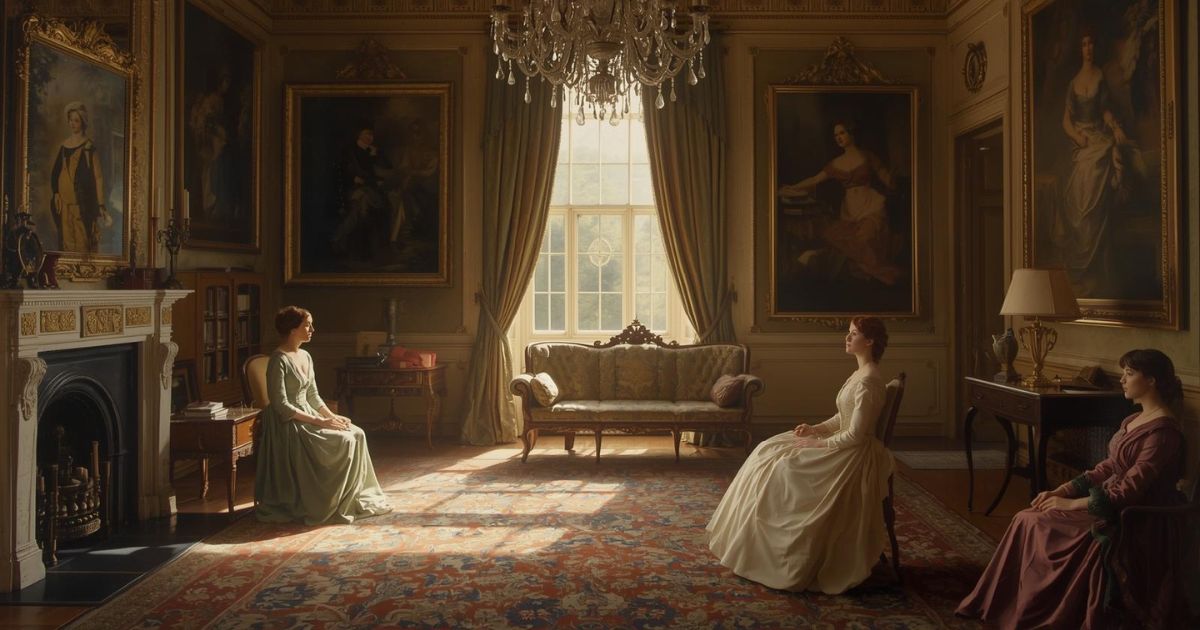
An excerpt from the original text.(complete · 1974 words)
arianne would have thought herself very inexcusable had she been able
to sleep at all the first night after parting from Willoughby. She
would have been ashamed to look her family in the face the next
morning, had she not risen from her bed in more need of repose than
when she lay down in it. But the feelings which made such composure a
disgrace, left her in no danger of incurring it. She was awake the
whole night, and she wept the greatest part of it. She got up with a
headache, was unable to talk, and unwilling to take any nourishment;
giving pain every moment to her mother and sisters, and forbidding all
attempt at consolation from either. Her sensibility was potent enough!
When breakfast was over she walked out by herself, and wandered about
the village of Allenham, indulging the recollection of past enjoyment
and crying over the present reverse for the chief of the morning.
The evening passed off in the equal indulgence of feeling. She played
over every favourite song that she had been used to play to Willoughby,
every air in which their voices had been oftenest joined, and sat at
the instrument gazing on every line of music that he had written out
for her, till her heart was so heavy that no farther sadness could be
gained; and this nourishment of grief was every day applied. She spent
whole hours at the pianoforte alternately singing and crying; her voice
often totally suspended by her tears. In books too, as well as in
music, she courted the misery which a contrast between the past and
present was certain of giving. She read nothing but what they had been
used to read together.
Such violence of affliction indeed could not be supported for ever; it
sunk within a few days into a calmer melancholy; but these employments,
to which she daily recurred, her solitary walks and silent meditations,
still produced occasional effusions of sorrow as lively as ever.
No letter from Willoughby came; and none seemed expected by Marianne.
Her mother was surprised, and Elinor again became uneasy. But Mrs.
Dashwood could find explanations whenever she wanted them, which at
least satisfied herself.
“Remember, Elinor,” said she, “how very often Sir John fetches our
letters himself from the post, and carries them to it. We have already
agreed that secrecy may be necessary, and we must acknowledge that it
could not be maintained if their correspondence were to pass through
Sir John’s hands.”
Elinor could not deny the truth of this, and she tried to find in it a
motive sufficient for their silence. But there was one method so
direct, so simple, and in her opinion so eligible of knowing the real
state of the affair, and of instantly removing all mystery, that she
could not help suggesting it to her mother.
“Why do you not ask Marianne at once,” said she, “whether she is or she
is not engaged to Willoughby? From you, her mother, and so kind, so
indulgent a mother, the question could not give offence. It would be
the natural result of your affection for her. She used to be all
unreserve, and to you more especially.”
“I would not ask such a question for the world. Supposing it possible
that they are not engaged, what distress would not such an enquiry
inflict! At any rate it would be most ungenerous. I should never
deserve her confidence again, after forcing from her a confession of
what is meant at present to be unacknowledged to any one. I know
Marianne’s heart: I know that she dearly loves me, and that I shall not
be the last to whom the affair is made known, when circumstances make
the revealment of it eligible. I would not attempt to force the
confidence of any one; of a child much less; because a sense of duty
would prevent the denial which her wishes might direct.”
Elinor thought this generosity overstrained, considering her sister’s
youth, and urged the matter farther, but in vain; common sense, common
care, common prudence, were all sunk in Mrs. Dashwood’s romantic
delicacy.
It was several days before Willoughby’s name was mentioned before
Marianne by any of her family; Sir John and Mrs. Jennings, indeed, were
not so nice; their witticisms added pain to many a painful hour;—but
one evening, Mrs. Dashwood, accidentally taking up a volume of
Shakespeare, exclaimed,
“We have never finished Hamlet, Marianne; our dear Willoughby went away
before we could get through it. We will put it by, that when he comes
again...But it may be months, perhaps, before that happens.”
“Months!” cried Marianne, with strong surprise. “No—nor many weeks.”
Mrs. Dashwood was sorry for what she had said; but it gave Elinor
pleasure, as it produced a reply from Marianne so expressive of
confidence in Willoughby and knowledge of his intentions.
One morning, about a week after his leaving the country, Marianne was
prevailed on to join her sisters in their usual walk, instead of
wandering away by herself. Hitherto she had carefully avoided every
companion in her rambles. If her sisters intended to walk on the downs,
she directly stole away towards the lanes; if they talked of the
valley, she was as speedy in climbing the hills, and could never be
found when the others set off. But at length she was secured by the
exertions of Elinor, who greatly disapproved such continual seclusion.
They walked along the road through the valley, and chiefly in silence,
for Marianne’s mind could not be controlled, and Elinor, satisfied
with gaining one point, would not then attempt more. Beyond the
entrance of the valley, where the country, though still rich, was less
wild and more open, a long stretch of the road which they had travelled
on first coming to Barton, lay before them; and on reaching that point,
they stopped to look around them, and examine a prospect which formed
the distance of their view from the cottage, from a spot which they had
never happened to reach in any of their walks before.
Amongst the objects in the scene, they soon discovered an animated one;
it was a man on horseback riding towards them. In a few minutes they
could distinguish him to be a gentleman; and in a moment afterwards
Marianne rapturously exclaimed,
“It is he; it is indeed;—I know it is!”—and was hastening to meet him,
when Elinor cried out,
“Indeed, Marianne, I think you are mistaken. It is not Willoughby. The
person is not tall enough for him, and has not his air.”
“He has, he has,” cried Marianne, “I am sure he has. His air, his coat,
his horse. I knew how soon he would come.”
She walked eagerly on as she spoke; and Elinor, to screen Marianne from
particularity, as she felt almost certain of its not being Willoughby,
quickened her pace and kept up with her. They were soon within thirty
yards of the gentleman. Marianne looked again; her heart sunk within
her; and abruptly turning round, she was hurrying back, when the voices
of both her sisters were raised to detain her; a third, almost as well
known as Willoughby’s, joined them in begging her to stop, and she
turned round with surprise to see and welcome Edward Ferrars.
He was the only person in the world who could at that moment be
forgiven for not being Willoughby; the only one who could have gained a
smile from her; but she dispersed her tears to smile on him, and in
her sister’s happiness forgot for a time her own disappointment.
He dismounted, and giving his horse to his servant, walked back with
them to Barton, whither he was purposely coming to visit them.
He was welcomed by them all with great cordiality, but especially by
Marianne, who showed more warmth of regard in her reception of him than
even Elinor herself. To Marianne, indeed, the meeting between Edward
and her sister was but a continuation of that unaccountable coldness
which she had often observed at Norland in their mutual behaviour. On
Edward’s side, more particularly, there was a deficiency of all that a
lover ought to look and say on such an occasion. He was confused,
seemed scarcely sensible of pleasure in seeing them, looked neither
rapturous nor gay, said little but what was forced from him by
questions, and distinguished Elinor by no mark of affection. Marianne
saw and listened with increasing surprise. She began almost to feel a
dislike of Edward; and it ended, as every feeling must end with her, by
carrying back her thoughts to Willoughby, whose manners formed a
contrast sufficiently striking to those of his brother elect.
After a short silence which succeeded the first surprise and enquiries
of meeting, Marianne asked Edward if he came directly from London. No,
he had been in Devonshire a fortnight.
“A fortnight!” she repeated, surprised at his being so long in the same
county with Elinor without seeing her before.
He looked rather distressed as he added, that he had been staying with
some friends near Plymouth.
“Have you been lately in Sussex?” said Elinor.
“I was at Norland about a month ago.”
“And how does dear, dear Norland look?” cried Marianne.
“Dear, dear Norland,” said Elinor, “probably looks much as it always
does at this time of the year. The woods and walks thickly covered with
dead leaves.”
“Oh,” cried Marianne, “with what transporting sensation have I formerly
seen them fall! How have I delighted, as I walked, to see them driven
in showers about me by the wind! What feelings have they, the season,
the air altogether inspired! Now there is no one to regard them. They
are seen only as a nuisance, swept hastily off, and driven as much as
possible from the sight.”
“It is not every one,” said Elinor, “who has your passion for dead
leaves.”
“No; my feelings are not often shared, not often understood. But
sometimes they are.”—As she said this, she sunk into a reverie for a
few moments;—but rousing herself again, “Now, Edward,” said she,
calling his attention to the prospect, “here is Barton valley. Look up
to it, and be tranquil if you can. Look at those hills! Did you ever
see their equals? To the left is Barton park, amongst those woods and
plantations. You may see the end of the house. And there, beneath that
farthest hill, which rises with such grandeur, is our cottage.”
“It is a beautiful country,” he replied; “but these bottoms must be
dirty in winter.”
“How can you think of dirt, with such objects before you?”
“Because,” replied he, smiling, “among the rest of the objects before
me, I see a very dirty lane.”
“How strange!” said Marianne to herself as she walked on.
“Have you an agreeable neighbourhood here? Are the Middletons pleasant
people?”
“No, not all,” answered Marianne; “we could not be more unfortunately
situated.”
“Marianne,” cried her sister, “how can you say so? How can you be so
unjust? They are a very respectable family, Mr. Ferrars; and towards us
have behaved in the friendliest manner. Have you forgot, Marianne, how
many pleasant days we have owed to them?”
“No,” said Marianne, in a low voice, “nor how many painful moments.”
Elinor took no notice of this; and directing her attention to their
visitor, endeavoured to support something like discourse with him, by
talking of their present residence, its conveniences, &c. extorting
from him occasional questions and remarks. His coldness and reserve
mortified her severely; she was vexed and half angry; but resolving to
regulate her behaviour to him by the past rather than the present, she
avoided every appearance of resentment or displeasure, and treated him
as she thought he ought to be treated from the family connection.
Master this chapter. Complete your experience
Purchase the complete book to access all chapters and support classic literature
As an Amazon Associate, we earn a small commission from qualifying purchases at no additional cost to you.
Available in paperback, hardcover, and e-book formats
Let's Analyse the Pattern
Using formal courtesy and social respectability to inflict emotional damage while avoiding accountability.
Why This Matters
Connect literature to life
This chapter teaches how to distinguish between genuine kindness and cruelty disguised as courtesy.
Practice This Today
This week, notice when someone's elaborate explanations for hurtful behavior sound more like reputation management than genuine concern for your feelings.
Now let's explore the literary elements.
Key Quotes & Analysis
"I have never been sensible of any engagement of that kind."
Context: Willoughby denies ever having any romantic commitment to Marianne
This formal denial is particularly cruel because it rewrites their entire relationship history. He's gaslighting her by pretending their connection never existed. The legal language makes it sound like a business transaction rather than matters of the heart.
In Today's Words:
We were never actually together, and I don't know why you thought we were.
"Be assured that I never reflected on my former acquaintance with your family in Devonshire without the deepest concern."
Context: Willoughby expresses fake regret about leading Marianne on
This is classic non-apology language - he expresses 'concern' but takes no responsibility for his actions. The formal tone makes his cruelty even worse because it's disguised as politeness. He's covering himself legally while destroying her emotionally.
In Today's Words:
Sorry if you got the wrong idea, but that's not my problem.
"Her sister, her mother, and their kind friend, all watched her anxiously through the whole."
Context: Describing how everyone responds to Marianne's breakdown
This shows how Marianne's pain affects her entire support network. Even Mrs. Jennings, usually focused on gossip, becomes genuinely concerned. The word 'anxiously' reveals that her grief is so intense it frightens those who love her.
In Today's Words:
Everyone was scared watching her fall apart like that.
Thematic Threads
Social Expectations
In This Chapter
Willoughby uses proper letter-writing conventions to deliver devastating news, hiding cruelty behind social forms
Development
Evolved from earlier subtle constraints to explicit weaponization of social rules
In Your Life:
You might recognize this when someone uses 'professional communication' to deliver personal attacks at work.
Class
In This Chapter
Willoughby's engagement to a wealthy woman reveals how financial necessity overrides romantic attachment
Development
Building from earlier hints about money's influence on relationships
In Your Life:
You see this when people choose partners based on financial security rather than genuine connection.
Human Relationships
In This Chapter
The stark contrast between Elinor's quiet support and Marianne's public breakdown shows different ways people handle crisis
Development
Deepening the established pattern of how the sisters process emotion differently
In Your Life:
You might notice this in how family members respond differently when someone is struggling—some step up, others step back.
Identity
In This Chapter
Marianne's collapse forces her to confront the gap between her romantic ideals and harsh reality
Development
Escalating from earlier romantic fantasies to brutal disillusionment
In Your Life:
You experience this when life events shatter your assumptions about how the world works or who you thought you were.
Personal Growth
In This Chapter
Mrs. Jennings shows unexpected depth and genuine kindness despite her gossipy reputation
Development
Introduced here as a counterpoint to surface judgments
In Your Life:
You might discover that people you dismissed as shallow actually have real compassion when it matters.
You now have the context. Time to form your own thoughts.
Discussion Questions
- 1
What specific techniques does Willoughby use in his letter to hurt Marianne while appearing socially proper?
analysis • surface - 2
Why does Willoughby choose this approach instead of simply disappearing or being directly honest about his intentions?
analysis • medium - 3
Where have you seen people use formal politeness or professional language to deliver hurtful messages in modern situations?
application • medium - 4
How would you advise someone who's receiving mixed messages—polite words but hurtful actions—to protect themselves?
application • deep - 5
What does this chapter reveal about how people use social rules and expectations to avoid taking responsibility for the pain they cause?
reflection • deep
Critical Thinking Exercise
Decode the Double Message
Think of a recent situation where someone's words seemed kind or professional, but their actions or the outcome hurt you or someone you know. Write down what they said versus what actually happened. Then rewrite their message in plain, honest language—what would they have said if they were being completely direct about their intentions?
Consider:
- •Notice how formal or flowery language can be used to hide uncomfortable truths
- •Consider whether the person was protecting their own reputation rather than your feelings
- •Think about how much energy you spent trying to make sense of the mixed signals
Journaling Prompt
Write about a time when you had to deliver difficult news to someone. Did you use any 'softening' language that might have made things more confusing? How could you have been both kind and clear?
Coming Up Next...
Chapter 17: London Bound
As Marianne struggles with devastating heartbreak, Colonel Brandon arrives with shocking news about Willoughby's true character. The revelations will change everything the Dashwood sisters thought they knew about the man who seemed so perfect.