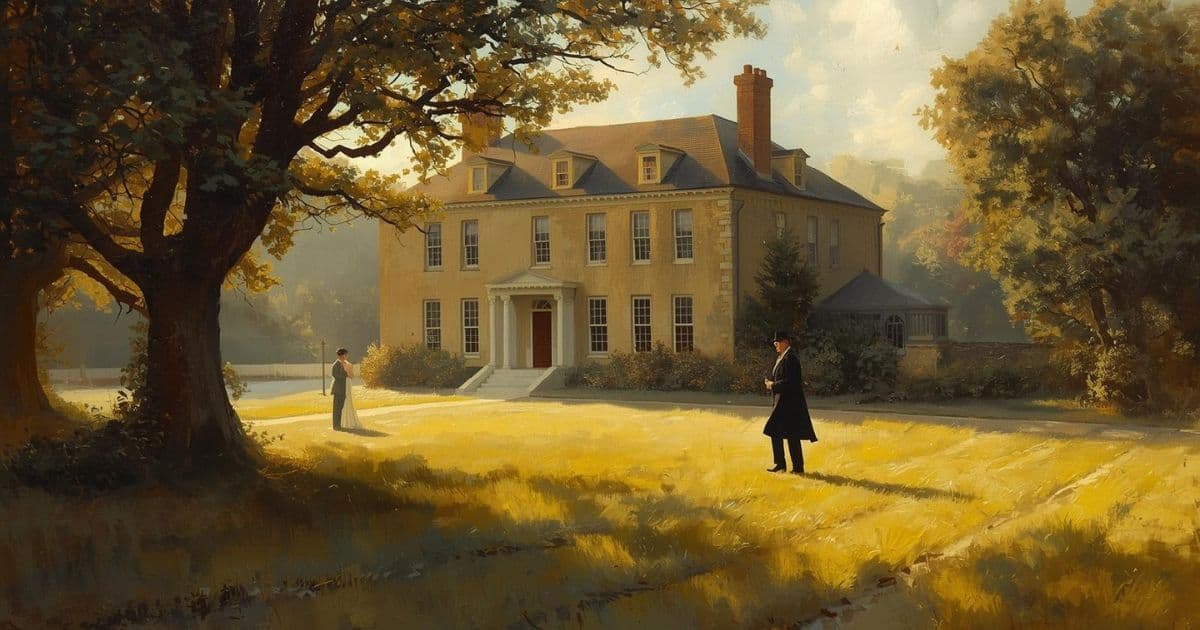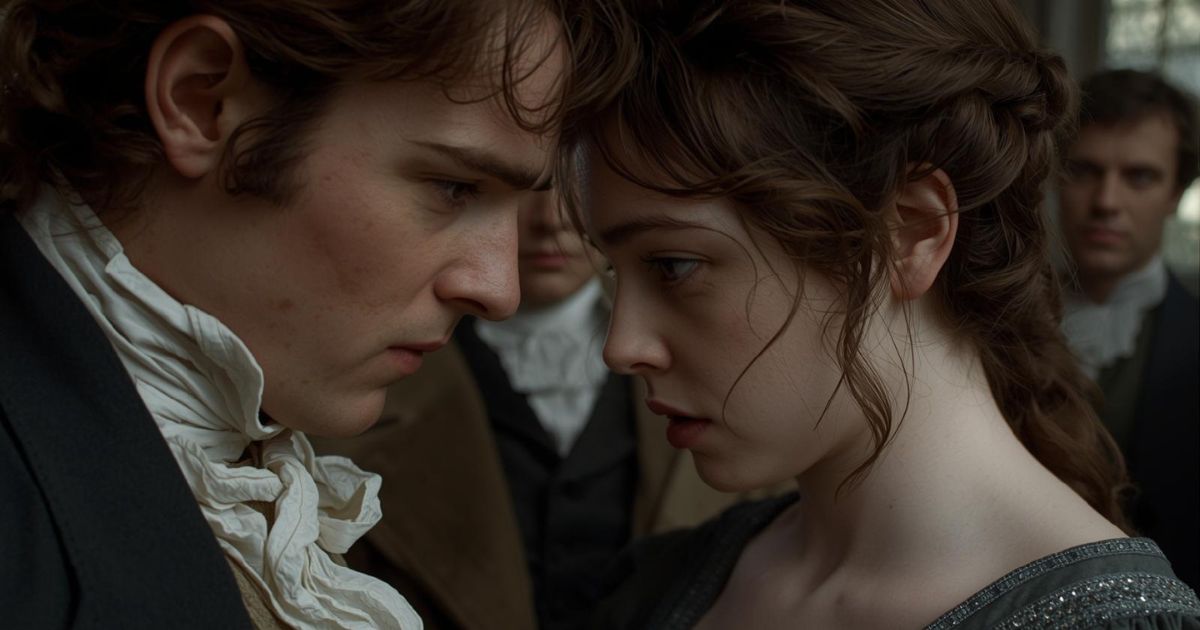
An excerpt from the original text.(complete · 1055 words)
[llustration]
On Saturday morning Elizabeth and Mr. Collins met for breakfast a few
minutes before the others appeared; and he took the opportunity of
paying the parting civilities which he deemed indispensably necessary.
“I know not, Miss Elizabeth,” said he, “whether Mrs. Collins has yet
expressed her sense of your kindness in coming to us; but I am very
certain you will not leave the house without receiving her thanks for
it. The favour of your company has been much felt, I assure you. We know
how little there is to tempt anyone to our humble abode. Our plain
manner of living, our small rooms, and few domestics, and the little we
see of the world, must make Hunsford extremely dull to a young lady like
yourself; but I hope you will believe us grateful for the condescension,
and that we have done everything in our power to prevent you spending
your time unpleasantly.”
Elizabeth was eager with her thanks and assurances of happiness. She had
spent six weeks with great enjoyment; and the pleasure of being with
Charlotte, and the kind attention she had received, must make her feel
the obliged. Mr. Collins was gratified; and with a more smiling
solemnity replied,--
“It gives me the greatest pleasure to hear that you have passed your
time not disagreeably. We have certainly done our best; and most
fortunately having it in our power to introduce you to very superior
society, and from our connection with Rosings, the frequent means of
varying the humble home scene, I think we may flatter ourselves that
your Hunsford visit cannot have been entirely irksome. Our situation
with regard to Lady Catherine’s family is, indeed, the sort of
extraordinary advantage and blessing which few can boast. You see on
what a footing we are. You see how continually we are engaged there. In
truth, I must acknowledge, that, with all the disadvantages of this
humble parsonage, I should not think anyone abiding in it an object of
compassion, while they are sharers of our intimacy at Rosings.”
Words were insufficient for the elevation of his feelings; and he was
obliged to walk about the room, while Elizabeth tried to unite civility
and truth in a few short sentences.
“You may, in fact, carry a very favourable report of us into
Hertfordshire, my dear cousin. I flatter myself, at least, that you will
be able to do so. Lady Catherine’s great attentions to Mrs. Collins you
have been a daily witness of; and altogether I trust it does not appear
that your friend has drawn an unfortunate--but on this point it will be
as well to be silent. Only let me assure you, my dear Miss Elizabeth,
that I can from my heart most cordially wish you equal felicity in
marriage. My dear Charlotte and I have but one mind and one way of
thinking. There is in everything a most remarkable resemblance of
character and ideas between us. We seem to have been designed for each
other.”
Elizabeth could safely say that it was a great happiness where that was
the case, and with equal sincerity could add, that she firmly believed
and rejoiced in his domestic comforts. She was not sorry, however, to
have the recital of them interrupted by the entrance of the lady from
whom they sprang. Poor Charlotte! it was melancholy to leave her to such
society! But she had chosen it with her eyes open; and though evidently
regretting that her visitors were to go, she did not seem to ask for
compassion. Her home and her housekeeping, her parish and her poultry,
and all their dependent concerns, had not yet lost their charms.
At length the chaise arrived, the trunks were fastened on, the parcels
placed within, and it was pronounced to be ready. After an affectionate
parting between the friends, Elizabeth was attended to the carriage by
Mr. Collins; and as they walked down the garden, he was commissioning
her with his best respects to all her family, not forgetting his thanks
for the kindness he had received at Longbourn in the winter, and his
compliments to Mr. and Mrs. Gardiner, though unknown. He then handed
her in, Maria followed, and the door was on the point of being closed,
when he suddenly reminded them, with some consternation, that they had
hitherto forgotten to leave any message for the ladies of Rosings.
[Illustration:
“They had forgotten to leave any message”
]
“But,” he added, “you will of course wish to have your humble respects
delivered to them, with your grateful thanks for their kindness to you
while you have been here.”
Elizabeth made no objection: the door was then allowed to be shut, and
the carriage drove off.
“Good gracious!” cried Maria, after a few minutes’ silence, “it seems
but a day or two since we first came! and yet how many things have
happened!”
“A great many indeed,” said her companion, with a sigh.
“We have dined nine times at Rosings, besides drinking tea there twice!
How much I shall have to tell!”
Elizabeth privately added, “And how much I shall have to conceal!”
Their journey was performed without much conversation, or any alarm; and
within four hours of their leaving Hunsford they reached Mr. Gardiner’s
house, where they were to remain a few days.
Jane looked well, and Elizabeth had little opportunity of studying her
spirits, amidst the various engagements which the kindness of her aunt
had reserved for them. But Jane was to go home with her, and at
Longbourn there would be leisure enough for observation.
It was not without an effort, meanwhile, that she could wait even for
Longbourn, before she told her sister of Mr. Darcy’s proposals. To know
that she had the power of revealing what would so exceedingly astonish
Jane, and must, at the same time, so highly gratify whatever of her own
vanity she had not yet been able to reason away, was such a temptation
to openness as nothing could have conquered, but the state of indecision
in which she remained as to the extent of what she should communicate,
and her fear, if she once entered on the subject, of being hurried into
repeating something of Bingley, which might only grieve her sister
further.
[Illustration:
“How nicely we are crammed in”
]
Master this chapter. Complete your experience
Purchase the complete book to access all chapters and support classic literature
As an Amazon Associate, we earn a small commission from qualifying purchases at no additional cost to you.
Available in paperback, hardcover, and e-book formats
Let's Analyse the Pattern
Why This Matters
Connect literature to life
This chapter teaches how to systematically challenge your initial judgments by actively seeking evidence that contradicts your first impression of someone's character or motives.
Now let's explore the literary elements.
Key Quotes & Analysis
"How despicably have I acted! I, who have prided myself on my discernment! I, who have valued myself on my abilities!"
Context: Elizabeth's internal reaction after reading Darcy's letter
This moment of brutal self-awareness shows Elizabeth recognizing that her 'good judgment' was actually prejudice. It's the painful but necessary moment when we realize our confidence was built on wrong assumptions.
"Till this moment, I never knew myself."
Context: Elizabeth's realization about her own character flaws
One of literature's most powerful statements about self-discovery. Elizabeth realizes that true self-knowledge requires facing uncomfortable truths about our own biases and mistakes.
"I have been a selfish being all my life, in practice, though not in principle."
Context: Darcy's admission in his letter about his past behavior
Darcy acknowledges the gap between his moral beliefs and his actual actions. This kind of honest self-assessment shows real character growth and the difference between having good intentions and acting on them.
Thematic Threads
Prejudice
In This Chapter
Elizabeth's complete reversal about Darcy's character shows how prejudice isn't just dislike—it's a filter that distorts all incoming information
Development
Evolved from simple first impressions to revealing the dangerous mechanics of how bias operates in the mind
In Your Life:
When have you realized that your strong dislike of someone was actually preventing you from seeing who they really are?
Truth
In This Chapter
Darcy's letter forces Elizabeth to confront objective facts versus her interpreted version of events
Development
Developed from social appearances to personal accountability for seeing reality clearly
In Your Life:
Can you think of a time when you had to admit that the 'facts' you believed about a situation were actually just your own interpretation?
Self-Knowledge
In This Chapter
Elizabeth's painful recognition that her 'good judgment' was actually blind prejudice represents true self-awareness
Development
Culmination of growing theme—moving from external judgments to internal examination
In Your Life:
What's the most difficult truth you've had to accept about your own character or behavior?
Class
In This Chapter
Elizabeth finally sees how her family's behavior genuinely affects their social standing and others' perceptions
Development
Shifted from defending against class prejudice to acknowledging class realities and personal responsibility
In Your Life:
How do you balance standing up for your values while also acknowledging when your background or circumstances might be affecting how others see you?
Pride
In This Chapter
Elizabeth discovers her pride in her judgment was actually the source of her blindness
Development
Evolved from seeing pride as Darcy's flaw to recognizing it as her own barrier to truth
In Your Life:
When has your confidence in being right about something actually been the very thing that kept you from seeing the truth?
You now have the context. Time to form your own thoughts.
Discussion Questions
- 1
What specific information in Darcy's letter completely changed how Elizabeth saw him, and why was she so shocked by these revelations?
- 2
Why did Elizabeth's brain automatically sort Darcy's actions into the 'arrogant snob' category while giving Wickham the benefit of the doubt - what made her trust one over the other?
- 3
Think about your workplace, family, or social media - where do you see people (including yourself) deciding someone is 'that type of person' and then filtering everything through that lens?
- 4
When you realize you've completely misjudged someone's character or motives, what's your strategy for rebuilding that relationship and preventing the same mistake?
- 5
Elizabeth had to admit her 'quick wit' was actually prejudice in disguise - what does this suggest about the difference between being smart and being wise?
Critical Thinking Exercise
Flip the Script on Your Judgments
Think of someone you've labeled negatively - maybe a coworker who seems lazy, a family member who appears selfish, or even a public figure you dislike. Write down three specific behaviors that led to your judgment. Now rewrite each behavior from a completely different perspective, imagining alternative explanations for their actions. What context might you be missing?
Consider:
- •Look for evidence you might have ignored because it didn't fit your initial impression
- •Consider what pressures, fears, or circumstances might drive their behavior that you can't see
- •Ask yourself what you'd want others to consider about your own actions before judging you
Coming Up Next...
Chapter 39
Elizabeth returns home to Hertfordshire, bringing all her new knowledge and changed perspectives back to a family that has no idea how much has shifted for her.