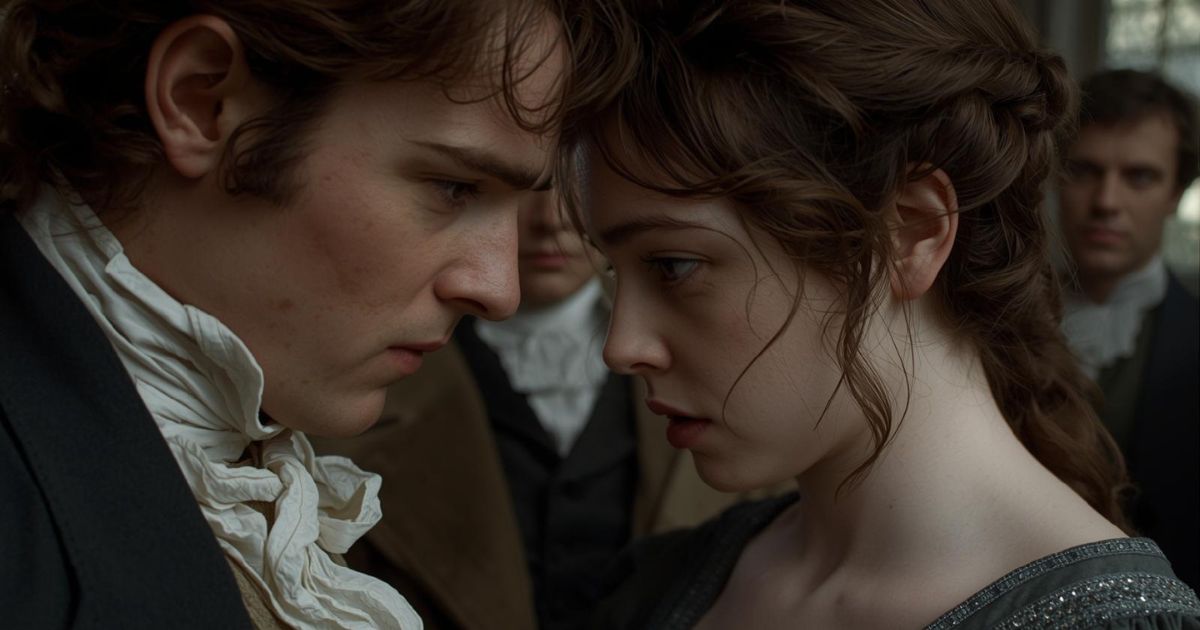
An excerpt from the original text.(complete · 1507 words)
[llustration]
Elizabeth was sitting by herself the next morning, and writing to Jane,
while Mrs. Collins and Maria were gone on business into the village,
when she was startled by a ring at the door, the certain signal of a
visitor. As she had heard no carriage, she thought it not unlikely to be
Lady Catherine; and under that apprehension was putting away her
half-finished letter, that she might escape all impertinent questions,
when the door opened, and to her very great surprise Mr. Darcy, and Mr.
Darcy only, entered the room.
He seemed astonished too on finding her alone, and apologized for his
intrusion, by letting her know that he had understood all the ladies to
be within.
They then sat down, and when her inquiries after Rosings were made,
seemed in danger of sinking into total silence. It was absolutely
necessary, therefore, to think of something; and in this emergency
recollecting when she had seen him last in Hertfordshire, and feeling
curious to know what he would say on the subject of their hasty
departure, she observed,--
“How very suddenly you all quitted Netherfield last November, Mr. Darcy!
It must have been a most agreeable surprise to Mr. Bingley to see you
all after him so soon; for, if I recollect right, he went but the day
before. He and his sisters were well, I hope, when you left London?”
“Perfectly so, I thank you.”
She found that she was to receive no other answer; and, after a short
pause, added,--
“I think I have understood that Mr. Bingley has not much idea of ever
returning to Netherfield again?”
“I have never heard him say so; but it is probable that he may spend
very little of his time there in future. He has many friends, and he is
at a time of life when friends and engagements are continually
increasing.”
“If he means to be but little at Netherfield, it would be better for the
neighbourhood that he should give up the place entirely, for then we
might possibly get a settled family there. But, perhaps, Mr. Bingley did
not take the house so much for the convenience of the neighbourhood as
for his own, and we must expect him to keep or quit it on the same
principle.”
“I should not be surprised,” said Darcy, “if he were to give it up as
soon as any eligible purchase offers.”
Elizabeth made no answer. She was afraid of talking longer of his
friend; and, having nothing else to say, was now determined to leave the
trouble of finding a subject to him.
He took the hint and soon began with, “This seems a very comfortable
house. Lady Catherine, I believe, did a great deal to it when Mr.
Collins first came to Hunsford.”
“I believe she did--and I am sure she could not have bestowed her
kindness on a more grateful object.”
“Mr. Collins appears very fortunate in his choice of a wife.”
“Yes, indeed; his friends may well rejoice in his having met with one of
the very few sensible women who would have accepted him, or have made
him happy if they had. My friend has an excellent understanding--though
I am not certain that I consider her marrying Mr. Collins as the wisest
thing she ever did. She seems perfectly happy, however; and, in a
prudential light, it is certainly a very good match for her.”
“It must be very agreeable to her to be settled within so easy a
distance of her own family and friends.”
“An easy distance do you call it? It is nearly fifty miles.”
“And what is fifty miles of good road? Little more than half a day’s
journey. Yes, I call it a very easy distance.”
“I should never have considered the distance as one of the advantages
of the match,” cried Elizabeth. “I should never have said Mrs. Collins
was settled near her family.”
“It is a proof of your own attachment to Hertfordshire. Anything beyond
the very neighbourhood of Longbourn, I suppose, would appear far.”
As he spoke there was a sort of smile, which Elizabeth fancied she
understood; he must be supposing her to be thinking of Jane and
Netherfield, and she blushed as she answered,--
“I do not mean to say that a woman may not be settled too near her
family. The far and the near must be relative, and depend on many
varying circumstances. Where there is fortune to make the expense of
travelling unimportant, distance becomes no evil. But that is not the
case here. Mr. and Mrs. Collins have a comfortable income, but not
such a one as will allow of frequent journeys--and I am persuaded my
friend would not call herself near her family under less than half
the present distance.”
Mr. Darcy drew his chair a little towards her, and said, “You cannot
have a right to such very strong local attachment. You cannot have
been always at Longbourn.”
Elizabeth looked surprised. The gentleman experienced some change of
feeling; he drew back his chair, took a newspaper from the table, and,
glancing over it, said, in a colder voice,--
“Are you pleased with Kent?”
A short dialogue on the subject of the country ensued, on either side
calm and concise--and soon put an end to by the entrance of Charlotte
and her sister, just returned from their walk. The tête-à-tête
surprised them. Mr. Darcy related the mistake which had occasioned his
intruding on Miss Bennet, and, after sitting a few minutes longer,
without saying much to anybody, went away.
[Illustration: “Accompanied by their aunt”
[Copyright 1894 by George Allen.]]
“What can be the meaning of this?” said Charlotte, as soon as he was
gone. “My dear Eliza, he must be in love with you, or he would never
have called on us in this familiar way.”
But when Elizabeth told of his silence, it did not seem very likely,
even to Charlotte’s wishes, to be the case; and, after various
conjectures, they could at last only suppose his visit to proceed from
the difficulty of finding anything to do, which was the more probable
from the time of year. All field sports were over. Within doors there
was Lady Catherine, books, and a billiard table, but gentlemen cannot be
always within doors; and in the nearness of the Parsonage, or the
pleasantness of the walk to it, or of the people who lived in it, the
two cousins found a temptation from this period of walking thither
almost every day. They called at various times of the morning, sometimes
separately, sometimes together, and now and then accompanied by their
aunt. It was plain to them all that Colonel Fitzwilliam came because he
had pleasure in their society, a persuasion which of course recommended
him still more; and Elizabeth was reminded by her own satisfaction in
being with him, as well as by his evident admiration, of her former
favourite, George Wickham; and though, in comparing them, she saw there
was less captivating softness in Colonel Fitzwilliam’s manners, she
believed he might have the best informed mind.
But why Mr. Darcy came so often to the Parsonage it was more difficult
to understand. It could not be for society, as he frequently sat there
ten minutes together without opening his lips; and when he did speak, it
seemed the effect of necessity rather than of choice--a sacrifice to
propriety, not a pleasure to himself. He seldom appeared really
animated. Mrs. Collins knew not what to make of him. Colonel
Fitzwilliam’s occasionally laughing at his stupidity proved that he was
generally different, which her own knowledge of him could not have told
her; and as she would have liked to believe this change the effect of
love, and the object of that love her friend Eliza, she set herself
seriously to work to find it out: she watched him whenever they were at
Rosings, and whenever he came to Hunsford; but without much success. He
certainly looked at her friend a great deal, but the expression of that
look was disputable. It was an earnest, steadfast gaze, but she often
doubted whether there were much admiration in it, and sometimes it
seemed nothing but absence of mind.
She had once or twice suggested to Elizabeth the possibility of his
being partial to her, but Elizabeth always laughed at the idea; and Mrs.
Collins did not think it right to press the subject, from the danger of
raising expectations which might only end in disappointment; for in her
opinion it admitted not of a doubt, that all her friend’s dislike would
vanish, if she could suppose him to be in her power.
In her kind schemes for Elizabeth, she sometimes planned her marrying
Colonel Fitzwilliam. He was, beyond comparison, the pleasantest man: he
certainly admired her, and his situation in life was most eligible; but,
to counterbalance these advantages, Mr. Darcy had considerable patronage
in the church, and his cousin could have none at all.
[Illustration: “On looking up”]
Master this chapter. Complete your experience
Purchase the complete book to access all chapters and support classic literature
As an Amazon Associate, we earn a small commission from qualifying purchases at no additional cost to you.
Available in paperback, hardcover, and e-book formats
Let's Analyse the Pattern
Why This Matters
Connect literature to life
This chapter teaches how manipulators exploit our wounds—they tell us what we want to hear about people who've hurt us, making us their allies against our actual protectors.
Now let's explore the literary elements.
Key Quotes & Analysis
"How despicably have I acted! I, who have prided myself on my discernment!"
Context: Elizabeth's horrified realization after reading Darcy's letter
This moment of brutal self-awareness shows Elizabeth recognizing her own arrogance. She's built her identity on being a good judge of character, only to discover she's been completely wrong.
"My character required it to be written and read."
Context: Darcy explaining why he felt compelled to write the letter
Shows Darcy's sense of honor and integrity. He's not trying to win Elizabeth back - he's defending his reputation and protecting others from Wickham.
"Till this moment, I never knew myself."
Context: Elizabeth's devastating self-reflection after learning the truth
The crushing moment when someone realizes they've been living in self-deception. Elizabeth must rebuild her understanding of herself and others from scratch.
Thematic Threads
Wounded Pride
In This Chapter
Elizabeth's initial hurt from Darcy's snub creates a filter that makes her see him as the villain in every situation
Development
Evolved from earlier defensive reactions to full recognition of how pride blinds judgment
In Your Life:
When has your wounded pride made you see someone as completely wrong or bad, even when evidence suggested otherwise?
Truth vs. Narrative
In This Chapter
The letter forces Elizabeth to confront that her version of events was completely wrong about both Darcy and Wickham
Development
Climax of the truth-revealing process that's been building through misunderstandings
In Your Life:
Have you ever discovered that a story you believed about someone was completely backwards from the truth?
Manipulation
In This Chapter
Wickham's predatory behavior toward Georgiana reveals his true nature as someone who exploits vulnerability for gain
Development
Full revelation of Wickham's character, confirming earlier subtle hints of his opportunism
In Your Life:
Can you think of someone in your life who seemed charming but turned out to be using people for their own gain?
Protection vs. Control
In This Chapter
Darcy's interventions with Bingley and his sister are reframed from controlling to protective
Development
Recontextualizes earlier perceived arrogance as care for family and friends
In Your Life:
When has someone's actions that annoyed you actually been them trying to protect people they care about?
Self-Knowledge
In This Chapter
Elizabeth realizes her confidence in reading people was actually a blind spot that made her vulnerable to deception
Development
Beginning of Elizabeth's journey toward genuine self-awareness and growth
In Your Life:
What's a time when you realized your confidence in judging people or situations was actually your biggest weakness?
You now have the context. Time to form your own thoughts.
Discussion Questions
- 1
What two major revelations does Darcy's letter contain about Wickham and about Jane's situation?
- 2
Why was Elizabeth so ready to believe Wickham's stories while dismissing everything positive about Darcy?
- 3
Think about your workplace, family, or social media - where do you see people interpreting actions through the lens of existing grudges?
- 4
When you realize you've misjudged someone badly, what's your strategy for moving forward without losing face?
- 5
What does Elizabeth's shock teach us about the difference between being smart and being wise?
Critical Thinking Exercise
Rewrite Your Villain's Story
Think of someone you really dislike - a boss, family member, or public figure. Write a one-paragraph defense of their actions from their perspective, using only facts you know to be true. Don't excuse bad behavior, but try to understand their motivations and constraints. What story might they be telling themselves?
Consider:
- •Focus on their circumstances and pressures, not whether you agree with their choices
- •Notice how hard it is to write this without slipping back into your original narrative
- •Ask yourself what information you might be missing about their situation
Coming Up Next...
Chapter 33
Elizabeth will keep encountering Darcy during her walks in the park, and she'll learn something shocking about his role in separating Jane and Bingley that changes everything.