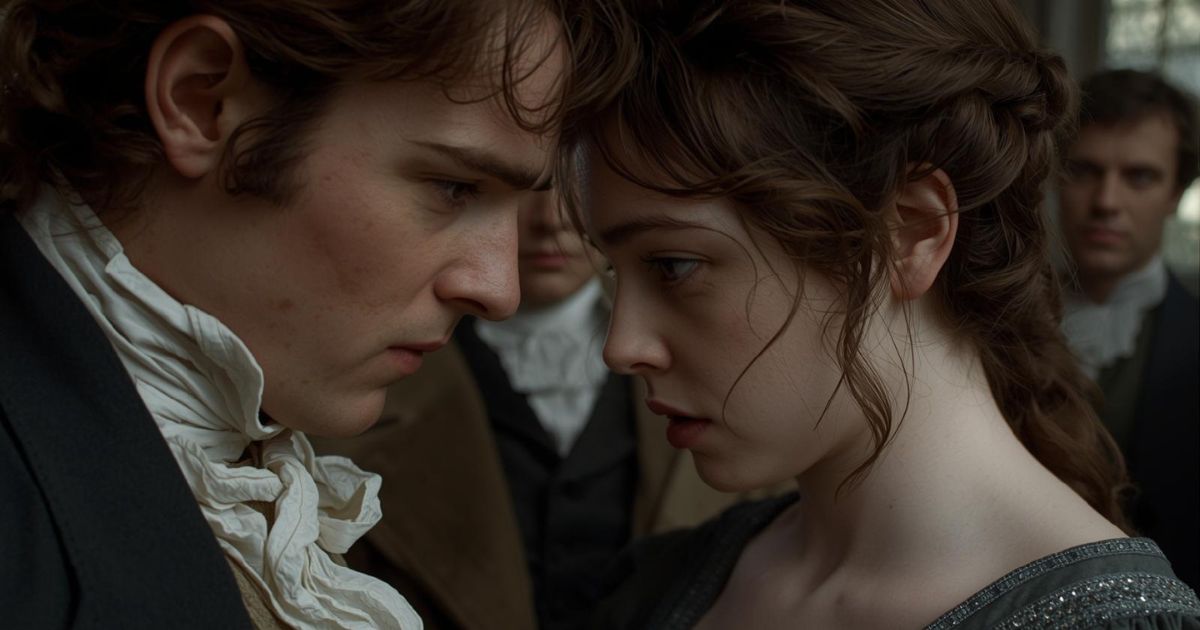
An excerpt from the original text.(complete · 1597 words)
[llustration]
When the ladies removed after dinner Elizabeth ran up to her sister, and
seeing her well guarded from cold, attended her into the drawing-room,
where she was welcomed by her two friends with many professions of
pleasure; and Elizabeth had never seen them so agreeable as they were
during the hour which passed before the gentlemen appeared. Their powers
of conversation were considerable. They could describe an entertainment
with accuracy, relate an anecdote with humour, and laugh at their
acquaintance with spirit.
But when the gentlemen entered, Jane was no longer the first object;
Miss Bingley’s eyes were instantly turned towards Darcy, and she had
something to say to him before he had advanced many steps. He addressed
himself directly to Miss Bennet with a polite congratulation; Mr. Hurst
also made her a slight bow, and said he was “very glad;” but diffuseness
and warmth remained for Bingley’s salutation. He was full of joy and
attention. The first half hour was spent in piling up the fire, lest she
should suffer from the change of room; and she removed, at his desire,
to the other side of the fireplace, that she might be farther from the
door. He then sat down by her, and talked scarcely to anyone else.
Elizabeth, at work in the opposite corner, saw it all with great
delight.
When tea was over Mr. Hurst reminded his sister-in-law of the
card-table--but in vain. She had obtained private intelligence that Mr.
Darcy did not wish for cards, and Mr. Hurst soon found even his open
petition rejected. She assured him that no one intended to play, and the
silence of the whole party on the subject seemed to justify her. Mr.
Hurst had, therefore, nothing to do but to stretch himself on one of the
sofas and go to sleep. Darcy took up a book. Miss Bingley did the same;
and Mrs. Hurst, principally occupied in playing with her bracelets and
rings, joined now and then in her brother’s conversation with Miss
Bennet.
Miss Bingley’s attention was quite as much engaged in watching Mr.
Darcy’s progress through his book, as in reading her own; and she was
perpetually either making some inquiry, or looking at his page. She
could not win him, however, to any conversation; he merely answered her
question and read on. At length, quite exhausted by the attempt to be
amused with her own book, which she had only chosen because it was the
second volume of his, she gave a great yawn and said, “How pleasant it
is to spend an evening in this way! I declare, after all, there is no
enjoyment like reading! How much sooner one tires of anything than of a
book! When I have a house of my own, I shall be miserable if I have not
an excellent library.”
No one made any reply. She then yawned again, threw aside her book, and
cast her eyes round the room in quest of some amusement; when, hearing
her brother mentioning a ball to Miss Bennet, she turned suddenly
towards him and said,--
“By the bye Charles, are you really serious in meditating a dance at
Netherfield? I would advise you, before you determine on it, to consult
the wishes of the present party; I am much mistaken if there are not
some among us to whom a ball would be rather a punishment than a
pleasure.”
“If you mean Darcy,” cried her brother, “he may go to bed, if he
chooses, before it begins; but as for the ball, it is quite a settled
thing, and as soon as Nicholls has made white soup enough I shall send
round my cards.”
“I should like balls infinitely better,” she replied, “if they were
carried on in a different manner; but there is something insufferably
tedious in the usual process of such a meeting. It would surely be much
more rational if conversation instead of dancing made the order of the
day.”
“Much more rational, my dear Caroline, I dare say; but it would not be
near so much like a ball.”
Miss Bingley made no answer, and soon afterwards got up and walked about
the room. Her figure was elegant, and she walked well; but Darcy, at
whom it was all aimed, was still inflexibly studious. In the
desperation of her feelings, she resolved on one effort more; and,
turning to Elizabeth, said,--
“Miss Eliza Bennet, let me persuade you to follow my example, and take a
turn about the room. I assure you it is very refreshing after sitting so
long in one attitude.”
Elizabeth was surprised, but agreed to it immediately. Miss Bingley
succeeded no less in the real object of her civility: Mr. Darcy looked
up. He was as much awake to the novelty of attention in that quarter as
Elizabeth herself could be, and unconsciously closed his book. He was
directly invited to join their party, but he declined it, observing that
he could imagine but two motives for their choosing to walk up and down
the room together, with either of which motives his joining them would
interfere. What could he mean? She was dying to know what could be his
meaning--and asked Elizabeth whether she could at all understand him.
“Not at all,” was her answer; “but, depend upon it, he means to be
severe on us, and our surest way of disappointing him will be to ask
nothing about it.”
Miss Bingley, however, was incapable of disappointing Mr. Darcy in
anything, and persevered, therefore, in requiring an explanation of his
two motives.
“I have not the smallest objection to explaining them,” said he, as soon
as she allowed him to speak. “You either choose this method of passing
the evening because you are in each other’s confidence, and have secret
affairs to discuss, or because you are conscious that your figures
appear to the greatest advantage in walking: if the first, I should be
completely in your way; and if the second, I can admire you much better
as I sit by the fire.”
“Oh, shocking!” cried Miss Bingley. “I never heard anything so
abominable. How shall we punish him for such a speech?”
“Nothing so easy, if you have but the inclination,” said Elizabeth. “We
can all plague and punish one another. Tease him--laugh at him. Intimate
as you are, you must know how it is to be done.”
“But upon my honour I do not. I do assure you that my intimacy has not
yet taught me that. Tease calmness of temper and presence of mind! No,
no; I feel he may defy us there. And as to laughter, we will not expose
ourselves, if you please, by attempting to laugh without a subject. Mr.
Darcy may hug himself.”
“Mr. Darcy is not to be laughed at!” cried Elizabeth. “That is an
uncommon advantage, and uncommon I hope it will continue, for it would
be a great loss to me to have many such acquaintance. I dearly love a
laugh.”
“Miss Bingley,” said he, “has given me credit for more than can be. The
wisest and best of men,--nay, the wisest and best of their actions,--may
be rendered ridiculous by a person whose first object in life is a
joke.”
“Certainly,” replied Elizabeth, “there are such people, but I hope I am
not one of them. I hope I never ridicule what is wise or good. Follies
and nonsense, whims and inconsistencies, do divert me, I own, and I
laugh at them whenever I can. But these, I suppose, are precisely what
you are without.”
“Perhaps that is not possible for anyone. But it has been the study of
my life to avoid those weaknesses which often expose a strong
understanding to ridicule.”
“Such as vanity and pride.”
“Yes, vanity is a weakness indeed. But pride--where there is a real
superiority of mind--pride will be always under good regulation.”
Elizabeth turned away to hide a smile.
“Your examination of Mr. Darcy is over, I presume,” said Miss Bingley;
“and pray what is the result?”
“I am perfectly convinced by it that Mr. Darcy has no defect. He owns it
himself without disguise.”
“No,” said Darcy, “I have made no such pretension. I have faults enough,
but they are not, I hope, of understanding. My temper I dare not vouch
for. It is, I believe, too little yielding; certainly too little for the
convenience of the world. I cannot forget the follies and vices of
others so soon as I ought, nor their offences against myself. My
feelings are not puffed about with every attempt to move them. My temper
would perhaps be called resentful. My good opinion once lost is lost for
ever.”
“That is a failing, indeed!” cried Elizabeth. “Implacable resentment
is a shade in a character. But you have chosen your fault well. I
really cannot laugh at it. You are safe from me.”
“There is, I believe, in every disposition a tendency to some particular
evil, a natural defect, which not even the best education can overcome.”
“And your defect is a propensity to hate everybody.”
“And yours,” he replied, with a smile, “is wilfully to misunderstand
them.”
“Do let us have a little music,” cried Miss Bingley, tired of a
conversation in which she had no share. “Louisa, you will not mind my
waking Mr. Hurst.”
Her sister made not the smallest objection, and the pianoforte was
opened; and Darcy, after a few moments’ recollection, was not sorry for
it. He began to feel the danger of paying Elizabeth too much attention.
[Illustration]
Master this chapter. Complete your experience
Purchase the complete book to access all chapters and support classic literature
As an Amazon Associate, we earn a small commission from qualifying purchases at no additional cost to you.
Available in paperback, hardcover, and e-book formats
Let's Analyse the Pattern
Why This Matters
Connect literature to life
This chapter teaches how to identify when someone is trying to diminish you to elevate themselves, and how your response determines who actually gains power in the situation.
Now let's explore the literary elements.
Key Quotes & Analysis
"I declare after all there is no enjoyment like reading! How much sooner one tires of any thing than of a book!"
Context: Caroline says this while trying to impress Darcy, but immediately abandons her book.
This shows Caroline's phoniness perfectly. She's performing what she thinks Darcy wants to hear rather than being genuine, and her actions immediately contradict her words.
"The indirect boast; for you are really proud of your defects in writing, because you consider them as proceeding from a rapidity of thought and carelessness of execution."
Context: Elizabeth challenges Darcy's claim about his character flaws.
Elizabeth sees right through people's attempts to make their weaknesses sound like strengths. She's calling out the way people disguise bragging as humility.
"Nothing is more deceitful than the appearance of humility. It is often only carelessness of opinion, and sometimes an indirect boast."
Context: Darcy responds during their verbal sparring about character flaws.
Darcy shows he's equally perceptive about human nature. This exchange reveals how well-matched Elizabeth and Darcy are intellectually, even as they challenge each other.
Thematic Threads
Class Warfare
In This Chapter
Caroline uses social status as a weapon against Elizabeth, highlighting her inferior family connections
Development
Escalating from earlier subtle hints to direct attacks in front of Darcy
In Your Life:
When you feel someone using their wealth, education, or connections to make you feel 'less than,' how do you respond without compromising your own values?
Authentic Confidence
In This Chapter
Elizabeth's unshakeable composure under social attack reveals her genuine self-worth
Development
Building from her initial boldness at the ball to proven grace under pressure
In Your Life:
How do you maintain your sense of self-worth when facing criticism or judgment from people you're trying to impress?
Jealousy's Blindness
In This Chapter
Caroline's obvious jealousy makes her strategies transparent and counterproductive
Development
Her desperation becoming more apparent as Darcy's interest in Elizabeth grows
In Your Life:
Think of a time when jealousy made you act in ways that actually pushed away what you wanted most - what would you do differently now?
Merit vs. Status
In This Chapter
Darcy increasingly values Elizabeth's intelligence over Caroline's social positioning
Development
His growing recognition that character matters more than breeding
In Your Life:
In your workplace or social circles, do you find yourself more drawn to people with impressive credentials or those who demonstrate genuine character and intelligence?
Social Performance
In This Chapter
The evening becomes theater where everyone plays roles while hiding true feelings
Development
The gap between public behavior and private desires widening for all characters
In Your Life:
How often do you find yourself putting on a performance in social situations, and what would happen if you allowed your authentic self to show through more?
You now have the context. Time to form your own thoughts.
Discussion Questions
- 1
What tactics does Caroline Bingley use to try to embarrass Elizabeth in front of Darcy, and how does Elizabeth respond?
- 2
Why does Caroline's strategy of putting Elizabeth down actually backfire and make Caroline look worse?
- 3
Think of a time when someone tried to make you look bad in front of others - at work, school, or family gatherings. What did they focus on to try to diminish you?
- 4
If you were in Elizabeth's position, how would you handle someone making snide comments about your background or family in front of people you want to impress?
- 5
What does this chapter reveal about the difference between trying to look impressive versus actually being impressive?
Critical Thinking Exercise
Map the Triangle Dynamic
Draw three circles representing Elizabeth, Caroline, and Darcy. For each person, write what they want from this social interaction and what tactics they use to get it. Then trace the arrows showing who has real power in this triangle and why. Notice how the person trying hardest to control the situation actually has the least control.
Consider:
- •Pay attention to who is reacting to whom - the person doing the reacting usually has less power
- •Consider what each person reveals about themselves through their behavior, not their words
- •Think about similar triangles in your own life where someone tries to use a third person to make you look bad
Coming Up Next...
Chapter 12
Elizabeth's stay at Netherfield comes to an end, but not before one final revealing conversation that will leave both her and Darcy with much to think about. The real test comes when she returns home to face her family's reaction to her absence.