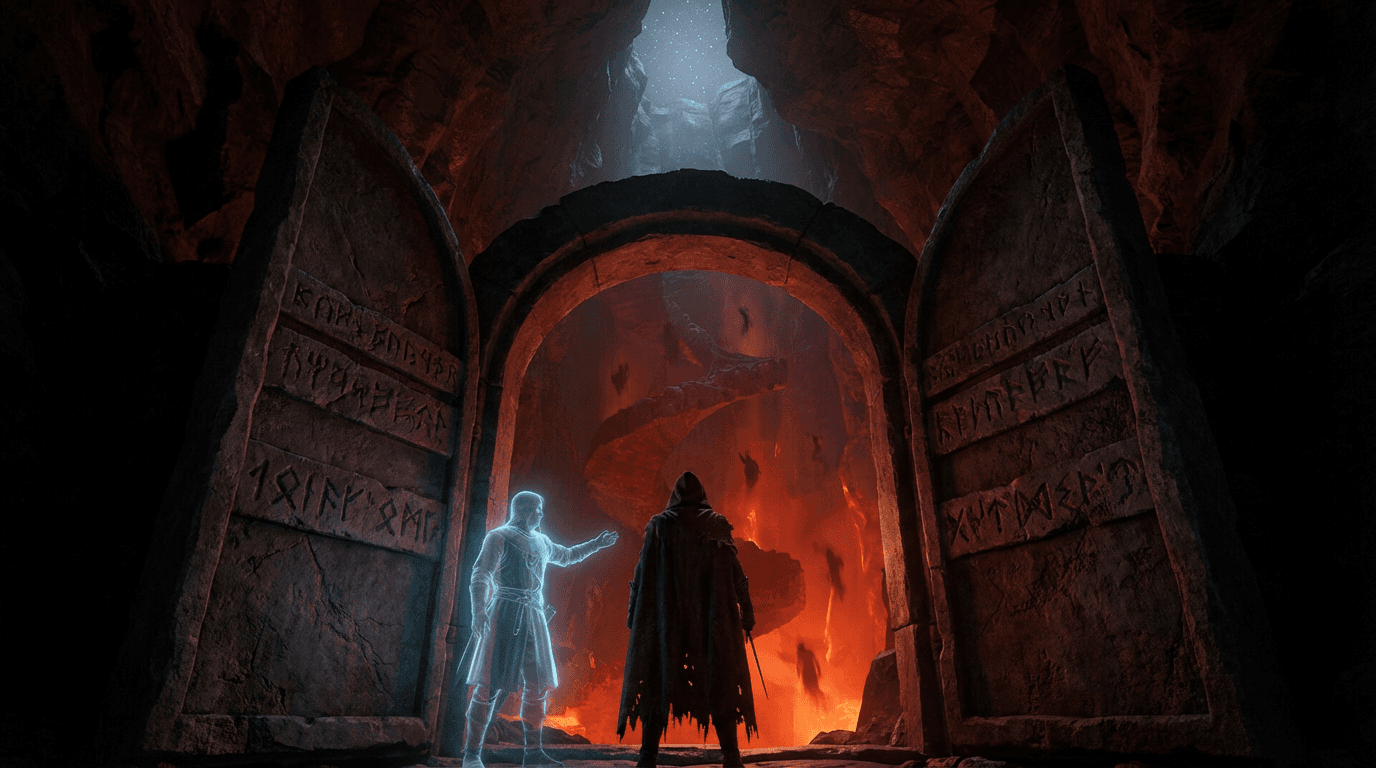
An excerpt from the original text.(complete · 4788 words)
Descend from Heaven, Urania, by that name
If rightly thou art called, whose voice divine
Following, above the Olympian hill I soar,
Above the flight of Pegasean wing!
The meaning, not the name, I call: for thou
Nor of the Muses nine, nor on the top
Of old Olympus dwellest; but, heavenly-born,
Before the hills appeared, or fountain flowed,
Thou with eternal Wisdom didst converse,
Wisdom thy sister, and with her didst play
In presence of the Almighty Father, pleased
With thy celestial song. Up led by thee
Into the Heaven of Heavens I have presumed,
An earthly guest, and drawn empyreal air,
Thy tempering: with like safety guided down
Return me to my native element:
Lest from this flying steed unreined, (as once
Bellerophon, though from a lower clime,)
Dismounted, on the Aleian field I fall,
Erroneous there to wander, and forlorn.
Half yet remains unsung, but narrower bound
Within the visible diurnal sphere;
Standing on earth, not rapt above the pole,
More safe I sing with mortal voice, unchanged
To hoarse or mute, though fallen on evil days,
On evil days though fallen, and evil tongues;
In darkness, and with dangers compassed round,
And solitude; yet not alone, while thou
Visitest my slumbers nightly, or when morn
Purples the east: still govern thou my song,
Urania, and fit audience find, though few.
But drive far off the barbarous dissonance
Of Bacchus and his revellers, the race
Of that wild rout that tore the Thracian bard
In Rhodope, where woods and rocks had ears
To rapture, till the savage clamour drowned
Both harp and voice; nor could the Muse defend
Her son. So fail not thou, who thee implores:
For thou art heavenly, she an empty dream.
Say, Goddess, what ensued when Raphael,
The affable Arch-Angel, had forewarned
Adam, by dire example, to beware
Apostasy, by what befel in Heaven
To those apostates; lest the like befall
In Paradise to Adam or his race,
Charged not to touch the interdicted tree,
If they transgress, and slight that sole command,
So easily obeyed amid the choice
Of all tastes else to please their appetite,
Though wandering. He, with his consorted Eve,
The story heard attentive, and was filled
With admiration and deep muse, to hear
Of things so high and strange; things, to their thought
So unimaginable, as hate in Heaven,
And war so near the peace of God in bliss,
With such confusion: but the evil, soon
Driven back, redounded as a flood on those
From whom it sprung; impossible to mix
With blessedness. Whence Adam soon repealed
The doubts that in his heart arose: and now
Led on, yet sinless, with desire to know
What nearer might concern him, how this world
Of Heaven and Earth conspicuous first began;
When, and whereof created; for what cause;
What within Eden, or without, was done
Before his memory; as one whose drouth
Yet scarce allayed still eyes the current stream,
Whose liquid murmur heard new thirst excites,
Proceeded thus to ask his heavenly guest.
Great things, and full of wonder in our ears,
Far differing from this world, thou hast revealed,
Divine interpreter! by favour sent
Down from the empyrean, to forewarn
Us timely of what might else have been our loss,
Unknown, which human knowledge could not reach;
For which to the infinitely Good we owe
Immortal thanks, and his admonishment
Receive, with solemn purpose to observe
Immutably his sovran will, the end
Of what we are. But since thou hast vouchsafed
Gently, for our instruction, to impart
Things above earthly thought, which yet concerned
Our knowing, as to highest wisdom seemed,
Deign to descend now lower, and relate
What may no less perhaps avail us known,
How first began this Heaven which we behold
Distant so high, with moving fires adorned
Innumerable; and this which yields or fills
All space, the ambient air wide interfused
Embracing round this floried Earth; what cause
Moved the Creator, in his holy rest
Through all eternity, so late to build
In Chaos; and the work begun, how soon
Absolved; if unforbid thou mayest unfold
What we, not to explore the secrets ask
Of his eternal empire, but the more
To magnify his works, the more we know.
And the great light of day yet wants to run
Much of his race though steep; suspense in Heaven,
Held by thy voice, thy potent voice, he hears,
And longer will delay to hear thee tell
His generation, and the rising birth
Of Nature from the unapparent Deep:
Or if the star of evening and the moon
Haste to thy audience, Night with her will bring,
Silence; and Sleep, listening to thee, will watch;
Or we can bid his absence, till thy song
End, and dismiss thee ere the morning shine.
Thus Adam his illustrious guest besought:
And thus the Godlike Angel answered mild.
This also thy request, with caution asked,
Obtain; though to recount almighty works
What words or tongue of Seraph can suffice,
Or heart of man suffice to comprehend?
Yet what thou canst attain, which best may serve
To glorify the Maker, and infer
Thee also happier, shall not be withheld
Thy hearing; such commission from above
I have received, to answer thy desire
Of knowledge within bounds; beyond, abstain
To ask; nor let thine own inventions hope
Things not revealed, which the invisible King,
Only Omniscient, hath suppressed in night;
To none communicable in Earth or Heaven:
Enough is left besides to search and know.
But knowledge is as food, and needs no less
Her temperance over appetite, to know
In measure what the mind may well contain;
Oppresses else with surfeit, and soon turns
Wisdom to folly, as nourishment to wind.
Know then, that, after Lucifer from Heaven
(So call him, brighter once amidst the host
Of Angels, than that star the stars among,)
Fell with his flaming legions through the deep
Into his place, and the great Son returned
Victorious with his Saints, the Omnipotent
Eternal Father from his throne beheld
Their multitude, and to his Son thus spake.
At least our envious Foe hath failed, who thought
All like himself rebellious, by whose aid
This inaccessible high strength, the seat
Of Deity supreme, us dispossessed,
He trusted to have seised, and into fraud
Drew many, whom their place knows here no more:
Yet far the greater part have kept, I see,
Their station; Heaven, yet populous, retains
Number sufficient to possess her realms
Though wide, and this high temple to frequent
With ministeries due, and solemn rites:
But, lest his heart exalt him in the harm
Already done, to have dispeopled Heaven,
My damage fondly deemed, I can repair
That detriment, if such it be to lose
Self-lost; and in a moment will create
Another world, out of one man a race
Of men innumerable, there to dwell,
Not here; till, by degrees of merit raised,
They open to themselves at length the way
Up hither, under long obedience tried;
And Earth be changed to Heaven, and Heaven to Earth,
One kingdom, joy and union without end.
Mean while inhabit lax, ye Powers of Heaven;
And thou my Word, begotten Son, by thee
This I perform; speak thou, and be it done!
My overshadowing Spirit and Might with thee
I send along; ride forth, and bid the Deep
Within appointed bounds be Heaven and Earth;
Boundless the Deep, because I Am who fill
Infinitude, nor vacuous the space.
Though I, uncircumscribed myself, retire,
And put not forth my goodness, which is free
To act or not, Necessity and Chance
Approach not me, and what I will is Fate.
So spake the Almighty, and to what he spake
His Word, the Filial Godhead, gave effect.
Immediate are the acts of God, more swift
Than time or motion, but to human ears
Cannot without process of speech be told,
So told as earthly notion can receive.
Great triumph and rejoicing was in Heaven,
When such was heard declared the Almighty’s will;
Glory they sung to the Most High, good will
To future men, and in their dwellings peace;
Glory to Him, whose just avenging ire
Had driven out the ungodly from his sight
And the habitations of the just; to Him
Glory and praise, whose wisdom had ordained
Good out of evil to create; instead
Of Spirits malign, a better race to bring
Into their vacant room, and thence diffuse
His good to worlds and ages infinite.
So sang the Hierarchies: Mean while the Son
On his great expedition now appeared,
Girt with Omnipotence, with radiance crowned
Of Majesty Divine; sapience and love
Immense, and all his Father in him shone.
About his chariot numberless were poured
Cherub, and Seraph, Potentates, and Thrones,
And Virtues, winged Spirits, and chariots winged
From the armoury of God; where stand of old
Myriads, between two brazen mountains lodged
Against a solemn day, harnessed at hand,
Celestial equipage; and now came forth
Spontaneous, for within them Spirit lived,
Attendant on their Lord: Heaven opened wide
Her ever-during gates, harmonious sound
On golden hinges moving, to let forth
The King of Glory, in his powerful Word
And Spirit, coming to create new worlds.
On heavenly ground they stood; and from the shore
They viewed the vast immeasurable abyss
Outrageous as a sea, dark, wasteful, wild,
Up from the bottom turned by furious winds
And surging waves, as mountains, to assault
Heaven’s highth, and with the center mix the pole.
Silence, ye troubled Waves, and thou Deep, peace,
Said then the Omnifick Word; your discord end!
Nor staid; but, on the wings of Cherubim
Uplifted, in paternal glory rode
Far into Chaos, and the world unborn;
For Chaos heard his voice: Him all his train
Followed in bright procession, to behold
Creation, and the wonders of his might.
Then staid the fervid wheels, and in his hand
He took the golden compasses, prepared
In God’s eternal store, to circumscribe
This universe, and all created things:
One foot he centered, and the other turned
Round through the vast profundity obscure;
And said, Thus far extend, thus far thy bounds,
This be thy just circumference, O World!
Thus God the Heaven created, thus the Earth,
Matter unformed and void: Darkness profound
Covered the abyss: but on the watery calm
His brooding wings the Spirit of God outspread,
And vital virtue infused, and vital warmth
Throughout the fluid mass; but downward purged
The black tartareous cold infernal dregs,
Adverse to life: then founded, then conglobed
Like things to like; the rest to several place
Disparted, and between spun out the air;
And Earth self-balanced on her center hung.
Let there be light, said God; and forthwith Light
Ethereal, first of things, quintessence pure,
Sprung from the deep; and from her native east
To journey through the aery gloom began,
Sphered in a radiant cloud, for yet the sun
Was not; she in a cloudy tabernacle
Sojourned the while. God saw the light was good;
And light from darkness by the hemisphere
Divided: light the Day, and darkness Night,
He named. Thus was the first day even and morn:
Nor past uncelebrated, nor unsung
By the celestial quires, when orient light
Exhaling first from darkness they beheld;
Birth-day of Heaven and Earth; with joy and shout
The hollow universal orb they filled,
And touched their golden harps, and hymning praised
God and his works; Creator him they sung,
Both when first evening was, and when first morn.
Again, God said, Let there be firmament
Amid the waters, and let it divide
The waters from the waters; and God made
The firmament, expanse of liquid, pure,
Transparent, elemental air, diffused
In circuit to the uttermost convex
Of this great round; partition firm and sure,
The waters underneath from those above
Dividing: for as earth, so he the world
Built on circumfluous waters calm, in wide
Crystalline ocean, and the loud misrule
Of Chaos far removed; lest fierce extremes
Contiguous might distemper the whole frame:
And Heaven he named the Firmament: So even
And morning chorus sung the second day.
The Earth was formed, but in the womb as yet
Of waters, embryon immature involved,
Appeared not: over all the face of Earth
Main ocean flowed, not idle; but, with warm
Prolifick humour softening all her globe,
Fermented the great mother to conceive,
Satiate with genial moisture; when God said,
Be gathered now ye waters under Heaven
Into one place, and let dry land appear.
Immediately the mountains huge appear
Emergent, and their broad bare backs upheave
Into the clouds; their tops ascend the sky:
So high as heaved the tumid hills, so low
Down sunk a hollow bottom broad and deep,
Capacious bed of waters: Thither they
Hasted with glad precipitance, uprolled,
As drops on dust conglobing from the dry:
Part rise in crystal wall, or ridge direct,
For haste; such flight the great command impressed
On the swift floods: As armies at the call
Of trumpet (for of armies thou hast heard)
Troop to their standard; so the watery throng,
Wave rolling after wave, where way they found,
If steep, with torrent rapture, if through plain,
Soft-ebbing; nor withstood them rock or hill;
But they, or under ground, or circuit wide
With serpent errour wandering, found their way,
And on the washy oose deep channels wore;
Easy, ere God had bid the ground be dry,
All but within those banks, where rivers now
Stream, and perpetual draw their humid train.
The dry land, Earth; and the great receptacle
Of congregated waters, he called Seas:
And saw that it was good; and said, Let the Earth
Put forth the verdant grass, herb yielding seed,
And fruit-tree yielding fruit after her kind,
Whose seed is in herself upon the Earth.
He scarce had said, when the bare Earth, till then
Desart and bare, unsightly, unadorned,
Brought forth the tender grass, whose verdure clad
Her universal face with pleasant green;
Then herbs of every leaf, that sudden flowered
Opening their various colours, and made gay
Her bosom, smelling sweet: and, these scarce blown,
Forth flourished thick the clustering vine, forth crept
The swelling gourd, up stood the corny reed
Embattled in her field, and the humble shrub,
And bush with frizzled hair implicit: Last
Rose, as in dance, the stately trees, and spread
Their branches hung with copious fruit, or gemmed
Their blossoms: With high woods the hills were crowned;
With tufts the valleys, and each fountain side;
With borders long the rivers: that Earth now
Seemed like to Heaven, a seat where Gods might dwell,
Or wander with delight, and love to haunt
Her sacred shades: though God had yet not rained
Upon the Earth, and man to till the ground
None was; but from the Earth a dewy mist
Went up, and watered all the ground, and each
Plant of the field; which, ere it was in the Earth,
God made, and every herb, before it grew
On the green stem: God saw that it was good:
So even and morn recorded the third day.
Again the Almighty spake, Let there be lights
High in the expanse of Heaven, to divide
The day from night; and let them be for signs,
For seasons, and for days, and circling years;
And let them be for lights, as I ordain
Their office in the firmament of Heaven,
To give light on the Earth; and it was so.
And God made two great lights, great for their use
To Man, the greater to have rule by day,
The less by night, altern; and made the stars,
And set them in the firmament of Heaven
To illuminate the Earth, and rule the day
In their vicissitude, and rule the night,
And light from darkness to divide. God saw,
Surveying his great work, that it was good:
For of celestial bodies first the sun
A mighty sphere he framed, unlightsome first,
Though of ethereal mould: then formed the moon
Globose, and every magnitude of stars,
And sowed with stars the Heaven, thick as a field:
Of light by far the greater part he took,
Transplanted from her cloudy shrine, and placed
In the sun’s orb, made porous to receive
And drink the liquid light; firm to retain
Her gathered beams, great palace now of light.
Hither, as to their fountain, other stars
Repairing, in their golden urns draw light,
And hence the morning-planet gilds her horns;
By tincture or reflection they augment
Their small peculiar, though from human sight
So far remote, with diminution seen,
First in his east the glorious lamp was seen,
Regent of day, and all the horizon round
Invested with bright rays, jocund to run
His longitude through Heaven’s high road; the gray
Dawn, and the Pleiades, before him danced,
Shedding sweet influence: Less bright the moon,
But opposite in levelled west was set,
His mirrour, with full face borrowing her light
From him; for other light she needed none
In that aspect, and still that distance keeps
Till night; then in the east her turn she shines,
Revolved on Heaven’s great axle, and her reign
With thousand lesser lights dividual holds,
With thousand thousand stars, that then appeared
Spangling the hemisphere: Then first adorned
With their bright luminaries that set and rose,
Glad evening and glad morn crowned the fourth day.
And God said, Let the waters generate
Reptile with spawn abundant, living soul:
And let fowl fly above the Earth, with wings
Displayed on the open firmament of Heaven.
And God created the great whales, and each
Soul living, each that crept, which plenteously
The waters generated by their kinds;
And every bird of wing after his kind;
And saw that it was good, and blessed them, saying.
Be fruitful, multiply, and in the seas,
And lakes, and running streams, the waters fill;
And let the fowl be multiplied, on the Earth.
Forthwith the sounds and seas, each creek and bay,
With fry innumerable swarm, and shoals
Of fish that with their fins, and shining scales,
Glide under the green wave, in sculls that oft
Bank the mid sea: part single, or with mate,
Graze the sea-weed their pasture, and through groves
Of coral stray; or, sporting with quick glance,
Show to the sun their waved coats dropt with gold;
Or, in their pearly shells at ease, attend
Moist nutriment; or under rocks their food
In jointed armour watch: on smooth the seal
And bended dolphins play: part huge of bulk
Wallowing unwieldy, enormous in their gait,
Tempest the ocean: there leviathan,
Hugest of living creatures, on the deep
Stretched like a promontory sleeps or swims,
And seems a moving land; and at his gills
Draws in, and at his trunk spouts out, a sea.
Mean while the tepid caves, and fens, and shores,
Their brood as numerous hatch, from the egg that soon
Bursting with kindly rupture forth disclosed
Their callow young; but feathered soon and fledge
They summed their pens; and, soaring the air sublime,
With clang despised the ground, under a cloud
In prospect; there the eagle and the stork
On cliffs and cedar tops their eyries build:
Part loosely wing the region, part more wise
In common, ranged in figure, wedge their way,
Intelligent of seasons, and set forth
Their aery caravan, high over seas
Flying, and over lands, with mutual wing
Easing their flight; so steers the prudent crane
Her annual voyage, borne on winds; the air
Floats as they pass, fanned with unnumbered plumes:
From branch to branch the smaller birds with song
Solaced the woods, and spread their painted wings
Till even; nor then the solemn nightingale
Ceased warbling, but all night tun’d her soft lays:
Others, on silver lakes and rivers, bathed
Their downy breast; the swan with arched neck,
Between her white wings mantling proudly, rows
Her state with oary feet; yet oft they quit
The dank, and, rising on stiff pennons, tower
The mid aereal sky: Others on ground
Walked firm; the crested cock whose clarion sounds
The silent hours, and the other whose gay train
Adorns him, coloured with the florid hue
Of rainbows and starry eyes. The waters thus
With fish replenished, and the air with fowl,
Evening and morn solemnized the fifth day.
The sixth, and of creation last, arose
With evening harps and matin; when God said,
Let the Earth bring forth soul living in her kind,
Cattle, and creeping things, and beast of the Earth,
Each in their kind. The Earth obeyed, and straight
Opening her fertile womb teemed at a birth
Innumerous living creatures, perfect forms,
Limbed and full grown: Out of the ground up rose,
As from his lair, the wild beast where he wons
In forest wild, in thicket, brake, or den;
Among the trees in pairs they rose, they walked:
The cattle in the fields and meadows green:
Those rare and solitary, these in flocks
Pasturing at once, and in broad herds upsprung.
The grassy clods now calved; now half appeared
The tawny lion, pawing to get free
His hinder parts, then springs as broke from bonds,
And rampant shakes his brinded mane; the ounce,
The libbard, and the tiger, as the mole
Rising, the crumbled earth above them threw
In hillocks: The swift stag from under ground
Bore up his branching head: Scarce from his mould
Behemoth biggest born of earth upheaved
His vastness: Fleeced the flocks and bleating rose,
As plants: Ambiguous between sea and land
The river-horse, and scaly crocodile.
At once came forth whatever creeps the ground,
Insect or worm: those waved their limber fans
For wings, and smallest lineaments exact
In all the liveries decked of summer’s pride
With spots of gold and purple, azure and green:
These, as a line, their long dimension drew,
Streaking the ground with sinuous trace; not all
Minims of nature; some of serpent-kind,
Wonderous in length and corpulence, involved
Their snaky folds, and added wings. First crept
The parsimonious emmet, provident
Of future; in small room large heart enclosed;
Pattern of just equality perhaps
Hereafter, joined in her popular tribes
Of commonalty: Swarming next appeared
The female bee, that feeds her husband drone
Deliciously, and builds her waxen cells
With honey stored: The rest are numberless,
And thou their natures knowest, and gavest them names,
Needless to thee repeated; nor unknown
The serpent, subtlest beast of all the field,
Of huge extent sometimes, with brazen eyes
And hairy mane terrifick, though to thee
Not noxious, but obedient at thy call.
Now Heaven in all her glory shone, and rolled
Her motions, as the great first Mover’s hand
First wheeled their course: Earth in her rich attire
Consummate lovely smiled; air, water, earth,
By fowl, fish, beast, was flown, was swum, was walked,
Frequent; and of the sixth day yet remained:
There wanted yet the master-work, the end
Of all yet done; a creature, who, not prone
And brute as other creatures, but endued
With sanctity of reason, might erect
His stature, and upright with front serene
Govern the rest, self-knowing; and from thence
Magnanimous to correspond with Heaven,
But grateful to acknowledge whence his good
Descends, thither with heart, and voice, and eyes
Directed in devotion, to adore
And worship God Supreme, who made him chief
Of all his works: therefore the Omnipotent
Eternal Father (for where is not he
Present?) thus to his Son audibly spake.
Let us make now Man in our image, Man
In our similitude, and let them rule
Over the fish and fowl of sea and air,
Beast of the field, and over all the Earth,
And every creeping thing that creeps the ground.
This said, he formed thee, Adam, thee, O Man,
Dust of the ground, and in thy nostrils breathed
The breath of life; in his own image he
Created thee, in the image of God
Express; and thou becamest a living soul.
Male he created thee; but thy consort
Female, for race; then blessed mankind, and said,
Be fruitful, multiply, and fill the Earth;
Subdue it, and throughout dominion hold
Over fish of the sea, and fowl of the air,
And every living thing that moves on the Earth.
Wherever thus created, for no place
Is yet distinct by name, thence, as thou knowest,
He brought thee into this delicious grove,
This garden, planted with the trees of God,
Delectable both to behold and taste;
And freely all their pleasant fruit for food
Gave thee; all sorts are here that all the Earth yields,
Variety without end; but of the tree,
Which, tasted, works knowledge of good and evil,
Thou mayest not; in the day thou eatest, thou diest;
Death is the penalty imposed; beware,
And govern well thy appetite; lest Sin
Surprise thee, and her black attendant Death.
Here finished he, and all that he had made
Viewed, and behold all was entirely good;
So even and morn accomplished the sixth day:
Yet not till the Creator from his work
Desisting, though unwearied, up returned,
Up to the Heaven of Heavens, his high abode;
Thence to behold this new created world,
The addition of his empire, how it showed
In prospect from his throne, how good, how fair,
Answering his great idea. Up he rode
Followed with acclamation, and the sound
Symphonious of ten thousand harps, that tuned
Angelick harmonies: The earth, the air
Resounded, (thou rememberest, for thou heardst,)
The heavens and all the constellations rung,
The planets in their station listening stood,
While the bright pomp ascended jubilant.
Open, ye everlasting gates! they sung,
Open, ye Heavens! your living doors; let in
The great Creator from his work returned
Magnificent, his six days work, a World;
Open, and henceforth oft; for God will deign
To visit oft the dwellings of just men,
Delighted; and with frequent intercourse
Thither will send his winged messengers
On errands of supernal grace. So sung
The glorious train ascending: He through Heaven,
That opened wide her blazing portals, led
To God’s eternal house direct the way;
A broad and ample road, whose dust is gold
And pavement stars, as stars to thee appear,
Seen in the galaxy, that milky way,
Which nightly, as a circling zone, thou seest
Powdered with stars. And now on Earth the seventh
Evening arose in Eden, for the sun
Was set, and twilight from the east came on,
Forerunning night; when at the holy mount
Of Heaven’s high-seated top, the imperial throne
Of Godhead, fixed for ever firm and sure,
The Filial Power arrived, and sat him down
With his great Father; for he also went
Invisible, yet staid, (such privilege
Hath Omnipresence) and the work ordained,
Author and End of all things; and, from work
Now resting, blessed and hallowed the seventh day,
As resting on that day from all his work,
But not in silence holy kept: the harp
Had work and rested not; the solemn pipe,
And dulcimer, all organs of sweet stop,
All sounds on fret by string or golden wire,
Tempered soft tunings, intermixed with voice
Choral or unison: of incense clouds,
Fuming from golden censers, hid the mount.
Creation and the six days acts they sung:
Great are thy works, Jehovah! infinite
Thy power! what thought can measure thee, or tongue
Relate thee! Greater now in thy return
Than from the giant Angels: Thee that day
Thy thunders magnified; but to create
Is greater than created to destroy.
Who can impair thee, Mighty King, or bound
Thy empire! Easily the proud attempt
Of Spirits apostate, and their counsels vain,
Thou hast repelled; while impiously they thought
Thee to diminish, and from thee withdraw
The number of thy worshippers. Who seeks
To lessen thee, against his purpose serves
To manifest the more thy might: his evil
Thou usest, and from thence createst more good.
Witness this new-made world, another Heaven
From Heaven-gate not far, founded in view
On the clear hyaline, the glassy sea;
Of amplitude almost immense, with stars
Numerous, and every star perhaps a world
Of destined habitation; but thou knowest
Their seasons: among these the seat of Men,
Earth, with her nether ocean circumfused,
Their pleasant dwelling-place. Thrice happy Men,
And sons of Men, whom God hath thus advanced!
Created in his image, there to dwell
And worship him; and in reward to rule
Over his works, on earth, in sea, or air,
And multiply a race of worshippers
Holy and just: Thrice happy, if they know
Their happiness, and persevere upright!
So sung they, and the empyrean rung
With halleluiahs: Thus was sabbath kept.
And thy request think now fulfilled, that asked
How first this world and face of things began,
And what before thy memory was done
From the beginning; that posterity,
Informed by thee, might know: If else thou seekest
Aught, not surpassing human measure, say.
Master this chapter. Complete your experience
Purchase the complete book to access all chapters and support classic literature
As an Amazon Associate, we earn a small commission from qualifying purchases at no additional cost to you.
Available in paperback, hardcover, and e-book formats
Let's Analyse the Pattern
Genuine desire to learn, expressed with humility and respect for boundaries, creates opportunities for deeper knowledge and stronger relationships.
Why This Matters
Connect literature to life
This chapter teaches how to distinguish between questions that seek understanding versus those that seek ammunition.
Practice This Today
This week, notice the tone and timing when people ask you difficult questions - are they genuinely curious or building a case against you?
Now let's explore the literary elements.
Key Quotes & Analysis
"The meaning, not the name, I call"
Context: Milton clarifies he's not calling on pagan muses but seeking true divine inspiration
This shows Milton's careful balance between classical literary tradition and Christian faith. He wants the power of epic poetry without compromising his religious beliefs.
In Today's Words:
I'm looking for the real deal, not just going through the motions
"Half yet remains unsung, but narrower bound / Within the visible diurnal sphere"
Context: Milton acknowledges he's moving from cosmic themes to earthly ones
The poet recognizes that after describing heavenly battles, he's now telling a more human-scale story. It's still epic, but more relatable to earthly experience.
In Today's Words:
I've covered the big cosmic stuff - now let's get down to what happens here on earth
"Knowledge is as food, and needs no less / Her temperance over appetite"
Context: Warning Adam about the dangers of unlimited curiosity
Raphael teaches that wisdom isn't just about gathering information - it's about knowing what you can handle and when to stop. Too much knowledge can be as harmful as too much food.
In Today's Words:
Information is like eating - you need to know when you've had enough, or you'll make yourself sick
Thematic Threads
Knowledge
In This Chapter
Raphael warns that knowledge needs moderation like food, and explains creation to satisfy Adam's curiosity while setting boundaries
Development
Expanded from earlier warnings about forbidden knowledge to show the difference between healthy and dangerous learning
In Your Life:
You might recognize this when deciding what questions to ask your supervisor or how much to probe into family drama
Authority
In This Chapter
God's creative authority is celebrated, while Raphael demonstrates how to share knowledge without undermining divine hierarchy
Development
Continues the theme of legitimate versus illegitimate authority from Satan's rebellion
In Your Life:
You see this when navigating how to learn from bosses, doctors, or other experts without seeming to challenge their expertise
Purpose
In This Chapter
Humans are created with specific purpose as stewards and worshippers, filling the gap left by fallen angels
Development
Builds on earlier hints about humanity's special role in the cosmic order
In Your Life:
You might struggle with this when questioning whether your work or relationships have deeper meaning beyond just getting by
Relationships
In This Chapter
Adam and Raphael model how curiosity and teaching can strengthen rather than threaten relationships
Development
Shows positive relationship dynamics in contrast to the manipulation and rebellion seen earlier
In Your Life:
You experience this when deciding how to ask personal questions or share knowledge without damaging trust
Creation
In This Chapter
The six days of creation show divine order, purpose, and celebration of each stage of development
Development
Introduced here as the positive counterpoint to destruction and rebellion
In Your Life:
You might recognize this pattern when building something meaningful in your life and celebrating each stage of progress
You now have the context. Time to form your own thoughts.
Discussion Questions
- 1
What does Adam ask Raphael about, and how does the angel respond to his request for knowledge?
analysis • surface - 2
Why does Raphael warn Adam that knowledge is like food that needs moderation? What's the difference between helpful and harmful curiosity?
analysis • medium - 3
Think about someone you know who asks great questions versus someone who asks questions that make people uncomfortable. What's the difference in how they approach seeking information?
application • medium - 4
When you want to learn something from a boss, teacher, or expert, how do you signal that you're genuinely curious rather than challenging their authority?
application • deep - 5
What does Adam's approach to learning reveal about the kind of curiosity that builds relationships versus the kind that damages them?
reflection • deep
Critical Thinking Exercise
Map Your Question Strategy
Think of a situation where you want to learn something important from someone in authority - a supervisor, doctor, teacher, or family member. Write down three questions you could ask: one that shows genuine curiosity, one that might come across as challenging, and one that demonstrates respect for their expertise while seeking understanding.
Consider:
- •Notice how the wording of your question signals your intent
- •Consider what the person gains or loses by answering your question
- •Think about timing - when is this person most likely to respond generously?
Journaling Prompt
Write about a time when someone responded really well to your questions versus a time when your curiosity seemed to make someone defensive. What was different about how you approached each situation?
Coming Up Next...
Chapter 8: The Cosmos, Companionship, and Creation's Design
Adam, deeply moved by this cosmic origin story, will express his gratitude and share his own first memories of awakening to consciousness in Paradise. But his curiosity isn't satisfied yet - he has more questions about his own creation and the mysterious companion God promised him.