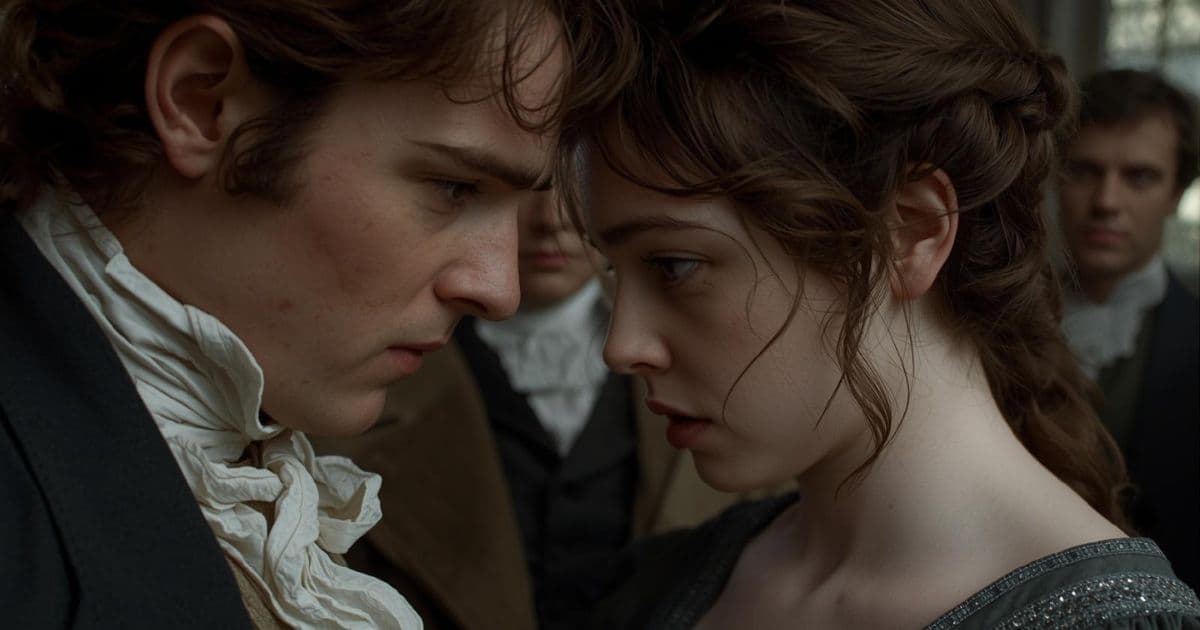
An excerpt from the original text.(complete · 1673 words)
he following conversation, which took place between the two friends in
the pump-room one morning, after an acquaintance of eight or nine days,
is given as a specimen of their very warm attachment, and of the
delicacy, discretion, originality of thought, and literary taste which
marked the reasonableness of that attachment.
They met by appointment; and as Isabella had arrived nearly five
minutes before her friend, her first address naturally was, “My dearest
creature, what can have made you so late? I have been waiting for you
at least this age!”
“Have you, indeed! i am very sorry for it; but really I thought I was
in very good time. It is but just one. I hope you have not been here
long?”
“Oh! these ten ages at least. I am sure I have been here this half
hour. But now, let us go and sit down at the other end of the room, and
enjoy ourselves. I have an hundred things to say to you. In the first
place, I was so afraid it would rain this morning, just as I wanted to
set off; it looked very showery, and that would have thrown me into
agonies! do you know, I saw the prettiest hat you can imagine, in a
shop window in Milsom Street just now—very like yours, only with
coquelicot ribbons instead of green; I quite longed for it. But, my
dearest Catherine, what have you been doing with yourself all this
morning? Have you gone on with Udolpho?”
“Yes, I have been reading it ever since I woke; and I am got to the
black veil.”
“Are you, indeed? How delightful! oh! i would not tell you what is
behind the black veil for the world! are not you wild to know?”
“Oh! yes, quite; what can it be? But do not tell me—I would not be told
upon any account. I know it must be a skeleton, I am sure it is
Laurentina’s skeleton. Oh! i am delighted with the book! i should like
to spend my whole life in reading it. I assure you, if it had not been
to meet you, I would not have come away from it for all the world.”
“Dear creature! how much I am obliged to you; and when you have
finished Udolpho, we will read the Italian together; and I have made
out a list of ten or twelve more of the same kind for you.”
“Have you, indeed! how glad I am! what are they all?”
“I will read you their names directly; here they are, in my pocketbook.
Castle of Wolfenbach, Clermont, Mysterious Warnings, Necromancer of the
Black Forest, Midnight Bell, Orphan of the Rhine, and Horrid Mysteries.
Those will last us some time.”
“Yes, pretty well; but are they all horrid, are you sure they are all
horrid?”
“Yes, quite sure; for a particular friend of mine, a Miss Andrews, a
sweet girl, one of the sweetest creatures in the world, has read every
one of them. I wish you knew Miss Andrews, you would be delighted with
her. She is netting herself the sweetest cloak you can conceive. I
think her as beautiful as an angel, and I am so vexed with the men for
not admiring her! i scold them all amazingly about it.”
“Scold them! do you scold them for not admiring her?”
“Yes, that I do. There is nothing I would not do for those who are
really my friends. I have no notion of loving people by halves; it is
not my nature. My attachments are always excessively strong. I told
Captain Hunt at one of our assemblies this winter that if he was to
tease me all night, I would not dance with him, unless he would allow
Miss Andrews to be as beautiful as an angel. The men think us incapable
of real friendship, you know, and I am determined to show them the
difference. Now, if I were to hear anybody speak slightingly of you, I
should fire up in a moment: but that is not at all likely, for you
are just the kind of girl to be a great favourite with the men.”
“Oh, dear!” cried Catherine, colouring. “How can you say so?”
“I know you very well; you have so much animation, which is exactly
what Miss Andrews wants, for I must confess there is something
amazingly insipid about her. Oh! i must tell you, that just after we
parted yesterday, I saw a young man looking at you so earnestly—I am
sure he is in love with you.” Catherine coloured, and disclaimed again.
Isabella laughed. “It is very true, upon my honour, but I see how it
is; you are indifferent to everybody’s admiration, except that of one
gentleman, who shall be nameless. Nay, I cannot blame you”—speaking
more seriously—“your feelings are easily understood. Where the heart is
really attached, I know very well how little one can be pleased with
the attention of anybody else. Everything is so insipid, so
uninteresting, that does not relate to the beloved object! i can
perfectly comprehend your feelings.”
“But you should not persuade me that I think so very much about Mr.
Tilney, for perhaps I may never see him again.”
“Not see him again! my dearest creature, do not talk of it. I am sure
you would be miserable if you thought so!”
“No, indeed, I should not. I do not pretend to say that I was not very
much pleased with him; but while I have Udolpho to read, I feel as if
nobody could make me miserable. Oh! the dreadful black veil! my dear
Isabella, I am sure there must be Laurentina’s skeleton behind it.”
“It is so odd to me, that you should never have read Udolpho before;
but I suppose Mrs. Morland objects to novels.”
“No, she does not. She very often reads Sir Charles Grandison herself;
but new books do not fall in our way.”
“Sir Charles Grandison! that is an amazing horrid book, is it not? I
remember Miss Andrews could not get through the first volume.”
“It is not like Udolpho at all; but yet I think it is very
entertaining.”
“Do you indeed! you surprise me; I thought it had not been readable.
But, my dearest Catherine, have you settled what to wear on your head
to-night? I am determined at all events to be dressed exactly like you.
The men take notice of that sometimes, you know.”
“But it does not signify if they do,” said Catherine, very innocently.
“Signify! oh, heavens! i make it a rule never to mind what they say.
They are very often amazingly impertinent if you do not treat them with
spirit, and make them keep their distance.”
“Are they? Well, I never observed that. They always behave very well
to me.”
“Oh! they give themselves such airs. They are the most conceited
creatures in the world, and think themselves of so much importance! by
the by, though I have thought of it a hundred times, I have always
forgot to ask you what is your favourite complexion in a man. Do you
like them best dark or fair?”
“I hardly know. I never much thought about it. Something between both,
I think. Brown—not fair, and—and not very dark.”
“Very well, Catherine. That is exactly he. I have not forgot your
description of Mr. Tilney—‘a brown skin, with dark eyes, and rather
dark hair.’ Well, my taste is different. I prefer light eyes, and as to
complexion—do you know—I like a sallow better than any other. You must
not betray me, if you should ever meet with one of your acquaintance
answering that description.”
“Betray you! what do you mean?”
“Nay, do not distress me. I believe I have said too much. Let us drop
the subject.”
Catherine, in some amazement, complied, and after remaining a few
moments silent, was on the point of reverting to what interested her at
that time rather more than anything else in the world, Laurentina’s
skeleton, when her friend prevented her, by saying, “For heaven’s sake!
Let us move away from this end of the room. Do you know, there are two
odious young men who have been staring at me this half hour. They
really put me quite out of countenance. Let us go and look at the
arrivals. They will hardly follow us there.”
Away they walked to the book; and while Isabella examined the names, it
was Catherine’s employment to watch the proceedings of these alarming
young men.
“They are not coming this way, are they? I hope they are not so
impertinent as to follow us. Pray let me know if they are coming. I am
determined I will not look up.”
In a few moments Catherine, with unaffected pleasure, assured her that
she need not be longer uneasy, as the gentlemen had just left the
pump-room.
“And which way are they gone?” said Isabella, turning hastily round.
“One was a very good-looking young man.”
“They went towards the church-yard.”
“Well, I am amazingly glad I have got rid of them! and now, what say
you to going to Edgar’s Buildings with me, and looking at my new hat?
You said you should like to see it.”
Catherine readily agreed. “Only,” she added, “perhaps we may overtake
the two young men.”
“Oh! never mind that. If we make haste, we shall pass by them
presently, and I am dying to show you my hat.”
“But if we only wait a few minutes, there will be no danger of our
seeing them at all.”
“I shall not pay them any such compliment, I assure you. I have no
notion of treating men with such respect. That is the way to spoil
them.”
Catherine had nothing to oppose against such reasoning; and therefore,
to show the independence of Miss Thorpe, and her resolution of humbling
the sex, they set off immediately as fast as they could walk, in
pursuit of the two young men.
Master this chapter. Complete your experience
Purchase the complete book to access all chapters and support classic literature
As an Amazon Associate, we earn a small commission from qualifying purchases at no additional cost to you.
Available in paperback, hardcover, and e-book formats
Let's Analyse the Pattern
The Performance Trap - When Actions Contradict Words
When people get so invested in maintaining their image that they constantly contradict their stated values while justifying the contradiction.
Why This Matters
Connect literature to life
This chapter teaches how to spot when people's actions consistently contradict their stated values and motivations.
Practice This Today
This week, notice when someone says one thing but their body language or follow-up actions suggest something entirely different.
Now let's explore the literary elements.
Key Quotes & Analysis
"My dearest creature, what can have made you so late? I have been waiting for you at least this age!"
Context: Isabella greets Catherine after arriving only five minutes early herself
Shows Isabella's tendency to dramatize everything and make herself the victim even in trivial situations. She creates problems where none exist to get attention and sympathy.
In Today's Words:
OMG where have you been? I've been here forever!
"But really I thought I was in very good time. It is but just one."
Context: Catherine's confused response to Isabella's dramatic accusation of lateness
Catherine's literal, honest response shows she doesn't understand that Isabella is performing drama, not expressing genuine grievance. She tries to solve a problem that doesn't actually exist.
In Today's Words:
But I'm right on time - it's exactly when we said we'd meet.
"How can you say so? But when I tell you that you will not meet with a more agreeable man in the world."
Context: Isabella contradicts herself about Miss Andrews within the same conversation
Demonstrates how Isabella's opinions change based on what serves her socially in the moment. She has no consistent principles, only shifting strategies for getting attention.
In Today's Words:
How can you say that? She's literally the nicest person ever.
Thematic Threads
Social Performance
In This Chapter
Isabella performs emotions she doesn't feel and creates elaborate justifications for contradictory behavior
Development
Introduced here - shows how social expectations create artificial personas
In Your Life:
You might recognize this in friends who always have drama but claim to hate conflict.
Friendship Manipulation
In This Chapter
Isabella uses friendship language while consistently prioritizing her own interests over Catherine's
Development
Building from earlier chapters where their friendship seemed genuine
In Your Life:
This appears when someone claims deep friendship but only contacts you when they need something.
Attention-Seeking
In This Chapter
Isabella creates scenes about unwanted male attention while actively pursuing it
Development
Introduced here - reveals the gap between public persona and private desires
In Your Life:
You see this in people who complain about drama while always being at the center of it.
Naive Trust
In This Chapter
Catherine takes Isabella's words at face value and misses the contradictions
Development
Continues Catherine's pattern of trusting appearances over actions
In Your Life:
This happens when you believe what people say instead of watching what they consistently do.
Class Performance
In This Chapter
Isabella performs proper feminine behavior while violating its actual principles
Development
Builds on earlier class themes by showing how social rules become theater
In Your Life:
You might see this in workplace situations where people perform professionalism while being fundamentally unprofessional.
You now have the context. Time to form your own thoughts.
Discussion Questions
- 1
What contradictions do you notice between what Isabella says and what she actually does in this chapter?
analysis • surface - 2
Why do you think Isabella creates such elaborate justifications for pursuing the young men after claiming to be offended by their attention?
analysis • medium - 3
Where do you see people today saying one thing while doing the opposite, especially on social media or in workplace situations?
application • medium - 4
When someone in your life consistently contradicts their stated values with their actions, how do you decide whether to trust their words or their behavior?
application • deep - 5
What does Isabella's performance reveal about the pressure people feel to maintain a certain image, and how does this pressure create internal conflict?
reflection • deep
Critical Thinking Exercise
Track the Performance Pattern
Think of someone you know who frequently says one thing but does another. Map out three specific examples where their actions contradicted their stated values or intentions. For each example, identify what they said, what they actually did, and what they might have really wanted underneath the performance.
Consider:
- •Look for patterns across multiple situations, not just isolated incidents
- •Consider what pressures or fears might drive them to perform rather than be direct
- •Think about how you can respond to their actual behavior rather than their stated intentions
Journaling Prompt
Write about a time when you caught yourself performing emotions you didn't really feel or justifying behavior that contradicted your stated values. What were you really trying to achieve, and what would have happened if you'd been more direct about your actual desires?
Coming Up Next...
Chapter 7: Meeting John Thorpe: Red Flags in Plain Sight
The chase continues as Catherine and Isabella pursue the mysterious young men through Bath's crowded streets. But navigating the busy intersection at Cheap Street proves more challenging than expected, and their 'accidental' encounter may not go as planned.