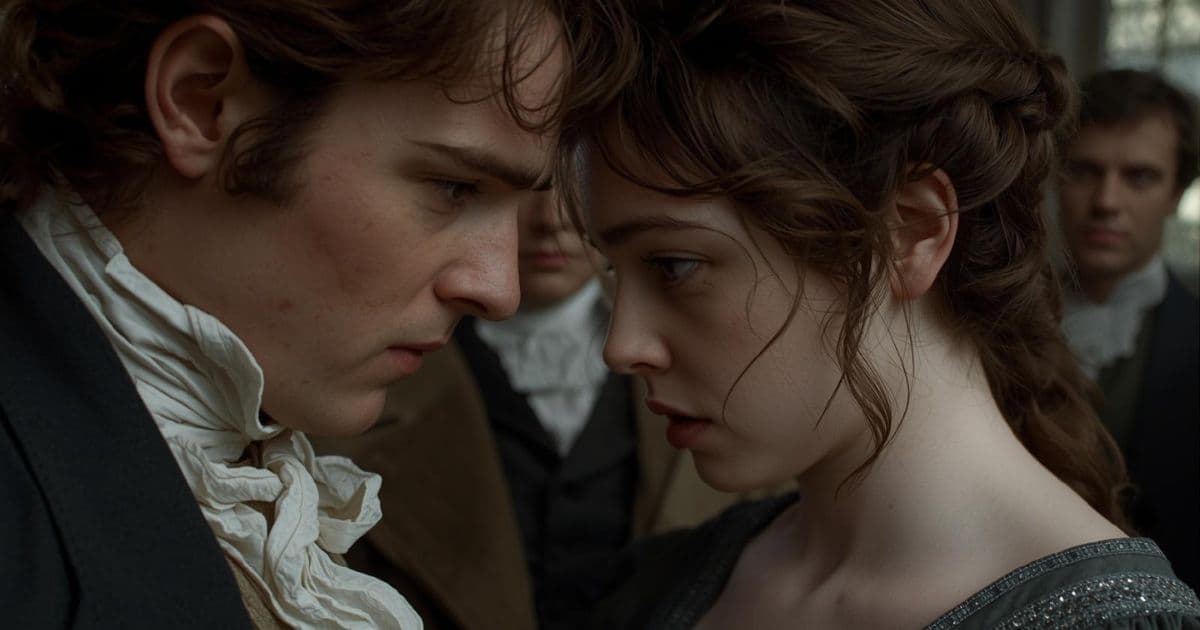
An excerpt from the original text.(complete · 2900 words)
he visions of romance were over. Catherine was completely awakened.
Henry’s address, short as it had been, had more thoroughly opened her
eyes to the extravagance of her late fancies than all their several
disappointments had done. Most grievously was she humbled. Most
bitterly did she cry. It was not only with herself that she was
sunk—but with Henry. Her folly, which now seemed even criminal, was all
exposed to him, and he must despise her forever. The liberty which her
imagination had dared to take with the character of his father—could he
ever forgive it? The absurdity of her curiosity and her fears—could
they ever be forgotten? She hated herself more than she could express.
He had—she thought he had, once or twice before this fatal morning,
shown something like affection for her. But now—in short, she made
herself as miserable as possible for about half an hour, went down when
the clock struck five, with a broken heart, and could scarcely give an
intelligible answer to Eleanor’s inquiry if she was well. The
formidable Henry soon followed her into the room, and the only
difference in his behaviour to her was that he paid her rather more
attention than usual. Catherine had never wanted comfort more, and he
looked as if he was aware of it.
The evening wore away with no abatement of this soothing politeness;
and her spirits were gradually raised to a modest tranquillity. She did
not learn either to forget or defend the past; but she learned to hope
that it would never transpire farther, and that it might not cost her
Henry’s entire regard. Her thoughts being still chiefly fixed on what
she had with such causeless terror felt and done, nothing could shortly
be clearer than that it had been all a voluntary, self-created
delusion, each trifling circumstance receiving importance from an
imagination resolved on alarm, and everything forced to bend to one
purpose by a mind which, before she entered the abbey, had been craving
to be frightened. She remembered with what feelings she had prepared
for a knowledge of Northanger. She saw that the infatuation had been
created, the mischief settled, long before her quitting Bath, and it
seemed as if the whole might be traced to the influence of that sort of
reading which she had there indulged.
Charming as were all Mrs. Radcliffe’s works, and charming even as were
the works of all her imitators, it was not in them perhaps that human
nature, at least in the Midland counties of England, was to be looked
for. Of the Alps and Pyrenees, with their pine forests and their vices,
they might give a faithful delineation; and Italy, Switzerland, and the
south of France might be as fruitful in horrors as they were there
represented. Catherine dared not doubt beyond her own country, and even
of that, if hard pressed, would have yielded the northern and western
extremities. But in the central part of England there was surely some
security for the existence even of a wife not beloved, in the laws of
the land, and the manners of the age. Murder was not tolerated,
servants were not slaves, and neither poison nor sleeping potions to be
procured, like rhubarb, from every druggist. Among the Alps and
Pyrenees, perhaps, there were no mixed characters. There, such as were
not as spotless as an angel might have the dispositions of a fiend. But
in England it was not so; among the English, she believed, in their
hearts and habits, there was a general though unequal mixture of good
and bad. Upon this conviction, she would not be surprised if even in
Henry and Eleanor Tilney, some slight imperfection might hereafter
appear; and upon this conviction she need not fear to acknowledge some
actual specks in the character of their father, who, though cleared
from the grossly injurious suspicions which she must ever blush to have
entertained, she did believe, upon serious consideration, to be not
perfectly amiable.
Her mind made up on these several points, and her resolution formed, of
always judging and acting in future with the greatest good sense, she
had nothing to do but to forgive herself and be happier than ever; and
the lenient hand of time did much for her by insensible gradations in
the course of another day. Henry’s astonishing generosity and nobleness
of conduct, in never alluding in the slightest way to what had passed,
was of the greatest assistance to her; and sooner than she could have
supposed it possible in the beginning of her distress, her spirits
became absolutely comfortable, and capable, as heretofore, of continual
improvement by anything he said. There were still some subjects,
indeed, under which she believed they must always tremble—the mention
of a chest or a cabinet, for instance—and she did not love the sight of
japan in any shape: but even she could allow that an occasional
memento of past folly, however painful, might not be without use.
The anxieties of common life began soon to succeed to the alarms of
romance. Her desire of hearing from Isabella grew every day greater.
She was quite impatient to know how the Bath world went on, and how the
rooms were attended; and especially was she anxious to be assured of
Isabella’s having matched some fine netting-cotton, on which she had
left her intent; and of her continuing on the best terms with James.
Her only dependence for information of any kind was on Isabella. James
had protested against writing to her till his return to Oxford; and
Mrs. Allen had given her no hopes of a letter till she had got back to
Fullerton. But Isabella had promised and promised again; and when she
promised a thing, she was so scrupulous in performing it! this made it
so particularly strange!
For nine successive mornings, Catherine wondered over the repetition of
a disappointment, which each morning became more severe: but, on the
tenth, when she entered the breakfast-room, her first object was a
letter, held out by Henry’s willing hand. She thanked him as heartily
as if he had written it himself. “’Tis only from James, however,” as
she looked at the direction. She opened it; it was from Oxford; and to
this purpose:
“Dear Catherine,
“Though, God knows, with little inclination for writing, I think it
my duty to tell you that everything is at an end between Miss
Thorpe and me. I left her and Bath yesterday, never to see either
again. I shall not enter into particulars—they would only pain you
more. You will soon hear enough from another quarter to know where
lies the blame; and I hope will acquit your brother of everything
but the folly of too easily thinking his affection returned. Thank
God! i am undeceived in time! but it is a heavy blow! after my
father’s consent had been so kindly given—but no more of this. She
has made me miserable forever! let me soon hear from you, dear
Catherine; you are my only friend; your love I do build upon. I
wish your visit at Northanger may be over before Captain Tilney
makes his engagement known, or you will be uncomfortably
circumstanced. Poor Thorpe is in town: I dread the sight of him;
his honest heart would feel so much. I have written to him and my
father. Her duplicity hurts me more than all; till the very last,
if I reasoned with her, she declared herself as much attached to me
as ever, and laughed at my fears. I am ashamed to think how long I
bore with it; but if ever man had reason to believe himself loved,
I was that man. I cannot understand even now what she would be at,
for there could be no need of my being played off to make her
secure of Tilney. We parted at last by mutual consent—happy for me
had we never met! i can never expect to know such another woman!
Dearest Catherine, beware how you give your heart.
“Believe me,” &c.
Catherine had not read three lines before her sudden change of
countenance, and short exclamations of sorrowing wonder, declared her
to be receiving unpleasant news; and Henry, earnestly watching her
through the whole letter, saw plainly that it ended no better than it
began. He was prevented, however, from even looking his surprise by his
father’s entrance. They went to breakfast directly; but Catherine could
hardly eat anything. Tears filled her eyes, and even ran down her
cheeks as she sat. The letter was one moment in her hand, then in her
lap, and then in her pocket; and she looked as if she knew not what she
did. The General, between his cocoa and his newspaper, had luckily no
leisure for noticing her; but to the other two her distress was equally
visible. As soon as she dared leave the table she hurried away to her
own room; but the housemaids were busy in it, and she was obliged to
come down again. She turned into the drawing-room for privacy, but
Henry and Eleanor had likewise retreated thither, and were at that
moment deep in consultation about her. She drew back, trying to beg
their pardon, but was, with gentle violence, forced to return; and the
others withdrew, after Eleanor had affectionately expressed a wish of
being of use or comfort to her.
After half an hour’s free indulgence of grief and reflection, Catherine
felt equal to encountering her friends; but whether she should make her
distress known to them was another consideration. Perhaps, if
particularly questioned, she might just give an idea—just distantly
hint at it—but not more. To expose a friend, such a friend as Isabella
had been to her—and then their own brother so closely concerned in it!
She believed she must waive the subject altogether. Henry and Eleanor
were by themselves in the breakfast-room; and each, as she entered it,
looked at her anxiously. Catherine took her place at the table, and,
after a short silence, Eleanor said, “No bad news from Fullerton, I
hope? Mr. and Mrs. Morland—your brothers and sisters—I hope they are
none of them ill?”
“No, I thank you” (sighing as she spoke); “they are all very well. My
letter was from my brother at Oxford.”
Nothing further was said for a few minutes; and then speaking through
her tears, she added, “I do not think I shall ever wish for a letter
again!”
“I am sorry,” said Henry, closing the book he had just opened; “if I
had suspected the letter of containing anything unwelcome, I should
have given it with very different feelings.”
“It contained something worse than anybody could suppose! poor James is
so unhappy! you will soon know why.”
“To have so kind-hearted, so affectionate a sister,” replied Henry
warmly, “must be a comfort to him under any distress.”
“I have one favour to beg,” said Catherine, shortly afterwards, in an
agitated manner, “that, if your brother should be coming here, you will
give me notice of it, that I may go away.”
“Our brother! frederick!”
“Yes; I am sure I should be very sorry to leave you so soon, but
something has happened that would make it very dreadful for me to be in
the same house with Captain Tilney.”
Eleanor’s work was suspended while she gazed with increasing
astonishment; but Henry began to suspect the truth, and something, in
which Miss Thorpe’s name was included, passed his lips.
“How quick you are!” cried Catherine: “you have guessed it, I declare!
And yet, when we talked about it in Bath, you little thought of its
ending so. Isabella—no wonder now I have not heard from her—Isabella
has deserted my brother, and is to marry yours! could you have believed
there had been such inconstancy and fickleness, and everything that is
bad in the world?”
“I hope, so far as concerns my brother, you are misinformed. I hope he
has not had any material share in bringing on Mr. Morland’s
disappointment. His marrying Miss Thorpe is not probable. I think you
must be deceived so far. I am very sorry for Mr. Morland—sorry that
anyone you love should be unhappy; but my surprise would be greater at
Frederick’s marrying her than at any other part of the story.”
“It is very true, however; you shall read James’s letter yourself.
Stay—There is one part—” recollecting with a blush the last line.
“Will you take the trouble of reading to us the passages which concern
my brother?”
“No, read it yourself,” cried Catherine, whose second thoughts were
clearer. “I do not know what I was thinking of” (blushing again that
she had blushed before); “James only means to give me good advice.”
He gladly received the letter, and, having read it through, with close
attention, returned it saying, “Well, if it is to be so, I can only say
that I am sorry for it. Frederick will not be the first man who has
chosen a wife with less sense than his family expected. I do not envy
his situation, either as a lover or a son.”
Miss Tilney, at Catherine’s invitation, now read the letter likewise,
and, having expressed also her concern and surprise, began to inquire
into Miss Thorpe’s connections and fortune.
“Her mother is a very good sort of woman,” was Catherine’s answer.
“What was her father?”
“A lawyer, I believe. They live at Putney.”
“Are they a wealthy family?”
“No, not very. I do not believe Isabella has any fortune at all: but
that will not signify in your family. Your father is so very liberal!
He told me the other day that he only valued money as it allowed him to
promote the happiness of his children.” The brother and sister looked
at each other. “But,” said Eleanor, after a short pause, “would it be
to promote his happiness, to enable him to marry such a girl? She must
be an unprincipled one, or she could not have used your brother so. And
how strange an infatuation on Frederick’s side! a girl who, before his
eyes, is violating an engagement voluntarily entered into with another
man! is not it inconceivable, Henry? Frederick too, who always wore his
heart so proudly! who found no woman good enough to be loved!”
“That is the most unpromising circumstance, the strongest presumption
against him. When I think of his past declarations, I give him up.
Moreover, I have too good an opinion of Miss Thorpe’s prudence to
suppose that she would part with one gentleman before the other was
secured. It is all over with Frederick indeed! he is a deceased
man—defunct in understanding. Prepare for your sister-in-law, Eleanor,
and such a sister-in-law as you must delight in! open, candid, artless,
guileless, with affections strong but simple, forming no pretensions,
and knowing no disguise.”
“Such a sister-in-law, Henry, I should delight in,” said Eleanor with a
smile.
“But perhaps,” observed Catherine, “though she has behaved so ill by
our family, she may behave better by yours. Now she has really got the
man she likes, she may be constant.”
“Indeed I am afraid she will,” replied Henry; “I am afraid she will be
very constant, unless a baronet should come in her way; that is
Frederick’s only chance. I will get the Bath paper, and look over the
arrivals.”
“You think it is all for ambition, then? And, upon my word, there are
some things that seem very like it. I cannot forget that, when she
first knew what my father would do for them, she seemed quite
disappointed that it was not more. I never was so deceived in anyone’s
character in my life before.”
“Among all the great variety that you have known and studied.”
“My own disappointment and loss in her is very great; but, as for poor
James, I suppose he will hardly ever recover it.”
“Your brother is certainly very much to be pitied at present; but we
must not, in our concern for his sufferings, undervalue yours. You
feel, I suppose, that in losing Isabella, you lose half yourself: you
feel a void in your heart which nothing else can occupy. Society is
becoming irksome; and as for the amusements in which you were wont to
share at Bath, the very idea of them without her is abhorrent. You
would not, for instance, now go to a ball for the world. You feel that
you have no longer any friend to whom you can speak with unreserve, on
whose regard you can place dependence, or whose counsel, in any
difficulty, you could rely on. You feel all this?”
“No,” said Catherine, after a few moments’ reflection, “I do not—ought
I? To say the truth, though I am hurt and grieved, that I cannot still
love her, that I am never to hear from her, perhaps never to see her
again, I do not feel so very, very much afflicted as one would have
thought.”
“You feel, as you always do, what is most to the credit of human
nature. Such feelings ought to be investigated, that they may know
themselves.”
Catherine, by some chance or other, found her spirits so very much
relieved by this conversation that she could not regret her being led
on, though so unaccountably, to mention the circumstance which had
produced it.
Master this chapter. Complete your experience
Purchase the complete book to access all chapters and support classic literature
As an Amazon Associate, we earn a small commission from qualifying purchases at no additional cost to you.
Available in paperback, hardcover, and e-book formats
Let's Analyse the Pattern
The uncomfortable but necessary process of checking our beliefs and assumptions against actual evidence to avoid costly mistakes.
Why This Matters
Connect literature to life
This chapter teaches how to distinguish between who we want people to be and who they actually are through their consistent actions.
Practice This Today
This week, notice when you're filling gaps in knowledge about someone with assumptions, and look for three specific actions that either support or contradict your beliefs about them.
Now let's explore the literary elements.
Key Quotes & Analysis
"The visions of romance were over. Catherine was completely awakened."
Context: Opening line as Catherine snaps out of her gothic fantasy delusions
This marks Catherine's transition from fantasy to reality. She's finally seeing the world as it actually is rather than through the dramatic lens of her novels. It's both a loss of innocence and a gain in wisdom.
In Today's Words:
Reality check complete - the daydream is officially over.
"Her folly, which now seemed even criminal, was all exposed to him, and he must despise her forever."
Context: Catherine's internal panic about what Henry must think of her
Shows how shame can make us catastrophize and assume the worst about how others see us. Catherine's convinced Henry will never forgive her, but she's wrong about his reaction.
In Today's Words:
I made such an idiot of myself - he's definitely going to think I'm crazy forever.
"The formidable Henry soon followed her into the room, and the only difference in his behaviour to her was that he paid her rather more attention than usual."
Context: Henry's surprising kindness when Catherine expects judgment
Henry's emotional intelligence shines here. Instead of making Catherine feel worse, he intuitively gives her the support she needs. His 'formidable' reputation is just Catherine's embarrassment talking.
In Today's Words:
The guy she was scared to face actually went out of his way to be extra nice to her.
Thematic Threads
Personal Growth
In This Chapter
Catherine matures by abandoning gothic fantasies and seeing Isabella's true nature
Development
Evolved from naive romanticism to evidence-based thinking
In Your Life:
Growth often means abandoning comfortable illusions about people or situations you believed in.
Class
In This Chapter
Isabella's pursuit of Captain Tilney reveals her mercenary approach to social climbing
Development
Consistent theme showing how class ambitions drive behavior
In Your Life:
Watch for people who seem more interested in your status or resources than in you as a person.
Human Relationships
In This Chapter
Catherine discovers her friendship with Isabella wasn't as deep as she thought
Development
Building on earlier hints about Isabella's superficiality
In Your Life:
Real friendships survive disappointments and challenges - fair-weather friends disappear when things get difficult.
Social Expectations
In This Chapter
Henry and Eleanor doubt Frederick would marry someone so obviously fortune-hunting
Development
Ongoing exploration of how society judges matches and motivations
In Your Life:
Others can often see red flags in your relationships that you're too close to notice.
Identity
In This Chapter
Catherine's sense of self shifts as she abandons both gothic fantasies and blind loyalty to Isabella
Development
Continuing journey from borrowed identity to authentic self-knowledge
In Your Life:
Your identity gets stronger when you stop defining yourself through fantasies or toxic relationships.
You now have the context. Time to form your own thoughts.
Discussion Questions
- 1
What two major reality checks does Catherine experience in this chapter, and how does she react to each one?
analysis • surface - 2
Why do you think Henry responds to Catherine's embarrassment with kindness rather than mockery, and what does this reveal about his character?
analysis • medium - 3
Where have you seen people create fantasy versions of relationships or situations that don't match reality? What usually causes these bubbles to burst?
application • medium - 4
When you discover someone isn't who you thought they were, how do you decide whether to adjust your expectations or end the relationship?
application • deep - 5
Catherine feels less devastated by Isabella's betrayal than she expected. What does this suggest about the difference between genuine connection and surface-level friendship?
reflection • deep
Critical Thinking Exercise
Reality Test Your Current Assumptions
Think of someone in your life about whom you have strong positive or negative feelings. Write down three specific beliefs you hold about this person, then identify what concrete evidence supports each belief versus what you've assumed or projected. Look for patterns in where your assumptions fill gaps in actual knowledge.
Consider:
- •Distinguish between what people say and what they consistently do
- •Notice if your beliefs about someone serve your emotional needs more than reflect reality
- •Consider whether you're applying movie or book logic to real-life situations
Journaling Prompt
Write about a time when discovering someone's true character was painful but ultimately helpful. How did that experience change how you evaluate people now?
Coming Up Next...
Chapter 26: The Visit to Woodston
The three young people continue discussing Isabella's shocking betrayal, but they're all convinced General Tilney will never approve of such an unsuitable match for his son. Catherine begins to understand the harsh realities of social class and money in marriage.