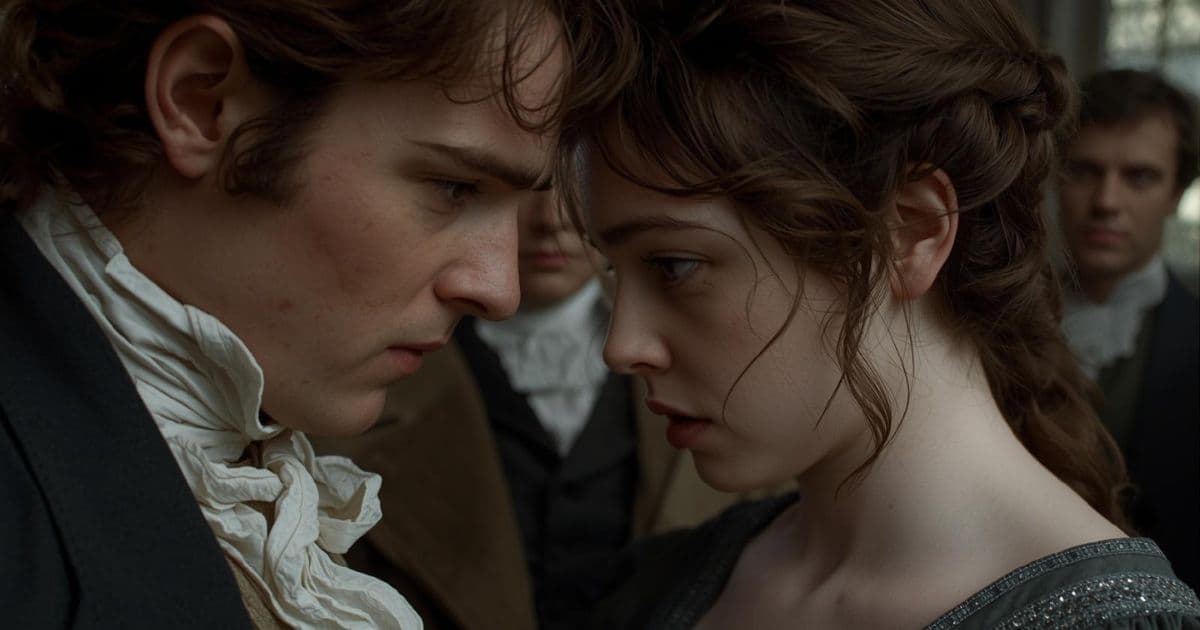
An excerpt from the original text.(complete · 2740 words)
atherine’s expectations of pleasure from her visit in Milsom Street
were so very high that disappointment was inevitable; and accordingly,
though she was most politely received by General Tilney, and kindly
welcomed by his daughter, though Henry was at home, and no one else of
the party, she found, on her return, without spending many hours in the
examination of her feelings, that she had gone to her appointment
preparing for happiness which it had not afforded. Instead of finding
herself improved in acquaintance with Miss Tilney, from the intercourse
of the day, she seemed hardly so intimate with her as before; instead
of seeing Henry Tilney to greater advantage than ever, in the ease of a
family party, he had never said so little, nor been so little
agreeable; and, in spite of their father’s great civilities to her—in
spite of his thanks, invitations, and compliments—it had been a release
to get away from him. It puzzled her to account for all this. It could
not be General Tilney’s fault. That he was perfectly agreeable and
good-natured, and altogether a very charming man, did not admit of a
doubt, for he was tall and handsome, and Henry’s father. He could not
be accountable for his children’s want of spirits, or for her want of
enjoyment in his company. The former she hoped at last might have been
accidental, and the latter she could only attribute to her own
stupidity. Isabella, on hearing the particulars of the visit, gave a
different explanation: “It was all pride, pride, insufferable
haughtiness and pride! she had long suspected the family to be very
high, and this made it certain. Such insolence of behaviour as Miss
Tilney’s she had never heard of in her life! not to do the honours of
her house with common good breeding! to behave to her guest with such
superciliousness! hardly even to speak to her!”
“But it was not so bad as that, Isabella; there was no
superciliousness; she was very civil.”
“Oh, don’t defend her! and then the brother, he, who had appeared so
attached to you! good heavens! well, some people’s feelings are
incomprehensible. And so he hardly looked once at you the whole day?”
“I do not say so; but he did not seem in good spirits.”
“How contemptible! of all things in the world inconstancy is my
aversion. Let me entreat you never to think of him again, my dear
Catherine; indeed he is unworthy of you.”
“Unworthy! i do not suppose he ever thinks of me.”
“That is exactly what I say; he never thinks of you. Such fickleness!
Oh! how different to your brother and to mine! i really believe John
has the most constant heart.”
“But as for General Tilney, I assure you it would be impossible for
anybody to behave to me with greater civility and attention; it seemed
to be his only care to entertain and make me happy.”
“Oh! i know no harm of him; I do not suspect him of pride. I believe he
is a very gentleman-like man. John thinks very well of him, and John’s
judgment—”
“Well, I shall see how they behave to me this evening; we shall meet
them at the rooms.”
“And must I go?”
“Do not you intend it? I thought it was all settled.”
“Nay, since you make such a point of it, I can refuse you nothing. But
do not insist upon my being very agreeable, for my heart, you know,
will be some forty miles off. And as for dancing, do not mention it, I
beg; that is quite out of the question. Charles Hodges will plague me
to death, I dare say; but I shall cut him very short. Ten to one but he
guesses the reason, and that is exactly what I want to avoid, so I
shall insist on his keeping his conjecture to himself.”
Isabella’s opinion of the Tilneys did not influence her friend; she was
sure there had been no insolence in the manners either of brother or
sister; and she did not credit there being any pride in their hearts.
The evening rewarded her confidence; she was met by one with the same
kindness, and by the other with the same attention, as heretofore: Miss
Tilney took pains to be near her, and Henry asked her to dance.
Having heard the day before in Milsom Street that their elder brother,
Captain Tilney, was expected almost every hour, she was at no loss for
the name of a very fashionable-looking, handsome young man, whom she
had never seen before, and who now evidently belonged to their party.
She looked at him with great admiration, and even supposed it possible
that some people might think him handsomer than his brother, though, in
her eyes, his air was more assuming, and his countenance less
prepossessing. His taste and manners were beyond a doubt decidedly
inferior; for, within her hearing, he not only protested against every
thought of dancing himself, but even laughed openly at Henry for
finding it possible. From the latter circumstance it may be presumed
that, whatever might be our heroine’s opinion of him, his admiration of
her was not of a very dangerous kind; not likely to produce animosities
between the brothers, nor persecutions to the lady. He cannot be the
instigator of the three villains in horsemen’s greatcoats, by whom she
will hereafter be forced into a traveling-chaise and four, which will
drive off with incredible speed. Catherine, meanwhile, undisturbed by
presentiments of such an evil, or of any evil at all, except that of
having but a short set to dance down, enjoyed her usual happiness with
Henry Tilney, listening with sparkling eyes to everything he said; and,
in finding him irresistible, becoming so herself.
At the end of the first dance, Captain Tilney came towards them again,
and, much to Catherine’s dissatisfaction, pulled his brother away. They
retired whispering together; and, though her delicate sensibility did
not take immediate alarm, and lay it down as fact, that Captain Tilney
must have heard some malevolent misrepresentation of her, which he now
hastened to communicate to his brother, in the hope of separating them
forever, she could not have her partner conveyed from her sight without
very uneasy sensations. Her suspense was of full five minutes’
duration; and she was beginning to think it a very long quarter of an
hour, when they both returned, and an explanation was given, by Henry’s
requesting to know, if she thought her friend, Miss Thorpe, would have
any objection to dancing, as his brother would be most happy to be
introduced to her. Catherine, without hesitation, replied that she was
very sure Miss Thorpe did not mean to dance at all. The cruel reply was
passed on to the other, and he immediately walked away.
“Your brother will not mind it, I know,” said she, “because I heard him
say before that he hated dancing; but it was very good-natured in him
to think of it. I suppose he saw Isabella sitting down, and fancied she
might wish for a partner; but he is quite mistaken, for she would not
dance upon any account in the world.”
Henry smiled, and said, “How very little trouble it can give you to
understand the motive of other people’s actions.”
“Why? What do you mean?”
“With you, it is not, How is such a one likely to be influenced, What
is the inducement most likely to act upon such a person’s feelings,
age, situation, and probable habits of life considered—but, How should
I be influenced, What would be my inducement in acting so and so?”
“I do not understand you.”
“Then we are on very unequal terms, for I understand you perfectly
well.”
“Me? Yes; I cannot speak well enough to be unintelligible.”
“Bravo! an excellent satire on modern language.”
“But pray tell me what you mean.”
“Shall I indeed? Do you really desire it? But you are not aware of the
consequences; it will involve you in a very cruel embarrassment, and
certainly bring on a disagreement between us.”
“No, no; it shall not do either; I am not afraid.”
“Well, then, I only meant that your attributing my brother’s wish of
dancing with Miss Thorpe to good nature alone convinced me of your
being superior in good nature yourself to all the rest of the world.”
Catherine blushed and disclaimed, and the gentleman’s predictions were
verified. There was a something, however, in his words which repaid her
for the pain of confusion; and that something occupied her mind so much
that she drew back for some time, forgetting to speak or to listen, and
almost forgetting where she was; till, roused by the voice of Isabella,
she looked up and saw her with Captain Tilney preparing to give them
hands across.
Isabella shrugged her shoulders and smiled, the only explanation of
this extraordinary change which could at that time be given; but as it
was not quite enough for Catherine’s comprehension, she spoke her
astonishment in very plain terms to her partner.
“I cannot think how it could happen! isabella was so determined not to
dance.”
“And did Isabella never change her mind before?”
“Oh! but, because—And your brother! after what you told him from me,
how could he think of going to ask her?”
“I cannot take surprise to myself on that head. You bid me be surprised
on your friend’s account, and therefore I am; but as for my brother,
his conduct in the business, I must own, has been no more than I
believed him perfectly equal to. The fairness of your friend was an
open attraction; her firmness, you know, could only be understood by
yourself.”
“You are laughing; but, I assure you, Isabella is very firm in
general.”
“It is as much as should be said of anyone. To be always firm must be
to be often obstinate. When properly to relax is the trial of judgment;
and, without reference to my brother, I really think Miss Thorpe has by
no means chosen ill in fixing on the present hour.”
The friends were not able to get together for any confidential
discourse till all the dancing was over; but then, as they walked about
the room arm in arm, Isabella thus explained herself: “I do not wonder
at your surprise; and I am really fatigued to death. He is such a
rattle! amusing enough, if my mind had been disengaged; but I would
have given the world to sit still.”
“Then why did not you?”
“Oh! my dear! it would have looked so particular; and you know how I
abhor doing that. I refused him as long as I possibly could, but he
would take no denial. You have no idea how he pressed me. I begged him
to excuse me, and get some other partner—but no, not he; after aspiring
to my hand, there was nobody else in the room he could bear to think
of; and it was not that he wanted merely to dance, he wanted to be with
me. Oh! such nonsense! i told him he had taken a very unlikely way to
prevail upon me; for, of all things in the world, I hated fine speeches
and compliments; and so—and so then I found there would be no peace if
I did not stand up. Besides, I thought Mrs. Hughes, who introduced him,
might take it ill if I did not: and your dear brother, I am sure he
would have been miserable if I had sat down the whole evening. I am so
glad it is over! my spirits are quite jaded with listening to his
nonsense: and then, being such a smart young fellow, I saw every eye
was upon us.”
“He is very handsome indeed.”
“Handsome! yes, I suppose he may. I dare say people would admire him in
general; but he is not at all in my style of beauty. I hate a florid
complexion and dark eyes in a man. However, he is very well. Amazingly
conceited, I am sure. I took him down several times, you know, in my
way.”
When the young ladies next met, they had a far more interesting subject
to discuss. James Morland’s second letter was then received, and the
kind intentions of his father fully explained. A living, of which Mr.
Morland was himself patron and incumbent, of about four hundred pounds
yearly value, was to be resigned to his son as soon as he should be old
enough to take it; no trifling deduction from the family income, no
niggardly assignment to one of ten children. An estate of at least
equal value, moreover, was assured as his future inheritance.
James expressed himself on the occasion with becoming gratitude; and
the necessity of waiting between two and three years before they could
marry, being, however unwelcome, no more than he had expected, was
borne by him without discontent. Catherine, whose expectations had been
as unfixed as her ideas of her father’s income, and whose judgment was
now entirely led by her brother, felt equally well satisfied, and
heartily congratulated Isabella on having everything so pleasantly
settled.
“It is very charming indeed,” said Isabella, with a grave face. “Mr.
Morland has behaved vastly handsome indeed,” said the gentle Mrs.
Thorpe, looking anxiously at her daughter. “I only wish I could do as
much. One could not expect more from him, you know. If he finds he
can do more by and by, I dare say he will, for I am sure he must be
an excellent good-hearted man. Four hundred is but a small income to
begin on indeed, but your wishes, my dear Isabella, are so moderate,
you do not consider how little you ever want, my dear.”
“It is not on my own account I wish for more; but I cannot bear to be
the means of injuring my dear Morland, making him sit down upon an
income hardly enough to find one in the common necessaries of life. For
myself, it is nothing; I never think of myself.”
“I know you never do, my dear; and you will always find your reward in
the affection it makes everybody feel for you. There never was a young
woman so beloved as you are by everybody that knows you; and I dare say
when Mr. Morland sees you, my dear child—but do not let us distress our
dear Catherine by talking of such things. Mr. Morland has behaved so
very handsome, you know. I always heard he was a most excellent man;
and you know, my dear, we are not to suppose but what, if you had had a
suitable fortune, he would have come down with something more, for I am
sure he must be a most liberal-minded man.”
“Nobody can think better of Mr. Morland than I do, I am sure. But
everybody has their failing, you know, and everybody has a right to do
what they like with their own money.”
Catherine was hurt by these insinuations. “I am very sure,” said she,
“that my father has promised to do as much as he can afford.”
Isabella recollected herself. “As to that, my sweet Catherine, there
cannot be a doubt, and you know me well enough to be sure that a much
smaller income would satisfy me. It is not the want of more money that
makes me just at present a little out of spirits; I hate money; and if
our union could take place now upon only fifty pounds a year, I should
not have a wish unsatisfied. Ah! my Catherine, you have found me out.
There’s the sting. The long, long, endless two years and a half that are
to pass before your brother can hold the living.”
“Yes, yes, my darling Isabella,” said Mrs. Thorpe, “we perfectly see
into your heart. You have no disguise. We perfectly understand the
present vexation; and everybody must love you the better for such a
noble honest affection.”
Catherine’s uncomfortable feelings began to lessen. She endeavoured to
believe that the delay of the marriage was the only source of
Isabella’s regret; and when she saw her at their next interview as
cheerful and amiable as ever, endeavoured to forget that she had for a
minute thought otherwise. James soon followed his letter, and was
received with the most gratifying kindness.
Master this chapter. Complete your experience
Purchase the complete book to access all chapters and support classic literature
As an Amazon Associate, we earn a small commission from qualifying purchases at no additional cost to you.
Available in paperback, hardcover, and e-book formats
Let's Analyse the Pattern
When social interactions feel off, we automatically assume we're the problem instead of considering external factors we can't see.
Why This Matters
Connect literature to life
This chapter teaches how to distinguish between personal rejection and situational tension in social interactions.
Practice This Today
This week, notice when interactions feel off and ask yourself 'What else could be happening here that I don't know about?' before assuming it's about you.
Now let's explore the literary elements.
Key Quotes & Analysis
"It could not be General Tilney's fault. That he was perfectly agreeable and good-natured, and altogether a very charming man, did not admit of a doubt, for he was tall and handsome, and Henry's father."
Context: Catherine tries to rationalize why the visit felt uncomfortable
This shows Catherine's naive reasoning - she thinks being tall, handsome, and Henry's father automatically makes someone charming. She's learning that surface qualities don't guarantee good character or comfortable interactions.
In Today's Words:
He had to be a good guy because he looked the part and was Henry's dad, right?
"I tell you what, Morland, I would not have the young people of the present day settle for such a trifling sum as that."
Context: Isabella commenting on James's modest living income
Isabella reveals her materialistic values while pretending to speak generally about 'young people.' She's already calculating that James's income won't support the lifestyle she wants.
In Today's Words:
Young couples today shouldn't have to settle for such a small paycheck.
"I would not stand up without your dear brother's company for all the world."
Context: Isabella explaining why she won't dance, right before she dances with Captain Tilney
This shows Isabella's pattern of making dramatic declarations that she immediately contradicts. She uses elaborate excuses to justify doing exactly what she said she wouldn't do.
In Today's Words:
I absolutely will not dance with anyone except James - that would be totally wrong!
Thematic Threads
Social Perception
In This Chapter
Catherine misreads the Tilneys' family tension as personal rejection, while Isabella's contradictory behavior reveals her self-deception
Development
Builds on earlier chapters where Catherine learned to read social cues—now she's learning that first impressions can be wrong
In Your Life:
You might misinterpret a coworker's bad mood as being about you when they're actually dealing with personal stress
Self-Deception
In This Chapter
Isabella creates elaborate justifications for dancing after claiming she absolutely wouldn't, showing how people rationalize contradictory behavior
Development
Isabella's tendency toward drama and inconsistency becomes more apparent
In Your Life:
You might catch yourself making excuses for breaking your own rules instead of simply admitting you changed your mind
Money and Expectations
In This Chapter
Isabella's disappointment about James's modest income reveals her true priorities despite her public gratitude
Development
Introduced here as a subplot that will drive future conflicts
In Your Life:
You might find yourself torn between what you say you value and what you actually need for security
Trust and Intuition
In This Chapter
Catherine's instincts about the Tilneys being good people prove correct despite one awkward encounter
Development
Catherine is learning to trust her judgment while remaining open to new information
In Your Life:
You might struggle to balance giving people the benefit of the doubt with protecting yourself from repeated disappointment
Class Awareness
In This Chapter
The chapter highlights how economic differences create tension in relationships, particularly around marriage expectations
Development
Continues exploring how class affects personal relationships and life choices
In Your Life:
You might find that money differences strain friendships or romantic relationships in ways that are hard to discuss openly
You now have the context. Time to form your own thoughts.
Discussion Questions
- 1
Why does Catherine immediately blame herself when the visit to the Tilneys feels awkward, even though she hasn't done anything wrong?
analysis • surface - 2
What's the difference between how Catherine and Isabella handle situations that don't match their expectations?
analysis • medium - 3
Think of a time when you assumed someone's cold behavior was about you. What else might have been going on in their life that you didn't know about?
application • medium - 4
How can you tell the difference between one awkward interaction (which might not be about you) and a genuine pattern of someone treating you poorly?
application • deep - 5
What does Isabella's elaborate justification for dancing reveal about how people protect their self-image when their actions contradict their stated values?
reflection • deep
Critical Thinking Exercise
Map the Invisible Pressures
Think of a recent interaction that felt awkward or cold. Instead of focusing on what you might have done wrong, brainstorm five possible external pressures or situations the other person might have been dealing with. Consider work stress, family issues, health concerns, financial worries, or relationship problems that could explain their behavior.
Consider:
- •Most people are dealing with challenges you can't see
- •Cold behavior often reflects the other person's stress, not your worth
- •One awkward interaction is just data - patterns over time are signals
Journaling Prompt
Write about a time when you were dealing with something difficult and probably seemed distant or cold to others. How did your internal struggle affect how you treated people around you?
Coming Up Next...
Chapter 17: The Abbey Invitation
The Allens must decide whether to extend their stay in Bath, and Catherine's entire happiness hangs in the balance. Will her growing attachment to the Tilneys survive, or is she about to face an abrupt goodbye that could change everything?