
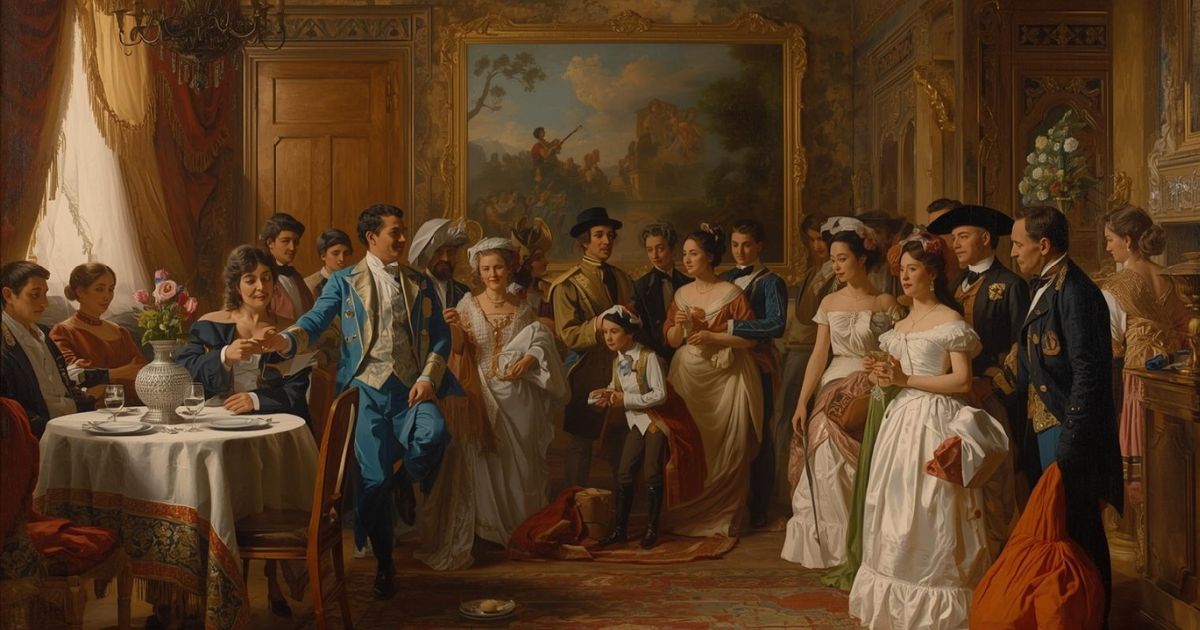
An excerpt from the original text.(complete · 2290 words)
umors and Beliefs
Day dawned at last for the terrified town. The streets near the
barracks and the town hail were still deserted and solitary, the
houses showed no signs of life. Nevertheless, the wooden panel of
a window was pushed back noisily and a child's head was stretched
out and turned from side to side, gazing about in all directions. At
once, however, a smack indicated the contact of tanned hide with the
soft human article, so the child made a wry face, closed its eyes,
and disappeared. The window slammed shut.
But an example had been set. That opening and shutting of the window
had no doubt been heard on all sides, for soon another window opened
slowly and there appeared cautiously the head of a wrinkled and
toothless old woman: it was the same Sister Puté who had raised such a
disturbance while Padre Damaso was preaching. Children and old women
are the representatives of curiosity in this world: the former from
a wish to know things and the latter from a desire to recollect them.
Apparently there was no one to apply a slipper to Sister Puté, for she
remained gazing out into the distance with wrinkled eyebrows. Then she
rinsed out her mouth, spat noisily, and crossed herself. In the house
opposite, another window was now timidly opened to reveal Sister Rufa,
she who did not wish to cheat or be cheated. They stared at each other
for a moment, smiled, made some signs, and again crossed themselves.
"Jesús, it seemed like a thanksgiving mass, regular
fireworks!" commented Sister Rufa.
"Since the town was sacked by Balat, I've never seen another night
equal to it," responded Sister Puté.
"What a lot of shots! They say that it was old Pablo's band."
"Tulisanes? That can't be! They say that it was the cuadrilleros
against the civil-guards. That's why Don Filipo has been arrested."
"Sanctus Deus! They say that at least fourteen were killed."
Other windows were now opened and more faces appeared to exchange
greetings and make comments. In the clear light, which promised a
bright day, soldiers could be seen in the distance, coming and going
confusedly like gray silhouettes.
"There goes one more corpse!" was the exclamation from a window.
"One? I see two."
"And I--but really, can it be you don't know what it was?" asked a
sly-featured individual.
"Oh, the cuadrilleros!"
"No, sir, it was a mutiny in the barracks!"
"What kind of mutiny? The curate against the alferez?"
"No, it was nothing of the kind," answered the man who had asked the
first question. "It was the Chinamen who have rebelled." With this
he shut his window.
"The Chinamen!" echoed all in great astonishment. "That's why not
one of them is to be seen!" "They've probably killed them all!"
"I thought they were going to do something bad. Yesterday--"
"I saw it myself. Last night--"
"What a pity!" exclaimed Sister Rufa. "To get killed just before
Christmas when they bring around their presents! They should have
waited until New Year's."
Little by little the street awoke to life. Dogs, chickens, pigs, and
doves began the movement, and these animals were soon followed by some
ragged urchins who held fast to each other's arms as they timidly
approached the barracks. Then a few old women with handkerchiefs
tied about their heads and fastened under their chins appeared with
thick rosaries in their hands, pretending to be at their prayers so
that the soldiers would let them pass. When it was seen that one
might walk about without being shot at, the men began to come out
with assumed airs of indifference. First they limited their steps
to the neighborhood of their houses, caressing their game-cocks,
then they extended their stroll, stopping from time to time, until
at last they stood in front of the town hall.
In a quarter of an hour other versions of the affair were in
circulation. Ibarra with his servants had tried to kidnap Maria Clara,
and Capitan Tiago had defended her, aided by the Civil Guard. The
number of killed was now not fourteen but thirty. Capitan Tiago was
wounded and would leave that very day with his family for Manila.
The arrival of two cuadrilleros carrying a human form on a covered
stretcher and followed by a civil-guard produced a great sensation. It
was conjectured that they came from the convento, and, from the shape
of the feet, which were dangling over one end, some guessed who the
dead man might be, some one else a little distance away told who it
was; further on the corpse was multiplied and the mystery of the Holy
Trinity duplicated, later the miracle of the loaves and fishes was
repeated--and the dead were then thirty and eight.
By half-past seven, when other guards arrived from neighboring towns,
the current version was clear and detailed. "I've just come from the
town hall, where I've seen Don Filipo and Don Crisostomo prisoners," a
man told Sister Puté. "I've talked with one of the cuadrilleros who are
on guard. Well, Bruno, the son of that fellow who was flogged to death,
confessed everything last night. As you know, Capitan Tiago is going
to marry his daughter to the young Spaniard, so Don Crisostomo in his
rage wanted to get revenge and tried to kill all the Spaniards, even
the curate. Last night they attacked the barracks and the convento,
but fortunately, by God's mercy, the curate was in Capitan Tiago's
house. They say that a lot of them escaped. The civil-guards burned
Don Crisostomo's house down, and if they hadn't arrested him first
they would have burned him also."
"They burned the house down?"
"All the servants are under arrest. Look, you can still see the smoke
from here!" answered the narrator, approaching the window. "Those
who come from there tell of many sad things."
All looked toward the place indicated. A thin column of smoke was
still slowly rising toward the sky. All made comments, more or less
pitying, more or less accusing.
"Poor youth!" exclaimed an old man, Puté's husband.
"Yes," she answered, "but look how he didn't order a mass said for
the soul of his father, who undoubtedly needs it more than others."
"But, woman, haven't you any pity?"
"Pity for the excommunicated? It's a sin to take pity on the enemies
of God, the curates say. Don't you remember? In the cemetery he walked
about as if he was in a corral."
"But a corral and the cemetery are alike," replied the old man,
"only that into the former only one kind of animal enters."
"Shut up!" cried Sister Puté. "You'll still defend those whom God
has clearly punished. You'll see how they'll arrest you, too. You're
upholding a falling house."
Her husband became silent before this argument.
"Yes," continued the old lady, "after striking Padre Damaso there
wasn't anything left for him to do but to kill Padre Salvi."
"But you can't deny that he was good when he was a little boy."
"Yes, he was good," replied the old woman, "but he went to Spain. All
those that go to Spain become heretics, as the curates have said."
"Oho!" exclaimed her husband, seeing his chance for a retort, "and
the curate, and all the curates, and the Archbishop, and the Pope,
and the Virgin--aren't they from Spain? Are they also heretics? Abá!"
Happily for Sister Puté the arrival of a maidservant running, all
pale and terrified, cut short this discussion.
"A man hanged in the next garden!" she cried breathlessly.
"A man hanged?" exclaimed all in stupefaction. The women crossed
themselves. No one could move from his place.
"Yes, sir," went on the trembling servant; "I was going to pick
peas--I looked into our neighbor's garden to see if it was--I saw
a man swinging--I thought it was Teo, the servant who always gives
me--I went nearer to--pick the peas, and I saw that it wasn't Teo,
but a dead man. I ran and I ran and--"
"Let's go see him," said the old man, rising. "Show us the way."
"Don't you go!" cried Sister Puté, catching hold of his
camisa. "Something will happen to you! Is he hanged? Then the worse
for him!"
"Let me see him, woman. You, Juan, go to the barracks and report
it. Perhaps he's not dead yet."
So he proceeded to the garden with the servant, who kept behind
him. The women, including even Sister Puté herself, followed after,
filled with fear and curiosity.
"There he is, sir," said the servant, as she stopped and pointed with
her finger.
The committee paused at a respectful distance and allowed the old
man to go forward alone.
A human body hanging from the branch of a santol tree swung about
gently in the breeze. The old man stared at it for a time and saw
that the legs and arms were stiff, the clothing soiled, and the head
doubled over.
"We mustn't touch him until some officer of the law arrives," he said
aloud. "He's already stiff, he's been dead for some time."
The women gradually moved closer.
"He's the fellow who lived in that little house there. He came here
two weeks ago. Look at the scar on his face."
"Ave Maria!" exclaimed some of the women.
"Shall we pray for his soul?" asked a young woman, after she had
finished staring and examining the body.
"Fool, heretic!" scolded Sister Puté. "Don't you know what Padre
Damaso said? It's tempting God to pray for one of the damned. Whoever
commits suicide is irrevocably damned and therefore he isn't buried
in holy ground."
Then she added, "I knew that this man was coming to a bad end;
I never could find out how he lived."
"I saw him twice talking with the senior sacristan," observed a
young woman.
"It wouldn't be to confess himself or to order a mass!"
Other neighbors came up until a large group surrounded the corpse,
which was still swinging about. After half an hour, an alguazil and
the directorcillo arrived with two cuadrilleros, who took the body
down and placed it on a stretcher.
"People are getting in a hurry to die," remarked the directorcillo
with a smile, as he took a pen from behind his ear.
He made captious inquiries, and took down the statement of the
maidservant, whom he tried to confuse, now looking at her fiercely,
now threatening her, now attributing to her things that she had not
said, so much so that she, thinking that she would have to go to jail,
began to cry and wound up by declaring that she wasn't looking for
peas but and she called Teo as a witness.
While this was taking place, a rustic in a wide salakot with a big
bandage on his neck was examining the corpse and the rope. The face
was not more livid than the rest of the body, two scratches and two
red spots were to be seen above the noose, the strands of the rope were
white and had no blood on them. The curious rustic carefully examined
the camisa and pantaloons, and noticed that they were very dusty and
freshly torn in some parts. But what most caught his attention were
the seeds of amores-secos that were sticking on the camisa even up
to the collar.
"What are you looking at?" the directorcillo asked him. "I was looking,
sir, to see if I could recognize him," stammered the rustic, partly
uncovering, but in such a way that his salakot fell lower.
"But haven't you heard that it's a certain Lucas? Were you asleep?"
The crowd laughed, while the abashed rustic muttered a few words and
moved away slowly with his head down.
"Here, where you going?" cried the old man after him.
"That's not the way out. That's the way to the dead man's house."
"The fellow's still asleep," remarked the directorcillo
facetiously. "Better pour some water over him."
Amid the laughter of the bystanders the rustic left the place where
he had played such a ridiculous part and went toward the church. In
the sacristy he asked for the senior sacristan.
"He's still asleep," was the rough answer. "Don't you know that the
convento was assaulted last night?"
"Then I'll wait till he wakes up." This with a stupid stare at
the sacristans, such as is common to persons who are used to rough
treatment.
In a corner which was still in shadow the one-eyed senior sacristan
lay asleep in a big chair. His spectacles were placed on his forehead
amid long locks of hair, while his thin, squalid chest, which was bare,
rose and fell regularly.
The rustic took a seat near by, as if to wait patiently, but he dropped
a piece of money and started to look for it with the aid of a candle
under the senior sacristan's chair. He noticed seeds of amores-secos
on the pantaloons and on the cuffs of the sleeper's camisa. The latter
awoke, rubbed his one good eye, and began to scold the rustic with
great ill-humor.
"I wanted to order a mass, sir," was the reply in a tone of excuse.
"The masses are already over," said the sacristan, sweetening his
tone a little at this. "If you want it for tomorrow--is it for the
souls in purgatory?"
"No, sir," answered the rustic, handing him a peso.
Then gazing fixedly at the single eye, he added, "It's for a person
who's going to die soon."
Hereupon he left the sacristy. "I could have caught him last night!" he
sighed, as he took off the bandage and stood erect to recover the
face and form of Elias.
Master this chapter. Complete your experience
Purchase the complete book to access all chapters and support classic literature
As an Amazon Associate, we earn a small commission from qualifying purchases at no additional cost to you.
Available in paperback, hardcover, and e-book formats
Let's Analyse the Pattern
Communities will actively choose emotionally satisfying falsehoods over truths that challenge their existing beliefs and social structures.
Why This Matters
Connect literature to life
This chapter teaches how to recognize when groups collectively create false narratives that protect their existing beliefs and power structures.
Practice This Today
This week, notice when workplace or family stories make everyone feel righteous while blaming one person - that's usually where the lie lives.
Now let's explore the literary elements.
Key Quotes & Analysis
"Children and old women are the representatives of curiosity in this world: the former from a wish to know things and the latter from a desire to recollect them."
Context: Describing why Sister Puté is the first to look out her window after the violent night
Rizal identifies who drives information flow in communities - children seeking knowledge and elders preserving memory. This explains why gossip networks often start with these groups who have both time and motivation to observe.
In Today's Words:
Kids want to know what's happening, and old folks want to remember everything - that's why they're always the first to notice drama.
"What starts as confused whispers about gunshots becomes an elaborate story blaming Ibarra for trying to kidnap Maria Clara and kill all the Spaniards."
Context: Describing how the townspeople's gossip transforms the previous night's events
Shows how truth gets distorted through retelling, with each person adding details that fit their existing beliefs. The community creates a villain story that confirms their suspicions about the 'corrupted' Ibarra.
In Today's Words:
By the time the story goes around town, a simple incident becomes this whole conspiracy theory that makes the outsider the bad guy.
"The townspeople eagerly embrace this version because it confirms their prejudices about the 'corrupted' young man who went to Europe."
Context: Explaining why the false story about Ibarra spreads so quickly
Reveals how communities protect themselves from uncomfortable truths by accepting stories that validate their existing prejudices. Education and foreign influence are seen as corruption rather than progress.
In Today's Words:
People believe what they want to believe, especially when it proves they were right to be suspicious all along.
Thematic Threads
Truth vs. Comfort
In This Chapter
Townspeople create elaborate lies about Ibarra rather than face uncomfortable questions about their leaders and judgments
Development
Builds on earlier themes of deception, now showing how entire communities participate in self-deception
In Your Life:
You might find yourself accepting workplace gossip that blames victims rather than examining systemic problems.
Class Prejudice
In This Chapter
The community eagerly believes Ibarra became 'corrupted' by European education, confirming their suspicions about social mobility
Development
Continues the exploration of how class assumptions shape perception and justify social hierarchies
In Your Life:
You might catch yourself assuming someone who 'got above their station' deserves whatever bad happens to them.
Investigation vs. Gossip
In This Chapter
Elias methodically searches for evidence while townspeople spread increasingly elaborate rumors
Development
Introduces the contrast between careful truth-seeking and emotionally driven storytelling
In Your Life:
You might choose between asking hard questions about family dysfunction or accepting the comfortable family narrative.
Power and Manipulation
In This Chapter
Those in authority benefit from the false narrative that protects them from scrutiny
Development
Develops from earlier corruption themes to show how power structures use public opinion
In Your Life:
You might notice how management lets rumors spread about fired employees rather than addressing real workplace issues.
Social Memory
In This Chapter
The community creates a collective memory that serves their emotional needs rather than preserving what actually happened
Development
New theme exploring how groups construct shared narratives
In Your Life:
You might participate in family stories that make everyone feel better about painful events rather than processing what really occurred.
You now have the context. Time to form your own thoughts.
Discussion Questions
- 1
How does the story about Ibarra change as it spreads through the town, and what details get added along the way?
analysis • surface - 2
Why do the townspeople prefer the gossip version of events over seeking out what actually happened?
analysis • medium - 3
Where have you seen communities choose a comfortable lie over an uncomfortable truth in your own life or workplace?
application • medium - 4
When you hear gossip or rumors, what strategies could you use to separate facts from speculation like Elias does?
application • deep - 5
What does this chapter reveal about how people protect their existing beliefs when faced with confusing or threatening events?
reflection • deep
Critical Thinking Exercise
Track the Truth vs. the Story
Think of a recent situation where you heard conflicting versions of the same event - maybe workplace drama, family conflict, or news coverage. Write down what you actually know happened versus what people are saying happened. Then identify what emotional needs each version of the story serves for the people telling it.
Consider:
- •What facts can you verify versus what requires you to trust someone's interpretation?
- •How does each version of the story make the teller look good or confirm their existing beliefs?
- •What would change if you approached this situation like Elias - looking for concrete evidence rather than accepting popular narratives?
Journaling Prompt
Write about a time when you realized you had been believing a comfortable story instead of facing a harder truth. What made you finally see the reality, and how did that change your approach to similar situations?
Coming Up Next...
Chapter 57: The Price of Resistance
As the dust settles on San Diego's night of violence, the full consequences of the failed uprising become clear. The victors will write their version of history, but at what cost to those who dared to dream of change?



