
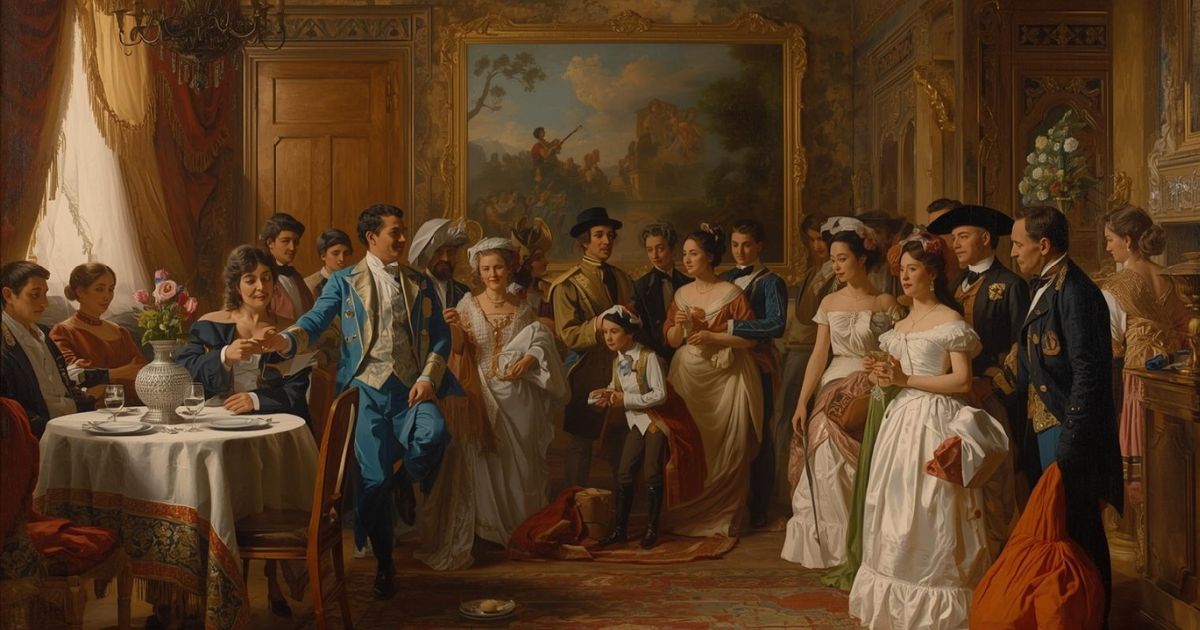
An excerpt from the original text.(complete · 1982 words)
he Catastrophe
There in the dining-room Capitan Tiago, Linares, and Aunt Isabel were
at supper, so that even in the sala the rattling of plates and dishes
was plainly heard. Maria Clara had said that she was not hungry and
had seated herself at the piano in company with the merry Sinang,
who was murmuring mysterious words into her ear. Meanwhile Padre
Salvi paced nervously back and forth in the room.
It was not, indeed, that the convalescent was not hungry, no; but she
was expecting the arrival of a certain person and was taking advantage
of this moment when her Argus was not present, Linares' supper-hour.
"You'll see how that specter will stay till eight," murmured Sinang,
indicating the curate. "And at eight he will come. The curate's in
love with Linares."
Maria Clara gazed in consternation at her friend, who went on
heedlessly with her terrible chatter: "Oh, I know why he doesn't
go, in spite of my hints--he doesn't want to burn up oil in the
convento! Don't you know that since you've been sick the two lamps that
he used to keep lighted he has had put out? But look how he stares,
and what a face!"
At that moment a clock in the house struck eight. The curate shuddered
and sat down in a corner.
"Here he comes!" exclaimed Sinang, pinching Maria Clara. "Don't you
hear him?"
The church bell boomed out the hour of eight and all rose to
pray. Padre Salvi offered up a prayer in a weak and trembling voice,
but as each was busy with his own thoughts no one paid any attention
to the priest's agitation.
Scarcely had the prayer ceased when Ibarra appeared. The youth was
in mourning not only in his attire but also in his face, to such an
extent that, on seeing him, Maria Clara arose and took a step toward
him to ask what the matter was. But at that instant the report of
firearms was heard. Ibarra stopped, his eyes rolled, he lost the power
of speech. The curate had concealed himself behind a post. More shots,
more reports were heard from the direction of the convento, followed
by cries and the sound of persons running. Capitan Tiago, Aunt Isabel,
and Linares rushed in pell-mell, crying, "Tulisan! Tulisan!" Andeng
followed, flourishing the gridiron as she ran toward her foster-sister.
Aunt Isabel fell on her knees weeping and reciting the Kyrie eleyson;
Capitan Tiago, pale and trembling, carried on his fork a chicken-liver
which he offered tearfully to the Virgin of Antipolo; Linares with his
mouth full of food was armed with a case-knife; Sinang and Maria Clara
were in each other's arms; while the only one that remained motionless,
as if petrified, was Crisostomo, whose paleness was indescribable.
The cries and sound of blows continued, windows were closed noisily,
the report of a gun was heard from time to time.
"Christie eleyson! Santiago, let the prophecy be fulfilled! Shut
the windows!" groaned Aunt Isabel.
"Fifty big bombs and two thanksgiving masses!" responded Capitan
Tiago. "Ora pro nobis!"
Gradually there prevailed a heavy silence which was soon broken by
the voice of the alferez, calling as he ran: "Padre, Padre Salvi,
come here!"
"Miserere! The alferez is calling for confession," cried Aunt
Isabel. "The alferez is wounded?" asked Linares hastily. "Ah!!!" Only
then did he notice that he had not yet swallowed what he had in
his mouth.
"Padre, come here! There's nothing more to fear!" the alferez continued
to call out.
The pallid Fray Salvi at last concluded to venture out from his
hiding-place, and went down the stairs.
"The outlaws have killed the alferez! Maria, Sinang, go into your
room and fasten the door! Kyrie eleyson!"
Ibarra also turned toward the stairway, in spite of Aunt Isabel's
cries: "Don't go out, you haven't been shriven, don't go out!" The
good old lady had been a particular friend of his mother's.
But Ibarra left the house. Everything seemed to reel around him,
the ground was unstable. His ears buzzed, his legs moved heavily and
irregularly. Waves of blood, lights and shadows chased one another
before his eyes, and in spite of the bright moonlight he stumbled
over the stones and blocks of wood in the vacant and deserted street.
Near the barracks he saw soldiers, with bayonets fixed, who were
talking among themselves so excitedly that he passed them unnoticed. In
the town hall were to be heard blows, cries, and curses, with the
voice of the alferez dominating everything: "To the stocks! Handcuff
them! Shoot any one who moves! Sergeant, mount the guard! Today no
one shall walk about, not even God! Captain, this is no time to go
to sleep!"
Ibarra hastened his steps toward home, where his servants were
anxiously awaiting him. "Saddle the best horse and go to bed!" he
ordered them.
Going into his study, he hastily packed a traveling-bag, opened an
iron safe, took out what money he found there and put it into some
sacks. Then he collected his jewels, took clown a portrait of Maria
Clara, armed himself with a dagger and two revolvers, and turned
toward a closet where he kept his instruments.
At that moment three heavy knocks sounded on the door. "Who's
there?" asked Ibarra in a gloomy tone.
"Open, in the King's name, open at once, or we'll break the door down,"
answered an imperious voice in Spanish.
Ibarra looked toward the window, his eyes gleamed, and he cocked his
revolver. Then changing his mind, he put the weapons down and went
to open the door just as the servant appeared. Three guards instantly
seized him.
"Consider yourself a prisoner in the King's name," said the sergeant.
"For what?"
"They'll tell you over there. We're forbidden to say." The youth
reflected a moment and then, perhaps not wishing that the soldiers
should discover his preparations for flight, picked up his hat, saying,
"I'm at your service. I suppose that it will only be for a few hours."
"If you promise not to try to escape, we won't tie you the alferez
grants this favor--but if you run--"
Ibarra went with them, leaving his servants in consternation.
Meanwhile, what had become of Elias? Leaving the house of Crisostomo,
he had run like one crazed, without heeding where he was going. He
crossed the fields in violent agitation, he reached the woods; he fled
from the town, from the light--even the moon so troubled him that he
plunged into the mysterious shadows of the trees. There, sometimes
pausing, sometimes moving along unfrequented paths, supporting himself
on the hoary trunks or being entangled in the undergrowth, he gazed
toward the town, which, bathed in the light of the moon, spread out
before him on the plain along the shore of the lake. Birds awakened
from their sleep flew about, huge bats and owls moved from branch to
branch with strident cries and gazed at him with their round eyes, but
Elias neither heard nor heeded them. In his fancy he was followed by
the offended shades of his family, he saw on every branch the gruesome
basket containing Balat's gory head, as his father had described it
to him; at every tree he seemed to stumble over the corpse of his
grandmother; he imagined that he saw the rotting skeleton of his
dishonored grandfather swinging among the shadows--and the skeleton
and the corpse and the gory head cried after him, "Coward! Coward!"
Leaving the hill, Elias descended to the lake and ran along the
shore excitedly. There at a distance in the midst of the waters,
where the moonlight seemed to form a cloud, he thought he could see a
specter rise and soar the shade of his sister with her breast bloody
and her loose hair streaming about. He fell to his knees on the sand
and extending his arms cried out, "You, too!"
Then with his gaze fixed on the cloud he arose slowly and went forward
into the water as if he were following some one. He passed over the
gentle slope that forms the bar and was soon far from the shore. The
water rose to his waist, but he plunged on like one fascinated,
following, ever following, the ghostly charmer. Now the water covered
his chest--a volley of rifle-shots sounded, the vision disappeared,
the youth returned to his senses. In the stillness of the night and
the greater density of the air the reports reached him clearly and
distinctly. He stopped to reflect and found himself in the water--over
the peaceful ripples of the lake he could still make out the lights
in the fishermen's huts.
He returned to the shore and started toward the town, but for what
purpose he himself knew not. The streets appeared to be deserted,
the houses were closed, and even the dogs that were wont to bark
through the night had hidden themselves in fear. The silvery light
of the moon added to the sadness and loneliness.
Fearful of meeting the civil-guards, he made his way along through
yards and gardens, in one of which he thought he could discern two
human figures, but he kept on his way, leaping over fences and walls,
until after great labor he reached the other end of the town and
went toward Crisostomo's house. In the doorway were the servants,
lamenting their master's arrest.
After learning about what had occurred Elias pretended to go away,
but really went around behind the house, jumped over the wall, and
crawled through a window into the study where the candle that Ibarra
had lighted was still burning. He saw the books and papers and found
the arms, the jewels, and the sacks of money. Reconstructing in his
imagination the scene that had taken place there and seeing so many
papers that might be of a compromising nature, he decided to gather
them up, throw them from the window, and bury them.
But, on glancing toward the street, he saw two guards approaching,
their bayonets and caps gleaming in the moonlight. With them was the
directorcillo. He made a sudden resolution: throwing the papers and
some clothing into a heap in the center of the room, he poured over
them the oil from a lamp and set fire to the whole. He was hurriedly
placing the arms in his belt when he caught sight of the portrait
of Maria Clara and hesitated a moment, then thrust it into one of
the sacks and with them in his hands leaped from the window into
the garden.
It was time that he did so, too, for the guards were forcing
an entrance. "Let us in to get your master's papers!" cried the
directorcillo.
"Have you permission? If you haven't, you won't get in,'" answered
an old man.
But the soldiers pushed him aside with the butts of their rifles and
ran up the stairway, just as a thick cloud of smoke rolled through the
house and long tongues of flame shot out from the study, enveloping
the doors and windows.
"Fire! Fire!" was the cry, as each rushed to save what he could. But
the blaze had reached the little laboratory and caught the inflammable
materials there, so the guards had to retire. The flames roared about,
licking up everything in their way and cutting off the passages. Vainly
was water brought from the well and cries for help raised, for the
house was set apart from the rest. The fire swept through all the
rooms and sent toward the sky thick spirals of smoke. Soon the whole
structure was at the mercy of the flames, fanned now by the wind,
which in the heat grew stronger. Some few rustics came up, but only
to gaze on this great bonfire, the end of that old building which
had been so long respected by the elements.
Master this chapter. Complete your experience
Purchase the complete book to access all chapters and support classic literature
As an Amazon Associate, we earn a small commission from qualifying purchases at no additional cost to you.
Available in paperback, hardcover, and e-book formats
Let's Analyse the Pattern
When external pressure destroys normal social structures, people's true character and loyalty become instantly visible, separating genuine allies from convenient acquaintances.
Why This Matters
Connect literature to life
This chapter teaches how to identify who will actually show up when your life implodes versus who just offers empty sympathy.
Practice This Today
This week, notice who responds with action versus words when someone in your circle faces real trouble—job loss, health crisis, family emergency.
Now let's explore the literary elements.
Key Quotes & Analysis
"Here he comes!"
Context: When she hears someone approaching at eight o'clock
This innocent exclamation marks the moment when the peaceful evening turns dangerous. Sinang expects a romantic visit but instead violence erupts, showing how quickly normal life can become a nightmare.
In Today's Words:
He's here!
"In the King's name!"
Context: When they arrive to arrest Ibarra
This formal declaration shows how colonial power operates - using legal language to justify persecution. The guards won't explain the charges, demonstrating how authority can destroy lives without accountability.
In Today's Words:
You're under arrest!
"The two lamps that he used to keep lighted he has had put out"
Context: Gossiping about Padre Salvi's behavior
This seemingly innocent observation about the priest's penny-pinching actually reveals his guilt and fear. He's cutting expenses because he knows trouble is coming and wants to lay low.
In Today's Words:
He's been acting cheap and sketchy lately
Thematic Threads
Class
In This Chapter
Ibarra's elite status evaporates instantly when the authorities turn against him—money and connections become worthless
Development
Escalated from social privilege being questioned to complete loss of protection
In Your Life:
Your job title or income level won't protect you when company politics or economic downturns hit
Loyalty
In This Chapter
Elias risks everything to save Ibarra, burning evidence and destroying property without hesitation
Development
Introduced here as the ultimate test of friendship under extreme pressure
In Your Life:
You discover who your real friends are when you're going through divorce, job loss, or serious illness
Identity
In This Chapter
Ibarra transforms from respected gentleman to hunted fugitive in one night, forced to abandon his entire life
Development
Culminated from gradual erosion of his social standing to complete identity destruction
In Your Life:
Major life disruptions force you to discover who you are when stripped of your usual roles and status
Power
In This Chapter
The authorities exercise absolute power through martial law, arresting without explanation or due process
Development
Evolved from subtle institutional pressure to open authoritarian control
In Your Life:
Bureaucratic systems can destroy your life with little recourse when they decide you're a problem
Survival
In This Chapter
Quick thinking and decisive action become the only things that matter as normal social rules collapse
Development
Introduced here as the fundamental skill when civilization's protections disappear
In Your Life:
In emergencies or major life crises, your ability to think clearly and act fast determines your outcomes
You now have the context. Time to form your own thoughts.
Discussion Questions
- 1
What happens to Ibarra's comfortable life in this chapter, and how quickly does everything change?
analysis • surface - 2
Why does Elias burn Ibarra's house down, and what does this tell us about how to help someone in crisis?
analysis • medium - 3
When have you seen someone's secure situation collapse overnight - job loss, illness, scandal - and who showed up to help versus who disappeared?
application • medium - 4
If you were building your own 'crisis network' of people who would actually help when things go wrong, what qualities would you look for and how would you cultivate those relationships?
application • deep - 5
What does Elias's willingness to sacrifice Ibarra's house to save Ibarra's life teach us about the difference between protecting things versus protecting people?
reflection • deep
Critical Thinking Exercise
Map Your Crisis Network
Draw three circles: Inner circle for people who would drop everything to help you in a real emergency, middle circle for those who would help if convenient, outer circle for those who would offer sympathy but no action. Then honestly assess: which circle are YOU in for the people around you? This exercise reveals the gap between who we think we can count on and who would actually show up.
Consider:
- •Consider both emotional support and practical help - some people are great listeners but won't lend money or drive you to the hospital
- •Think about reciprocity - are you someone others can count on, or do you mainly receive support without giving it?
- •Remember that crisis reveals character - someone might surprise you by stepping up, while others might disappoint you by stepping back
Journaling Prompt
Write about a time when you were someone's Elias - when you took real risks or made real sacrifices to help someone in crisis. What motivated you to act when others might have hesitated?
Coming Up Next...
Chapter 56: Truth in the Smoke and Shadows
As smoke rises from the ruins and arrests multiply, the town buzzes with wild theories about what really happened. But in a world where truth is dangerous, rumors might be the only currency that matters.



