
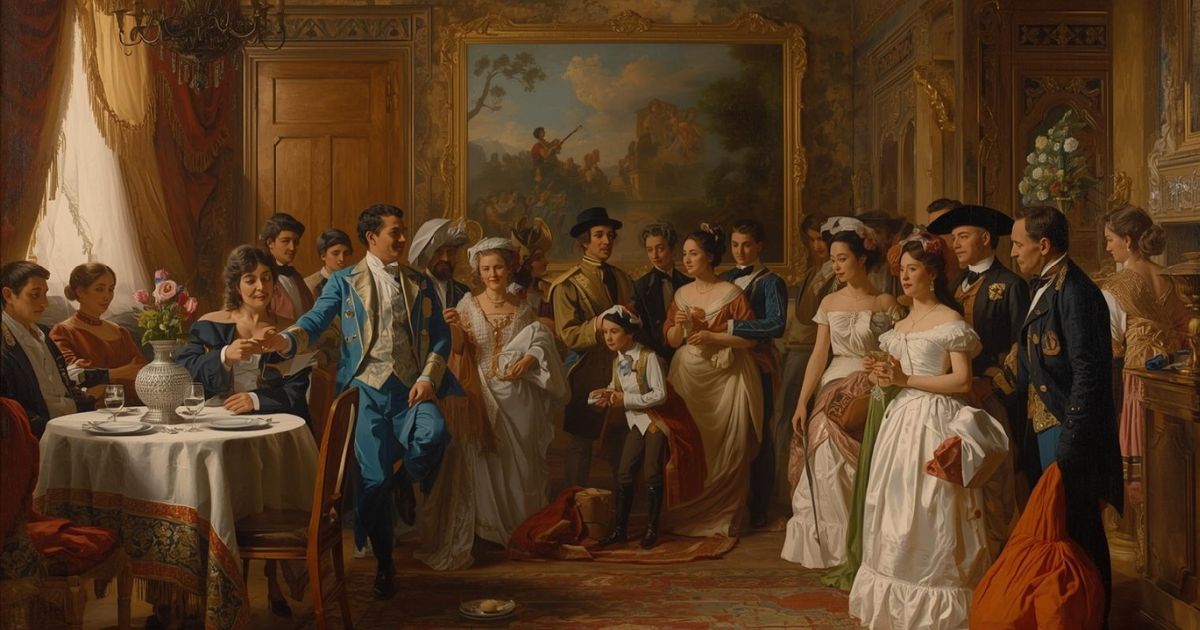
An excerpt from the original text.(complete · 3424 words)
he Sermon
Fray Damaso began slowly in a low voice: "'Et spiritum bonum dedisti,
qui doceret eos, et manna tuum non prohibuisti ab ore eorum, et aquam
dedisti eis in siti. And thou gavest thy good Spirit to teach them,
and thy manna thou didst not withhold from their mouth, and thou
gavest them water for their thirst!' Words which the Lord spoke
through the mouth of Esdras, in the second book, the ninth chapter,
and the twentieth verse." [88]
Padre Sibyla glanced in surprise at the preacher. Padre Manuel Martin
turned pale and swallowed hard that was better than his! Whether Padre
Damaso noticed this or whether he was still hoarse, the fact is that
he coughed several times as he placed both hands on the rail of the
pulpit. The Holy Ghost was above his head, freshly painted, clean and
white, with rose-colored beak and feet. "Most honorable sir" (to the
alcalde), "most holy priests, Christians, brethren in Jesus Christ!"
Here he made a solemn pause as again he swept his gaze over the
congregation, with whose attention and concentration he seemed
satisfied.
"The first part of the sermon is to be in Spanish and the other in
Tagalog; loquebantur omnes linguas."
After the salutations and the pause he extended his right hand
majestically toward the altar, at the same time fixing his gaze on
the alcalde. He slowly crossed his arms without uttering a word, then
suddenly passing from calmness to action, threw back his head and
made a sign toward the main door, sawing the air with his open hand
so forcibly that the sacristans interpreted the gesture as a command
and closed the doors. The alferez became uneasy, doubting whether
he should go or stay, when the preacher began in a strong voice,
full and sonorous; truly his old housekeeper was skilled in medicine.
"Radiant and resplendent is the altar, wide is the great door, the
air is the vehicle of the holy and divine words that will spring
from my mouth! Hear ye then with the ears of your souls and hearts
that the words of the Lord may not fall on the stony soil where the
birds of Hell may consume them, but that ye may grow and flourish
as holy seed in the field of our venerable and seraphic father,
St. Francis! O ye great sinners, captives of the Moros of the soul
that infest the sea of eternal life in the powerful craft of the
flesh and the world, ye who are laden with the fetters of lust and
avarice, and who toil in the galleys of the infernal Satan, look
ye here with reverent repentance upon him who saved souls from the
captivity of the devil, upon the intrepid Gideon, upon the valiant
David, upon the triumphant Roland of Christianity, upon the celestial
Civil Guard, more powerful than all the Civil Guards together, now
existing or to exist!" (The alferez frowned.) "Yes, señor alferez,
more valiant and powerful, he who with no other weapon than a wooden
cross boldly vanquishes the eternal tulisan of the shades and all
the hosts of Lucifer, and who would have exterminated them forever,
were not the spirits immortal! This marvel of divine creation, this
wonderful prodigy, is the blessed Diego of Alcala, who, if I may avail
myself of a comparison, since comparisons aid in the comprehension of
incomprehensible things, as another has said, I say then that this
great saint is merely a private soldier, a steward in the powerful
company which our seraphic father, St. Francis, sends from Heaven,
and to which I have the honor to belong as a corporal or sergeant,
by the grace of God!"
The "rude Indians," as the correspondent would say, caught nothing
more from this paragraph than the words "Civil Guard," "tulisan,"
"San Diego," and "St. Francis," so, observing the wry face of the
alferez and the bellicose gestures of the preacher, they deduced that
the latter was reprehending him for not running down the tulisanes. San
Diego and St. Francis would be commissioned in this duty and justly
so, as is proved by a picture existing in the convento at Manila,
representing St. Francis, by means of his girdle only, holding back the
Chinese invasion in the first years after the discovery. The devout
were accordingly not a little rejoiced and thanked God for this aid,
not doubting that once the tulisanes had disappeared, St. Francis would
also destroy the Civil Guard. With redoubled attention, therefore,
they listened to Padre Damaso, as he continued:
"Most honorable sir" Great affairs are great affairs even by the side
of the small and the small are always small even by the side of the
great. So History says, but since History hits the nail on the head
only once in a hundred times, being a thing made by men, and men make
mistakes--errarle es hominum, [89] as Cicero said--he who opens his
mouth makes mistakes, as they say in my country then the result is
that there are profound truths which History does not record. These
truths, most honorable sir, the divine Spirit spoke with that supreme
wisdom which human intelligence has not comprehended since the times
of Seneca and Aristotle, those wise priests of antiquity, even to our
sinful days, and these truths are that not always are small affairs
small, but that they are great, not by the side of the little things,
but by the side of the grandest of the earth and of the heavens and
of the air and of the clouds and of the waters and of space and of
life and of death!"
"Amen!" exclaimed the leader of the Tertiaries, crossing himself.
With this figure of rhetoric, which he had learned from a famous
preacher in Manila, Padre Damaso wished to startle his audience,
and in fact his holy ghost was so fascinated with such great truths
that it was necessary to kick him to remind him of his business.
"Patent to your eyes--" prompted the holy ghost below.
"Patent to your eyes is the conclusive and impressive proof of this
eternal philosophical truth! Patent is that sun of virtue, and I say
sun and not moon, for there is no great merit in the fact that the
moon shines during the night,--in the land of the blind the one-eyed
man is king; by night may shine a light, a tiny star,--so the greatest
merit is to be able to shine even in the middle of the day, as the sun
does; so shines our brother Diego even in the midst of the greatest
saints! Here you have patent to your eyes, in your impious disbelief,
the masterpiece of the Highest for the confusion of the great of the
earth, yes, my brethren, patent, patent to all, PATENT!"
A man rose pale and trembling and hid himself in a confessional. He was
a liquor dealer who had been dozing and dreaming that the carbineers
were demanding the patent, or license, that he did not have. It may
safely be affirmed that he did not come out from his hiding-place
while the sermon lasted.
"Humble and lowly saint, thy wooden cross" (the one that the image held
was of silver), "thy modest gown, honors the great Francis whose sons
and imitators we are. We propagate thy holy race in the whole world,
in the remote places, in the cities, in the towns, without distinction
between black and white" (the alcalde held his breath), "suffering
hardships and martyrdoms, thy holy race of faith and religion militant"
("Ah!" breathed the alcalde) "which holds the world in balance and
prevents it from falling into the depths of perdition."
His hearers, including even Capitan Tiago, yawned little by
little. Maria Clara was not listening to the sermon, for she knew
that Ibarra was near and was thinking about him while she fanned
herself and gazed at an evangelical bull that had all the outlines
of a small carabao.
"All should know by heart the Holy Scriptures and the lives of the
saints and then I should not have to preach to you, O sinners! You
should know such important and necessary things as the Lord's
Prayer, although many of you have forgotten it, living now as do
the Protestants or heretics, who, like the Chinese, respect not the
ministers of God. But the worse for you, O ye accursed, moving as
you are toward damnation!"
"Abá, Pale Lamaso, what!" [90] muttered Carlos, the Chinese,
looking angrily at the preacher, who continued to extemporize,
emitting a series of apostrophes and imprecations.
"You will die in final unrepentance, O race of heretics! God punishes
you even on this earth with jails and prisons! Women should flee from
you, the rulers should hang all of you so that the seed of Satan
be not multiplied in the vineyard of the Lord! Jesus Christ said:
'If you have an evil member that leads you to sin, cut it off, and
cast it into the fire--'"
Having forgotten both his sermon and his rhetoric, Fray Damaso began to
be nervous. Ibarra became uneasy and looked about for a quiet corner,
but the church was crowded. Maria Clara neither heard nor saw anything
as she was analyzing a picture, of the blessed souls in purgatory,
souls in the shape of men and women dressed in hides, with miters,
hoods, and cowls, all roasting in the fire and clutching St. Francis'
girdle, which did not break even with such great weight. With that
improvisation on the preacher's part, the holy-ghost friar lost the
thread of the sermon and skipped over three long paragraphs, giving
the wrong cue to the now laboriously-panting Fray Damaso.
"Who of you, O sinners, would lick the sores of a poor and ragged
beggar? Who? Let him answer by raising his hand! None! That I knew, for
only a saint like Diego de Alcala would do it. He licked all the sores,
saying to an astonished brother, 'Thus is this sick one cured!' O
Christian charity! O matchless example! O virtue of virtues! O
inimitable pattern! O spotless talisman!" Here he continued a long
series of exclamations, the while crossing his arms and raising and
lowering them as though he wished to fly or to frighten the birds away.
"Before dying he spoke in Latin, without knowing Latin! Marvel, O
sinners! You, in spite of what you study, for which blows are given
to you, you do not speak Latin, and you will die without speaking
it! To speak Latin is a gift of God and therefore the Church uses
Latin! I, too, speak Latin! Was God going to deny this consolation
to His beloved Diego? Could he die, could he be permitted to die,
without speaking Latin? Impossible! God wouldn't be just, He Wouldn't
be God! So he talked in Latin, and of that fact the writers of his
time bear witness!"
He ended this exordium with the passage which had cost him the most
toil and which he had plagiarized from a great writer, Sinibaldo de
Mas. "Therefore, I salute thee, illustrious Diego, the glory of our
Order! Thou art the pattern of virtue, meek with honor, humble with
nobility, compliant with fortitude, temperate with ambition, hostile
with loyalty, compassionate with pardon, holy with conscientiousness,
full of faith with devotion, credulous with sincerity, chaste with
love, reserved with secrecy; long-suffering with patience, brave
with timidity, moderate with desire, bold with resolution, obedient
with subjection., modest with pride, zealous with disinterestedness,
skilful with capability, ceremonious with politeness, astute with
sagacity, merciful with piety, secretive with modesty, revengeful with
valor, poor on account of thy labors with true conformity, prodigal
with economy, active with ease, economical with liberality, innocent
with sagacity, reformer with consistency, indifferent with zeal for
learning: God created thee to feel the raptures of Platonic love! Aid
me in singing thy greatness and thy name higher than the stars and
clearer than the sun itself that circles about thy feet! Aid me, all
of you, as you appeal to God for sufficient inspiration by reciting
the Ave Maria!"
All fell upon their knees and raised a murmur like the humming of a
thousand bees. The alcalde laboriously bent one knee and wagged his
head in a disgusted manner, while the alferez looked pale and penitent.
"To the devil with the curate!" muttered one of two youths who had
come from Manila.
"Keep still!" admonished his companion. "His woman might hear us."
Meanwhile, Padre Damaso, instead of reciting the Ave Maria,
was scolding his holy ghost for having skipped three of his best
paragraphs; at the same time he consumed a couple of cakes and a
glass of Malaga, secure of encountering therein greater inspiration
than in all the holy ghosts, whether of wood in the form of a dove
or of flesh in the shape of an inattentive friar.
Then he began the sermon in Tagalog. The devout old woman again gave
her granddaughter a hearty slap. The child awoke ill-naturedly and
asked, "Is it time to cry now?"
"Not yet, O lost one, but don't go to sleep again!" answered the
good grandmother.
Of the second part of the sermon--that in Tagalog--we have only a
few rough notes, for Padre Damaso extemporized in this language,
not because he knew it better, but because, holding the provincial
Filipinos ignorant of rhetoric, he was not afraid of making blunders
before them. With Spaniards the case was different; he had heard
rules of oratory spoken of, and it was possible that among his hearers
some one had been in college-halls, perhaps the alcalde, so he wrote
out his sermons, corrected and polished them, and then memorized and
rehearsed them for several days beforehand.
It is common knowledge that none of those present understood the drift
of the sermon. They were so dull of understanding and the preacher
was so profound, as Sister Rufa said, that the audience waited in
vain for an opportunity to weep, and the lost grandchild of the
blessed old woman went to sleep again. Nevertheless, this part had
greater consequences than the first, at least for certain hearers,
as we shall see later.
He began with a "Mana capatir con cristiano," [91] followed by an
avalanche of untranslatable phrases. He talked of the soul, of Hell,
of "mahal na santo pintacasi," [92] of the Indian sinners and of
the virtuous Franciscan Fathers.
"The devil!" exclaimed one of the two irreverent Manilans to his
companion. "That's all Greek to me. I'm going." Seeing the doors
closed, he went out through the sacristy, to the great scandal of
the people and especially of the preacher, who turned pale and paused
in the midst of his sentence. Some looked for a violent apostrophe,
but Padre Damaso contented himself with watching the delinquent,
and then he went on with his sermon.
Then were let loose curses upon the age, against the lack of reverence,
against the growing indifference to Religion. This matter seemed to
be his forte, for he appeared to be inspired and expressed himself
with force and clearness. He talked of the sinners who did not attend
confession, who died in prisons without the sacraments, of families
accursed, of proud and puffed-up little half-breeds, of young sages
and little philosophers, of pettifoggers, of picayunish students,
and so on. Well known is this habit that many have when they wish
to ridicule their enemies; they apply to them belittling epithets
because their brains do not appear to furnish them any other means,
and thus they are happy.
Ibarra heard it all and understood the allusions. Preserving an outward
calm, he turned his eyes to God and the authorities, but saw nothing
more than the images of saints, and the alcalde was sleeping.
Meanwhile, the preacher's enthusiasm was rising by degrees. He spoke
of the times when every Filipino upon meeting a priest took off
his hat, knelt on the ground, and kissed the priest's hand. "But
now," he added, "you only take off your salakot or your felt hat,
which you have placed on the side of your head in order not to
ruffle your nicely combed hair! You content yourself with saying,
'good day, among,' and there are proud dabblers in a little Latin
who, from having studied in Manila or in Europe, believe that they
have the right to shake a priest's hand instead of kissing it. Ah,
the day of judgment will quickly come, the world will end, as many
saints have foretold; it will rain fire, stones, and ashes to chastise
your pride!" The people were exhorted not to imitate such "savages"
but to hate and shun them, since they were beyond the religious pale.
"Hear what the holy decrees say! When an Indian meets a curate in the
street he should bow his head and offer his neck for his master to
step upon. If the curate and the Indian are both on horseback, then
the Indian should stop and take off his hat or salakot reverently;
and finally, if the Indian is on horseback and the curate on foot,
the Indian should alight and not mount again until the curate has
told him to go on, or is far away. This is what the holy decrees say
and he who does not obey will be excommunicated."
"And when one is riding a carabao?" asked a scrupulous countryman of
his neighbor.
"Then--keep on going!" answered the latter, who was a casuist.
But in spite of the cries and gestures of the preacher many fell
asleep or wandered in their attention, since these sermons were
ever the same. In vain some devout women tried to sigh and sob
over the sins of the wicked; they had to desist in the attempt from
lack of supporters. Even Sister Puté was thinking of something quite
different. A man beside her had dropped off to sleep in such a way that
he had fallen over and crushed her habit, so the good woman caught
up one of her clogs and with blows began to wake him, crying out,
"Get away, savage, brute, devil, carabao, cur, accursed!"
Naturally, this caused somewhat of a stir. The preacher paused and
arched his eyebrows, surprised at so great a scandal. Indignation
choked the words in his throat and he was able only to bellow, while
he pounded the pulpit with his fists. This had the desired effect,
however, for the old woman, though still grumbling, dropped her clog
and, crossing herself repeatedly, fell devoutly upon her knees.
"Aaah! Aaah!" the indignant priest was at last able to roar out as
he crossed his arms and shook his head. "For this do I preach to
you the whole morning, savages! Here in the house of God you quarrel
and curse, shameless ones! Aaaah! You respect nothing! This is the
result of the luxury and the looseness of the age! That's just what
I've told you, aah!"
Upon this theme he continued to preach for half an hour. The alcalde
snored, and Maria Clara nodded, for the poor child could no longer keep
from sleeping, since she had no more paintings or images to study,
nor anything else to amuse her. On Ibarra the words and allusions
made no more impression, for he was thinking of a cottage on the top
of a mountain and saw Maria Clara in the garden; let men crawl about
in their miserable towns in the depths of the valley!
Padre Salvi had caused the altar bell to be rung twice, but this was
only adding fuel to the flame, for Padre Damaso became stubborn and
prolonged the sermon. Fray Sibyla gnawed at his lips and repeatedly
adjusted his gold-mounted eye-glasses. Fray Manuel Martin was the
only one who appeared to listen with pleasure, for he was smiling.
But at last God said "Enough"; the orator became weary and descended
from the pulpit. All knelt to render thanks to God. The alcalde rubbed
his eyes, stretched out one arm as if to waken himself, and yawned
with a deep aah. The mass continued.
When all were kneeling and the priests had lowered their heads while
the Incarnatus est was being sung, a man murmured in Ibarra's ear,
"At the laying of the cornerstone, don't move away from the curate,
don't go down into the trench, don't go near the stone--your life
depends upon it!"
Ibarra turned to see Elias, who, as soon as he had said this,
disappeared in the crowd.
Master this chapter. Complete your experience
Purchase the complete book to access all chapters and support classic literature
As an Amazon Associate, we earn a small commission from qualifying purchases at no additional cost to you.
Available in paperback, hardcover, and e-book formats
Let's Analyse the Pattern
Using legitimate power and trusted platforms to launch personal attacks while appearing to fulfill official duties.
Why This Matters
Connect literature to life
This chapter teaches how to recognize when people in power use their positions to disguise personal attacks as official business or moral instruction.
Practice This Today
This week, notice when authority figures shift from their stated purpose to personal criticism—and ask yourself what they're really trying to protect or control.
Now let's explore the literary elements.
Key Quotes & Analysis
"The first part of the sermon is to be in Spanish and the other in Tagalog; loquebantur omnes linguas."
Context: Damaso announces his plan to deliver the sermon in multiple languages to different audiences
This reveals the calculated nature of colonial control - different messages for different groups. The Latin phrase means 'they spoke in all tongues,' but Damaso uses language as a weapon to divide and intimidate rather than unite.
In Today's Words:
I'm going to speak to the important people first, then talk down to the rest of you in your own language.
"Take off your hat, bend your knee, bow your head, and offer your neck!"
Context: Damaso describes how natives should behave toward priests and colonial authority
This shocking demand reveals the true goal of colonial religion - complete submission and dehumanization. The progression from removing a hat to offering one's neck to be stepped on shows how oppression escalates from small compliance to total degradation.
In Today's Words:
Shut up, know your place, and be grateful we don't destroy you completely.
"Your life depends upon it - don't go near the cornerstone or the trench."
Context: Elias suddenly appears to warn Ibarra of mortal danger at the upcoming ceremony
This urgent warning shifts the story from public humiliation to physical danger, showing how resistance movements operate through secret networks. Elias knows something deadly is planned and risks exposure to save Ibarra.
In Today's Words:
They're planning to hurt you at that event - stay away from the main area if you want to live.
Thematic Threads
Power Corruption
In This Chapter
Fray Damaso transforms religious authority into a weapon for personal revenge, corrupting his sacred role
Development
Evolved from earlier hints of clerical abuse to open demonstration of how institutional power enables personal vendettas
In Your Life:
You might see this when a supervisor uses their position to get back at you for questioning their methods.
Public Humiliation
In This Chapter
Damaso uses the captive congregation to shame Ibarra publicly, knowing he cannot respond or leave
Development
Builds on earlier themes of social pressure and appearances, showing how public settings become weapons
In Your Life:
This appears when someone calls you out in group settings where you can't defend yourself without looking worse.
Hidden Resistance
In This Chapter
Elias appears with warnings, representing underground networks that operate outside corrupt official channels
Development
Introduced here as counterbalance to oppressive authority, suggesting alternative sources of protection
In Your Life:
You might find unexpected allies who privately share your concerns about unfair treatment at work or in institutions.
Class Warfare
In This Chapter
Damaso specifically targets 'educated natives' and 'little philosophers' who dare to think for themselves
Development
Intensifies earlier class tensions by showing how education and independent thinking threaten established hierarchies
In Your Life:
This surfaces when people in authority feel threatened by your education, questions, or refusal to automatically defer.
Institutional Shame
In This Chapter
Even fellow priests show embarrassment at Damaso's crude performance, revealing institutional awareness of corruption
Development
Develops the theme that corruption damages institutions from within, creating internal conflict
In Your Life:
You might notice decent people within corrupt systems who are quietly uncomfortable with what they witness.
You now have the context. Time to form your own thoughts.
Discussion Questions
- 1
How does Fray Damaso transform his sermon from religious instruction into a personal attack on Ibarra?
analysis • surface - 2
Why does Damaso choose a public sermon rather than a private confrontation to express his anger toward Ibarra?
analysis • medium - 3
Where have you seen someone use their official position or authority to settle personal scores in modern settings?
application • medium - 4
How would you protect yourself if someone in authority was using their position to publicly humiliate you?
application • deep - 5
What does Damaso's behavior reveal about the difference between having power and having actual moral authority?
reflection • deep
Critical Thinking Exercise
Decode the Power Play
Think of a time when someone in authority (boss, teacher, family member, etc.) seemed to be addressing one thing publicly but was actually targeting something else entirely. Write down what they said they were doing versus what they were actually doing. Then identify what gave them the power to do this and what prevented others from calling it out.
Consider:
- •Notice how authority figures often wrap personal grievances in official language
- •Consider why public settings make these power plays more effective
- •Think about what happens to bystanders who witness but can't intervene
Journaling Prompt
Write about a time when you recognized someone was abusing their authority. How did you handle it? What would you do differently now that you can name this pattern?
Coming Up Next...
Chapter 32: The Derrick Disaster
The cornerstone ceremony begins with great fanfare, but Elias's cryptic warning weighs heavily on Ibarra's mind. As the community gathers to celebrate this symbol of progress, hidden dangers lurk beneath the surface of the festivities.



