
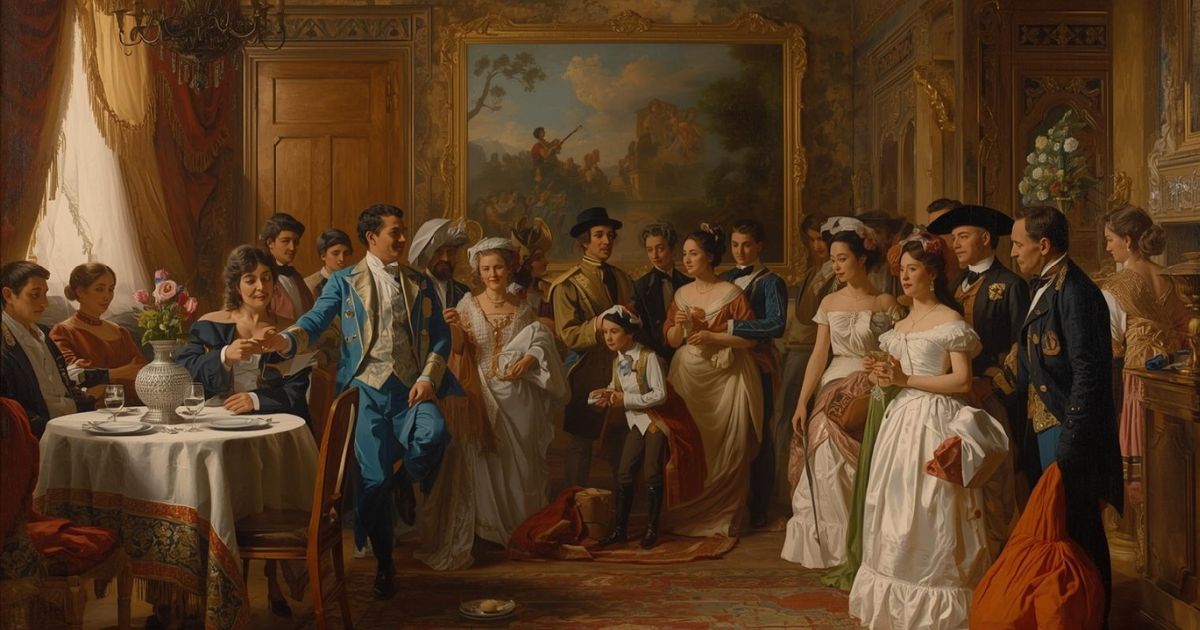
An excerpt from the original text.(complete · 1358 words)
the Church
From end to end the huge barn that men dedicate as a home to the
Creator of all existing things was filled with people. Pushing,
crowding, and crushing one another, the few who were leaving and
the many who were entering filled the air with exclamations of
distress. Even from afar an arm would be stretched out to dip the
fingers in the holy water, but at the critical moment the surging crowd
would force the hand away. Then would be heard a complaint, a trampled
woman would upbraid some one, but the pushing would continue. Some old
people might succeed in dipping their fingers in the water, now the
color of slime, where the population of a whole town, with transients
besides, had washed. With it they would anoint themselves devoutly,
although with difficulty, on the neck, on the crown of the head,
on the forehead, on the chin, on the chest, and on the abdomen,
in the assurance that thus they were sanctifying those parts and
that they would suffer neither stiff neck, headache, consumption,
nor indigestion. The young people, whether they were not so ailing or
did not believe in that holy prophylactic, hardly more than moistened
the tip of a finger--and this only in order that the devout might
have no cause to talk--and pretended to make the sign of the cross on
their foreheads, of course without touching them. "It may be blessed
and everything you may wish," some young woman doubtless thought,
"but it has such a color!"
It was difficult to breathe in the heat amid the smells of the human
animal, but the preacher was worth all these inconveniences, as the
sermon was costing the town two hundred and fifty pesos. Old Tasio
had said: "Two hundred and fifty pesos for a sermon! One man on one
occasion! Only a third of what comedians cost, who will work for
three nights! Surely you must be very rich!"
"What has that to do with the drama?" testily inquired the nervous
leader of the Tertiary Brethren. "With the drama souls go to hell but
with the sermon to heaven! If he had asked a thousand, we would have
paid him and should still owe him gratitude."
"After all, you're right," replied the Sage, "for the sermon is more
amusing to me at least than the drama."
"But I am not amused even by the drama!" yelled the other furiously.
"I believe it, since you understand one about as well as you do the
other!" And the impious old man moved away without paying any attention
to the insults and the direful prophecies that the irritated leader
offered concerning his future existence.
While they were waiting for the alcalde, the people sweated and yawned,
agitating the air with fans, hats, and handkerchiefs. Children shouted
and cried, which kept the sacristans busy putting them out of the
sacred edifice. Such action brought to the dull and conscientious
leader of the Brotherhood of the Holy Rosary this thought: "'Suffer
little children to come unto me,' said Our Savior, it is true, but
here must be understood, children who do not cry."
An old woman in a guingón habit, Sister Puté, chid her granddaughter,
a child of six years, who was kneeling at her side, "O lost one, give
heed, for you're going to hear a sermon like that of Good Friday!" Here
the old lady gave her a pinch to awaken the piety of the child,
who made a grimace, stuck out her nose, and wrinkled up her eyebrows.
Some men squatted on their heels and dozed beside the confessional. One
old man nodding caused our old woman to believe that he was mumbling
prayers, so, running her fingers rapidly over the beads of her
rosary--as that was the most reverent way of respecting the designs
of Heaven--little by little she set herself to imitating hint.
Ibarra stood in one corner while Maria Clara knelt near the high
altar in a space which the curate had had the courtesy to order the
sacristans to clear for her. Capitan Tiago, in a frock coat, sat on
one of the benches provided for the authorities, which caused the
children who did not know him to take him for another gobernadorcillo
and to be wary about getting near him.
At last the alcalde with his staff arrived, proceeding from the
sacristy and taking their seats in magnificent chairs placed on strips
of carpet. The alcalde wore a full-dress uniform and displayed the
cordon of Carlos III, with four or five other decorations. The people
did not recognize him.
"Abá!" exclaimed a rustic. "A civil-guard dressed as a comedian!"
"Fool!" rejoined a bystander, nudging him with his elbow. "It's the
Prince Villardo that we saw at the show last night!"
So the alcalde went up several degrees in the popular estimation by
becoming an enchanted prince, a vanquisher of giants.
When the mass began, those who were seated arose and those who
had been asleep were awakened by the ringing of the bells and the
sonorous voices of the singers. Padre Salvi, in spite of his gravity,
wore a look of deep satisfaction, since there were serving him as
deacon and subdeacon none less than two Augustinians. Each one, as
it came his turn, sang well, in a more or less nasal tone and with
unintelligible articulation, except the officiating priest himself,
whose voice trembled somewhat, even getting out of tune at times,
to the great wonder of those who knew him. Still he moved about
with precision and elegance while he recited the Dominus vobiscum
unctuously, dropping his head a little to the side and gazing toward
heaven. Seeing him receive the smoke from the incense one would
have said that Galen was right in averring the passage of smoke in
the nasal canals to the head through a screen of ethmoids, since
he straightened himself, threw his head back, and moved toward the
middle of the altar with such pompousness and gravity that Capitan
Tiago found him more majestic than the Chinese comedian of the
night before, even though the latter had been dressed as an emperor,
paint-bedaubed, with beribboned sword, stiff beard like a horse's
mane, and high-soled slippers. "Undoubtedly," so his thoughts ran,
"a single curate of ours has more majesty than all the emperors."
At length came the expected moment, that of hearing Padre Damaso. The
three priests seated themselves in their chairs in an edifying
attitude, as the worthy correspondent would say, the alcalde and
other persons of place and position following their example. The
music ceased.
The sudden transition from noise to silence awoke our aged Sister Puté,
who was already snoring under cover of the music. Like Segismundo,
[87] or like the cook in the story of the Sleeping Beauty, the first
thing that she did upon awaking was to whack her granddaughter on
the neck, as the child had also fallen asleep. The latter screamed,
but soon consoled herself at the sight of a woman who was beating her
breast with contrition and enthusiasm. All tried to place themselves
comfortably, those who had no benches squatting down on the floor or
on their heels.
Padre Damaso passed through the congregation preceded by two
sacristans and followed by another friar carrying a massive volume. He
disappeared as he went up the winding staircase, but his round head
soon reappeared, then his fat neck, followed immediately by his
body. Coughing slightly, he looked about him with assurance. He
noticed Ibarra and with a special wink gave to understand that he
would not overlook that youth in his prayers. Then he turned a look
of satisfaction upon Padre Sibyla and another of disdain upon Padre
Martin, the preacher of the previous day. This inspection concluded,
he turned cautiously and said, "Attention, brother!" to his companion,
who opened the massive volume.
But the sermon deserves a separate chapter. A young man who was then
learning stenography and who idolizes great orators, took it down;
thanks to this fact, we can here present a selection from the sacred
oratory of those regions.
Master this chapter. Complete your experience
Purchase the complete book to access all chapters and support classic literature
As an Amazon Associate, we earn a small commission from qualifying purchases at no additional cost to you.
Available in paperback, hardcover, and e-book formats
Let's Analyse the Pattern
When institutions prioritize elaborate displays over their stated purpose, trapping everyone in meaningless spectacle.
Why This Matters
Connect literature to life
This chapter teaches how to distinguish between organizations that spend money on problems versus those that spend money on looking like they care about problems.
Practice This Today
This week, notice when institutions announce expensive initiatives - ask yourself whether the money goes toward actual solutions or toward announcing they have solutions.
Now let's explore the literary elements.
Key Quotes & Analysis
"It may be blessed and everything you may wish, but it's still dirty water"
Context: Said about the holy water that's turned the color of slime from everyone touching it
This captures the gap between what institutions claim to offer and what they actually deliver. The blessing doesn't make the water clean, just like religious authority doesn't automatically make something pure or good.
In Today's Words:
Just because someone in charge says it's special doesn't mean it's not still gross
"Two hundred and fifty pesos for a sermon! For that money we could have three nights of comedies"
Context: Criticizing the enormous cost of Padre Damaso's sermon
Tasio exposes the economic exploitation disguised as religious devotion. He shows how the church prioritizes profit over the people's actual needs and entertainment.
In Today's Words:
We're paying premium prices for something that's supposed to be free, and we're not even getting good value
"The alcalde appeared in full uniform, so covered with gold braid that some mistook him for an actor from last night's play"
Context: Describing the Spanish official's theatrical entrance to church
Rizal shows how colonial authority is essentially performance art. The official is so overdressed that he becomes indistinguishable from entertainment, revealing how hollow his power really is.
In Today's Words:
He was trying so hard to look important that people thought he was just playing dress-up
Thematic Threads
Class
In This Chapter
The expensive sermon costs 250 pesos while families struggle, with seating arrangements reflecting social hierarchy
Development
Deepening from earlier chapters showing how economic inequality shapes every social interaction
In Your Life:
Notice how money determines access and treatment in healthcare, education, and community events
Performance
In This Chapter
Everyone from the alcalde to churchgoers puts on elaborate displays of devotion and status
Development
Introduced here as religious theater, building on earlier social pretenses
In Your Life:
Recognize when you're performing roles at work or family events instead of being authentic
Authority
In This Chapter
Religious and civil authorities use pageantry to maintain power and distance from ordinary people
Development
Expanding from individual corrupt officials to institutional corruption
In Your Life:
Question whether leaders' elaborate presentations serve you or just reinforce their position
Isolation
In This Chapter
Ibarra stands apart from the crowd's fevered devotion, unable to participate in the collective delusion
Development
Growing from his earlier social awkwardness to deeper alienation from community norms
In Your Life:
Sometimes maintaining your integrity means accepting that you won't fit in with group dynamics
Waste
In This Chapter
Resources that could feed families for months are spent on one sermon and religious spectacle
Development
Introduced here, highlighting misplaced priorities in resource allocation
In Your Life:
Notice when organizations spend lavishly on appearances while cutting essential services or support
You now have the context. Time to form your own thoughts.
Discussion Questions
- 1
Why does the town spend 250 pesos on one sermon when that money could feed families for months?
analysis • surface - 2
What does the alcalde's elaborate military costume reveal about how authority works in this community?
analysis • medium - 3
Where have you seen people spend big money on appearances while ignoring practical needs?
application • medium - 4
How would you handle being in a group where everyone's performing devotion but you see through the act?
application • deep - 5
What happens to genuine faith or purpose when institutions turn everything into expensive theater?
reflection • deep
Critical Thinking Exercise
Spot the Performance Theater
Think of a situation in your life where people spend time, money, or energy on elaborate displays rather than addressing real needs. Map out who benefits from the spectacle, who pays the costs, and what the original purpose was supposed to be. Then identify one small way you could focus on substance instead of show.
Consider:
- •Look for situations where the ritual has become more important than the result
- •Notice who has power to set the rules of the performance
- •Consider what would happen if someone quietly opted out of the theater
Journaling Prompt
Write about a time when you felt pressure to perform devotion, enthusiasm, or agreement in a group setting. How did you handle it, and what would you do differently now?
Coming Up Next...
Chapter 31: The Sermon
Padre Damaso finally takes the pulpit for his expensive sermon. What he says will shock some listeners and reveal the true nature of colonial religious authority.



