
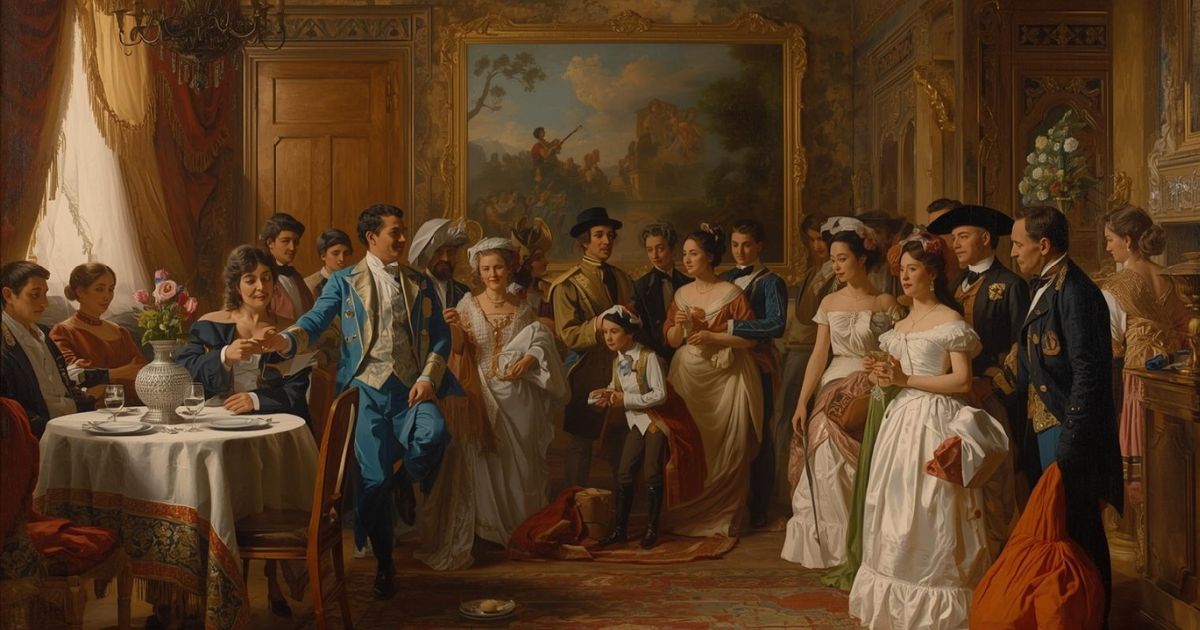
An excerpt from the original text.(complete · 1516 words)
ll Saints
The one thing perhaps that indisputably distinguishes man from the
brute creation is the attention which he pays to those who have passed
away and, wonder of wonders! this characteristic seems to be more
deeply rooted in proportion to the lack of civilization. Historians
relate that the ancient inhabitants of the Philippines venerated and
deified their ancestors; but now the contrary is true, and the dead
have to entrust themselves to the living. It is also related that
the people of New Guinea preserve the bones of their dead in chests
and maintain communication with them. The greater part of the peoples
of Asia, Africa, and America offer them the finest products of their
kitchens or dishes of what was their favorite food when alive, and
give banquets at which they believe them to be present. The Egyptians
raised up palaces and the Mussulmans built shrines, but the masters
in these things, those who have most clearly read the human heart,
are the people of Dahomey. These negroes know that man is revengeful,
so they consider that nothing will more content the dead than to
sacrifice all his enemies upon his grave, and, as man is curious and
may not know how to entertain himself in the other life, each year
they send him a newsletter under the skin of a beheaded slave.
We ourselves differ from all the rest. In spite of the inscriptions on
the tombs, hardly any one believes that the dead rest, and much less,
that they rest in peace. The most optimistic fancies his forefathers
still roasting in purgatory and, if it turns out that he himself be
not completely damned, he will yet be able to associate with them for
many years. If any one would contradict let him visit the churches and
cemeteries of the country on All Saints' day and he will be convinced.
Now that we are in San Diego let us visit its cemetery, which is
located in the midst of paddy-fields, there toward the west--not a
city, merely a village of the dead, approached by a path dusty in dry
weather and navigable on rainy days. A wooden gate and a fence half
of stone and half of bamboo stakes, appear to separate it from the
abode of the living but not from the curate's goats and some of the
pigs of the neighborhood, who come and go making explorations among the
tombs and enlivening the solitude with their presence. In the center of
this enclosure rises a large wooden cross set on a stone pedestal. The
storms have doubled over the tin plate for the inscription INRI, and
the rains have effaced the letters. At the foot of the cross, as on
the real Golgotha, is a confused heap of skulls and bones which the
indifferent grave-digger has thrown from the graves he digs, and there
they will probably await, not the resurrection of the dead, but the
coming of the animals to defile them. Round about may be noted signs
of recent excavations; here the earth is sunken, there it forms a low
mound. There grow in all their luxuriance the tarambulo to prick
the feet with its spiny berries and the pandakaki to add its odor
to that of the cemetery, as if the place did not have smells enough
already. Yet the ground is sprinkled with a few little flowers which,
like those skulls, are known only to their Creator; their petals wear
a pale smile and their fragrance is the fragrance of the tombs. The
grass and creepers fill up the corners or climb over the walls and
niches to cover and beautify the naked ugliness and in places even
penetrate into the fissures made by the earthquakes, so as to hide
from sight the revered hollowness of the sepulcher.
At the time we enter, the people have driven the animals away, with the
single exception of some old hog, an animal that is hard to convince,
who shows his small eyes and pulling back his head from a great gap
in the fence, sticks up his snout and seems to say to a woman praying
near, "Don't eat it all, leave something for me, won't you?"
Two men are digging a grave near one of the tottering walls. One
of them, the grave-digger, works with indifference, throwing about
bones as a gardener does stones and dry branches, while the other,
more intent on his work, is perspiring, smoking, and spitting at
every moment.
"Listen," says the latter in Tagalog, "wouldn't it be better for us
to dig in some other place? This is too recent."
"One grave is as recent as another."
"I can't stand it any longer! That bone you're just cut in two has
blood oozing from it--and those hairs?"
"But how sensitive you are!" was the other's reproach. "Just as if
you were a town clerk! If, like myself, you had dug up a corpse of
twenty days, on a dark and rainy night--! My lantern went out--"
His companion shuddered.
"The coffin burst open, the corpse fell half-way out, it stunk--and
supposing you had to carry it--the rain wet us both--"
"Ugh! And why did you dig it up?"
The grave-digger looked at him in surprise. "Why? How do I know? I
was ordered to do so."
"Who ordered you?"
The grave-digger stepped backward and looked his companion over from
head to foot. "Man, you're like a Spaniard, for afterwards a Spaniard
asked me the same questions, but in secret. So I'm going to answer
you as I answered the Spaniard: the fat curate ordered me to do so."
"Ah! And what did you do with the corpse afterwards?" further
questioned the sensitive one.
"The devil! If I didn't know you and was not sure that you are a man
I would say that you were certainly a Spaniard of the Civil Guard,
since you ask questions just as he did. Well, the fat curate ordered
me to bury it in the Chinamen's cemetery, but the coffin was heavy
and the Chinese cemetery far away--"
"No, no! I'm not going to dig any more!" the other interrupted in
horror as he threw away his spade and jumped out of the hole. "I've cut
a skull in two and I'm afraid that it won't let me sleep tonight." The
old grave-digger laughed to see how the chicken-hearted fellow left,
crossing himself.
The cemetery was filling up with men and women dressed in
mourning. Some sought a grave for a time, disputing among themselves
the while, and as if they were unable to agree, they scattered
about, each kneeling where he thought best. Others, who had niches
for their deceased relatives, lighted candles and fell to praying
devoutly. Exaggerated or suppressed sighs and sobs were heard amid
the hum of prayers, orapreo, orapreiss, requiem-aeternams, that
arose from all sides.
A little old man with bright eyes entered bareheaded. Upon seeing
him many laughed, and some women knitted their eyebrows. The old man
did not seem to pay any attention to these demonstrations as he went
toward a pile of skulls and knelt to look earnestly for something
among the bones. Then he carefully removed the skulls one by one, but
apparently without finding what he sought, for he wrinkled his brow,
nodded his head from side to side, looked all about him, and finally
rose and approached the grave-digger, who raised his head when the
old man spoke to him.
"Do you know where there is a beautiful skull, white as the meat of a
coconut, with a complete set of teeth, which I had there at the foot
of the cross under those leaves?"
The grave-digger shrugged his shoulders.
"Look!" added the old man, showing a silver coin, "I have only this,
but I'll give it to you if you find the skull for me."
The gleam of the silver caused the grave-digger to consider, and
staring toward the heap of bones he said, "Isn't it there? No? Then
I don't know where it is."
"Don't you know? When those who owe me pay me, I'll give you more,"
continued the old man. "It was the skull of my wife, so if you find
it for me--"
"Isn't it there? Then I don't know! But if you wish, I can give
you another."
"You're like the grave you're digging," apostrophized the old man
nervously. "You don't know the value of what you lose. For whom is
that grave?"
"How should I know?" replied the other in bad humor.
"For a corpse!"
"Like the grave, like the grave!" repeated the old man with a dry
smile. "You don't know what you throw away nor what you receive! Dig,
dig on!" And he turned away in the direction of the gate.
Meanwhile, the grave-digger had completed his task, attested by the
two mounds of fresh red earth at the sides of the grave. He took some
buyo from his salakot and began to chew it while he stared stupidly
at what was going on around him.
Master this chapter. Complete your experience
Purchase the complete book to access all chapters and support classic literature
As an Amazon Associate, we earn a small commission from qualifying purchases at no additional cost to you.
Available in paperback, hardcover, and e-book formats
Let's Analyse the Pattern
When institutions distance guardians from the human meaning of their work, protection transforms into exploitation.
Why This Matters
Connect literature to life
This chapter teaches how to recognize when institutions have inverted their purpose, turning protection into exploitation through systematic dehumanization.
Practice This Today
This week, notice when service workers start using dehumanizing language like 'cases' or 'units' instead of people's names - it signals institutional corruption taking root.
Now let's explore the literary elements.
Key Quotes & Analysis
"The one thing perhaps that indisputably distinguishes man from the brute creation is the attention which he pays to those who have passed away"
Context: Opening the chapter with a philosophical observation about human nature
Rizal establishes that caring for the dead is what makes us human, setting up the tragic irony that follows. The colonial system has stripped away this basic humanity from Filipino society.
In Today's Words:
What separates humans from animals is that we remember and honor our dead
"How should I know? Do you think I keep track of all the skulls?"
Context: Responding to the old man's desperate search for his wife's remains
This callous response shows how the system has dehumanized even those charged with sacred duties. The gravedigger treats human remains like inventory, having lost all sense of reverence or compassion.
In Today's Words:
That's not my problem - I don't keep track of every little detail
"The fat curate told me to dig up the body and throw it anywhere"
Context: Explaining why bodies are being secretly moved around the cemetery
This reveals the corruption at the heart of the religious institution. The priest treats sacred burial as a business transaction, showing complete disregard for spiritual duties and human dignity.
In Today's Words:
The boss told me to get rid of it and he didn't care where
Thematic Threads
Institutional Corruption
In This Chapter
The church secretly moves bodies for profit while the cemetery becomes a wasteland of neglect
Development
Building from earlier hints of clerical abuse, now showing complete institutional moral collapse
In Your Life:
You might see this when healthcare systems prioritize profits over patient care, or when schools focus on metrics while students struggle.
Class Exploitation
In This Chapter
Poor families cannot afford proper burial sites while the wealthy get preferential treatment even in death
Development
Continues the pattern of economic hierarchy determining human dignity established in earlier chapters
In Your Life:
You experience this when quality of service depends on your ability to pay, from healthcare to housing to education.
Sacred vs Profane
In This Chapter
What should be holy ground for remembrance becomes a place where pigs roam among scattered human bones
Development
Introduced here as a new lens for understanding how colonialism corrupts fundamental human values
In Your Life:
You see this when meaningful traditions get commercialized or when spaces meant for community become profit centers.
Individual Dignity
In This Chapter
The old man's desperate search for his wife's skull represents personal love persisting despite systemic failure
Development
Echoes earlier themes of individuals maintaining humanity within dehumanizing systems
In Your Life:
You experience this when you fight to honor someone's memory or maintain relationships despite institutional obstacles.
Systemic Indifference
In This Chapter
Gravediggers treat human remains callously, responding to grief with 'How should I know?'
Development
New manifestation of the colonial system's dehumanizing effects on both oppressed and oppressor
In Your Life:
You encounter this in bureaucratic systems where workers have been trained to see people as problems rather than human beings.
You now have the context. Time to form your own thoughts.
Discussion Questions
- 1
What specific details show how the cemetery has been neglected, and what does the gravedigger's attitude reveal about his view of his job?
analysis • surface - 2
Why does the church secretly move bodies, and how does this connect to the broader pattern of corruption Rizal is exposing?
analysis • medium - 3
Where do you see this same pattern today - people in charge of something sacred treating it carelessly because they've become disconnected from its human meaning?
application • medium - 4
If you were the old man searching for his wife's remains, how would you handle the gravedigger's indifference while still trying to get what you need?
application • deep - 5
What does this cemetery scene teach us about how distance from human suffering makes cruelty easier, and why maintaining connection to purpose matters?
reflection • deep
Critical Thinking Exercise
Track the Distance Pattern
Think of a workplace, institution, or system you interact with regularly. Map out how many layers exist between the people making decisions and the people affected by those decisions. Then identify where 'sacred neglect' might be happening - where something important to human dignity is being treated carelessly because of this distance.
Consider:
- •Look for language that turns people into numbers or categories
- •Notice when procedures matter more than outcomes for real people
- •Consider how physical and emotional distance affects empathy and accountability
Journaling Prompt
Write about a time when you felt like a number in a system rather than a human being. What could have been done differently to maintain your dignity and humanity in that situation?
Coming Up Next...
Chapter 13: The Desecrated Grave
As tensions simmer beneath San Diego's surface, warning signs begin to emerge that will shake the town's fragile peace. The storm clouds gathering suggest more than just weather ahead.



