
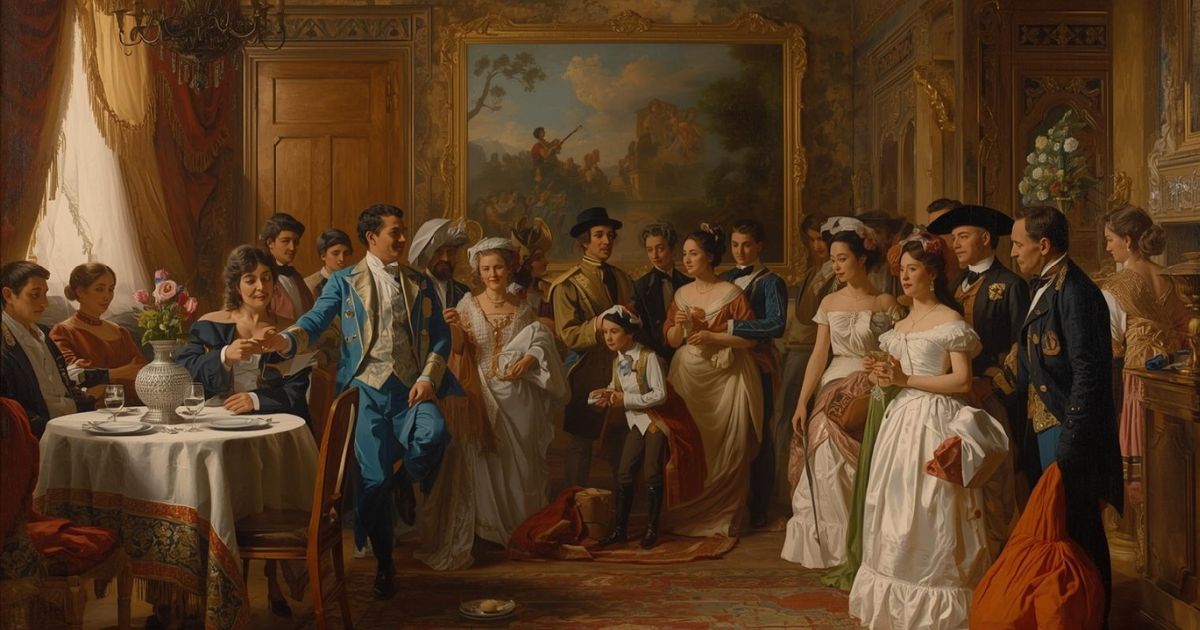
An excerpt from the original text.(complete · 1847 words)
he Rulers
Divide and rule.
(The New Machiavelli.)
Who were the caciques of the town?
Don Rafael, when alive, even though he was the richest, owned more
land, and was the patron of nearly everybody, had not been one of
them. As he was modest and depreciated the value of his own deeds,
no faction in his favor had ever been formed in the town, and we
have already seen how the people all rose up against him when they
saw him hesitate upon being attacked.
Could it be Capitan Tiago? True it was that when he went there he
was received with an orchestra by his debtors, who banqueted him and
heaped gifts upon him. The finest fruits burdened his table and a
quarter of deer or wild boar was his share of the hunt. If he found
the horse of a debtor beautiful, half an hour afterwards it was in
his stable. All this was true, but they laughed at him behind his
back and in secret called him "Sacristan Tiago."
Perhaps it was the gobernadorcillo? [52] No, for he was only an
unhappy mortal who commanded not, but obeyed; who ordered not, but
was ordered; who drove not, but was driven. Nevertheless, he had
to answer to the alcalde for having commanded, ordered, and driven,
just as if he were the originator of everything. Yet be it said to
his credit that he had never presumed upon or usurped such honors,
which had cost him five thousand pesos and many humiliations. But
considering the income it brought him, it was cheap.
Well then, might it be God? Ah, the good God disturbed neither the
consciences nor the sleep of the inhabitants. At least, He did not
make them tremble, and if by chance He might have been mentioned in
a sermon, surely they would have sighed longingly, "Oh, that only
there were a God!" To the good Lord they paid little attention, as
the saints gave them enough to do. For those poor folk God had come
to be like those unfortunate monarchs who are surrounded by courtiers
to whom alone the people render homage.
San Diego was a kind of Rome: not the Rome of the time when the cunning
Romulus laid out its walls with a plow, nor of the later time when,
bathed in its own and others' blood, it dictated laws to the world--no,
it was a Rome of our own times with the difference that in place of
marble monuments and colosseums it had its monuments of sawali and its
cockpit of nipa. The curate was the Pope in the Vatican; the alferez
of the Civil Guard, the King of Italy on the Quirinal: all, it must be
understood, on a scale of nipa and bamboo. Here, as there, continual
quarreling went on, since each wished to be the master and considered
the other an intruder. Let us examine the characteristics of each.
Fray Bernardo Salvi was that silent young Franciscan of whom we
have spoken before. In his habits and manners he was quite different
from his brethren and even from his predecessor, the violent Padre
Damaso. He was thin and sickly, habitually pensive, strict in the
fulfilment of his religious duties, and careful of his good name. In
a month after his arrival nearly every one in the town had joined
the Venerable Tertiary Order, to the great distress of its rival,
the Society of the Holy Rosary. His soul leaped with joy to see about
each neck four or five scapularies and around each waist a knotted
girdle, and to behold the procession of corpses and ghosts in guingón
habits. The senior sacristan made a small fortune selling--or giving
away as alms, we should say--all things necessary for the salvation
of the soul and the warfare against the devil, as it is well known
that this spirit, which formerly had the temerity to contradict God
himself face to face and to doubt His words, as is related in the
holy book of Job, who carried our Lord Christ through the air as
afterwards in the Dark Ages he carried the ghosts, and continues,
according to report, to carry the asuang of the Philippines, now
seems to have become so shamefaced that he cannot endure the sight of
a piece of painted cloth and that he fears the knots on a cord. But
all this proves nothing more than that there is progress on this side
also and that the devil is backward, or at least a conservative,
as are all who dwell in darkness. Otherwise, we must attribute to
him the weakness of a fifteen-year-old girl.
As we have said, Fray Salvi was very assiduous in the fulfilment of his
duties, too assiduous, the alferez thought. While he was preaching--he
was very fond of preaching--the doors of the church were closed,
wherein he was like Nero, who allowed no one to leave the theater while
he was singing. But the former did it for the salvation and the latter
for the corruption of souls. Fray Salvi rarely resorted to blows,
but was accustomed to punish every shortcoming of his subordinates
with fines. In this respect he was very different from Padre Damaso,
who had been accustomed to settle everything with his fists or a cane,
administering such chastisement with the greatest good-will. For this,
however, he should not be judged too harshly, as he was firm in the
belief that the Indian could be managed only by beating him, just
as was affirmed by a friar who knew enough to write books, and Padre
Damaso never disputed anything that he saw in print, a credulity of
which many might have reason to complain. Although Fray Salvi made
little use of violence, yet, as an old wiseacre of the town said,
what he lacked in quantity he made up in quality. But this should
not be counted against him, for the fasts and abstinences thinned his
blood and unstrung his nerves and, as the people said, the wind got
into his head. Thus it came about that it was not possible to learn
from the condition of the sacristans' backs whether the curate was
fasting or feasting.
The only rival of this spiritual power, with tendencies toward the
temporal, was, as we have said, the alferez: the only one, since the
women told how the devil himself would flee from the curate, because,
having one day dared to tempt him, he was caught, tied to a bedpost,
soundly whipped with a rope, and set at liberty only after nine
days. As a consequence, any one who after this would still be the
enemy of such a man, deserved to fall into worse repute than even
the weak and unwary devils.
But the alferez deserved his fate. His wife was an old Filipina of
abundant rouge and paint, known as Doña Consolacion--although her
husband and some others called her by quite another name. The alferez
revenged his conjugal misfortunes on his own person by getting so
drunk that he made a tank of himself, or by ordering his soldiers to
drill in the sun while he remained in the shade, or, more frequently,
by beating up his consort, who, if she was not a lamb of God to
take away one's sins, at least served to lay up for her spouse many
torments in Purgatory--if perchance he should get there, a matter of
doubt to the devout women. As if for the fun of it, these two used to
beat each other up beautifully, giving free shows to the neighborhood
with vocal and instrumental accompaniments, four-handed, soft, loud,
with pedal and all.
Whenever these scandals reached the ears of Padre Salvi, he would
smile, cross himself, and recite a paternoster. They called him a
grafter, a hypocrite, a Carlist, and a miser: he merely smiled and
recited more prayers. The alferez had a little anecdote which he
always related to the occasional Spaniards who visited him:
"Are you going over to the convento to visit the sanctimonious rascal
there, the little curate? Yes! Well, if he offers you chocolate which
I doubt--but if he offers it remember this: if he calls to the servant
and says, 'Juan, make a cup of chocolate, eh!' then stay without
fear; but if he calls out, 'Juan, make a cup of chocolate, ah!'
then take your hat and leave on a run."
"What!" the startled visitor would ask, "does he poison
people? Carambas!"
"No, man, not at all!"
"What then?"
"'Chocolate, eh!' means thick and rich, while 'chocolate, ah!'
means watered and thin."
But we are of the opinion that this was a slander on the part of
the alferez, since the same story is told of many curates. At least,
it may be a thing peculiar to the Order.
To make trouble for the curate, the soldier, at the instigation of his
wife, would prohibit any one from walking abroad after nine o'clock at
night. Doña Consolacion would then claim that she had seen the curate,
disguised in a piña camisa and salakot, walking about late. Fray Salvi
would take his revenge in a holy manner. Upon seeing the alferez enter
the church he would innocently order the sacristan to close all the
doors, and would then go up into the pulpit and preach until the very
saints closed their eyes and even the wooden dove above his head,
the image of the Holy Ghost, murmured for mercy. But the alferez,
like all the unregenerate, did not change his ways for this; he would
go away cursing, and as soon as he was able to catch a sacristan, or
one of the curate's servants, he would arrest him, give him a beating,
and make him scrub the floor of the barracks and that of his own house,
which at such times was put in a decent condition. On going to pay
the fine imposed by the curate for his absence, the sacristan would
explain the cause. Fray Salvi would listen in silence, take the money,
and at once turn out his goats and sheep so that they might graze
in the alferez's garden, while he himself looked up a new text for
another longer and more edifying sermon. But these were only little
pleasantries, and if the two chanced to meet they would shake hands
and converse politely.
When her husband was sleeping off the wine he had drunk, or was
snoring through the siesta, and she could not quarrel with him, Doña
Consolacion, in a blue flannel camisa, with a big cigar in her mouth,
would take her stand at the window. She could not endure the young
people, so from there she would scrutinize and mock the passing girls,
who, being afraid of her, would hurry by in confusion, holding their
breath the while, and not daring to raise their eyes. One great virtue
Doña Consolation possessed, and this was that she had evidently never
looked in a mirror.
These were the rulers of the town of San Diego.
Master this chapter. Complete your experience
Purchase the complete book to access all chapters and support classic literature
As an Amazon Associate, we earn a small commission from qualifying purchases at no additional cost to you.
Available in paperback, hardcover, and e-book formats
Let's Analyse the Pattern
The Shadow Power Game - How Real Authority Hides Behind Official Titles
Real authority often operates behind official titles, controlled by people pursuing personal agendas rather than institutional goals.
Why This Matters
Connect literature to life
This chapter teaches how to identify who really runs things versus who just has the official title.
Practice This Today
This week, notice when people say 'you'll have to ask so-and-so' - that person often holds more real power than their job title suggests.
Now let's explore the literary elements.
Key Quotes & Analysis
"Who were the caciques of the town?"
Context: Rizal opens the chapter by asking who really holds power in San Diego
This question cuts straight to the heart of how power actually works versus how it appears to work. Rizal is teaching readers to look beyond official titles and wealth to understand real influence.
In Today's Words:
So who actually runs this place?
"All rose up against him when they saw him hesitate upon being attacked"
Context: Describing how the people turned on Don Rafael when he was accused
Shows how quickly public opinion can turn against even good people when they appear weak. It reveals the harsh reality that virtue without political skill leaves you vulnerable.
In Today's Words:
The moment he looked uncertain, everyone threw him under the bus
"They laughed at him behind his back and in secret called him 'Sacristan Tiago'"
Context: Revealing how people really feel about Capitan Tiago despite their public deference
Exposes the difference between public respect and private opinion. Money can buy compliance but not genuine respect, and people will mock those they serve if they see them as weak or foolish.
In Today's Words:
Everyone kissed up to his face but made fun of him the second he left the room
"He commanded not, but obeyed; who ordered not, but was ordered; who drove not, but was driven"
Context: Describing the powerless position of the gobernadorcillo
This rhythmic repetition emphasizes how colonial systems created the illusion of local authority while keeping real power in Spanish hands. It's a perfect example of how bureaucracy can trap people in impossible positions.
In Today's Words:
He wasn't the boss, he just looked like one - and got blamed like one
Thematic Threads
Hidden Power
In This Chapter
The priest and officer wield more influence than official leaders through fear and force
Development
Building on earlier hints about who really controls colonial society
In Your Life:
Your workplace likely has informal power brokers who matter more than the org chart suggests
Petty Tyranny
In This Chapter
Fray Salvi and the officer abuse their positions to settle personal scores
Development
Introduced here as a new dimension of corruption
In Your Life:
Small-scale bullies often hide behind official roles to justify their behavior
Scapegoating
In This Chapter
The puppet governor takes blame while real decision-makers avoid responsibility
Development
Extends the theme of how colonial systems deflect accountability
In Your Life:
Middle managers often get blamed for policies they didn't create and can't change
Class Illusion
In This Chapter
Don Rafael's wealth doesn't translate to political power due to his modesty
Development
Continues exploring how different types of status interact
In Your Life:
Money and influence don't always go together - sometimes the richest person isn't the most powerful
Institutional Decay
In This Chapter
The entire governing structure serves personal vendettas rather than public good
Development
Deepens the critique of colonial administration
In Your Life:
When institutions stop serving their stated purpose, ordinary people pay the price
You now have the context. Time to form your own thoughts.
Discussion Questions
- 1
Who actually runs San Diego according to Rizal, and why isn't it the people you'd expect to be in charge?
analysis • surface - 2
Why do Fray Salvi and the alferez waste so much energy fighting each other instead of actually governing the town?
analysis • medium - 3
Think about your workplace, school, or community - who has the real influence versus who has the official title?
application • medium - 4
If you were new to San Diego and needed something important done, how would you figure out who to actually approach for help?
application • deep - 5
What does this chapter reveal about how personal grudges can hijack entire systems that are supposed to serve people?
reflection • deep
Critical Thinking Exercise
Map Your Real Power Structure
Choose one environment you navigate regularly - your workplace, your family, your neighborhood, or even your friend group. Draw or list the official structure (who's supposed to be in charge), then map the real power structure (who actually makes things happen, who controls resources, who influences decisions). Look for the shadow players like Fray Salvi and the alferez - people whose personal agendas drive their actions.
Consider:
- •Notice who people actually go to when they need something done, not just who holds the title
- •Identify any ongoing conflicts between power holders that might affect how things get done
- •Consider how you might navigate this structure more effectively now that you see it clearly
Journaling Prompt
Write about a time when you appealed to the wrong person for help because you didn't understand the real power structure. What would you do differently now?
Coming Up Next...
Chapter 12: The Living and the Dead
As the town prepares for All Saints' Day, the religious festivities will bring all these power players together in one place. With tensions already simmering between the priest and the military officer, what could possibly go wrong when the whole community gathers?



