
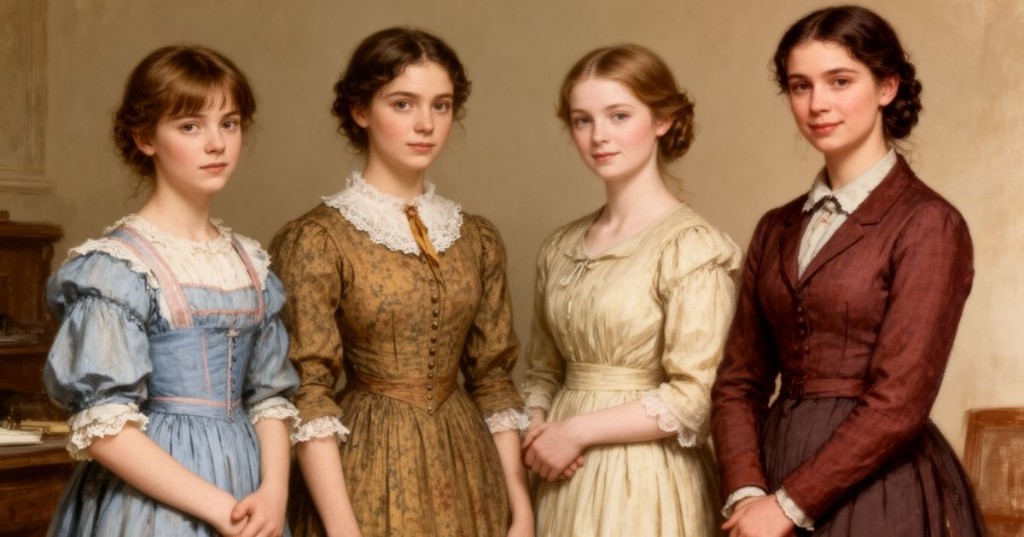
An excerpt from the original text.(complete · 2721 words)
CHAPTER TWENTY CONFIDENTIAL
I don’t think I have any words in which to tell the meeting of the
mother and daughters. Such hours are beautiful to live, but very hard
to describe, so I will leave it to the imagination of my readers,
merely saying that the house was full of genuine happiness, and that
Meg’s tender hope was realized, for when Beth woke from that long,
healing sleep, the first objects on which her eyes fell were the little
rose and Mother’s face. Too weak to wonder at anything, she only smiled
and nestled close in the loving arms about her, feeling that the hungry
longing was satisfied at last. Then she slept again, and the girls
waited upon their mother, for she would not unclasp the thin hand which
clung to hers even in sleep.
Hannah had ‘dished up’ an astonishing breakfast for the traveler,
finding it impossible to vent her excitement in any other way, and Meg
and Jo fed their mother like dutiful young storks, while they listened
to her whispered account of Father’s state, Mr. Brooke’s promise to
stay and nurse him, the delays which the storm occasioned on the
homeward journey, and the unspeakable comfort Laurie’s hopeful face had
given her when she arrived, worn out with fatigue, anxiety, and cold.
What a strange yet pleasant day that was. So brilliant and gay without,
for all the world seemed abroad to welcome the first snow. So quiet and
reposeful within, for everyone slept, spent with watching, and a
Sabbath stillness reigned through the house, while nodding Hannah
mounted guard at the door. With a blissful sense of burdens lifted off,
Meg and Jo closed their weary eyes, and lay at rest, like storm-beaten
boats safe at anchor in a quiet harbor. Mrs. March would not leave
Beth’s side, but rested in the big chair, waking often to look at,
touch, and brood over her child, like a miser over some recovered
treasure.
Laurie meanwhile posted off to comfort Amy, and told his story so well
that Aunt March actually ‘sniffed’ herself, and never once said “I told
you so”. Amy came out so strong on this occasion that I think the good
thoughts in the little chapel really began to bear fruit. She dried her
tears quickly, restrained her impatience to see her mother, and never
even thought of the turquoise ring, when the old lady heartily agreed
in Laurie’s opinion, that she behaved ‘like a capital little woman’.
Even Polly seemed impressed, for he called her a good girl, blessed her
buttons, and begged her to “come and take a walk, dear”, in his most
affable tone. She would very gladly have gone out to enjoy the bright
wintry weather, but discovering that Laurie was dropping with sleep in
spite of manful efforts to conceal the fact, she persuaded him to rest
on the sofa, while she wrote a note to her mother. She was a long time
about it, and when she returned, he was stretched out with both arms
under his head, sound asleep, while Aunt March had pulled down the
curtains and sat doing nothing in an unusual fit of benignity.
After a while, they began to think he was not going to wake up till
night, and I’m not sure that he would, had he not been effectually
roused by Amy’s cry of joy at sight of her mother. There probably were
a good many happy little girls in and about the city that day, but it
is my private opinion that Amy was the happiest of all, when she sat in
her mother’s lap and told her trials, receiving consolation and
compensation in the shape of approving smiles and fond caresses. They
were alone together in the chapel, to which her mother did not object
when its purpose was explained to her.
“On the contrary, I like it very much, dear,” looking from the dusty
rosary to the well-worn little book, and the lovely picture with its
garland of evergreen. “It is an excellent plan to have some place where
we can go to be quiet, when things vex or grieve us. There are a good
many hard times in this life of ours, but we can always bear them if we
ask help in the right way. I think my little girl is learning this.”
“Yes, Mother, and when I go home I mean to have a corner in the big
closet to put my books and the copy of that picture which I’ve tried to
make. The woman’s face is not good, it’s too beautiful for me to draw,
but the baby is done better, and I love it very much. I like to think
He was a little child once, for then I don’t seem so far away, and that
helps me.”
As Amy pointed to the smiling Christ child on his Mother’s knee, Mrs.
March saw something on the lifted hand that made her smile. She said
nothing, but Amy understood the look, and after a minute’s pause, she
added gravely, “I wanted to speak to you about this, but I forgot it.
Aunt gave me the ring today. She called me to her and kissed me, and
put it on my finger, and said I was a credit to her, and she’d like to
keep me always. She gave that funny guard to keep the turquoise on, as
it’s too big. I’d like to wear them Mother, can I?”
“They are very pretty, but I think you’re rather too young for such
ornaments, Amy,” said Mrs. March, looking at the plump little hand,
with the band of sky-blue stones on the forefinger, and the quaint
guard formed of two tiny golden hands clasped together.
“I’ll try not to be vain,” said Amy. “I don’t think I like it only
because it’s so pretty, but I want to wear it as the girl in the story
wore her bracelet, to remind me of something.”
“Do you mean Aunt March?” asked her mother, laughing.
“No, to remind me not to be selfish.” Amy looked so earnest and sincere
about it that her mother stopped laughing, and listened respectfully to
the little plan.
“I’ve thought a great deal lately about my ‘bundle of naughties’, and
being selfish is the largest one in it, so I’m going to try hard to
cure it, if I can. Beth isn’t selfish, and that’s the reason everyone
loves her and feels so bad at the thoughts of losing her. People
wouldn’t feel so bad about me if I was sick, and I don’t deserve to
have them, but I’d like to be loved and missed by a great many friends,
so I’m going to try and be like Beth all I can. I’m apt to forget my
resolutions, but if I had something always about me to remind me, I
guess I should do better. May we try this way?”
“Yes, but I have more faith in the corner of the big closet. Wear your
ring, dear, and do your best. I think you will prosper, for the sincere
wish to be good is half the battle. Now I must go back to Beth. Keep up
your heart, little daughter, and we will soon have you home again.”
That evening while Meg was writing to her father to report the
traveler’s safe arrival, Jo slipped upstairs into Beth’s room, and
finding her mother in her usual place, stood a minute twisting her
fingers in her hair, with a worried gesture and an undecided look.
“What is it, deary?” asked Mrs. March, holding out her hand, with a
face which invited confidence.
“I want to tell you something, Mother.”
“About Meg?”
“How quickly you guessed! Yes, it’s about her, and though it’s a little
thing, it fidgets me.”
“Beth is asleep. Speak low, and tell me all about it. That Moffat
hasn’t been here, I hope?” asked Mrs. March rather sharply.
“No. I should have shut the door in his face if he had,” said Jo,
settling herself on the floor at her mother’s feet. “Last summer Meg
left a pair of gloves over at the Laurences’ and only one was returned.
We forgot about it, till Teddy told me that Mr. Brooke owned that he
liked Meg but didn’t dare say so, she was so young and he so poor. Now,
isn’t it a dreadful state of things?”
“Do you think Meg cares for him?” asked Mrs. March, with an anxious
look.
“Mercy me! I don’t know anything about love and such nonsense!” cried
Jo, with a funny mixture of interest and contempt. “In novels, the
girls show it by starting and blushing, fainting away, growing thin,
and acting like fools. Now Meg does not do anything of the sort. She
eats and drinks and sleeps like a sensible creature, she looks straight
in my face when I talk about that man, and only blushes a little bit
when Teddy jokes about lovers. I forbid him to do it, but he doesn’t
mind me as he ought.”
“Then you fancy that Meg is not interested in John?”
“Who?” cried Jo, staring.
“Mr. Brooke. I call him ‘John’ now. We fell into the way of doing so at
the hospital, and he likes it.”
“Oh, dear! I know you’ll take his part. He’s been good to Father, and
you won’t send him away, but let Meg marry him, if she wants to. Mean
thing! To go petting Papa and helping you, just to wheedle you into
liking him.” And Jo pulled her hair again with a wrathful tweak.
“My dear, don’t get angry about it, and I will tell you how it
happened. John went with me at Mr. Laurence’s request, and was so
devoted to poor Father that we couldn’t help getting fond of him. He
was perfectly open and honorable about Meg, for he told us he loved
her, but would earn a comfortable home before he asked her to marry
him. He only wanted our leave to love her and work for her, and the
right to make her love him if he could. He is a truly excellent young
man, and we could not refuse to listen to him, but I will not consent
to Meg’s engaging herself so young.”
“Of course not. It would be idiotic! I knew there was mischief brewing.
I felt it, and now it’s worse than I imagined. I just wish I could
marry Meg myself, and keep her safe in the family.”
This odd arrangement made Mrs. March smile, but she said gravely, “Jo,
I confide in you and don’t wish you to say anything to Meg yet. When
John comes back, and I see them together, I can judge better of her
feelings toward him.”
“She’ll see those handsome eyes that she talks about, and then it will
be all up with her. She’s got such a soft heart, it will melt like
butter in the sun if anyone looks sentimentlly at her. She read the
short reports he sent more than she did your letters, and pinched me
when I spoke of it, and likes brown eyes, and doesn’t think John an
ugly name, and she’ll go and fall in love, and there’s an end of peace
and fun, and cozy times together. I see it all! They’ll go lovering
around the house, and we shall have to dodge. Meg will be absorbed and
no good to me any more. Brooke will scratch up a fortune somehow, carry
her off, and make a hole in the family, and I shall break my heart, and
everything will be abominably uncomfortable. Oh, dear me! Why weren’t
we all boys, then there wouldn’t be any bother.”
Jo leaned her chin on her knees in a disconsolate attitude and shook
her fist at the reprehensible John. Mrs. March sighed, and Jo looked up
with an air of relief.
“You don’t like it, Mother? I’m glad of it. Let’s send him about his
business, and not tell Meg a word of it, but all be happy together as
we always have been.”
“I did wrong to sigh, Jo. It is natural and right you should all go to
homes of your own in time, but I do want to keep my girls as long as I
can, and I am sorry that this happened so soon, for Meg is only
seventeen and it will be some years before John can make a home for
her. Your father and I have agreed that she shall not bind herself in
any way, nor be married, before twenty. If she and John love one
another, they can wait, and test the love by doing so. She is
conscientious, and I have no fear of her treating him unkindly. My
pretty, tender hearted girl! I hope things will go happily with her.”
“Hadn’t you rather have her marry a rich man?” asked Jo, as her
mother’s voice faltered a little over the last words.
“Money is a good and useful thing, Jo, and I hope my girls will never
feel the need of it too bitterly, nor be tempted by too much. I should
like to know that John was firmly established in some good business,
which gave him an income large enough to keep free from debt and make
Meg comfortable. I’m not ambitious for a splendid fortune, a
fashionable position, or a great name for my girls. If rank and money
come with love and virtue, also, I should accept them gratefully, and
enjoy your good fortune, but I know, by experience, how much genuine
happiness can be had in a plain little house, where the daily bread is
earned, and some privations give sweetness to the few pleasures. I am
content to see Meg begin humbly, for if I am not mistaken, she will be
rich in the possession of a good man’s heart, and that is better than a
fortune.”
“I understand, Mother, and quite agree, but I’m disappointed about Meg,
for I’d planned to have her marry Teddy by-and-by and sit in the lap of
luxury all her days. Wouldn’t it be nice?” asked Jo, looking up with a
brighter face.
“He is younger than she, you know,” began Mrs. March, but Jo broke
in...
“Only a little, he’s old for his age, and tall, and can be quite
grown-up in his manners if he likes. Then he’s rich and generous and
good, and loves us all, and I say it’s a pity my plan is spoiled.”
“I’m afraid Laurie is hardly grown-up enough for Meg, and altogether
too much of a weathercock just now for anyone to depend on. Don’t make
plans, Jo, but let time and their own hearts mate your friends. We
can’t meddle safely in such matters, and had better not get ‘romantic
rubbish’ as you call it, into our heads, lest it spoil our friendship.”
“Well, I won’t, but I hate to see things going all crisscross and
getting snarled up, when a pull here and a snip there would straighten
it out. I wish wearing flatirons on our heads would keep us from
growing up. But buds will be roses, and kittens cats, more’s the pity!”
“What’s that about flatirons and cats?” asked Meg, as she crept into
the room with the finished letter in her hand.
“Only one of my stupid speeches. I’m going to bed. Come, Peggy,” said
Jo, unfolding herself like an animated puzzle.
“Quite right, and beautifully written. Please add that I send my love
to John,” said Mrs. March, as she glanced over the letter and gave it
back.
“Do you call him ‘John’?” asked Meg, smiling, with her innocent eyes
looking down into her mother’s.
“Yes, he has been like a son to us, and we are very fond of him,”
replied Mrs. March, returning the look with a keen one.
“I’m glad of that, he is so lonely. Good night, Mother, dear. It is so
inexpressibly comfortable to have you here,” was Meg’s answer.
The kiss her mother gave her was a very tender one, and as she went
away, Mrs. March said, with a mixture of satisfaction and regret, “She
does not love John yet, but will soon learn to.”
Master this chapter. Complete your experience
Purchase the complete book to access all chapters and support classic literature
As an Amazon Associate, we earn a small commission from qualifying purchases at no additional cost to you.
Available in paperback, hardcover, and e-book formats
Let's Analyse the Pattern
When people who care about you work behind the scenes to create conditions for your success while respecting your autonomy to choose.
Why This Matters
Connect literature to life
This chapter teaches how to distinguish between controlling behavior and loving guidance by examining the motives and methods behind the scenes.
Practice This Today
This week, notice when someone in your life sets boundaries or makes decisions that initially feel restrictive—look for whether they're creating conditions for your success or demanding specific outcomes from you.
Now let's explore the literary elements.
Key Quotes & Analysis
"I want my daughters to be beautiful, accomplished, and good; to be admired, loved, and respected; to have a happy youth, to be well and wisely married, and to lead useful, pleasant lives."
Context: Explaining her hopes for her daughters' futures to Jo
This reveals the Victorian ideal of female success - beauty, skills, virtue, and ultimately marriage. But Mrs. March emphasizes 'well and wisely married,' showing she values compatibility and wisdom over just finding any husband.
In Today's Words:
I want you girls to be confident, capable, and good people who find love with the right person and build meaningful lives.
"Love will come to you, my little girl, and when it does, you will know how to make it a blessing and not a curse."
Context: Reassuring Jo about love and marriage
Shows Mrs. March's wisdom that love is inevitable but requires skill to handle well. She's teaching that successful relationships take work and wisdom, not just feeling.
In Today's Words:
You'll fall in love someday, and when you do, you'll know how to make it work instead of letting it mess up your life.
"I just wish we could all stay as we are forever, and be happy together."
Context: Expressing her fear of family changes to her mother
Captures the universal fear of losing what we love through change. Jo's wish is both touching and impossible - growth requires change, even when it's scary.
In Today's Words:
I wish nothing ever had to change and we could all just stay close like this forever.
Thematic Threads
Trust
In This Chapter
Jo discovers her parents have been managing John's courtship with wisdom and foresight, working behind the scenes to protect Meg
Development
Evolved from earlier chapters about family bonds to show how trust operates through protective action
In Your Life:
You might see this when family members make decisions about your welfare that you don't understand until later.
Growth
In This Chapter
Amy earns the turquoise ring through genuine character development rather than manipulation, showing authentic change
Development
Continued from Amy's earlier vanity and selfishness to demonstrate real personal evolution
In Your Life:
You experience this when external rewards finally come from internal change rather than just wanting them.
Transition
In This Chapter
Jo's distress about Meg growing up and potentially marrying reflects the pain of family evolution and change
Development
Building on earlier themes of childhood ending and adult responsibilities beginning
In Your Life:
You feel this when your relationships change as people grow—kids becoming adults, friends getting married, roles shifting.
Practical Love
In This Chapter
Mrs. March balances romantic feeling with financial security, understanding that love needs both emotion and foundation
Development
Reinforces earlier lessons about responsibility and realistic planning within relationships
In Your Life:
You navigate this when making decisions about relationships that require both heart and practical considerations.
Healing
In This Chapter
Beth's recovery and the family's reunion show how crisis can strengthen bonds and create deeper appreciation
Development
Culminates the illness storyline while showing how families can emerge stronger from difficulty
In Your Life:
You experience this when going through tough times actually brings you closer to the people who matter most.
You now have the context. Time to form your own thoughts.
Discussion Questions
- 1
What does Mrs. March reveal to Jo about John Brooke's courtship of Meg, and how long have the parents known about his feelings?
analysis • surface - 2
Why do Mr. and Mrs. March set conditions for John's courtship rather than simply forbidding it or allowing it immediately?
analysis • medium - 3
Think about your own life - when has someone helped guide your decisions from behind the scenes? How did you feel when you realized what they were doing?
application • medium - 4
If you were in Meg's position, would you want your parents managing your romantic relationship this way? What are the benefits and risks of this approach?
application • deep - 5
What does this chapter suggest about the difference between controlling someone and protecting them? How can you tell which one is happening?
reflection • deep
Critical Thinking Exercise
Map the Hidden Helpers
Think about a major decision or challenge you've faced in the past year. Write down everyone who influenced that situation - not just people who gave direct advice, but those who created opportunities, removed obstacles, or provided support without being asked. Next to each name, note what they did and whether you recognized their help at the time.
Consider:
- •Look for actions that seemed coincidental but might have been intentional
- •Consider people who asked seemingly casual questions that made you think differently
- •Notice who was conspicuously absent during difficult moments - sometimes stepping back is also protective wisdom
Journaling Prompt
Write about someone who helped guide your life from behind the scenes. What did they do, and how do you feel about their approach now? How might you offer this kind of protective wisdom to someone you care about?
Coming Up Next...
Chapter 21: Mischief, Secrets, and Making Peace
With family secrets now in the open and Laurie back in the mix, the delicate balance of the March household is about to face new complications. Sometimes those trying to help can create the very problems they're trying to prevent.



