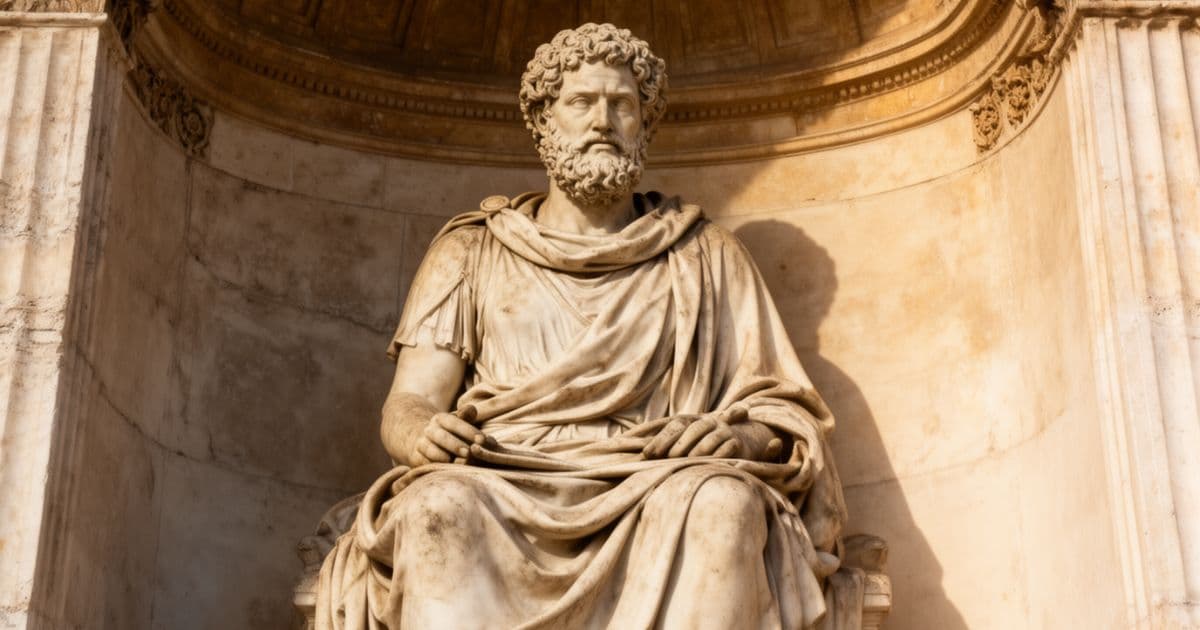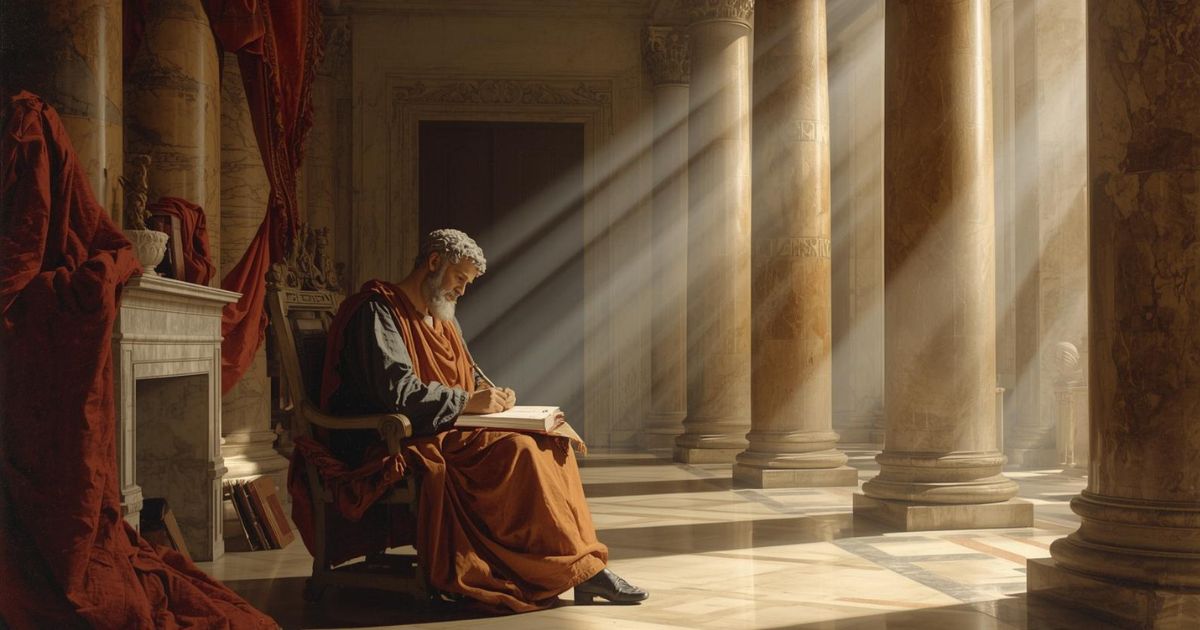
An excerpt from the original text.(complete · 1521 words)
←etter 92. On the happy lifeMoral letters to Luciliusby Seneca, translated by Richard Mott GummereLetter 93. On the quality, as contrasted with the length, of lifeLetter 94. On the value of advice→483668Moral letters to Lucilius — Letter 93. On the quality, as contrasted with the length, of lifeRichard Mott GummereSeneca THE EPISTLES OF SENECA XCIII. ON THE QUALITY, AS CONTRASTED WITH THE LENGTH, OF LIFE 1. While reading the letter in which you were lamenting the death of the philosopher Metronax[1] as if he might have, and indeed ought to have, lived longer, I missed the spirit of fairness which abounds in all your discussions concerning men and things, but is lacking when you approach one single subject,—as is indeed the case with us all. In other words, I have noticed many who deal fairly with their fellow-men, but none who deals fairly with the gods. We rail every day at Fate, saying “Why has A. been carried off in the very middle of his career? Why is not B. carried off instead? Why should he prolong his old age, which is a burden to himself as well as to others?” 2. But tell me, pray, do you consider it fairer that you should obey Nature, or that Nature should obey you? And what difference does it make how soon you depart from a place which you must depart from sooner or later? We should strive, not to live long, but to live rightly;[2] for to achieve long life you have need of Fate only, but for right living you need the soul. A life is really long if it is a full life; but fulness is not attained until the soul has rendered to itself its proper Good,[3] that is, until it has assumed control over itself. 3. What benefit does this older man derive from the eighty years he has spent in idleness? A person like him has not lived; he has merely tarried awhile in life. Nor has he died late in life; he has simply been a long time dying. He has lived eighty years, has he? That depends upon the date from which you reckon his death! Your other friend,[4] however, departed in the bloom of his manhood. 4. But he had fulfilled all the duties of a good citizen, a good friend, a good son; in no respect had he fallen short. His age may have been incomplete, but his life was complete. The other man has lived eighty years, has he? Nay, he has existed eighty years, unless perchance you mean by “he has lived” what we mean when we say that a tree “lives.” Pray, let us see to it, my dear Lucilius, that our lives, like jewels of great price, be noteworthy not because of their width but because of their weight.[5] Let us measure them by their performance, not by their duration. Would you know wherein lies the difference between this hardy man who, despising Fortune, has served through every campaign of life and has attained to life’s Supreme Good, and that other person over whose head many years have passed? The former exists even after his death; the latter has died even before he was dead.[6] 5. We should therefore praise, and number in the company of the blest, that man who has invested well the portion of time, however little, that has been allotted to him; for such a one has seen the true light. He has not been one of the common herd. He has not been one of the common herd. He has not only lived, but flourished. Sometimes he enjoyed fair skies; sometimes, as often happens, it was only through the clouds that there flashed to him the radiance of the mighty star.[7] Why do you ask: “How long did he live?” He still lives! At one bound he has passed over into posterity and has consigned himself to the guardianship of memory. 6. And yet I would not on that account decline for myself a few additional years; although, if my life’s space be shortened, I shall not say that I have lacked aught that is essential to a happy life. For I have not planned to live up to the very last day that my greedy hopes had promised me; nay, I have looked upon every day as if it were my last. Why ask the date of my birth, or whether I am still enrolled on the register of the younger men?[8] What I have is my own. 7. Just as one of small stature can be a perfect man, so a life of small compass can be a perfect life. Age ranks among the external things.[9] How long I am to exist is not mine to decide, but how long I shall go on existing in my present way is in my own control. This is the only thing you have the right to require of me,—that I shall cease to measure out an inglorious age as it were in darkness, and devote myself to living instead of being carried along past life. 8. And what, you ask, is the fullest span of life? It is living until you possess wisdom. He who has attained wisdom has reached, not the furthermost, but the most important, goal. Such a one may indeed exult boldly and give thanks to the gods—aye, and to himself also—and he may count himself Nature’s creditor for having lived. He will indeed have the right to do so, for he has paid her back a better life than he has received. He has set up the pattern of a good man, showing the quality and the greatness of a good man. Had another year been added, it would merely have been like the past. 9. And yet how long are we to keep living? We have had the joy of learning the truth about the universe. We know from what beginnings Nature arises; how she orders the course of the heavens; by what successive changes she summons back the year; how she has brought to an end all things that ever have been, and has established herself as the only end of her own being.[10] We know that the stars move by their own motion, and that nothing except the earth stands still, while all the other bodies run on with uninterrupted swiftness.[11] We know how the moon outstrips the sun; why it is that the slower leaves the swifter behind; in what manner she receives her light, or loses it again; what brings on the night, and what brings back the day. To that place you must go where you are to have a closer view of all these things. 10. “And yet,” says the wise man, “I do not depart more valiantly because of this hope—because I judge the path lies clear before me to my own gods. I have indeed earned admission to their presence, and in fact have already been in their company; I have sent my soul to them as they had previously sent theirs to me. But suppose that I am utterly annihilated, and that after death nothing mortal remains; I have no less courage, even if, when I depart, my course leads—nowhere.” “But,” you say, “he has not lived as many years as he might have lived.” 11. There are books which contain very few lines, admirable and useful in spite of their size; and there are also the Annals of Tanusius,[12]—you know how bulky the book is, and what men say of it. This is the case with the long life of certain persons,—a state which resembles the Annals of Tanusius! 12. Do you regard as more fortunate the fighter who is slain on the last day of the games than one who goes to his death in the middle of the festivities? Do you believe that anyone is so foolishly covetous of life that he would rather have his throat cut in the dressing-room than in the amphitheatre? It is by no longer an interval than this that we precede one another. Death visits each and all; the slayer soon follows the slain. It is an insignificant trifle, after all, that people discuss with so much concern. And anyhow, what does it matter for how long a time you avoid that which you cannot escape? Farewell. ↑ A philosopher of Naples, mentioned as giving lectures there: cf. Ep. lxxvi. 4. ↑ i.e., “adequately,” equivalent to ὠς δεῖ. ↑ For a complete definition of the Supreme Good cf. Ep. lxxi. 4 ff. ↑ i.e., the Metronax mentioned above. ↑ For the same phrase see Ep. lxvi. 30 and footnote. ↑ Cf. Ep. lx. 4 mortem suam antecesserunt. ↑ i.e., the Sun. ↑ As in the original comitia centuriata, men between the ages of seventeen and forty-six. ↑ As riches, health, etc. ↑ i.e., Nature herself is eternal. ↑ See, however, Seneca, N. Q. vii. 2. 3 sciamus utrum mundus terra stante circumeat an mundo stante terra vertatur. For doubts and discoveries cf. Arnold, Roman Stoicism, pp. 178 f. ↑ See Index of Proper Names.
Master this chapter. Complete your experience
Purchase the complete book to access all chapters and support classic literature
As an Amazon Associate, we earn a small commission from qualifying purchases at no additional cost to you.
Available in paperback, hardcover, and e-book formats
Let's Analyse the Pattern
The Quality vs. Quantity Trap
Measuring lives and experiences by duration rather than depth, creating false metrics that obscure what actually matters.
Why This Matters
Connect literature to life
This chapter teaches how to recognize when you're just going through the motions versus actually building something meaningful.
Practice This Today
This week, notice when you choose safety over growth—ask yourself if you're adding years or adding value.
Now let's explore the literary elements.
Key Quotes & Analysis
"We should strive, not to live long, but to live rightly"
Context: Seneca's main argument against measuring life by years rather than accomplishments
This captures the core Stoic principle that quality trumps quantity. Seneca argues that a meaningful life isn't about accumulating years but about fulfilling your duties and living according to wisdom.
In Today's Words:
It's not about how many years you get - it's about what you do with them.
"Do you consider it fairer that you should obey Nature, or that Nature should obey you?"
Context: Challenging Lucilius's anger at fate for taking Metronax
Seneca points out the absurdity of expecting the universe to conform to our preferences. This rhetorical question forces readers to confront their own unrealistic expectations about control.
In Today's Words:
Do you really think the world should revolve around what you want?
"What difference does it make how soon you depart from a place which you must depart from sooner or later?"
Context: Explaining why mourning based on age doesn't make logical sense
This metaphor treats life like a temporary residence we all must eventually leave. It reframes death not as a tragedy but as an inevitable transition, making the timing less important than how we spent our stay.
In Today's Words:
Everyone has to leave the party eventually - does it really matter if you leave at 10 PM or midnight?
Thematic Threads
Identity
In This Chapter
True identity comes from how we live, not how long we live—the person who fulfills their roles meaningfully has achieved complete selfhood
Development
Builds on earlier themes about authentic self-expression versus social performance
In Your Life:
You might define yourself by years at a job rather than the impact you made there
Class
In This Chapter
The wealthy can afford to waste years in idleness while the working class must make every moment count—yet society judges both by longevity
Development
Expands the critique of how social expectations blind us to real value
In Your Life:
You might feel pressure to stay in situations that aren't serving you because leaving seems like 'failure'
Social Expectations
In This Chapter
Society expects us to mourn based on age rather than achievement, revealing how external standards distort our judgment
Development
Continues the theme of questioning conventional wisdom about success and failure
In Your Life:
You might judge your own life by others' timelines instead of your own meaningful milestones
Personal Growth
In This Chapter
Growth happens through wisdom and right action, not through mere accumulation of time and experience
Development
Reinforces that internal development matters more than external circumstances
In Your Life:
You might mistake years of experience for actual learning and development
Human Relationships
In This Chapter
The value of relationships lies in their depth and impact, not their duration—brief but meaningful connections can be more valuable than decades of shallow interaction
Development
Introduced here as a new way to evaluate connection and love
In Your Life:
You might undervalue short but intense friendships while overvaluing long but superficial ones
You now have the context. Time to form your own thoughts.
Discussion Questions
- 1
What specific distinction does Seneca make between 'living' and merely 'existing'? How does he use the metaphor of jewels to explain this?
analysis • surface - 2
Why does Seneca argue that we're being 'unfair' when we rage about people dying 'too young' while ignoring those who live 'too long'? What assumption about life is he challenging?
analysis • medium - 3
Where do you see this pattern of measuring duration over depth in your own life or workplace? Think about how we evaluate success, relationships, or careers.
application • medium - 4
If you applied Seneca's framework to your current situation, what would you need to change to focus more on 'living' rather than just surviving? What specific actions would demonstrate depth over duration?
application • deep - 5
What does this chapter reveal about how humans naturally measure value and meaning? Why might we instinctively focus on quantity over quality?
reflection • deep
Critical Thinking Exercise
Audit Your Life by Weight, Not Length
Create two lists: things in your life you're measuring by duration (how long you've done them) versus things you should measure by impact or depth (what they've contributed). Include relationships, work projects, habits, and commitments. Then identify one area where you're staying too long out of habit rather than value.
Consider:
- •Consider whether you're staying in situations because of time invested rather than current value
- •Think about relationships or commitments you maintain simply because they've lasted a long time
- •Examine whether you're confusing endurance with accomplishment in any area of your life
Journaling Prompt
Write about a time when you chose to end something meaningful because it had run its course, or when you stayed too long in something that had lost its value. What did you learn about measuring life by depth versus duration?
Coming Up Next...
Chapter 94: The Great Advice Debate
Having established that quality trumps quantity in life, Seneca turns to a practical question: how do we actually achieve that quality? The next letter explores the value of philosophical advice and guidance in shaping our daily choices.