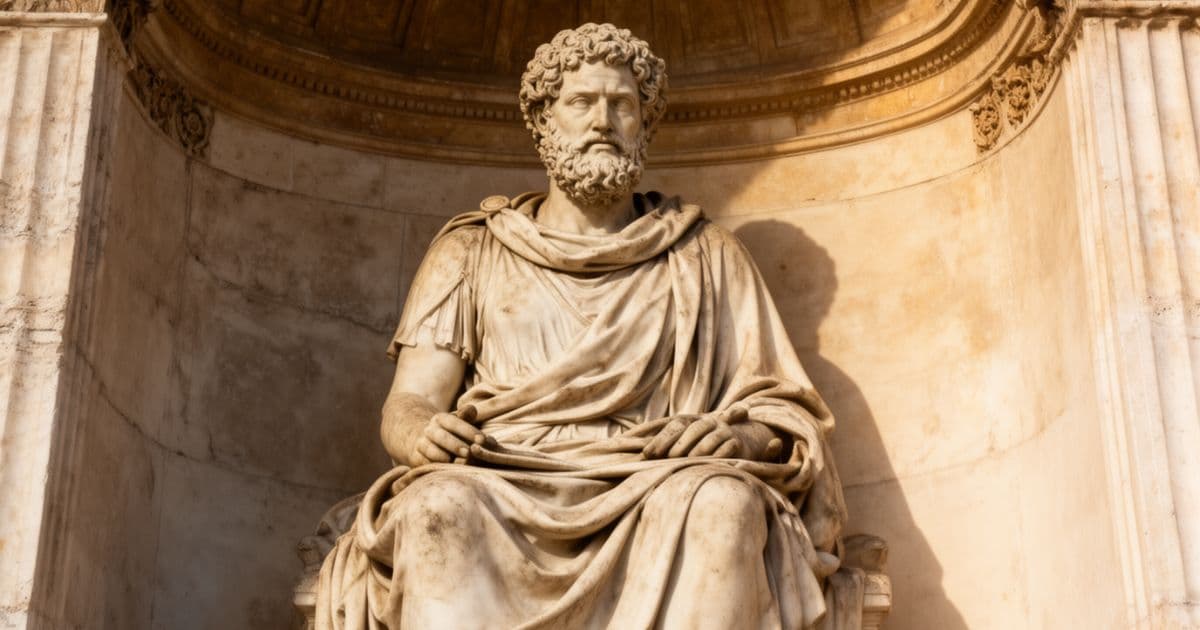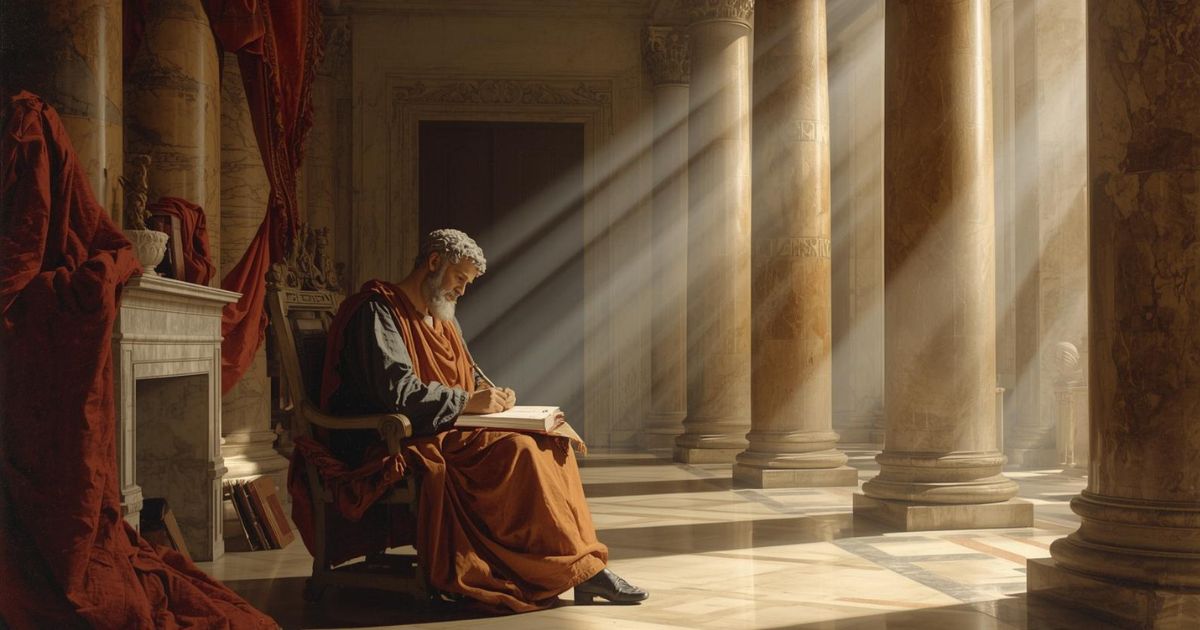
An excerpt from the original text.(complete · 6182 words)
←etter 89. On the parts of philosophyMoral letters to Luciliusby Seneca, translated by Richard Mott GummereLetter 90. On the part played by philosophy in the progress of manLetter 91. On the lesson to be drawn from the burning of Lyons→483389Moral letters to Lucilius — Letter 90. On the part played by philosophy in the progress of manRichard Mott GummereSeneca XC. ON THE PART PLAYED BY PHILOSOPHY IN THE PROGRESS OF MAN 1. Who can doubt, my dear Lucilius, that life is the gift of the immortal gods, but that living well[1] is the gift of philosophy? Hence the idea that our debt to philosophy is greater than our debt to the gods, in proportion as a good life is more of a benefit than mere life, would be regarded as correct, were not philosophy itself a boon which the gods have bestowed upon us. They have given the knowledge thereof to none, but the faculty of acquiring it they have given to all. 2. For if they had made philosophy also a general good, and if we were gifted with understanding at our birth, wisdom would have lost her best attribute—that she is not one of the gifts of fortune. For as it is, the precious and noble characteristic of wisdom is that she does not advance to meet us, that each man is indebted to himself for her, and that we do not seek her at the hands of others. What would there be in philosophy worthy of your respect, if she were a thing that came by bounty? 3. Her sole function is to discover the truth about things divine and things human. From her side religion never departs, nor duty, nor justice, nor any of the whole company of virtues which cling together in close-united fellowship. Philosophy has taught us to worship that which is divine, to love that which is human[2]; she has told us that with the gods lies dominion, and among men, fellowship. This fellowship remained unspoiled for a long time, until avarice tore the community asunder and became the cause of poverty, even in the case of those whom she herself had most enriched. For men cease to possess all things the moment they desire all things for their own. 4. But the first men and those who sprang from them, still unspoiled, followed nature, having one man as both their leader and their law, entrusting themselves to the control of one better than themselves. For nature has the habit of subjecting the weaker to the stronger. Even among the dumb animals those which are either biggest or fiercest hold sway. It is no weakling bull that leads the herd; it is one that has beaten the other males by his might and his muscle. In the case of elephants, the tallest goes first; among men, the best is regarded as the highest. That is why it was to the mind that a ruler was assigned; and for that reason the greatest happiness rested with those peoples among whom a man could not be the more powerful unless he were the better. For that man can safely accomplish what he will who thinks he can do nothing except what he ought to do. 5. Accordingly, in that age which is maintained to be the golden age,[3] Posidonius[4] holds that the government was under the jurisdiction of the wise. They kept their hands under control, and protected the weaker from the stronger. They gave advice, both to do and not to do; they showed what was useful and what was useless. Their forethought provided that their subjects should lack nothing; their bravery warded off dangers; their kindness enriched and adorned their subjects. For them ruling was a service, not an exercise of royalty. No ruler tried his power against those to whom he owed the beginnings of his power; and no one had the inclination, or the excuse, to do wrong, since the ruler ruled well and the subject obeyed well, and the king could utter no greater threat against disobedient subjects than that they should depart from the kingdom. 6. But when once vice stole in and kingdoms were transformed into tyrannies, a need arose for laws; and these very laws were in turn framed by the wise. Solon, who established Athens upon a firm basis by just laws, was one of the seven men renowned for their wisdom.[5] Had Lycurgus lived in the same period, an eighth would have been added to that hallowed number seven. The laws of Zaleucus and Charondas are praised; it was not in the forum or in the offices of skilled counsellors, but in the silent and holy retreat of Pythagoras, that these two men learned the principles of justice which they were to establish in Sicily (which at that time was prosperous) and throughout Grecian Italy. 7. Up to this point I agree with Posidonius; but that philosophy discovered the arts of which life makes use in its daily round[6] I refuse to admit, nor will I ascribe to it an artisan’s glory. Posidonius says: “When men were scattered over the earth, protected by caves or by the dug-out shelter of a cliff or by the trunk of a hollow tree, it was philosophy that taught them to build houses.” But I, for my part, do not hold that philosophy devised these shrewdly-contrived dwellings of ours which rise story upon story, where city crowds against city, any more than that she invented the fish-preserves, which are enclosed for the purpose of saving men’s gluttony from having to run the risk of storms, and in order that, no matter how wildly the sea is raging, luxury may have its safe harbours in which to fatten fancy breeds of fish. 8. What! Was it philosophy that taught the use of keys and bolts? Nay, what was that except giving a hint to avarice? Was it philosophy that erected all these towering tenements, so dangerous to the persons who dwell in them? Was it not enough for man to provide himself a roof of any chance covering, and to contrive for himself some natural retreat without the help of art and without trouble? Believe me, that was a happy age, before the days of architects, before the days of builders! 9. All this sort of thing was born when luxury was being born,—this matter of cutting timbers square and cleaving a beam with unerring hand as the saw made its way over the marked-out line. The primal man with wedges split his wood.[7] For they were not preparing a roof for a future banquet-ball; for no such use did they carry the pine-trees or the firs along the trembling streets[8] with a long row of drays—merely to fasten thereon panelled ceilings heavy with gold. 10. Forked poles erected at either end propped up their houses. With close-packed branches and with leaves heaped up and laid sloping they contrived a drainage for even the heaviest rains. Beneath such dwellings, they lived, but they lived in peace. A thatched roof once covered free men; under marble and gold dwells slavery. 11. On another point also I differ from Posidonius, when he holds that mechanical tools were the invention of wise men. For on that basis one might maintain that those were wise who taught the arts Of setting traps for game, and liming twigs For birds, and girdling mighty woods with dogs.[9] It was man’s ingenuity, not his wisdom, that discovered all these devices. 12. And I also differ from him when he says that wise men discovered our mines of iron and copper, “when the earth, scorched by forest fires, melted the veins of ore which lay near the surface and caused the metal to gush forth.”[10] Nay, the sort of men who discover such things are the sort of men who are busied with them. 13. Nor do I consider this question so subtle as Posidonius thinks, namely, whether the hammer or the tongs came first into use. They were both invented by some man whose mind was nimble and keen, but not great or exalted; and the same holds true of any other discovery which can only be made by means of a bent body and of a mind whose gaze is upon the ground. The wise man was easy-going in his way of living. And why not? Even in our own times he would prefer to be as little cumbered as possible. 14. How, I ask, can you consistently admire both Diogenes and Daedalus? Which of these two seems to you a wise man—the one who devised the saw, or the one who, on seeing a boy drink water from the hollow of his hand, forthwith took his cup from his wallet and broke it, upbraiding himself with these words:[11] “Fool that I am, to have been carrying superfluous baggage all this time!” and then curled himself up in his tub and lay down to sleep? 15. In these our own times, which man, pray, do you deem the wiser—the one who invents a process for spraying saffron perfumes to a tremendous height from hidden pipes, who fills or empties canals by a sudden rush of waters, who so cleverly constructs a dining-room with a ceiling of movable panels that it presents one pattern after another, the roof changing as often as the courses,[12]—or the one who proves to others, as well as to himself, that nature has laid upon us no stern and difficult law when she tells us that we can live without the marble-cutter and the engineer, that we can clothe ourselves without traffic in silk fabrics, that we can have everything that is indispensable to our use, provided only that we are content with what the earth has placed on its surface? If mankind were willing to listen to this sage, they would know that the cook is as superfluous to them as the soldier. 16. Those were wise men, or at any rate like the wise, who found the care of the body a problem easy to solve. The things that are indispensable require no elaborate pains for their acquisition; it is only the luxuries that call for labour. Follow nature, and you will need no skilled craftsmen. Nature did not wish us to be harassed. For whatever she forced upon us, she equipped us. “But cold cannot be endured by the naked body.” What then? Are there not the skins of wild beasts and other animals, which can protect us well enough, and more than enough, from the cold? Do not many tribes cover their bodies with the bark of trees? Are not the feathers of birds sewn together to serve for clothing? Even at the present day does not a large portion of the Scythian tribe garb itself in the skins of foxes and mice, soft to the touch and impervious to the winds? 17. “For all that, men must have some thicker protection than the skin, in order to keep off the heat of the sun in summer.” What then? Has not antiquity produced many retreats which, hollowed out either by the damage wrought by time or by any other occurrence you will, have opened into caverns? What then? Did not the very first-comers take twigs[13] and weave them by hand into wicker mats, smear them with common mud, and then with stubble and other wild grasses construct a roof, and thus pass their winters secure, the rains carried off by means of the sloping gables? What then? Do not the peoples on the edge of the Syrtes dwell in dug-out houses—and indeed all the tribes who, because of the too fierce blaze of the sun, possess no protection sufficient to keep off the heat except the parched soil itself? 18. Nature was not so hostile to man that, when she gave all the other animals an easy rôle in life, she made it impossible for him alone to live without all these artifices. None of these was imposed upon us by her; none of them had to be painfully sought out that our lives might be prolonged. All things were ready for us at our birth; it is we that have made everything difficult for ourselves, through our disdain for what is easy. Houses, shelter, creature comforts, food, and all that has now become the source of vast trouble, were ready at hand, free to all, and obtainable for trifling pains. For the limit everywhere corresponded to the need; it is we that have made all those things valuable, we that have made them admired, we that have caused them to be sought for by extensive and manifold devices. 19. Nature suffices for what she demands. Luxury has turned her back upon nature; each day she expands herself, in all the ages she has been gathering strength, and by her wit promoting the vices. At first, luxury began to lust for what nature regarded as superfluous, then for that which was contrary to nature; and finally she made the soul a bondsman to the body, and bade it be an utter slave to the body’s lusts. All these crafts by which the city is patrolled—or shall I say kept in uproar—are but engaged in the body’s business; time was when all things were offered to the body as to a slave, but now they are made ready for it as for a master. Accordingly, hence have come the workshops of the weavers and the carpenters; hence the savoury smells of the professional cooks; hence the wantonness of those who teach wanton postures, and wanton and affected singing. For that moderation which nature prescribes, which limits our desires by resources restricted to our needs, has abandoned the field; it has now come to this—that to want only what is enough is a sign both of boorishness and of utter destitution. 20. It is hard to believe, my dear Lucilius, how easily the charm of eloquence wins even great men away from the truth. Take, for example, Posidonius—who, in my estimation, is of the number of those who have contributed most to philosophy—when he wishes to describe the art of weaving. He tells how, first, some threads are twisted and some drawn out from the soft, loose mass of wool; next, how the upright warp keeps the threads stretched by means of hanging weights; then, how the inserted thread of the woof, which softens the hard texture of the web which holds it fast on either side, is forced by the batten to make a compact union with the warp. He maintains that even the weaver’s art was discovered by wise men, forgetting that the more complicated art which he describes was invented in later days—the art wherein The web is bound to frame; asunder now The reed doth part the warp. Between the threads Is shot the woof by pointed shuttles borne; The broad comb’s well-notched teeth then drive it home.[14] Suppose he had had the opportunity of seeing the weaving of our own day, which produces the clothing that will conceal nothing, the clothing which affords—I will not say no protection to the body, but none even to modesty! 21. Posidonius then passes on to the farmer. With no less eloquence he describes the ground which is broken up and crossed again by the plough, so that the earth, thus loosened, may allow freer play to the roots; then the seed is sown, and the weeds plucked out by hand, lest any chance growth or wild plant spring up and spoil the crop. This trade also, he declares, is the creation of the wise,—just as if cultivators of the soil were not even at the present day discovering countless new methods of increasing the soil’s fertility! 22. Furthermore, not confining his attention to these arts, he even degrades the wise man by sending him to the mill. For he tells us how the sage, by imitating the processes of nature, began to make bread. “The grain,”[15] he says, “once taken into the mouth, is crushed by the flinty teeth, which meet in hostile encounter, and whatever grain slips out the tongue turns back to the selfsame teeth. Then it is blended into a mass, that it may the more easily pass down the slippery throat. When this has reached the stomach, it is digested by the stomach’s equable heat; then, and not till then, it is assimilated with the body. 23. Following this pattern,” he goes on, “someone placed two rough stones, the one above the other, in imitation of the teeth, one set of which is stationary and awaits the motion of the other set. Then, by the rubbing of the one stone against the other, the grain is crushed and brought back again and again, until by frequent rubbing it is reduced to powder. Then this man sprinkled the meal with water, and by continued manipulation subdued the mass and moulded the loaf. This loaf was, at first, baked by hot ashes or by an earthen vessel glowing hot; later on ovens were gradually discovered and the other devices whose heat will render obedience to the sage’s will.” Posidonius came very near declaring that even the cobbler’s trade was the discovery of the wise man. 24. Reason did indeed devise all these things, but it was not right reason. It was man, but not the wise man, that discovered them; just as they invented ships, in which we cross rivers and seas—ships fitted with sails for the purpose of catching the force of the winds, ships with rudders added at the stern in order to turn the vessel’s course in one direction or another. The model followed was the fish, which steers itself by its tail, and by its slightest motion on this side or on that bends its swift course. 25. “But,” says Posidonius, “the wise man did indeed discover all these things; they were, however, too petty for him to deal with himself and so he entrusted them to his meaner assistants.” Not so; these early inventions were thought out by no other class of men than those who have them in charge to-day. We know that certain devices have come to light only within our own memory—such as the use of windows which admit the clear light through transparent tiles,[16] and such as the vaulted baths, with pipes let into their walls for the purpose of diffusing the heat which maintains an even temperature in their lowest as well as in their highest spaces. Why need I mention the marble with which our temples and our private houses are resplendent? Or the rounded and polished masses of stone by means of which we erect colonnades and buildings roomy enough for nations? Or our signs[17] for whole words, which enable us to take down a speech, however rapidly uttered, matching speed of tongue by speed of hand? All this sort of thing has been devised by the lowest grade of slaves. 26. Wisdom’s seat is higher; she trains not the hands, but is mistress of our minds. Would you know what wisdom has brought forth to light, what she has accomplished? It is not the graceful poses of the body, or the varied notes produced by horn and flute, whereby the breath is received and, as it passes out or through, is transformed into voice. It is not wisdom that contrives arms, or walls, or instruments useful in war; nay, her voice is for peace, and she summons all mankind to concord. 27. It is not she, I maintain, who is the artisan of our indispensable implements of daily use. Why do you assign to her such petty things? You see in her the skilled artisan of life. The other arts, it is true, wisdom has under her control; for he whom life serves is also served by the things which equip life. But wisdom’s course is toward the state of happiness; thither she guides us, thither she opens the way for us. 28. She shows us what things are evil and what things are seemingly evil; she strips our minds of vain illusion. She bestows upon us a greatness which is substantial, but she represses the greatness which is inflated, and showy but filled with emptiness; and she does not permit us to be ignorant of the difference between what is great and what is but swollen; nay, she delivers to us the knowledge of the whole of nature and of her own nature. She discloses to us what the gods are and of what sort they are; what are the nether gods, the household deities, and the protecting spirits; what are the souls which have been endowed with lasting life and have been admitted to the second class of divinities,[18] where is their abode and what their activities, powers, and will. Such are wisdom’s rites of initiation, by means of which is unlocked, not a village shrine, but the vast temple of all the gods—the universe itself, whose true apparitions and true aspects she offers to the gaze of our minds. For the vision of our eyes is too dull for sights so great. 29. Then she goes back to the beginnings of things, to the eternal Reason[19] which was imparted to the whole, and to the force which inheres in all the seeds of things, giving them the power to fashion each thing according to its kind. Then wisdom begins to inquire about the soul, whence it comes, where it dwells, how long it abides, into how many divisions it falls. Finally, she has turned her attention from the corporeal to the incorporeal, and has closely examined truth and the marks whereby truth is known, inquiring next how that which is equivocal can be distinguished from the truth, whether in life or in language; for in both are elements of the false mingled with the true. 30. It is my opinion that the wise man has not withdrawn himself, as Posidonius thinks, from those arts which we were discussing, but that he never took them up at all.[20] For he would have judged that nothing was worth discovering that he would not afterwards judge to be worth using always. He would not take up things which would have to be laid aside. 31. “But Anacharsis,” says Posidonius, “invented the potter’s wheel, whose whirling gives shape to vessels.”[21] Then because the potter’s wheel is mentioned in Homer, people prefer to believe that Homer’s verses are false rather than the story of Posidonius! But I maintain that Anacharsis was not the creator of this wheel; and even if he was, although he was a wise man when he invented it, yet he did not invent it qua “wise man”—just as there are a great many things which wise men do as men, not as wise men. Suppose, for example, that a wise man is exceedingly fleet of foot; he will outstrip all the runners in the race by virtue of being fleet, not by virtue of his wisdom. I should like to show Posidonius some glass-blower who by his breath moulds the glass into manifold shapes which could scarcely be fashioned by the most skilful hand. Nay, these discoveries have been made since we men have ceased to discover wisdom. 32. But Posidonius again remarks: “Democritus is said to have discovered the arch,[22] whose effect was that the curving line of stones, which gradually lean toward each other, is bound together by the keystone.” I am inclined to pronounce this statement false. For there must have been, before Democritus, bridges and gateways in which the curvature did not begin until about the top. 33. It seems to have quite slipped your memory that this same Democritus discovered how ivory could be softened, how, by boiling, a pebble could be transformed into an emerald,[23]—the same process used even to-day for colouring stones which are found to be amenable to this treatment! It may have been a wise man who discovered all such things, but he did not discover them by virtue of being a wise man; for he does many things which we see done just as well, or even more skilfully and dexterously, by men who are utterly lacking in sagacity. 34. Do you ask what, then, the wise man has found out and what he has brought to light? First of all there is truth, and nature; and nature he has not followed as the other animals do, with eyes too dull to perceive the divine in it. In the second place, there is the law of life, and life he has made to conform to universal principles; and he has taught us, not merely to know the gods, but to follow them, and to welcome the gifts of chance precisely as if they were divine commands. He has forbidden us to give heed to false opinions, and has weighed the value of each thing by a true standard of appraisement. He has condemned those pleasures with which remorse is intermingled, and has praised those goods which will always satisfy; and he has published the truth abroad that he is most happy who has no need of happiness, and that he is most powerful who has power over himself. 35. I am not speaking of that philosophy which has placed the citizen outside his country and the gods outside the universe, and which has bestowed virtue upon pleasure,[24] but rather of that philosophy which counts nothing good except what is honourable,—one which cannot be cajoled by the gifts either of man or of fortune, one whose value is that it cannot be bought for any value. That this philosophy existed in such a rude age, when the arts and crafts were still unknown and when useful things could only be learned by use,—this I refuse to believe. 36. Next there came the fortune-favoured period when the bounties of nature lay open to all, for men’s indiscriminate use, before avarice and luxury had broken the bonds which held mortals together, and they, abandoning their communal existence, had separated and turned to plunder. The men of the second age were not wise men, even though they did what wise men should do.[25] 37. Indeed, there is no other condition of the human race that anyone would regard more highly; and if God should commission a man to fashion earthly creatures and to bestow institutions upon peoples, this man would approve of no other system than that which obtained among the men of that age, when No ploughman tilled the soil, nor was it right To portion off or bound one’s property. Men shared their gains, and earth more freely gave Her riches to her sons who sought them not.[26] 38. What race of men was ever more blest than that race? They enjoyed all nature in partnership. Nature sufficed for them, now the guardian, as before she was the parent, of all; and this her gift consisted of the assured possession by each man of the common resources. Why should I not even call that race the richest among mortals, since you could not find a poor person among them? But avarice broke in upon a condition so happily ordained, and, by its eagerness to lay something away and to turn it to its own private use, made all things the property of others, and reduced itself from boundless wealth to straitened need. It was avarice that introduced poverty and, by craving much, lost all. 39. And so, although she now tries to make good her loss, although she adds one estate to another, evicting a neighbour either by buying him out or by wronging him, although she extends her country-seats to the size of provinces and defines ownership as meaning extensive travel through one’s own property,—in spite of all these efforts of hers, no enlargement of our boundaries will bring us back to the condition from which we have departed. When there is no more that we can do, we shall possess much; but we once possessed the whole world! 40. The very soil was more productive when untilled, and yielded more than enough for peoples who refrained from despoiling one another. Whatever gift nature had produced, men found as much pleasure in revealing it to another as in having discovered it. It was possible for no man either to surpass another or to fall short of him; what there was, was divided among unquarrelling friends. Not yet had the stronger begun to lay hands upon the weaker; not yet had the miser, by hiding away what lay before him, begun to shut off his neighbour from even the necessities of life; each cared as much for his neighbour as for himself. 41. Armour lay unused, and the hand, unstained by human blood, had turned all its hatred against wild beasts. The men of that day, who had found in some dense grove protection against the sun, and security against the severity of winter or of rain in their mean hiding-places, spent their lives under the branches of the trees and passed tranquil nights without a sigh. Care vexes us in our purple, and routs us from our beds with the sharpest of goads; but how soft was the sleep the hard earth bestowed upon the men of that day! 42. No fretted and panelled ceilings hung over them, but as they lay beneath the open sky the stars glided quietly above them, and the firmament, night’s noble pageant, marched swiftly by, conducting its mighty task in silence. For them by day, as well as by night, the visions of this most glorious abode were free and open. It was their joy to watch the constellations as they sank from mid-heaven, and others, again, as they rose from their hidden abodes. 43. What else but joy could it be to wander among the marvels which dotted the heavens far and wide? But you of the present day shudder at every sound your houses make, and as you sit among your frescoes the slightest creak makes you shrink in terror. They had no houses as big as cities. The air, the breezes blowing free through the open spaces, the flitting shade of crag or tree, springs crystal-clear and streams not spoiled by man’s work, whether by water-pipe[27] or by any confinement of the channel, but running at will, and meadows beautiful without the use of art,—amid such scenes were their rude homes, adorned with rustic hand. Such a dwelling was in accordance with nature; therein it was a joy to live, fearing neither the dwelling itself nor for its safety. In these days, however, our houses constitute a large portion of our dread. 44. But no matter how excellent and guileless was the life of the men of that age, they were not wise men; for that title is reserved for the highest achievement. Still, I would not deny that they were men of lofty spirit and—I may use the phrase—fresh from the gods. For there is no doubt that the world produced a better progeny before it was yet worn out. However, not all were endowed with mental faculties of highest perfection, though in all cases their native powers were more sturdy than ours and more fitted for toil. For nature does not bestow virtue; it is an art to become good. 45. They, at least, searched not in the lowest dregs of the earth for gold, nor yet for silver or transparent stones; and they still were merciful even to the dumb animals—so far removed was that epoch from the custom of slaying man by man, not in anger or through fear, but just to make a show! They had as yet no embroidered garments nor did they weave cloth of gold; gold was not yet even mined. 46. What, then, is the conclusion of the matter? It was by reason of their ignorance of things that the men of those days were innocent; and it makes a great deal of difference whether one wills not to sin or has not the knowledge to sin.[28] Justice was unknown to them, unknown prudence, unknown also self-control and bravery; but their rude life possessed certain qualities akin to all these virtues. Virtue is not vouchsafed to a soul unless that soul has been trained and taught, and by unremitting practice brought to perfection. For the attainment of this boon, but not in the possession of it, were we born; and even in the best of men, before you refine them by instruction, there is but the stuff of virtue, not virtue itself. Farewell. ↑ Cf. Plato, Crito 48, “not life itself, but a good life, is chiefly to be desired.” ↑ Compare the “knowledge of things divine and things human” of lxxxix. 5. ↑ The “Golden Age” motif was a frequent one in Latin literature. Compare, e.g., Tibullus, i. 3. 35 ff., the passage beginning:Quam bene Saturno vivebant rege, priusquamTellus in longas est patefacta vias!Cf. § 46, summing up the message of Seneca’s letter. ↑ While modern philosophy would probably side with Seneca rather than Posidonius, it is interesting to know the opinion of Macaulay, who holds (Essay on Bacon) that there is much in common between Posidonius and the English inductive philosopher, and thinks but little of Seneca’s ideas on the subject. Cf. W. C. Summers, Select letters of Seneca, p. 312. ↑ Cleobulus of Rhodes, Periander of Corinth, Pittacus of Mitylene, Bias of Priene, Thales of Miletus, Chilon of Sparta, and Solon of Athens. For some of these substitutions are made in certain lists. ↑ Cf. Ep. lxxxviii. 20 ad alia multum, ad virtutem nihil. ↑ Vergil, Georg. i. 144. ↑ Cf. Juvenal, iii. 254 ff.:Longa coruscatSerraco veniente abies, atque altera pinumPlaustra vehunt, nutant alte populoque minantur.Compare also the “towering tenements” of § 8. ↑ Vergil, Georg. i. 139 f. ↑ Cf. T. Rice Holmes, Ancient Britain, pp. 121 f., who concludes that the discovery of ore-smelting was accidental. ↑ Cf. Diog. Laert. vi. 37 θεασάμενός ποτε παιδίον ταῖς χερσὶ ἐξέῤῥιψε τῆς πήρας τὴν κοτύλην, εἰπών, Παιδίον με νενίκηκεν εὐτελεία. ↑ Compare the halls of Nero which Seneca may easily have had in mind: (Suet. Nero 31) cenationes laqueatae tabulis eburneis versatilibus . . . praecipua cenationum rotunda, quae perpetuo diebus ac noctibus vice mundi circumageretur. ↑ Cf. Ovid, Met. i. 121 f.:Domus antra fueruntEt densi frutices et vinctae cortice virgae.Among many accounts by Roman writers of early man, compare this passage of Ovid, and that in the fifth book of Lucretius. ↑ Ovid, Met. vi. 55 ff. ↑ Professor Summers calls attention to the similarity of this passage and Cicero, De Nat. Deor. ii. 134 ff. dentibus manditur . . . a lingua adiuvari videtur . . . in alvo . . . calore . . . in reliquum corpus dividantur. ↑ Besides lapis specularis (window-glass) the Romans used alabaster, mica, and shells for this purpose. ↑ Suetonius tells us that a certain Ennius, a grammarian of the Augustan age, was the first to develop shorthand on a scientific basis, and that Tiro, Cicero’s freedman, had invented the process. He also mentions Seneca as the most scientific and encyclopaedic authority on the subject. ↑ Possibly either the manes or the indigitamenta of the early Roman religion. ↑ i.e., λόγος. ↑ Seneca, himself one of the keenest scientific observers in history (witness Nat. Quaest., Epp. lvii., lxxix., etc.), is pushing his argument very far in this letter. His message is clear enough; but the modern combination of natural science, psychology, and philosophy shows that Posidonius had some justification for his theories. Cf. also Lucretius, v. 1105–7 ff. ↑ This Scythian prince and friend of Solon, who visited Athens in the sixth century B.C., is also said to have invented the bellows and the anchor. Cf., however, Iliad xviii. 600 f. ὡς ὅτε τις τροχὸν ἄρμενον ἐν παλάμηισιν ἑζόμενος κεραμεὺς πειρήσεται, and Leaf’s comment: “The potter’s wheel was known in pre-Mycenean times, and was a very ancient invention to the oldest Epic poets.” Seneca is right. ↑ Seneca (see next sentence) is right again. The arch was known in Chaldaea and in Egypt before 3000 B.C. Greek bee-hive tombs, Etruscan gateways, and early Roman remains, testify to its immemorial use. ↑ The ancients judged precious stones merely by their colour; their smaragdus included also malachite, jade, and several kinds of quartz. Exposure to heat alters the colour of some stones; and the alchemists believed that the “angelic stone” changed common flints into diamonds, rubies, emeralds, etc. See G. F. Kunz, The Magic of Jewels and Charms, p. 16. It was also an ancient superstition that emeralds were produced from jasper. ↑ i.e., the Epicureans, who withdraw from civil life and regarded the gods as taking no part in the affairs of men. ↑ i.e., live according to nature. ↑ Verg. Georg. i. 125 ff. ↑ Cf. Horace, Ep. i. 10. 20 f.:Purior in vicis aqua tendit rumpere plumbumQuam quae per pronum trepidat cum murmure rivum? ↑ Because virtue depends upon reason, and none but voluntary acts should meet with praise or blame.
Master this chapter. Complete your experience
Purchase the complete book to access all chapters and support classic literature
As an Amazon Associate, we earn a small commission from qualifying purchases at no additional cost to you.
Available in paperback, hardcover, and e-book formats
Let's Analyse the Pattern
The tendency to mistake increasingly complicated solutions for genuine progress, losing sight of original simple needs.
Why This Matters
Connect literature to life
This chapter teaches how to recognize when solutions create more problems than they solve.
Practice This Today
This week, notice when someone suggests adding a new system, app, or process—ask yourself what simple problem it's supposed to solve and whether it might create new ones.
Now let's explore the literary elements.
Key Quotes & Analysis
"Life is the gift of the immortal gods, but living well is the gift of philosophy."
Context: Opening argument about philosophy's true value versus mere existence
Seneca establishes that just being alive isn't enough - we need wisdom to make life meaningful. This sets up his entire argument that philosophy's purpose isn't inventing gadgets but teaching us how to live well.
In Today's Words:
Anyone can exist, but it takes wisdom to actually live a good life.
"Wisdom would have lost her best attribute—that she is not one of the gifts of fortune."
Context: Explaining why the gods made wisdom something we must earn rather than receive automatically
Wisdom has value precisely because it requires effort and choice. If we got it for free, it wouldn't mean anything. This challenges our culture's expectation of instant gratification and easy answers.
In Today's Words:
Wisdom is valuable because you have to work for it - if it came easy, it wouldn't be worth much.
"What would there be in philosophy worthy of your respect if she were a matter of gift and not of acquisition?"
Context: Continuing his argument about why wisdom must be earned
Respect comes from achievement, not inheritance. Seneca argues that philosophy's difficulty is what makes it worthwhile - easy answers aren't usually the right answers to life's big questions.
In Today's Words:
You only respect what you had to earn - if wisdom was handed to you, why would you value it?
"It was not the man who first observed the shadows of bodies, or who compressed the scattered light into a narrow opening, that discovered light, but someone who designated its uses."
Context: Distinguishing between technical innovation and true wisdom
Seneca separates the clever inventor from the wise person who understands deeper meaning. Technical skill and life wisdom are different kinds of intelligence, and we shouldn't confuse them.
In Today's Words:
The person who figures out how something works isn't necessarily the one who understands what it means or how we should use it.
Thematic Threads
Class
In This Chapter
Seneca distinguishes between practical cleverness (working-class innovation) and philosophical wisdom (traditionally upper-class pursuit)
Development
Continues class themes from earlier letters, but here validates practical intelligence while defending philosophy's different purpose
In Your Life:
You might feel pressure to prove your intelligence through complexity rather than recognizing the wisdom in simple, effective solutions
Identity
In This Chapter
The confusion between being clever and being wise, between what you can do and who you are
Development
Builds on identity themes by showing how we define ourselves by our innovations rather than our character
In Your Life:
You might define your worth by your productivity or problem-solving ability rather than your values and relationships
Social Expectations
In This Chapter
The pressure to view technological progress as automatically good and necessary for civilization
Development
Extends earlier critiques of social pressure by questioning society's assumption that more complex equals better
In Your Life:
You might feel obligated to adopt every new system or technology even when simpler approaches work better for you
Personal Growth
In This Chapter
True growth comes from understanding life's bigger questions, not from accumulating skills or possessions
Development
Reinforces growth themes by distinguishing between external advancement and internal development
In Your Life:
You might mistake learning new techniques or acquiring things for actual personal development
Human Relationships
In This Chapter
The golden age featured natural cooperation that was destroyed by artificial competition over luxury goods
Development
Introduces relationship themes by showing how material desires corrupt natural human connection
In Your Life:
You might find that pursuing status symbols or competing over possessions damages your relationships with family and friends
You now have the context. Time to form your own thoughts.
Discussion Questions
- 1
According to Seneca, what's the difference between being clever and being wise? Why does he think the person who invented the saw isn't necessarily wise?
analysis • surface - 2
Seneca describes humanity's 'golden age' when people lived simply in caves but were content. What changed to end this era, and why does he see this as a loss rather than progress?
analysis • medium - 3
Where do you see 'complexity creep' in your own life—areas where solutions have piled on top of solutions until the original problem is buried under layers of complications?
application • medium - 4
Think about a recent purchase or life decision you made. How would you apply Seneca's test: 'What am I actually trying to accomplish here?' Would this change your choice?
application • deep - 5
Seneca argues that true wisdom focuses on 'how to live well' rather than inventing better tools. What does this suggest about where we should direct our mental energy in daily life?
reflection • deep
Critical Thinking Exercise
Strip Away the Layers
Choose one area of your life that feels unnecessarily complicated—your morning routine, work processes, household management, or financial setup. Write down every step or component involved. Then trace backwards: what was the original need or problem? Circle which steps actually address that core need versus which ones solve problems created by previous solutions.
Consider:
- •Look for solutions that created new problems requiring more solutions
- •Identify which complications you added versus which were imposed by systems
- •Notice where you chose sophistication over simplicity because it felt more 'advanced'
Journaling Prompt
Write about a time when you simplified something in your life by removing rather than adding. What did you learn about the difference between what you need and what you think you need?
Coming Up Next...
Chapter 91: When Everything Burns Down
The next letter shifts dramatically from philosophical theory to harsh reality, as Seneca responds to devastating news about the city of Lyons burning to the ground. He'll use this catastrophe to explore how we should respond when disaster strikes—both in our own lives and in our communities.