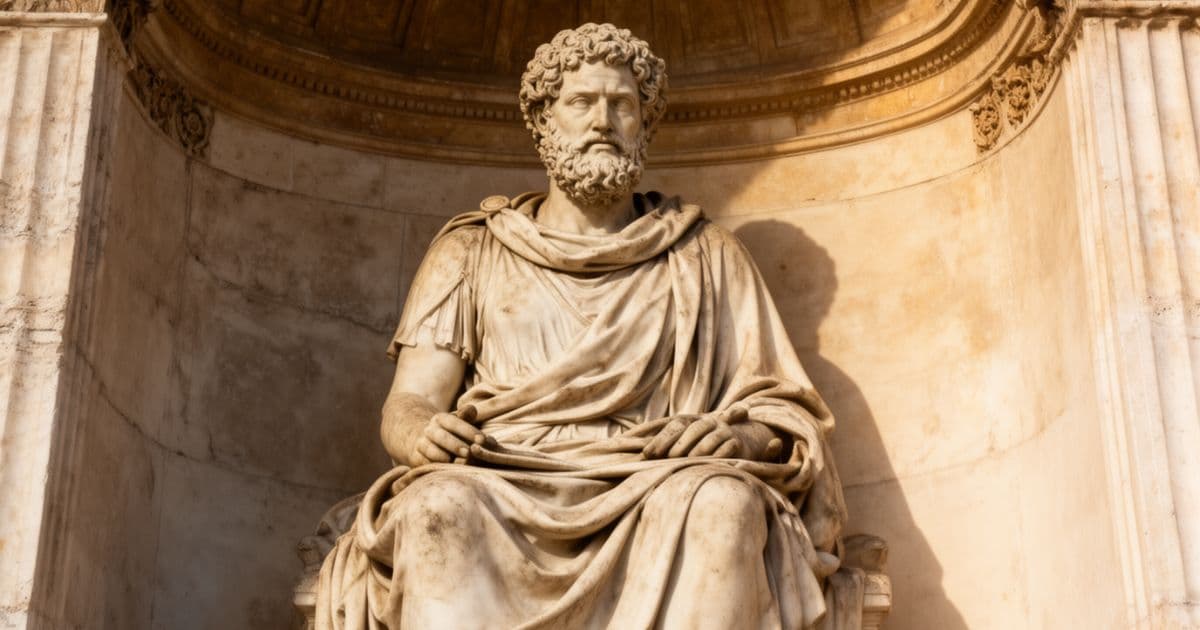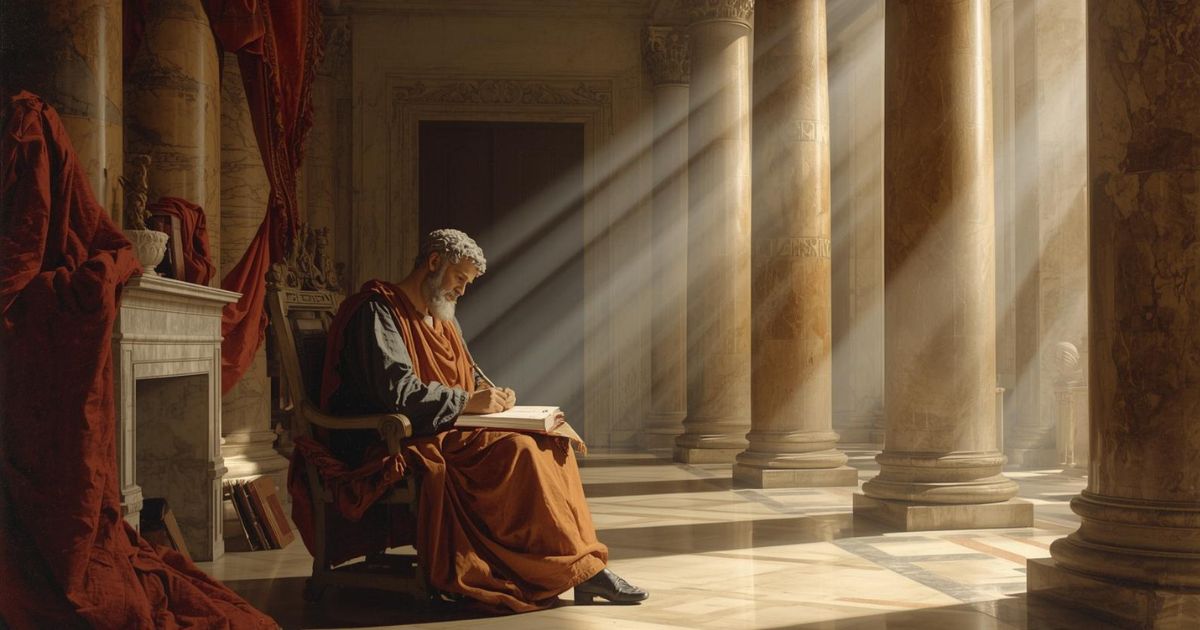
An excerpt from the original text.(complete · 2795 words)
←etter 88. On liberal and vocational studiesMoral letters to Luciliusby Seneca, translated by Richard Mott GummereLetter 89. On the parts of philosophyLetter 90. On the part played by philosophy in the progress of man→483388Moral letters to Lucilius — Letter 89. On the parts of philosophyRichard Mott GummereSeneca LXXXIX. ON THE PARTS OF PHILOSOPHY 1. It is a useful fact that you wish to know, one which is essential to him who hastens after wisdom—namely, the parts of philosophy and the division of its huge bulk into separate members. For by studying the parts we can be brought more easily to understand the whole. I only wish that philosophy might come before our eyes in all her unity, just as the whole expanse of the firmament is spread out for us to gaze upon! It would be a sight closely resembling that of the firmament. For then surely philosophy would ravish all mortals with love for her;[1] we should abandon all those things which, in our ignorance of what is great, we believe to be great. Inasmuch, however, as this cannot fall to our lot, we must view philosophy just as men gaze upon the secrets of the firmament. 2. The wise man’s mind, to be sure, embraces the whole framework of philosophy, surveying it with no less rapid glance than our mortal eyes survey the heavens; we, however, who must break through the gloom, we whose vision fails even for that which is near at hand, can be shown with greater ease each separate object even though we cannot yet comprehend the universe. I shall therefore comply with your demand, and shall divide philosophy into parts, but not into scraps. For it is useful that philosophy should be divided, but not chopped into bits. Just as it is hard to take in what is indefinitely large, so it is hard to take in what is indefinitely small. 3. The people are divided into tribes, the army into centuries. Whatever has grown to greater size is more easily identified if it is broken up into parts; but the parts, as I have remarked, must not be countless in number and diminutive in size. For over-analysis is faulty in precisely the same way as no analysis at all; whatever you cut so fine that it becomes dust is as good as blended into a mass again.[2] 4. In the first place, therefore, if you approve, I shall draw the distinction between wisdom and philosophy. Wisdom is the perfect good of the human mind; philosophy is the love of wisdom, and the endeavour to attain it. The latter strives toward the goal which the former has already reached. And it is clear why philosophy was so called. For it acknowledges by its very name the object of its love.[3] 5. Certain persons have defined wisdom as the knowledge of things divine and things human.[4] Still others say: “Wisdom is knowing things divine and things human, and their causes also.”[5] This added phrase seems to me to be superfluous, since the causes of things divine and things human are a part of the divine system. Philosophy also has been defined in various ways; some have called it “the study of virtue,”[6] others have referred to it as “a study of the way to amend the mind,”[7] and some have named it “the search for right reason.” 6. One thing is practically settled, that there is some difference between philosophy and wisdom. Nor indeed is it possible that that which is sought and that which seeks are identical. As there is a great difference between avarice and wealth, the one being the subject of the craving and the other its object, so between philosophy and wisdom. For the one is a result and a reward of the other. Philosophy does the going, and wisdom is the goal. 7. Wisdom is that which the Greeks call σοφία. The Romans also were wont to use this word in the sense in which they now use “philosophy” also. This will be proved to your satisfaction by our old national plays, as well as by the epitaph that is carved on the tomb of Dossennus:[8] Pause, stranger, and read the wisdom of Dossennus. 8. Certain of our school, however, although philosophy meant to them “the study of virtue,” and though virtue was the object sought and philosophy the seeker, have maintained nevertheless that the two cannot be sundered. For philosophy cannot exist without virtue, nor virtue without philosophy. Philosophy is the study of virtue, by means, however, of virtue itself; but neither can virtue exist without the study of itself, nor can the study of virtue exist without virtue itself. For it is not like trying to hit a target at long range, where the shooter and the object to be shot at are in different places. Nor, as roads which lead into a city, are the approaches to virtue situated outside virtue herself; the path by which one reaches virtue leads by way of virtue herself; philosophy and virtue cling closely together. 9. The greatest authors, and the greatest number of authors, have maintained that there are three divisions of philosophy—moral, natural, and rational.[9] The first keeps the soul in order; the second investigates the universe; the third works out the essential meanings of words, their combinations, and the proofs which keep falsehood from creeping in and displacing truth. But there have also been those who divided philosophy on the one hand into fewer divisions, on the other hand into more. 10. Certain of the Peripatetic school have added a fourth division, “civil philosophy,” because it calls for a special sphere of activity and is interested in a different subject matter. Some have added a department for which they use the Greek term “economics,”[10] the science of managing one’s own household. Still others have made a distinct heading for the various kinds of life.[11] There is no one of these subdivisions, however, which will not be found under the branch called “moral” philosophy. 11. The Epicureans[12] held that philosophy was twofold, natural and moral; they did away with the rational branch. Then, when they were compelled by the facts themselves to distinguish between equivocal ideas and to expose fallacies that lay hidden under the cloak of truth, they themselves also introduced a heading to which they give the name “forensic and regulative,”[13] which is merely “rational” under another name, although they hold that this section is accessory to the department of “natural” philosophy. 12. The Cyrenaic[14] school abolished the natural as well as the rational department, and were content with the moral side alone; and yet these philosophers also include under another title that which they have rejected. For they divide moral philosophy into five parts: (1) What to avoid and what to seek, (2) The Passions, (3) Actions, (4) Causes, (5) Proofs. Now the causes of things really belong to the “natural” division, the proofs to the “rational.” 13. Aristo[15] of Chios remarked that the natural and the rational were not only superfluous, but were also contradictory. He even limited the “moral,” which was all that was left to him; for he abolished that heading which embraced advice, maintaining that it was the business of the pedagogue, and not of the philosopher—as if the wise man were anything else than the pedagogue of the human race! 14. Since, therefore, philosophy is threefold, let us first begin to set in order the moral side. It has been agreed that this should be divided into three parts. First, we have the speculative[16] part, which assigns to each thing its particular function and weighs the worth of each; it is highest in point of utility. For what is so indispensable as giving to everything its proper value? The second has to do with impulse,[17] the third with actions.[18] For the first duty is to determine severally what things are worth; the second, to conceive with regard to them a regulated and ordered impulse; the third, to make your impulse and your actions harmonize, so that under all these conditions you may be consistent with yourself. 15. If any of these three be defective, there is confusion in the rest also. For what benefit is there in having all things appraised, each in its proper relations, if you go to excess in your impulses? What benefit is there in having checked your impulses and in having your desires in your own control, if when you come to action you are unaware of the proper times and seasons, and if you do not know when, where, and how each action should be carried out? It is one thing to understand the merits and the values of facts, another thing to know the precise moment for action, and still another to curb impulses and to proceed, instead of rushing, toward what is to be done. Hence life is in harmony with itself only when action has not deserted impulse, and when impulse toward an object arises in each case from the worth of the object, being languid or more eager as the case may be, according as the objects which arouse it are worth seeking. 16. The natural side of philosophy is twofold: bodily and non-bodily.[19] Each is divided into its own grades of importance, so to speak. The topic concerning bodies deals, first, with these two grades: the creative and the created[20]; and the created things are the elements. Now this very topic of the elements, as some writers hold, is integral[21]; as others hold, it is divided into matter, the cause which moves all things, and the elements. 17. It remains for me to divide rational philosophy into its parts. Now all speech is either continuous, or split up between questioner and answerer. It has been agreed upon that the former should be called rhetoric, and the latter dialectic. Rhetoric deals with words, and meanings, and arrangement. Dialectic is divided into two parts: words and their meanings, that is, into things which are said, and the words in which they are said. Then comes a subdivision of each—and it is of vast extent. Therefore I shall stop at this point, and But treat the climax of the story;[22] for if I should take a fancy to give the subdivisions, my letter would become a debater’s handbook! 18. I am not trying to discourage you, excellent Lucilius, from reading on this subject, provided only that you promptly relate to conduct all that you have read. It is your conduct that you must hold in check; you must rouse what is languid in you, bind fast what has become relaxed, conquer what is obstinate, persecute your appetites, and the appetites of mankind, as much as you can; and to those who say: “How long will this unending talk go on?” answer with the words: 19. “I ought to be asking you ‘How long will these unending sins of yours go on?’” Do you really desire my remedies to stop before your vices? But I shall speak of my remedies all the more, and just because you offer objections I shall keep on talking. Medicine begins to do good at the time when a touch makes the diseased body tingle with pain. I shall utter words that will help men even against their will. At times you should allow words other than compliments to reach your ears, and because as individuals you are unwilling to hear the truth, hear it collectively. 20. How far will you extend the boundaries of your estates? An estate which held a nation is too narrow for a single lord. How far will you push forward your ploughed fields—you who are not content to confine the measure of your farms even within the amplitude of provinces?[23] You have noble rivers flowing down through your private grounds; you have mighty streams—boundaries of mighty nations—under your dominion from source to outlet. This also is too little for you unless you also surround whole seas with your estates, unless your steward holds sway on the other side of the Adriatic, the Ionian, and the Aegean seas, unless the islands, homes of famous chieftains, are reckoned by you as the most paltry of possessions! Spread them as widely as you will, if only you may have as a “farm” what was once called a kingdom; make whatever you can your own, provided only that it is more than your neighbour’s! 21. And now for a word with you, whose luxury spreads itself out as widely as the greed of those to whom I have just referred. To you I say: “Will this custom continue until there is no lake over which the pinnacles of your country-houses do not tower? Until there is no river whose banks are not bordered by your lordly structures? Wherever hot waters shall gush forth in rills, there you will be causing new resorts of luxury to rise. Wherever the shore shall bend into a bay, there will you straightway be laying foundations, and, not content with any land that has not been made by art, you will bring the sea within your boundaries.[24] On every side let your house-tops flash in the sun, now set on mountain peaks where they command an extensive outlook over sea and land, now lifted from the plain to the height of mountains; build your manifold structures, your huge piles,—you are nevertheless but individuals, and puny ones at that! What profit to you are your many bed-chambers? You sleep in one. No place is yours where you yourselves are not.” 22. “Next I pass to you, you whose bottomless and insatiable maw explores on the one hand the seas, on the other the earth, with enormous toil hunting down your prey, now with hook, now with snare, now with nets of various kinds; no animal has peace except when you are cloyed with it. And how slight a portion of those banquets of yours, prepared for you by so many hands, do you taste with your pleasure-jaded palate! How slight a portion of all that game, whose taking was fraught with danger, does the master’s sick and squeamish stomach relish? How slight a portion of all those shell-fish, imported from so far, slips down that insatiable gullet? Poor wretches, do you not know that your appetites are bigger than your bellies?” 23. Talk in this way to other men,—provided that while you talk you also listen; write in this way,—provided that while you write you read, remembering that everything[25] you hear or read, is to be applied to conduct, and to the alleviation of passion’s fury. Study, not in order to add anything to your knowledge, but to make your knowledge better. Farewell. ↑ See Plato, especially Symposium 211 ff. ↑ i.e., an infinitely small divisio is the same as its opposite—confusio. ↑ “Love-of-Wisdom.” ↑ Θείων τε καὶ ἀνθρωπίνων ἐπιστήμη, quoted by Plutarch, De Plac. Phil. 874 E. ↑ Cicero, De Off. ii. 2. 5. ↑ The ἄσκησις ἀρετῆς of the earlier Stoics. Seneca (Frag. 17) also calls it recta vivendi ratio. ↑ i.e., to make a bona mens out of a mala mens. ↑ It is doubtful whether this was the name of a real person, or a mere “Joe Miller” type from the Fabula Atellana. The character in Horace, Ep. ii. 1. 173, is certainly the latter; and the testimony of Pliny (N. H. xiv. 15), who quotes a line from a play called Acharistio, is not reliable. ↑ i.e., logic. ↑ i.e., “the management of the home.” ↑ That is, of the various arts which deal with the departments of living, such as generalship, politics, business, etc. ↑ Frag. 242 Usener. ↑ Seneca by de iudicio is translating the Greek adjective δικανικός, “that which has to do with the courts of law,” and by de regula the word κανονικός, “that which has to do with rules,” here the rules of logic. The Epicureans used for logic κανονική, in contrast with Aristotle and his successors, who used λογική. The Latin rationalis is a translation of the latter. ↑ Led by Aristippus of Cyrene. As the Cynics developed into the Stoics, so the Cyrenaics developed into the Epicureans. ↑ Frag. 357 von Arnim. ↑ Seneca translates θεωρητική. ↑ Ὸρμητική; the ὁρμαί, impetus, in the Stoic philosophy, are the natural instincts, which require training and regulation before they can be trusted. ↑ Πρακτική. ↑ Σωματική and ἀσώματος. ↑ Ποιητικά and παθητικά. ↑ i.e., has no subdivisions. ↑ Vergil, Aeneid, i. 342. ↑ For the thought compare Petronius, Sat. 48 nunc coniungere agellis Siciliam volo, ut, cum Africam libuerit ire, per meos fines navigem. ↑ i.e., by building embankments, etc. Cf. Horace, Od. ii. 18. 22 parum locuples continente ripa. ↑ Cf. § 18.
Master this chapter. Complete your experience
Purchase the complete book to access all chapters and support classic literature
As an Amazon Associate, we earn a small commission from qualifying purchases at no additional cost to you.
Available in paperback, hardcover, and e-book formats
Let's Analyse the Pattern
The tendency to over-analyze problems until understanding dissolves and action becomes impossible.
Why This Matters
Connect literature to life
This chapter teaches how to identify when helpful thinking becomes destructive overthinking that prevents action.
Practice This Today
This week, notice when you're researching or planning something for more than three days—ask yourself if you're gaining wisdom or just grinding it into dust.
Now let's explore the literary elements.
Key Quotes & Analysis
"Philosophy is the love and pursuit of wisdom; wisdom is the fruit of philosophy"
Context: He's explaining the difference between studying something and actually mastering it
This distinction matters because many people confuse reading about self-improvement with actually improving. Seneca wants action, not just understanding.
In Today's Words:
Learning about something isn't the same as being good at it
"We must view philosophy just as men gaze upon the secrets of the firmament"
Context: He's explaining why we need to break philosophy into parts to understand the whole
Like astronomers studying individual stars to understand the universe, we need to examine specific philosophical concepts to grasp the bigger picture of how to live well.
In Today's Words:
You have to understand the pieces before you can see how everything fits together
"When will you have enough land? When will your appetite be satisfied?"
Context: He's challenging people who constantly want more possessions and pleasures
These rhetorical questions force readers to examine their own endless desires. Seneca is showing how philosophical thinking should lead to questioning our assumptions about what we need.
In Today's Words:
Seriously, how much stuff do you actually need to be happy?
Thematic Threads
Class
In This Chapter
Seneca critiques the wealthy who endlessly expand estates, showing how class privilege enables boundless appetite without natural limits
Development
Evolved from earlier discussions of wealth's dangers to specific examination of how unlimited resources corrupt judgment
In Your Life:
You might see this in how people with more resources often struggle more with knowing when they have 'enough.'
Personal Growth
In This Chapter
The three-step framework for moral development: know what matters, control impulses, align actions with values
Development
Builds on previous letters by providing concrete structure for philosophical development
In Your Life:
You might recognize how you sometimes know what's right but struggle to control your impulses or follow through with action.
Social Expectations
In This Chapter
Seneca addresses those whose appetites know no bounds, challenging societal acceptance of endless accumulation
Development
Continues theme of questioning what society considers normal or admirable
In Your Life:
You might notice pressure to always want more—bigger house, better job, more stuff—without questioning if you actually need it.
Identity
In This Chapter
The distinction between philosophy (the pursuit) and wisdom (the destination) reflects how we define ourselves by our journey versus our achievements
Development
Introduced here as a way to understand the relationship between aspiration and accomplishment
In Your Life:
You might struggle with whether to identify as someone 'trying to get healthy' versus someone who 'is healthy.'
Human Relationships
In This Chapter
Seneca's teaching method demonstrates how to guide others without overwhelming them with complexity
Development
Shows evolution from earlier letters about friendship to practical mentoring techniques
In Your Life:
You might recognize the challenge of helping someone learn without drowning them in too much information at once.
You now have the context. Time to form your own thoughts.
Discussion Questions
- 1
Seneca breaks philosophy into three branches: moral (how to live well), natural (understanding the world), and rational (clear thinking). Which of these three do you rely on most when making tough decisions?
analysis • surface - 2
Why does Seneca warn against grinding philosophy 'so fine it becomes dust'? What happens when we over-analyze something instead of acting on it?
analysis • medium - 3
Where have you seen people get stuck in endless analysis instead of taking action? Think about work projects, relationship problems, or major life decisions.
application • medium - 4
Seneca says you need all three steps working together: know what matters, control your impulses, and align your actions. Which step is hardest for you, and how would you strengthen it?
application • deep - 5
What does this chapter reveal about the human tendency to complicate things that should be simple? How do we know when we're thinking too much versus not enough?
reflection • deep
Critical Thinking Exercise
The Analysis Trap Audit
Think of one area of your life where you've been stuck in analysis mode without taking action. Write down what you keep researching, discussing, or debating. Then identify the three most essential facts you need to move forward and set a deadline for making a decision.
Consider:
- •Notice if you're using research as a way to avoid making a difficult choice
- •Ask yourself what you're really afraid will happen if you act with imperfect information
- •Consider whether you're seeking certainty in a situation that will always involve some risk
Journaling Prompt
Write about a time when you took action despite not having all the answers. What happened? What did you learn about the difference between helpful preparation and paralyzing over-analysis?
Coming Up Next...
Chapter 90: Philosophy vs. Technology: What Really Matters
Next, Seneca explores how philosophy has shaped human progress throughout history, examining whether our technological advances have actually made us happier or just more complicated.