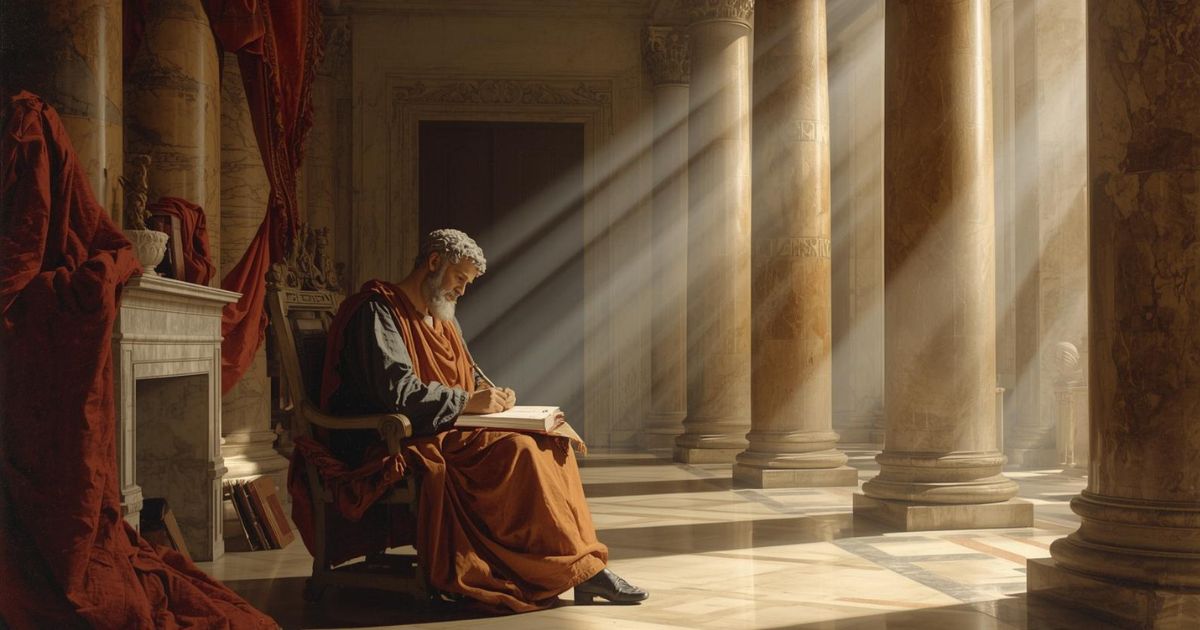
An excerpt from the original text.(complete · 2284 words)
←etter 8. On the philosopher's seclusionMoral letters to Luciliusby Seneca, translated by Richard Mott GummereLetter 9. On philosophy and friendshipLetter 10. On living to oneself→482835Moral letters to Lucilius — Letter 9. On philosophy and friendshipRichard Mott GummereSeneca IX. ON PHILOSOPHY AND FRIENDSHIP 1. You desire to know whether Epicurus is right when, in one of his letters,[1] he rebukes those who hold that the wise man is self-sufficient and for that reason does not stand in need of friendships. This is the objection raised by Epicurus against Stilbo and those who believe[2] that the Supreme Good is a soul which is insensible to feeling. 2. We are bound to meet with a double meaning if we try to express the Greek term "lack of feeling" summarily, in a single word, rendering it by the Latin word impatientia. For it may be understood in the meaning the opposite to that which we wish it to have. What we mean to express is, a soul which rejects any sensation of evil; but people will interpret the idea as that of a soul which can endure no evil. Consider, therefore, whether it is not better to say “a soul that cannot be harmed,” or “a soul entirely beyond the realm of suffering.” 3. There is this difference between ourselves and the other school[3]: our ideal wise man feels his troubles, but overcomes them; their wise man does not even feel them. But we and they alike hold this idea,—that the wise man is self-sufficient. Nevertheless, he desires friends, neighbours, and associates, no matter how much he is sufficient unto himself. 4. And mark how self-sufficient he is; for on occasion he can be content with a part of himself. If he lose a hand through disease or war, or if some accident puts out one or both of his eyes, he will be satisfied with what is left, taking as much pleasure in his impaired and maimed body as he took when it was sound. But while he does not pine for these parts if they are missing, he prefers not to lose them. 5. In this sense the wise man is self-sufficient, that he can do without friends, not that he desires to do without them. When I say “can,” I mean this: he endures the loss of a friend with equanimity. But he need never lack friends, for it lies in his own control how soon he shall make good a loss. Just as Phidias, if he lose a statue, can straightway carve another, even so our master in the art of making friendships can fill the place of a friend he has lost. 6. If you ask how one can make oneself a friend quickly, I will tell you, provided we are agreed that I may pay my debt[4] at once and square the account, so far as this letter is concerned. Hecato,[5] says: “I can show you a philtre, compounded without drugs, herbs, or any witch’s incantation: ‘If you would be loved, love.’” Now there is great pleasure, not only in maintaining old and established friendships, but also in beginning and acquiring new ones. 7. There is the same difference between winning a new friend and having already won him, as there is between the farmer who sows and the farmer who reaps. The philosopher Attalus used to say: “It is more pleasant to make than to keep a friend, as it is more pleasant to the artist to paint than to have finished painting.” When one is busy and absorbed in one’s work, the very absorption affords great delight; but when one has withdrawn one’s hand from the completed masterpiece, the pleasure is not so keen. Henceforth it is the fruits of his art that he enjoys; it was the art itself that he enjoyed while he was painting. In the case of our children, their young manhood yields the more abundant fruits, but their infancy was sweeter. 8. Let us now return to the question. The wise man, I say, self-sufficient though he be, nevertheless desires friends if only for the purpose of practising friendship, in order that his noble qualities may not lie dormant. Not, however, for the purpose mentioned by Epicurus[6] in the letter quoted above: “That there may be someone to sit by him when he is ill, to help him when he is in prison or in want;” but that he may have someone by whose sick-bed he himself may sit, someone a prisoner in hostile hands whom he himself may set free. He who regards himself only, and enters upon friendships for this reason, reckons wrongly. The end will be like the beginning: he has made friends with one who might assist him out of bondage; at the first rattle of the chain such a friend will desert him. 9. These are the so-called “fair-weather” friendships; one who is chosen for the sake of utility will be satisfactory only so long as he is useful. Hence prosperous men are blockaded by troops of friends; but those who have failed stand amid vast loneliness, their friends fleeing from the very crisis which is to test their worth. Hence, also, we notice those many shameful cases of persons who, through fear, desert or betray. The beginning and the end cannot but harmonize. He who begins to be your friend because it pays will also cease because it pays. A man will be attracted by some reward offered in exchange for his friendship, if he be attracted by aught in friendship other than friendship itself. 10. For what purpose, then, do I make a man my friend? In order to have someone for whom I may die, whom I may follow into exile, against whose death I may stake my own life, and pay the pledge, too. The friendship which you portray is a bargain and not a friendship; it regards convenience only, and looks to the results. 11. Beyond question the feeling of a lover has in it something akin to friendship; one might call it friendship run mad. But, though this is true, does anyone love for the sake of gain, or promotion, or renown? Pure[7] love, careless of all other things, kindles the soul with desire for the beautiful object, not without the hope of a return of the affection. What then? Can a cause which is more honourable produce a passion that is base? 12. You may retort: “We are not now discussing the question whether friendship is to be cultivated for its own sake.” On the contrary, nothing more urgently requires demonstration; for if friendship is to be sought for its own sake, he may seek it who is self-sufficient. “How, then,” you ask, “does he seek it?” Precisely as he seeks an object of great beauty, not attracted to it by desire for gain, nor yet frightened by the instability of Fortune. One who seeks friendship for favourable occasions, strips it of all its nobility. 13. “The wise man is self-sufficient.” This phrase, my dear Lucilius, is incorrectly explained by many; for they withdraw the wise man from the world, and force him to dwell within his own skin. But we must mark with care what this sentence signifies and how far it applies; the wise man is sufficient unto himself for a happy existence, but not for mere existence. For he needs many helps towards mere existence; but for a happy existence he needs only a sound and upright soul, one that despises Fortune. 14. I should like also to state to you one of the distinctions of Chrysippus,[8] who declares that the wise man is in want of nothing, and yet needs many things.[9] “On the other hand,” he says, “nothing is needed by the fool, for he does not understand how to use anything, but he is in want of everything.” The wise man needs hands, eyes, and many things that are necessary for his daily use; but he is in want of nothing. For want implies a necessity, and nothing is necessary to the wise man. 15. Therefore, although he is self-sufficient, yet he has need of friends. He craves as many friends as possible, not, however, that he may live happily; for he will live happily even without friends. The Supreme Good calls for no practical aids from outside; it is developed at home, and arises entirely within itself. If the good seeks any portion of itself from without, it begins to be subject to the play of Fortune. 16. People may say: “But what sort of existence will the wise man have, if he be left friendless when thrown into prison, or when stranded in some foreign nation, or when delayed on a long voyage, or when cast upon a lonely shore?” His life will be like that of Jupiter, who, amid the dissolution of the world, when the gods are confounded together and Nature rests for a space from her work, can retire into himself and give himself over to his own thoughts.[10] In some such way as this the sage will act; he will retreat into himself, and live with himself. 17. As long as he is allowed to order his affairs according to his judgment, he is self-sufficient—and marries a wife; he is self-sufficient—and brings up children; he is self-sufficient—and yet could not live if he had to live without the society of man. Natural promptings, and not his own selfish needs, draw him into friendships. For just as other things have for us an inherent attractiveness, so has friendship. As we hate solitude and crave society, as nature draws men to each other, so in this matter also there is an attraction which makes us desirous of friendship. 18. Nevertheless, though the sage may love his friends dearly, often comparing them with himself, and putting them ahead of himself, yet all the good will be limited to his own being, and he will speak the words which were spoken by the very Stilbo[11] whom Epicurus criticizes in his letter. For Stilbo, after his country was captured and his children and his wife lost, as he emerged from the general desolation alone and yet happy, spoke as follows to Demetrius, called Sacker of Cities because of the destruction he brought upon them, in answer to the question whether he had lost anything: “I have all my goods with me!” 19. There is a brave and stout-hearted man for you! The enemy conquered, but Stilbo conquered his conqueror. “I have lost nothing!” Aye, he forced Demetrius to wonder whether he himself had conquered after all. “My goods are all all with me!” In other words, he deemed nothing that might be taken from him to be a good. We marvel at certain animals because they can pass through fire and suffer no bodily harm; but how much more marvellous is a man who has marched forth unhurt and unscathed through fire and sword and devastation! Do you understand now how much easier it is to conquer a whole tribe than to conquer one man? This saying of Stilbo makes common ground with Stoicism; the Stoic also can carry his goods unimpaired through cities that have been burned to ashes; for he is self-sufficient. Such are the bounds which he sets to his own happiness. 20. But you must not think that our school alone can utter noble words; Epicurus himself, the reviler of Stilbo, spoke similar language;[12] put it down to my credit, though I have already wiped out my debt for the present day.[13] He says: “Whoever does not regard what he has as most ample wealth, is unhappy, though he be master of the whole world.” Or, if the following seems to you a more suitable phrase,—for we must try to render the meaning and not the mere words: “A man may rule the world and still be unhappy, if he does not feel that he is supremely happy.” 21. In order, however, that you may know that these sentiments are universal,[14] suggested, of course, by Nature, you will find in one of the comic poets this verse: Unblest is he who thinks himself unblest.[15] For what does your condition matter, if it is bad in your own eyes? 22. You may say: “What then? If yonder man, rich by base means, and yonder man, lord of many but slave of more, shall call themselves happy, will their own opinion make them happy?” It matters not what one says, but what one feels; also, not how one feels on one particular day, but how one feels at all times. There is no reason, however, why you should fear that this great privilege will fall into unworthy hands; only the wise man is pleased with his own. Folly is ever troubled with weariness of itself. Farewell. ↑ Frag. 174 Usener. ↑ i.e., the Cynics. ↑ i.e., the Cynics. ↑ i.e., the diurna mercedula; see Ep. vi, 7. ↑ Frag. 27 Fowler. ↑ Frag. 175 Usener. ↑ “Pure love,” i.e., love in its essence, unalloyed with other emotions. ↑ Cf. his Frag. moral. 674 von Arnim. ↑ The distinction is based upon the meaning of egere, “to be in want of” something indispensible, and opus esse, “to have need of” something which one can do without. ↑ This refers to the Stoic conflagration: after certain cycles their world was destroyed by fire. Cf. E. V. Arnold, Roman Stoicism, pp. 192 f.; cf. also Chrysippus, Frag. phys. 1065 von Arnim. ↑ Gnomologici Vaticani 515ᵃ Sternberg. ↑ Frag. 474 Usener. ↑ Cf. above § 6. ↑ i.e., not confined to the Stoics, etc. ↑ Author unknown; perhaps, as Buecheler thinks, adapted from the Greek.
Master this chapter. Complete your experience
Purchase the complete book to access all chapters and support classic literature
As an Amazon Associate, we earn a small commission from qualifying purchases at no additional cost to you.
Available in paperback, hardcover, and e-book formats
Let's Analyse the Pattern
Desperation in relationships creates a cycle where neediness repels quality connections and attracts users, while self-sufficiency paradoxically enables deeper, more authentic bonds.
Why This Matters
Connect literature to life
This chapter teaches how to recognize when people are connecting with you versus connecting with what you can do for them.
Practice This Today
This week, notice who reaches out when you can't offer anything—those are your real friends, while the others reveal themselves as fair-weather connections.
Now let's explore the literary elements.
Key Quotes & Analysis
"The wise man is self-sufficient. Nevertheless, he desires friends, neighbours, and associates."
Context: He's explaining that self-sufficiency doesn't mean isolation
This captures the key paradox - being complete within yourself actually frees you to love others better. When you're not desperate, you can choose relationships for the right reasons.
In Today's Words:
Strong people don't need others to complete them, but they still want good people in their lives.
"I have all my goods with me."
Context: Said after losing his family and possessions in war
This shows the Stoic belief that your real wealth is internal - your character, skills, and wisdom. External things can be lost, but who you are remains.
In Today's Words:
Everything that really matters about me is still here inside me.
"Our ideal wise man feels his troubles, but overcomes them; their wise man does not even feel them."
Context: Contrasting Stoic and other philosophical approaches to suffering
Seneca argues that feeling pain but handling it well is more human and realistic than claiming to feel nothing. It's about emotional resilience, not numbness.
In Today's Words:
We think it's better to feel the hit but stay standing than to pretend nothing hurts.
Thematic Threads
Self-Sufficiency
In This Chapter
Seneca argues that true wisdom means being able to survive alone while choosing connection, not clinging to others out of desperation
Development
Building on earlier letters about inner strength, now applied specifically to relationships
In Your Life:
You might notice how your neediest moments often push people away, while your strongest moments draw them closer
Authentic Connection
In This Chapter
Real friendship emerges when you choose to care for others without expecting rescue in return
Development
Introduced here as a new dimension of Stoic practice
In Your Life:
You might recognize the difference between friends who stick around when times are good versus those who show up when you're struggling
Inner Strength
In This Chapter
Stilbo's example shows that true wealth lies in what cannot be taken from you—your character and capabilities
Development
Continues the theme of internal resources being more reliable than external circumstances
In Your Life:
You might find that your skills, knowledge, and emotional stability matter more than your possessions when crisis hits
Class Dynamics
In This Chapter
The chapter implicitly addresses how desperation creates power imbalances in relationships, while strength enables equality
Development
Extends earlier discussions of social position to interpersonal relationships
In Your Life:
You might notice how financial stress affects your friendships, making you either too proud to ask for help or too desperate in seeking it
Personal Growth
In This Chapter
Friendship becomes a training ground for virtue—a place to practice loyalty, compassion, and sacrifice
Development
Builds on the idea that philosophy must be lived and practiced, not just studied
In Your Life:
You might see how your closest relationships reveal your character strengths and weaknesses most clearly
You now have the context. Time to form your own thoughts.
Discussion Questions
- 1
According to Seneca, what's the difference between needing friends and choosing friends?
analysis • surface - 2
Why does Seneca argue that desperate people make worse friends than self-sufficient people?
analysis • medium - 3
Think about your workplace or social circle. Who are the people others avoid versus the ones everyone wants to be around? What patterns do you notice?
application • medium - 4
How would you build the kind of self-sufficiency that makes you a better friend rather than a needier one?
application • deep - 5
What does this chapter reveal about why some people seem to effortlessly attract good relationships while others struggle?
reflection • deep
Critical Thinking Exercise
Audit Your Relationship Energy
Make two lists: relationships where you mostly give energy versus relationships where you mostly take energy. Be honest about which column is longer and what patterns you notice. Then identify one specific way you could shift from taking to giving in your most important relationships.
Consider:
- •Consider emotional energy, not just practical favors - who drains you versus who energizes you?
- •Look for relationships where you only reach out when you need something
- •Notice if you're the person others avoid when they see your name on caller ID
Journaling Prompt
Write about a time when you approached someone from desperation versus strength. How did the other person respond differently? What did you learn about the energy you bring to relationships?
Coming Up Next...
Chapter 10: The Art of Being Alone
After exploring the balance between self-sufficiency and friendship, Seneca turns to an even more challenging question: how much solitude is too much? The next letter warns against both the crowd and complete isolation, suggesting there's a sweet spot for living authentically.