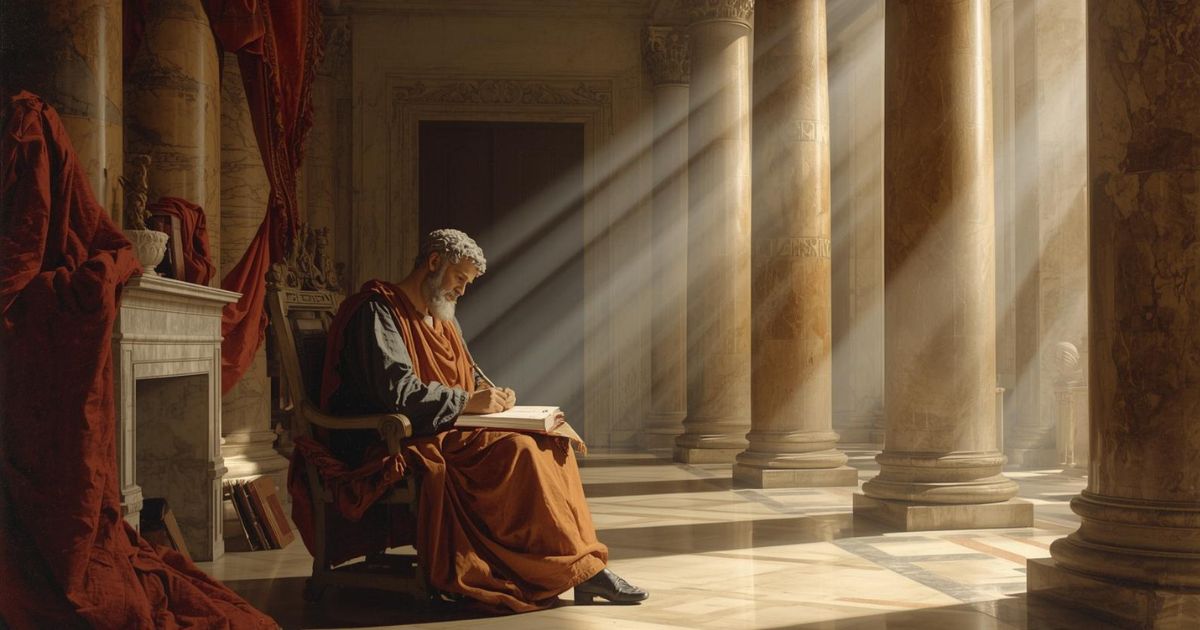
An excerpt from the original text.(complete · 4348 words)
←etter 86. On Scipio's villaMoral letters to Luciliusby Seneca, translated by Richard Mott GummereLetter 87. Some arguments in favour of the simple lifeLetter 88. On liberal and vocational studies→483386Moral letters to Lucilius — Letter 87. Some arguments in favour of the simple lifeRichard Mott GummereSeneca LXXXVII. SOME ARGUMENTS IN OF THE SIMPLE LIFE 1. “I was shipwrecked before I got aboard.”[1] I shall not add how that happened, lest you may reckon this also as another of the Stoic paradoxes;[2] and yet I shall, whenever you are willing to listen, nay, even though you be unwilling, prove to you that these words are by no means untrue, nor so surprising as one at first sight would think. Meantime, the journey showed me this: how much we possess that is superfluous; and how easily we can make up our minds to do away with things whose loss, whenever it is necessary to part with them, we do not feel. 2. My friend Maximus and I have been spending a most happy period of two days, taking with us very few slaves—one carriage-load—and no paraphernalia except what we wore on our persons. The mattress lies on the ground, and I upon the mattress. There are two rugs—one to spread beneath us and one to cover us. 3. Nothing could have been subtracted from our luncheon; it took not more than an hour to prepare, and we were nowhere without dried figs, never without writing tablets.[3] If I have bread, I use figs as a relish; if not, I regard figs as a substitute for bread. Hence they bring me a New Year feast every day,[4] and I make the New Year happy and prosperous by good thoughts and greatness of soul; for the soul is never greater than when it has laid aside all extraneous things, and has secured peace for itself by fearing nothing, and riches by craving no riches. 4. The vehicle in which I have taken my seat is a farmer’s cart. Only by walking do the mules show that they are alive. The driver is barefoot, and not because it is summer either. I can scarcely force myself to wish that others shall think this cart mine. My false embarrassment about the truth still holds out, you see; and whenever we meet a more sumptuous party I blush in spite of myself—proof that this conduct which I approve and applaud has not yet gained a firm and steadfast dwelling-place within me. He who blushes at riding in a rattle-trap will boast when he rides in style. 5. So my progress is still insufficient. I have not yet the courage openly to acknowledge my thriftiness. Even yet I am bothered by what other travellers think of me. But instead of this, I should really have uttered an opinion counter to that in which mankind believe, saying, “You are mad, you are misled, your admiration devotes itself to superfluous things! You estimate no man at his real worth. When property is concerned, you reckon up in this way with most scrupulous calculation those to whom you shall lend either money or benefits; for by now you enter benefits also as payments in your ledger. 6. You say: ‘His estates are wide, but his debts are large.’ ‘He has a fine house, but he has built it on borrowed capital.’ ‘No man will display a more brilliant retinue on short notice, but he cannot meet his debts.’[5] ‘If he pays off his creditors, he will have nothing left.’” So you will feel bound to do in all other cases as well,—to find out by elimination the amount of every man’s actual possessions. 7. I suppose you call a man rich just because his gold plate goes with him even on his travels, because he farms land in all the provinces, because he unrolls a large account-book, because he owns estates near the city so great that men would grudge his holding them in the waste lands of Apulia. But after you have mentioned all these facts, he is poor. And why? He is in debt. “To what extent?” you ask. For all that he has. Or perchance you think it matters whether one has borrowed from another man or from Fortune. 8. What good is there in mules caparisoned in uniform livery? Or in decorated chariots and Steeds decked with purple and with tapestry, With golden harness hanging from their necks, Champing their yellow bits, all clothed in gold?[6] Neither master nor mule is improved by such trappings. 9. Marcus Cato the Censor, whose existence helped the state as much as did Scipio’s,—for while Scipio fought against our enemies, Cato fought against our bad morals,—used to ride a donkey, and a donkey, at that, which carried saddle-bags containing the master’s necessaries. O how I should love to see him meet to-day on the road one of our coxcombs,[7] with his outriders and Numidians, and a great cloud of dust before him! Your dandy would no doubt seem refined and well-attended in comparison with Marcus Cato,—your dandy, who, in the midst of all his luxurious paraphernalia, is chiefly concerned whether to turn his hand to the sword or to the hunting-knife.[8] 10. O what a glory to the times in which he lived, for a general who had celebrated a triumph, a censor, and what is most noteworthy of all, a Cato, to be content with a single nag, and with less than a whole nag at that! For part of the animal was preempted by the baggage that hung down on either flank. Would you not therefore prefer Cato’s steed, that single steed, saddle-worn by Cato himself, to the coxcomb’s whole retinue of plump ponies, Spanish cobs,[9] and trotters?[10] 11. I see that there will be no end in dealing with such a theme unless I make an end myself. So I shall now become silent, at least with reference to superfluous things like these; doubtless the man who first called them “hindrances”[11] had a prophetic inkling that they would be the very sort of thing they now are. At present I should like to deliver to you the syllogisms, as yet very few, belonging to our school and bearing upon the question of virtue, which, in our opinion, is sufficient for the happy life. 12. “That which is good makes men good. For example, that which is good in the art of music makes the musician. But chance events do not make a good man; therefore, chance events are not goods.” The Peripatetics reply to this by saying that the premiss is false; that men do not in every case become good by means of that which is good; that in music there is something good, like a flute, a harp, or an organ suited to accompany singing; but that none of these instruments makes the musician. 13. We shall then reply: “You do not understand in what sense we have used the phrase ’that which is good in music.’ For we do not mean that which equips the musician, but that which makes the musician; you, however, are referring to the instruments of the art, and not to the art itself.[12] If, however, anything in the art of music is good, that will in every case make the musician.” 14. And I should like to put this idea still more clearly. We define the good in the art of music in two ways: first, that by which the performance of the musician is assisted, and second, that by which his art is assisted. Now the musical instruments have to do with his performance,—such as flutes and organs and harps; but they do not have to do with the musician’s art itself. For he is an artist even without them; he may perhaps be lacking in the ability to practise his art. But the good in man is not in the same way twofold; for the good of man and the good of life are the same. 15. “That which can fall to the lot of any man, no matter how base or despised he may be, is not a good. But wealth falls to the lot of the pander and the trainer of gladiators; therefore wealth is not a good.” “Another wrong premiss,” they say, “for we notice that goods fall to the lot of the very lowest sort of men, not only in the scholar’s art, but also in the art of healing or in the art of navigating.” 16. These arts, however, make no profession of greatness of soul; they do not rise to any heights nor do they frown upon what fortune may bring.[13] It is virtue that uplifts man and places him superior to what mortals hold dear; virtue neither craves overmuch nor fears to excess that which is called good or that which is called bad. Chelidon, one of Cleopatra’s eunuchs, possessed great wealth; and recently Natalis—a man whose tongue was as shameless as it was dirty, a man whose mouth used to perform the vilest offices—was the heir of many, and also made many his heirs. What then? Was it his money that made him unclean, or did he himself besmirch his money? Money tumbles into the hands of certain men as a shilling tumbles down a sewer. 17. Virtue stands above all such things. It is appraised in coin of its own minting;[14] and it deems none of these random windfalls to be good. But medicine and navigation do not forbid themselves and their followers to marvel at such things. One who is not a good man can nevertheless be a physician, or a pilot, or a scholar,—yes, just as well as he can be a cook! He to whose lot it falls to possess something which is not of a random sort, cannot be called a random sort of man; a person is of the same sort as that which he possesses. 18. A strong-box is worth just what it holds; or rather, it is a mere accessory of that which it holds. Who ever sets any price upon a full purse except the price established by the count of the money deposited therein? This also applies to the owners of great estates: they are only accessories and incidentals to their possessions. Why, then, is the wise man great? Because he has a great soul. Accordingly, it is true that that which falls to the lot even of the most despicable person is not a good. 19. Thus, I should never regard inactivity as a good; for even the tree-frog and the flea possess this quality.[15] Nor should I regard rest and freedom from trouble as a good; for what is more at leisure than a worm? Do you ask what it is that produces the wise man? That which produces a god.[16] You must grant that the wise man has in an element of godliness, heavenliness, grandeur. The good does not come to every one, nor does it allow any random person to possess it. 20. Behold: What fruits each country bears, or will not bear; Here corn, and there the vine, grow richlier. And elsewhere still the tender tree and grass Unbidden clothe themselves in green. Seest thou How Tmolus ships its saffron perfumes forth, And ivory comes from Ind; soft Sheba sends Its incense, and the unclad Chalybes Their iron.[17] 21. These products are apportioned to separate countries in order that human beings may be constrained to traffic among themselves, each seeking something from his neighbour in his turn. So the Supreme Good has also its own abode. It does not grow where ivory grows, or iron. Do you ask where the Supreme Good dwells? In the soul. And unless the soul be pure and holy, there is no room in it for God. 22. “Good does not result from evil. But riches result from greed; therefore, riches are not a good.” “It is not true,” they say, “that good does not result from evil. For money comes from sacrilege and theft. Accordingly, although sacrilege and theft are evil, yet they are evil only because they work more evil than good. For they bring gain; but the gain is accompanied by fear, anxiety, and torture of mind and body.” 23. Whoever says this must perforce admit that sacrilege, though it be an evil because it works much evil, is yet partly good because it accomplishes a certain amount of good. What can be more monstrous than this? We have, to be sure, actually convinced the world that sacrilege, theft, and adultery are to be regarded as among the goods. How many men there are who do not blush at theft, how many who boast of having committed adultery! For petty sacrilege is punished, but sacrilege on a grand scale is honoured by a triumphal procession. 24. Besides, sacrilege, if it is wholly good in some respect, will also be honourable and will be called right conduct; for it is conduct which concerns ourselves. But no human being, on serious consideration, admits this idea. Therefore, goods cannot spring from evil. For if, as you object, sacrilege is an evil for the single reason that it brings on much evil, if you but absolve sacrilege of its punishment and pledge it immunity, sacrilege will be wholly good. And yet the worst punishment for crime lies in the crime itself. 25. You are mistaken, I maintain, if you propose to reserve your punishments for the hangman or the prison; the crime is punished immediately after it is committed; nay, rather, at the moment when it is committed. Hence, good does not spring from evil, any more than figs grow from olive-trees. Things which grow correspond to their seed; and goods cannot depart from their class. As that which is honourable does not grow from that which is base, so neither does good grow from evil. For the honourable and the good are identical.[18] 26. Certain of our school oppose this statement as follows: “Let us suppose that money taken from any source whatsoever is a good; even though it is taken by an act of sacrilege, the money does not on that account derive its origin from sacrilege. You may get my meaning through the following illustration: In the same jar there is a piece of gold and there is a serpent. If you take the gold from the jar, it is not just because the serpent is there too, I say, that the jar yields me the gold—because it contains the serpent as well,—but it yields the gold in spite of containing the serpent also. Similarly, gain results from sacrilege, not just because sacrilege is a base and accursed act, but because it contains gain also. As the serpent in the jar is an evil, and not the gold which lies there, beside the serpent; so in an act of sacrilege it is the crime, not the profit, that is evil.” 27. But I differ from these men; for the conditions in each case are not at all the same. In the one instance I can take the gold without the serpent, in the other I cannot make the profit without committing the sacrilege. The gain in the latter case does not lie side by side with the crime; it is blended with the crime. 28. “That which, while we are desiring to attain it, involves us in many evils, is not a good. But while we are desiring to attain riches, we become involved in many evils; therefore, riches are not a good,”[19] “Your first premiss,” they say, “contains two meanings; one is: we become involved in many evils while we are desiring to attain riches. But we also become involved in many evils while we are desiring to attain virtue. One man, while travelling in order to prosecute his studies, suffers shipwreck, and another is taken captive. 29. The second meaning is as follows: that through which we become involved in evils is not a good. And it will not logically follow from our proposition that we become involved in evils through riches or through pleasure; otherwise, if it is through riches that we become involved in many evils, riches are not only not a good, but they are positively an evil. You, however, maintain merely that they are not a good. Moreover,” the objector says, “you grant that riches are of some use. You reckon them among the advantages; and yet on this basis they cannot even be an advantage, for it is through the pursuit of riches that we suffer much disadvantage.” 30. Certain men answer this objection as follows: “You are mistaken if you ascribe disadvantages to riches. Riches injure no one; it is a man’s own folly, or his neighbour’s wickedness, that harms him in each case, just as a sword by itself does not slay; it is merely the weapon used by the slayer. Riches themselves do not harm you, just because it is on account of riches that you suffer harm.” 31. I think that the reasoning of Posidonius is better: he holds that riches are a cause of evil, not because, of themselves, they do any evil, but because they goad men on so that they are ready to do evil. For the efficient cause, which necessarily produces harm at once, is one thing, and the antecedent cause is another. It is this antecedent cause which inheres in riches; they puff up the spirit and beget pride, they bring on unpopularity and unsettle the mind to such an extent that the mere reputation of having wealth, though it is bound to harm us, nevertheless affords delight. 32. All goods, however, ought properly to be free from blame; they are pure, they do not corrupt the spirit, and they do not tempt us. They do, indeed, uplift and broaden the spirit, but without puffing it up. Those things which are goods produce confidence, but riches produce shamelessness. The things which are goods give us greatness of soul, but riches give us arrogance. And arrogance is nothing else than a false show of greatness. 33. “According to that argument,” the objector says, “riches are not only not a good, but are a positive evil.” Now they would be an evil if they did harm of themselves, and if, as I remarked, it were the efficient cause which inheres in them; in fact, however, it is the antecedent cause which inheres in riches, and indeed it is that cause which, so far from merely arousing the spirit, actually drags it along by force. Yes, riches shower upon us a semblance of the good, which is like the reality and wins credence in the eyes of many men. 34. The antecedent cause inheres in virtue also; it is this which brings on envy—for many men become unpopular because of their wisdom, and many men because of their justice. But this cause, though it inheres in virtue, is not the result of virtue itself, nor is it a mere semblance of the reality; nay, on the contrary, far more like the reality is that vision which is flashed by virtue upon the spirits of men, summoning them to love it and marvel thereat. 35. Posidonius thinks that the syllogism should be framed as follows: “Things which bestow upon the soul no greatness or confidence or freedom from care are not goods. But riches and health and similar conditions do none of these things; therefore, riches and health are not goods.” This syllogism he then goes on to extend still further in the following way: “Things which bestow upon the soul no greatness or confidence or freedom from care, but on the other hand create in it arrogance, vanity, and insolence, are evils. But things which are the gift of Fortune drive us into these evil ways. Therefore these things are not goods.” 36. “But,” says the objector, “by such reasoning, things which are the gift of Fortune will not even be advantages.” No, advantages and goods stand each in a different situation. An advantage is that which contains more of usefulness than of annoyance. But a good ought to be unmixed and with no element in it of harmfulness. A thing is not good if it contains more benefit than injury, but only if it contains nothing but benefit. 37. Besides, advantages may be predicated of animals, of men who are less than perfect, and of fools. Hence the advantageous may have an element of disadvantage mingled with it, but the word “advantageous” is used of the compound because it is judged by its predominant element. The good, however, can be predicated of the wise man alone; it is bound to be without alloy, 38. Be of good cheer; there is only one knot[20] left for you to untangle, though it is a knot for a Hercules: “Good does not result from evil. But riches result from numerous cases of poverty; therefore, riches are not a good.” This syllogism is not recognized by our school, but the Peripatetics both concoct it and give its solution. Posidonius, however, remarks that this fallacy, which has been bandied about among all the schools of dialectic, is refuted by Antipater[21] as follows: 39. “The word ‘poverty’ is used to denote, not the possession[22] of something, but the non-possession or, as the ancients have put it, deprivation, (for the Greeks use the phrase ‘by deprivation,’ meaning ‘negatively’). ‘Poverty’ states, not what a man has, but what he has not. Consequently there can be no fulness resulting from a multitude of voids; many positive things, and not many deficiencies, make up riches. You have,” says he, “a wrong notion of the meaning of what poverty is. For poverty does not mean the possession of little, but the non-possession of much; it is used, therefore, not of what a man has, but of what he lacks.” 40. I could express my meaning more easily if there were a Latin word which could translate the Greek word which means “not-possessing.” Antipater assigns this quality to poverty, but for my part I cannot see what else poverty is than the possession of little. If ever we have plenty of leisure, we shall investigate the question: What is the essence of riches, and what the essence of poverty; but when the time comes, we shall also consider whether it is not better to try to mitigate poverty, and to relieve wealth of its arrogance, than to quibble about the words as if the question of the things were already decided. 41. Let us suppose that we have been summoned to an assembly; an act dealing with the abolition of riches has been brought before the meeting. Shall we be supporting it, or opposing it, if we use these syllogisms? Will these syllogisms help us to bring it about that the Roman people shall demand poverty and praise it—poverty, the foundation and cause of their empire,—and, on the other hand, shall shrink in fear from their present wealth, reflecting that they have found it among the victims of their conquests, that wealth is the source from which office-seeking and bribery and disorder[23] have burst into a city once characterized by the utmost scrupulousness and sobriety, and that because of wealth an exhibition all too lavish is made of the spoils of conquered nations; reflecting, finally, that whatever one people has snatched away from all the rest may still more easily be snatched by all away from one? Nay, it were better to support this law by our conduct and to subdue our desires by direct assault rather than to circumvent them by logic. If we can, let us speak more boldly; if not, let us speak more frankly. ↑ i.e., on my journey I travelled with almost as meagre an equipment as a shipwrecked man. ↑ Cf. Ep. lxxxi. 11 and note. ↑ As Pliny the Elder (a man of the same inquiring turn of mind) did on his journeys, Pliny, Ep. iii. 5. 15. ↑ Caricas were sent as New Year gifts, implying by their sweetness the good wishes of the sender. ↑ Nomen in this sense means primarily the name entered in the ledger; secondarily, the item or transaction with which the name is connected. ↑ Vergil, Aeneid, vii. 277 ff., describing the gifts sent by King Latinus to Aeneas. ↑ For trossuli cf. Ep. lxxvi. 2, and footnote. ↑ i.e., whether to turn gladiator or bestiarius. ↑ “Amblers” from Asturia in Spain. ↑ Horses with rapid steps, compared with gradarii, “slow pacers,” cf. Ep. xl. 11. ↑ The literal meaning of impedimenta, “luggage.” ↑ Cf. Plato, Phaedo 86, where Socrates contrasts the material lyre with the “incorporeal, fair, divine” harmony which makes the music. ↑ See Ep. lxxxviii., which is devoted to the development of this thought. ↑ i.e., at its own worth. ↑ Cf. the argument in lxxvi. 9 f. ↑ i.e., perfect reason and obedience to Nature. ↑ Vergil, Georg. i. 53 ff. ↑ The good is absolute. The Stoics held that virtue and moral worth were identical, although those who followed the argument to its logical conclusion had to explain away many seeming inconsistencies. Cf. Ep. lxxxv. 17. ↑ That riches are not a good, but merely an advantage, was one of the Stoic paradoxes. In another passage (Dial. vii. 24. 5) Seneca speaks of them in a kindlier manner: divitias nego bonum esse; nam si essent, bonos facerent. Ceterum et habendas esse et utiles et magna commoda vitae adferentis fateor. Cf. § 36 of this letter. ↑ The “knot of Hercules” is associated with the caduceus (twining serpents) in Macrob. Sat. i. 19. 16; and in Pliny, N. H. xxviii. 63, it has magic properties in the binding up of wounds. ↑ Frag. 54 von Arnim. ↑ Per possessionem translates the Greek καθ᾽ ἕξιν, as per orbationem (or detractionem) translates κατὰ στέρησιν. ↑ Seneca here bursts into a diatribe on the corruption of Rome, a habit which we find in many other of his writings, especially in the Naturales Quaestiones.
Master this chapter. Complete your experience
Purchase the complete book to access all chapters and support classic literature
As an Amazon Associate, we earn a small commission from qualifying purchases at no additional cost to you.
Available in paperback, hardcover, and e-book formats
Let's Analyse the Pattern
Living between old and new values creates maximum discomfort with minimum authentic progress.
Why This Matters
Connect literature to life
This chapter teaches how to distinguish between what we truly believe and what we think we should display to others.
Practice This Today
This week, notice when you feel embarrassed about choices that align with your actual values—that's the signal you're growing beyond old conditioning.
Now let's explore the literary elements.
Key Quotes & Analysis
"I was shipwrecked before I got aboard."
Context: Opening the letter to explain why he chose to travel with almost nothing
This paradox means he deliberately chose to live like a shipwreck survivor - with minimal possessions. It challenges the assumption that we need lots of stuff to be comfortable or happy.
In Today's Words:
I decided to travel light before I even left the house.
"How much we possess that is superfluous; and how easily we can make up our minds to do away with things whose loss we do not feel."
Context: Reflecting on what he learned from traveling simply
Reveals that most of what we think we need is actually unnecessary. We only discover this when we're forced to or choose to go without these things.
In Today's Words:
Turns out we own a ton of stuff we don't actually need, and getting rid of it is way easier than we think.
"I confess that we have not yet attained perfect peace of mind, for I still feel shame."
Context: Admitting he feels embarrassed when other travelers see his simple setup
Shows remarkable honesty about his own imperfection. Even philosophers struggle with social pressure and caring what others think. This makes his teaching more trustworthy.
In Today's Words:
I'll be honest - I'm still not totally confident about this, because I still care what people think.
Thematic Threads
Class Anxiety
In This Chapter
Seneca feels embarrassed when other travelers see his simple setup, revealing class consciousness even while rejecting materialism
Development
Deepened from earlier discussions of wealth—now showing how class shame operates internally
In Your Life:
You might feel this when your lifestyle choices don't match your income bracket or professional status.
Social Performance
In This Chapter
Despite choosing simplicity, Seneca still cares about how others perceive his choices
Development
Builds on themes of reputation management, showing even philosophers struggle with image
In Your Life:
You experience this when you make good choices but still worry about others' judgments.
Authentic Values
In This Chapter
Seneca contrasts his incomplete commitment with Cato's shameless authenticity
Development
Evolved from abstract discussions to concrete examples of living by principles
In Your Life:
You face this when you know what's right but struggle to fully commit to it.
Internal Conflict
In This Chapter
The tension between Seneca's philosophical beliefs and his emotional reactions to social judgment
Development
Introduced here as honest self-examination of philosophical practice
In Your Life:
You feel this when your head and heart want different things, especially around status.
Personal Growth
In This Chapter
Seneca's honest admission that his commitment to simple living isn't yet complete
Development
Continues theme of gradual development rather than instant transformation
In Your Life:
You experience this in any area where you're trying to change but aren't fully there yet.
You now have the context. Time to form your own thoughts.
Discussion Questions
- 1
Why does Seneca feel embarrassed about his simple travel setup, even though he believes it's the right way to live?
analysis • surface - 2
What's the difference between how Seneca handles judgment from others versus how Marcus Cato handled it?
analysis • medium - 3
Where do you see people today living in this uncomfortable middle ground between their values and social expectations?
application • medium - 4
When you're caught between doing what you believe is right and worrying about what others think, how do you decide which voice to follow?
application • deep - 5
What does Seneca's honesty about his own struggles teach us about the process of changing how we live?
reflection • deep
Critical Thinking Exercise
Map Your Own Half-Measures
Think of an area where you know what's right but find yourself compromising because of social pressure or old habits. Write down what you actually believe, what you're currently doing instead, and what specific judgment or consequence you're trying to avoid. Then honestly assess: are you ready to commit fully to your values, or do you need to admit you're still in transition?
Consider:
- •There's no shame in admitting you're not ready for full commitment yet
- •Half-measures often create more stress than either full commitment or honest acknowledgment
- •Social pressure is real and affects everyone, even philosophers like Seneca
Journaling Prompt
Write about a time when you tried to live by new values but still felt embarrassed or conflicted. What would it look like to either commit fully or honestly acknowledge you're still working toward that goal?
Coming Up Next...
Chapter 88: True Education vs. Academic Busy Work
Next, Seneca tackles education itself, questioning whether traditional liberal studies actually make us better people or just more impressive at dinner parties. He's about to challenge everything we think we know about the value of formal learning.