An excerpt from the original text.(complete · 3759 words)
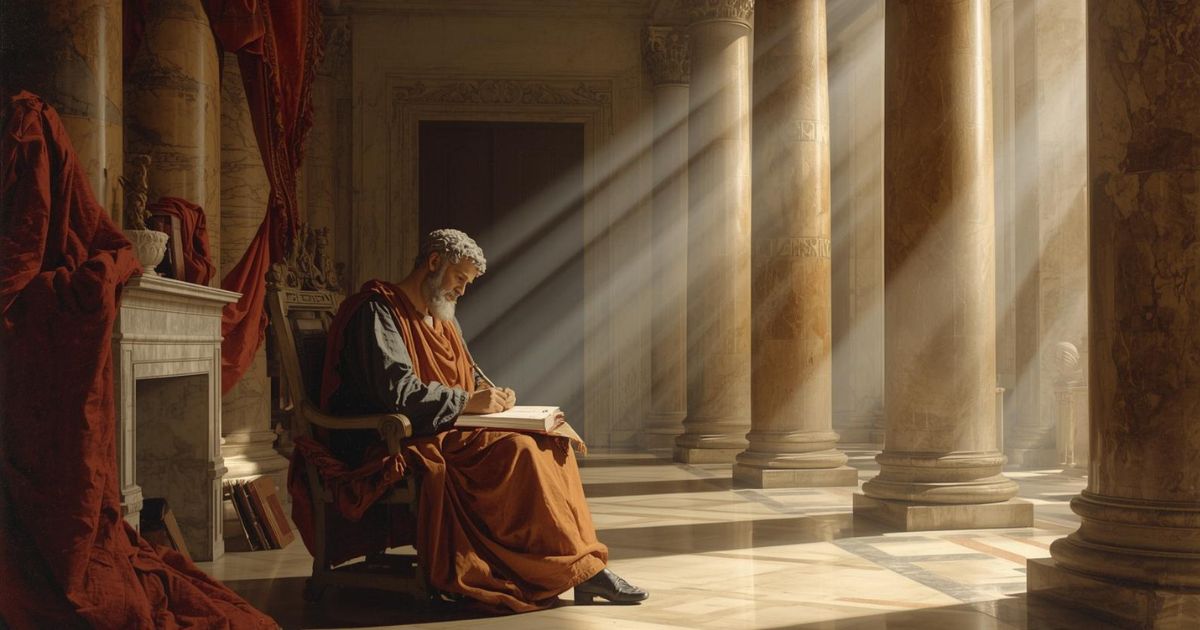
←etter 75. On the diseases of the soulMoral letters to Luciliusby Seneca, translated by Richard Mott GummereLetter 76. On learning wisdom in old ageLetter 77. On taking one's own life→483285Moral letters to Lucilius — Letter 76. On learning wisdom in old ageRichard Mott GummereSeneca LXXVI. ON LEARNING WISDOM IN OLD AGE 1. You have been threatening me with your enmity, if I do not keep you informed about all my daily actions. But see, now, upon what frank terms you and I live: for I shall confide even the following fact to your ears. I have been hearing the lectures of a philosopher; four days have already passed since I have been attending his school and listening to the harangue, which begins at two o’clock. “A fine time of life for that!” you say. Yes, fine indeed! Now what is more foolish than refusing to learn, simply because one has not been learning for a long time? 2. “What do you mean? Must I follow the fashion set by the fops[1] and youngsters?” But I am pretty well off if this is the only thing that discredits my declining years. Men of all ages are admitted to this class-room. You retort: “Do we grow old merely in order to tag after the youngsters?” But if I, an old man, go to the theatre, and am carried to the races, and allow no duel in the arena to be fought to a finish without my presence, shall I blush to attend a philosopher’s lecture? 3. You should keep learning as long as you are ignorant,—even to the end of your life, if there is anything in the proverb. And the proverb suits the present case as well as any: “As long as you live, keep learning how to live.” For all that, there is also something which I can teach in that school. You ask, do you, what I can teach? That even an old man should keep learning. 4. But I am ashamed of mankind, as often as I enter the lecture-hall. On my way to the house of Metronax[2] I am compelled to go, as you know, right past the Neapolitan Theatre. The building is jammed; men are deciding, with tremendous zeal, who is entitled to be called a good flute-player; even the Greek piper and the herald draw their crowds. But in the other place, where the question discussed is: “What is a good man?” and the lesson which we learn is “How to be a good man,” very few are in attendance, and the majority think that even these few are engaged in no good business; they have the name of being empty-headed idlers. I hope I may be blessed with that kind of mockery; for one should listen in an unruffled spirit to the railings of the ignorant; when one is marching toward the goal of honour, one should scorn scorn itself. 5. Proceed, then, Lucilius, and hasten, lest you yourself be compelled to learn in your old age, as is the case with me. Nay, you must hasten all the more, because for a long time you have not approached the subject, which is one that you can scarcely learn thoroughly when you are old. “How much progress shall I make?” you ask. Just as much as you try to make. 6. Why do you wait? Wisdom comes haphazard to no man. Money will come of its own accord; titles will be given to you; influence and authority will perhaps be thrust upon you; but virtue will not fall upon you by chance. Neither is knowledge thereof to be won by light effort or small toil; but toiling is worth while when one is about to win all goods at a single stroke. 7. For there is but a single good,—namely, that which is honourable; in all those other things of which the general opinion approves, you will find no truth or certainty. Why it is, however, that there is but one good, namely, that which is honourable, I shall now tell you, inasmuch as you judge that in my earlier letter[3] I did not carry the discussion far enough, and think that this theory was commended to you rather than proved. I shall also compress the remarks of other authors into narrow compass. 8. Everything is estimated by the standard of its own good. The vine is valued for its productiveness and the flavour of its wine, the stag for his speed. We ask, with regard to beasts of burden, how sturdy of back they are; for their only use is to bear burdens. If a dog is to find the trail of a wild beast, keenness of scent is of first importance; if to catch his quarry, swiftness of foot; if to attack and harry it, courage. In each thing that quality should be best for which the thing is brought into being and by which it is judged. 9. And what quality is best in man? It is reason; by virtue of reason he surpasses the animals, and is surpassed only by the gods. Perfect reason is therefore the good peculiar to man; all other qualities he shares in some degree with animals and plants. Man is strong; so is the lion. Man is comely; so is the peacock. Man is swift; so is the horse. I do not say that man is surpassed in all these qualities. I am not seeking to find that which is greatest in him, but that which is peculiarly his own. Man has body; so also have trees. Man has the power to act and to move at will; so have beasts and worms. Man has a voice; but how much louder is the voice of the dog, how much shriller that of the eagle, how much deeper that of the bull, how much sweeter and more melodious that of the nightingale! 10. What then is peculiar to man? Reason. When this is right and has reached perfection, man’s felicity is complete. Hence, if everything is praiseworthy and has arrived at the end intended by its nature, when it has brought its peculiar good to perfection, and if man’s peculiar good is reason; then, if a man has brought his reason to perfection, he is praiseworthy and has reached the end suited to his nature. This perfect reason is called virtue, and is likewise that which is honourable. 11. Hence that in man is alone a good which alone belongs to man. For we are not now seeking to discover what is a good, but what good is man’s. And if there is no other attribute which belongs peculiarly to man except reason, then reason will be his one peculiar good, but a good that is worth all the rest put together. If any man is bad, he will, I suppose, be regarded with disapproval; if good, I suppose he will be regarded with approval. Therefore, that attribute of man whereby he is approved or disapproved is his chief and only good. 12. You do not doubt whether this is a good; you merely doubt whether it is the sole good. If a man possess all other things, such as health, riches, pedigree,[4] a crowded reception-hall, but is confessedly bad, you will disapprove of him. Likewise, if a man possess none of the things which I have mentioned, and lacks money, or an escort of clients, or rank and a line of grandfathers and great-grandfathers, but is confessedly good, you will approve of him. Hence, this is man’s one peculiar good, and the possessor of it is to be praised even if he lacks other things; but he who does not possess it, though he possess everything else in abundance, is condemned and rejected. 13. The same thing holds good regarding men as regarding things. A ship is said to be good not when it is decorated with costly colours, nor when its prow is covered with silver or gold or its figure-head[5] embossed in ivory, nor when it is laden with the imperial revenues [6] or with the wealth of kings, but when it is steady and staunch and taut, with seams that keep out the water, stout enough to endure the buffeting of the waves’ obedient to its helm, swift and caring naught for the winds. 14. You will speak of a sword as good, not when its sword-belt is of gold, or its scabbard studded with gems, but when its edge is fine for cutting and its point will pierce any armour. Take the carpenter’s rule: we do not ask how beautiful it is, but how straight it is. Each thing is praised in regard to that attribute which is taken as its standard, in regard to that which is its peculiar quality. 15. Therefore in the case of man also, it is not pertinent to the question to know how many acres he ploughs, how much money he has out at interest, how many callers attend his receptions, how costly is the couch on which he lies, how transparent are the cups from which he drinks, but how good he is. He is good, however, if his reason is well-ordered and right and adapted to that which his nature has willed. 16. It is this that is called virtue; this is what we mean by “honourable”;[7] it is man’s unique good. For since reason alone brings man to perfection, reason alone, when perfected, makes man happy. This, moreover, is man’s only good, the only means by which he is made happy. We do indeed say that those things also[8] are goods which are furthered and brought together by virtue,—that is, all the works of virtue; but virtue itself is for this reason the only good, because there is no good without virtue. 17. If every good is in the soul, then whatever strengthens, uplifts, and enlarges the soul, is a good; virtue, however, does make the soul stronger, loftier, and larger. For all other things, which arouse our desires, depress the soul and weaken it, and when we think that they are uplifting the soul, they are merely puffing it up and cheating it with much emptiness. Therefore, that alone is good which will make the soul better. 18. All the actions of life, taken as a whole, are controlled by the consideration of what is honourable or base; it is with reference to these two things that our reason is governed in doing or not doing a particular thing. I shall explain what I mean: A good man will do what he thinks it will be honourable for him to do, even if it involves toil; he will do it even if it involves harm to him; he will do it even if it involves peril; again, he will not do that which will be base, even if it brings him money, or pleasure, or power. Nothing will deter him from that which is honourable, and nothing will tempt him into baseness. 19. Therefore, if he is determined invariably to follow that which is honourable, invariably to avoid baseness, and in every act of his life to have regard for these two things, deeming nothing else good except that which is honourable, and nothing else bad except that which is base; if virtue alone is unperverted in him and by itself keeps its even course, then virtue is that man’s only good, and nothing can thenceforth happen to it which may make it anything else than good. It has escaped all risk of change; folly may creep upwards towards wisdom, but wisdom never slips back into folly. 20. You may perhaps remember my saying[9] that the things which have been generally desired and feared have been trampled down by many a man in moments of sudden passion. There have been found men who would place their hands in the flames, men whose smiles could not be stopped by the torturer, men who would shed not a tear at the funeral of their children, men who would meet death unflinchingly. It is love, for example, anger, lust, which have challenged dangers. If a momentary stubbornness can accomplish all this when roused by some goad that pricks the spirit, how much more can be accomplished by virtue, which does not act impulsively or suddenly, but uniformly and with a strength that is lasting! 21. It follows that the things which are often scorned by the men who are moved with a sudden passion, and are always scorned by the wise, are neither goods nor evils. Virtue itself is therefore the only good; she marches proudly between the two extremes of fortune, with great scorn for both. 22. If, however, you accept the view that there is anything good besides that which is honourable, all the virtues will suffer. For it will never be possible for any virtue to be won and held, if there is anything outside itself which virtue must take into consideration. If there is any such thing, then it is at variance with reason, from which the virtues spring, and with truth also, which cannot exist without reason. Any opinion, however, which is at variance with truth, is wrong. 23. A good man, you will admit, must have the highest sense of duty toward the gods. Hence he will endure with an unruffled spirit whatever happens to him; for he will know that it has happened as a result of the divine law, by which the whole creation moves. This being so, there will be for him one good, and only one, namely, that which is honourable; for one of its dictates is that we shall obey the gods and not blaze forth in anger at sudden misfortunes or deplore our lot, but rather patiently accept fate and obey its commands. 24. If anything except the honourable is good, we shall be hounded by greed for life, and by greed for the things which provide life with its furnishings,—an intolerable state, subject to no limits, unstable. The only good, therefore, is that which is honourable, that which is subject to bounds. 25. I have declared[10] that man’s life would be more blest than that of the gods, if those things which the gods do not enjoy are goods,—such as money and offices of dignity. There is this further consideration: if only it is true that our souls, when released from the body, still abide, a happier condition is in store for them than is theirs while they dwell in the body. And yet, if those things are goods which we make use of for our bodies’ sake, our souls will be worse off when set free; and that is contrary to our belief, to say that the soul is happier when it is cabined and confined than when it is free and has betaken itself to the universe. 26. I also said[11] that if those things which dumb animals possess equally with man are goods, then dumb animals also will lead a happy life; which is of course impossible. One must endure all things in defence of that which is honourable; but this would not be necessary if there existed any other good besides that which is honourable. Although this question was discussed by me pretty extensively in a previous letter,[12] I have discussed it summarily and briefly run through the argument. 27. But an opinion of this kind will never seem true to you unless you exalt your mind and ask yourself whether, at the call of duty, you would be willing to die for your country, and buy the safety of all your fellow-citizens at the price of your own; whether you would offer your neck not only with patience, but also with gladness. If you would do this, there is no other good in your eyes. For you are giving up everything in order to acquire this good. Consider how great is the power of that which is honourable: you will die for your country, even at a moment’s notice, when you know that you ought to do so. 28. Sometimes, as a result of noble conduct, one wins great joy even in a very short and fleeting space of time; and though none of the fruits of a deed that has been done will accrue to the doer after he is dead and removed from the sphere of human affairs, yet the mere contemplation of a deed that is to be done is a delight, and the brave and upright man, picturing to himself the guerdons of his death,—guerdons such as the freedom of his country and the deliverance of all those for whom he is paying out his life,—partakes of the greatest pleasure and enjoys the fruit of his own peril. 29. But that man also who is deprived of this joy, the joy which is afforded by the contemplation of some last noble effort, will leap to his death without a moment’s hesitation, content to act rightly and dutifully. Moreover, you may confront him with many discouragements; you may say: “Your deed will speedily be forgotten,” or “Your fellow-citizens will offer you scant thanks.” He will answer: “All these matters lie outside my task. My thoughts are on the deed itself. I know that this is honourable. Therefore, whithersoever I am led and summoned by honour, I will go.” 30. This, therefore, is the only good, and not only is every soul that has reached perfection aware of it, but also every soul that is by nature noble and of right instincts; all other goods are trivial and mutable. For this reason we are harassed if we possess them. Even though, by the kindness of Fortune, they have been heaped together, they weigh heavily upon their owners, always pressing them down and sometimes crushing them. 31. None of those whom you behold clad in purple is happy, any more than one of these actors[13] upon whom the play bestows a sceptre and a cloak while on the stage; they strut their hour before a crowded house, with swelling port and buskined foot; but when once they make their exit the foot-gear is removed and they return to their proper stature. None of those who have been raised to a loftier height by riches and honours is really great. Why then does he seem great to you? It is because you are measuring the pedestal along with the man. A dwarf is not tall, though he stand upon a mountain-top; a colossal statue will still be tall, though you place it in a well. 32. This is the error under which we labour; this is the reason why we are imposed upon: we value no man at what he is, but add to the man himself the trappings in which he is clothed. But when you wish to inquire into a man’s true worth, and to know what manner of man he is, look at him when he is naked; make him lay aside his inherited estate, his titles, and the other deceptions of fortune; let him even strip off his body. Consider his soul, its quality and its stature, and thus learn whether its greatness is borrowed, or its own. 33. If a man can behold with unflinching eyes the flash of a sword, if he knows that it makes no difference to him whether his soul takes flight through his mouth or through a wound in his throat,[14] you may call him happy; you may also call him happy if, when he is threatened with bodily torture, whether it be the result of accident or of the might of the stronger, he can without concern hear talk of chains, or of exile, or of all the idle fears that stir men’s minds, and can say: “O maiden, no new sudden form of toil Springs up before my eyes; within my soul I have forestalled and surveyed everything.[15] To-day it is you who threaten me with these terrors; but I have always threatened myself with them, and have prepared myself as a man to meet man’s destiny.” 34. If an evil has been pondered beforehand, the blow is gentle when it comes. To the fool, however, and to him who trusts in fortune, each event as it arrives “comes in a new and sudden form,” and a large part of evil, to the inexperienced, consists in its novelty. This is proved by the fact that men endure with greater courage, when they have once become accustomed to them, the things which they had at first regarded as hardships. 35. Hence, the wise man accustoms himself to coming trouble, lightening by long reflection the evils which others lighten by long endurance. We sometimes hear the inexperienced say: “I knew that this was in store for me.” But the wise man knows that all things are in store for him. Whatever happens, he says: “I knew it.” Farewell. ↑ A mock-heroic nickname for the knights, derived from the town of Trossulum in Etruria, which they captured by a sensational charge. See Persius, i. 82, and Seneca, Ep. lxxxvii. 9. ↑ See also Ep. xciii. ↑ Ep. lxxiv. ↑ Literally “many masks” of his ancestors. These were placed in the atrium. ↑ Literally “the guardian deity”; cf. Horace, Od. i. 14. 10. These were images of the gods, carried and invoked by the ancients, in the same manner as St. Nicholas to-day. ↑ The fiscus was the private treasury of the Roman Emperor, as contrasted with the aerarium, which theoretically was controlled by the Senate. ↑ i.e., “moral worth.” ↑ i.e., peace, the welfare of one’s country, dutiful children, etc. ↑ Cf. Ep. lxxiv. 21. ↑ Cf. Ep. lxxiv. 14 aut ista bona non sunt, quae vocantur, aut homo felicior deo est, quoniam quidem quae parata nobis sunt, non habet in usu deus. ↑ e.g., Ep. lxxiv. 16 summum bonum . . . obsolescit, si ab optima nostri parte ad pessimam transit et transfertur ad sensus, qui agiliores sunt animalibus mutis. ↑ Ep. lxxiv., esp. § 14. ↑ Compare the argument in Ep. lxxx. § 7, “This farce of living, in which we act our parts so ill”; § 8, the loudmouthed impersonator of heroes, who sleeps on rags; and § 9 hominem involutum aestimas? ↑ As the world-soul is spread through the universe, so the human soul (as fire, or breath) is diffused through the body, and may take its departure in various ways. ↑ Vergil, Aeneid, vi. 103 ff. (The answer of Aeneas to the Sibyl’s prophecy.)
Master this chapter. Complete your experience
Purchase the complete book to access all chapters and support classic literature
As an Amazon Associate, we earn a small commission from qualifying purchases at no additional cost to you.
Available in paperback, hardcover, and e-book formats
Let's Analyse the Pattern
The social pressure to appear knowledgeable prevents the continued learning necessary for actual wisdom and effectiveness.
Why This Matters
Connect literature to life
This chapter teaches how to recognize when people (including yourself) use social pressure to avoid the discomfort of learning and changing.
Practice This Today
This week, notice when someone mocks another person's attempt to improve themselves—the pattern reveals who has given up on their own growth.
Now let's explore the literary elements.
Key Quotes & Analysis
"What is more foolish than refusing to learn, simply because one has not been learning for a long time?"
Context: Defending his decision to attend philosophy lectures despite his age
This challenges the common excuse that it's 'too late' to start something new. Seneca points out the illogical nature of this thinking - past inaction isn't a reason for continued inaction.
In Today's Words:
Just because you haven't done something before doesn't mean you shouldn't start now.
"If I, an old man, go to the theatre, and am carried to the races, and allow no duel in the arena to be fought to a finish without my presence, shall I blush to attend a philosopher's lecture?"
Context: Pointing out the hypocrisy of social expectations about age-appropriate activities
He exposes how society accepts older people pursuing entertainment but judges them for pursuing wisdom. This reveals our backwards priorities about what's truly valuable.
In Today's Words:
If nobody judges me for binge-watching Netflix, why should they judge me for taking a class?
"When reason is perfected, it is called virtue"
Context: Explaining what makes humans special and valuable
This defines virtue not as following rules, but as using our thinking capacity to its fullest. It suggests that being a good person is about developing our natural human abilities.
In Today's Words:
Being a good person means using your brain the right way.
Thematic Threads
Social Expectations
In This Chapter
Seneca faces criticism for learning at his age, challenging the expectation that older people should only teach, never learn
Development
Builds on earlier themes about defying social conventions when they conflict with personal growth
In Your Life:
You might feel pressure to appear expert in your field when you actually need to keep learning new approaches
Identity
In This Chapter
Seneca argues that human identity should be based on developing reason and virtue, not external achievements or possessions
Development
Deepens the ongoing exploration of what makes a person truly valuable versus superficially impressive
In Your Life:
You might catch yourself defining your worth by your job title, possessions, or others' opinions rather than your character growth
Class
In This Chapter
The letter critiques those who judge worth by external status symbols rather than inner development, comparing them to actors in costumes
Development
Continues examining how social hierarchies often reward appearance over substance
In Your Life:
You might notice how people treat you differently based on your uniform, car, or address rather than who you actually are
Personal Growth
In This Chapter
Seneca insists that learning and character development must continue throughout life, regardless of age or social position
Development
Reinforces the central Stoic theme that wisdom and virtue require constant cultivation
In Your Life:
You might realize that staying curious and open to change is more important than appearing to have all the answers
Human Relationships
In This Chapter
The letter explores how people relate to each other based on superficial qualities versus deeper character traits
Development
Extends earlier discussions about authentic connection versus social performance
In Your Life:
You might recognize when you're judging others by their circumstances rather than their character, or when others are doing this to you
You now have the context. Time to form your own thoughts.
Discussion Questions
- 1
Why does Seneca feel he needs to defend attending philosophy lectures at his age, and what does this reveal about social expectations around learning?
analysis • surface - 2
How does Seneca's comparison of humans to ships and swords help explain his argument about what makes a person truly valuable?
analysis • medium - 3
Where do you see people today avoiding learning opportunities because they think it makes them look weak or foolish?
application • medium - 4
Think of someone you know who stopped growing or learning. What fears or social pressures might be holding them back, and how could they overcome this?
application • deep - 5
What does Seneca's willingness to be mocked for learning teach us about the relationship between ego and personal growth?
reflection • deep
Critical Thinking Exercise
Map Your Learning Resistance
List three areas where you've stopped learning or growing because you felt you 'should already know this' or worried about looking foolish. For each area, write down what you're actually afraid of losing (respect, authority, image) and what you might gain by embracing beginner's mind again.
Consider:
- •Notice how ego protection often costs more than the temporary embarrassment of not knowing something
- •Consider whether the people whose opinions you fear would actually respect you more for being willing to learn
- •Think about how your refusal to grow in these areas might be affecting your relationships or effectiveness
Journaling Prompt
Write about a time when you had to swallow your pride and learn something new as an adult. What made it difficult, and what did you discover about yourself in the process?
Coming Up Next...
Chapter 77: When Death Becomes Freedom
The next letter takes a dramatic turn as Seneca discusses one of philosophy's most controversial topics: when and why someone might choose to end their own life. He'll explore the Stoic view on suicide as a rational choice rather than an act of desperation.