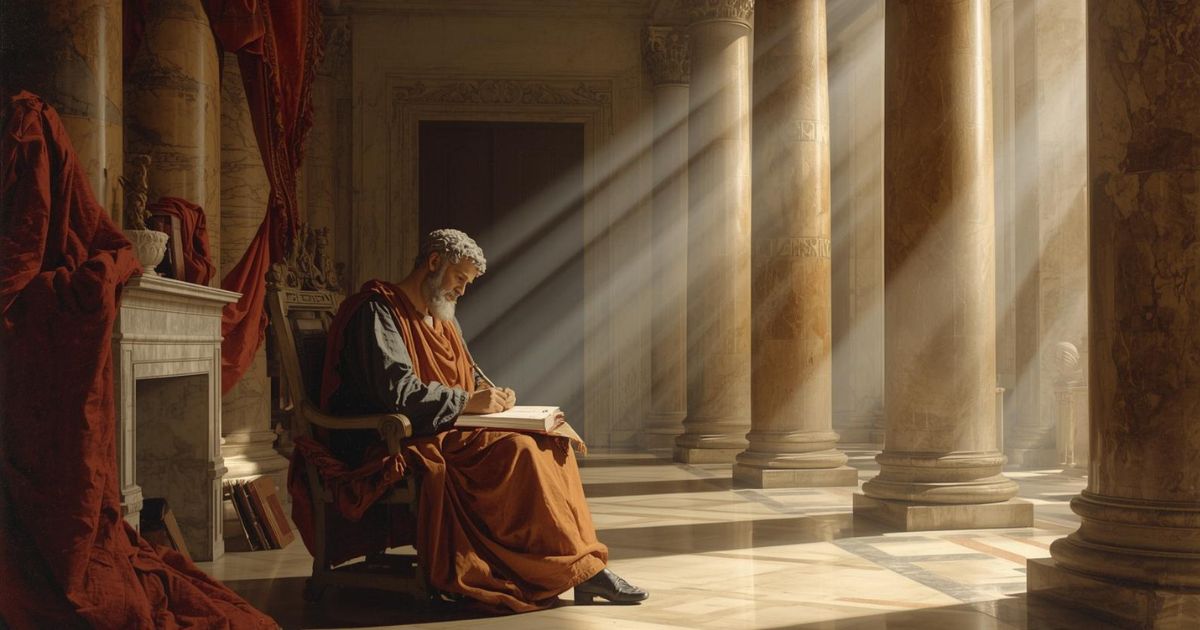
An excerpt from the original text.(complete · 1629 words)
←etter 62. On good companyMoral letters to Luciliusby Seneca, translated by Richard Mott GummereLetter 63. On grief for lost friendsLetter 64. On the philosopher's task→483040Moral letters to Lucilius — Letter 63. On grief for lost friendsRichard Mott GummereSeneca LXIII. ON GRIEF FOR LOST FRIENDS 1. I am grieved to hear that your friend Flaccus is dead, but I would not have you sorrow more than is fitting. That you should not mourn at all I shall hardly dare to insist; and yet I know that it is the better way. But what man will ever be so blessed with that ideal steadfastness of soul, unless he has already risen far above the reach of Fortune? Even such a man will be stung by an event like this, but it will be only a sting. We, however, may be forgiven for bursting into tears, if only our tears have not flowed to excess, and if we have checked them by our own efforts. Let not the eyes be dry when we have lost a friend, nor let them overflow. We may weep, but we must not wail. 2. Do you think that the law which I lay down for you is harsh, when the greatest of Greek poets has extended the privilege of weeping to one day only, in the lines where he tells us that even Niobe took thought of food?[1] Do you wish to know the reason for lamentations and excessive weeping? It is because we seek the proofs of our bereavement in our tears, and do not give way to sorrow, but merely parade it. No man goes into mourning for his own sake. Shame on our ill-timed folly! There is an element of self-seeking even in our sorrow. 3. “What,” you say, “am I to forget my friend?” It is surely a short-lived memory that you vouchsafe to him, if it is to endure only as long as your grief; presently that brow of yours will be smoothed out in laughter by some circumstance, however casual. It is to a time no more distant than this that I put off the soothing of every regret, the quieting of even the bitterest grief. As soon as you cease to observe yourself, the picture of sorrow which you have contemplated will fade away; at present you are keeping watch over your own suffering. But even while you keep watch it slips away from you, and the sharper it is, the more speedily it comes to an end. 4. Let us see to it that the recollection of those whom we have lost becomes a pleasant memory to us. No man reverts with pleasure to any subject which he will not be able to reflect upon without pain. So too it cannot but be that the names of those whom we have loved and lost come back to us with a sort of sting; but there is a pleasure even in this sting. 5. For, as my friend Attalus[2] used to say: “The remembrance of lost friends is pleasant in the same way that certain fruits have an agreeably acid taste, or as in extremely old wines it is their very bitterness that pleases us. Indeed, after a certain lapse of time, every thought that gave pain is quenched, and the pleasure comes to us unalloyed.” 6. If we take the word of Attalus for it, “to think of friends who are alive and well is like enjoying a meal of cakes and honey; the recollection of friends who have passed away gives a pleasure that is not without a touch of bitterness. Yet who will deny that even these things, which are bitter and contain an element of sourness, do serve to arouse the stomach?” 7. For my part, I do not agree with him. To me, the thought of my dead friends is sweet and appealing. For I have had them as if I should one day lose them; I have lost them as if I have them still. Therefore, Lucilius, act as befits your own serenity of mind, and cease to put a wrong interpretation on the gifts of Fortune. Fortune has taken away, but Fortune has given. 8. Let us greedily enjoy our friends, because we do not know how long this privilege will be ours. Let us think how often we shall leave them when we go upon distant journeys, and how often we shall fail to see them when we tarry together in the same place; we shall thus understand that we have lost too much of their time while they were alive. 9. But will you tolerate men who are most careless of their friends, and then mourn them most abjectly, and do not love anyone unless they have lost him? The reason why they lament too unrestrainedly at such times is that they are afraid lest men doubt whether they really have loved; all too late they seek for proofs of their emotions. 10. If we have other friends, we surely deserve ill at their hands and think ill of them, if they are of so little account that they fail to console us for the loss of one. If, on the other hand, we have no other friends, we have injured ourselves more than Fortune has injured us; since Fortune has robbed us of one friend, but we have robbed ourselves of every friend whom we have failed to make. 11. Again, he who has been unable to love more than one, has had none too much love even for that one.[3] If a man who has lost his one and only tunic through robbery chooses to bewail his plight rather than look about him for some way to escape the cold, or for something with which to cover his shoulders, would you not think him an utter fool? You have buried one whom you loved; look about for someone to love. It is better to replace your friend than to weep for him. 12. What I am about to add is, I know, a very hackneyed remark, but I shall not omit it simply because it is a common phrase: A man ends his grief by the mere passing of time, even if he has not ended it of his own accord. But the most shameful cure for sorrow, in the case of a sensible man, is to grow weary of sorrowing. I should prefer you to abandon grief, rather than have grief abandon you; and you should stop grieving as soon as possible, since, even if you wish to do so, it is impossible to keep it up for a long time. 13. Our forefathers[4] have enacted that, in the case of women, a year should be the limit for mourning; not that they needed to mourn for so long, but that they should mourn no longer. In the case of men, no rules are laid down, because to mourn at all is not regarded as honourable. For all that, what woman can you show me, of all the pathetic females that could scarcely be dragged away from the funeral-pile or torn from the corpse, whose tears have lasted a whole month? Nothing becomes offensive so quickly as grief; when fresh, it finds someone to console it and attracts one or another to itself; but after becoming chronic, it is ridiculed, and rightly. For it is either assumed or foolish. 14. He who writes these words to you is no other than I, who wept so excessively for my dear friend Annaeus Serenus[5] that, in spite of my wishes, I must be included among the examples of men who have been overcome by grief. To-day, however, I condemn this act of mine, and I understand that the reason why I lamented so greatly was chiefly that I had never imagined it possible for his death to precede mine. The only thought which occurred to my mind was that he was the younger, and much younger, too,—as if the Fates kept to the order of our ages! 15. Therefore let us continually think as much about our own mortality as about that of all those we love. In former days I ought to have said: “My friend Serenus is younger than I; but what does that matter? He would naturally die after me, but he may precede me.” It was just because I did not do this that I was unprepared when Fortune dealt me the sudden blow. Now is the time for you to reflect, not only that all things are mortal, but also that their mortality is subject to no fixed law. Whatever can happen at any time can happen to-day. 16. Let us therefore reflect, my beloved Lucilius, that we shall soon come to the goal which this friend, to our own sorrow, has reached. And perhaps, if only the tale told by wise men is true[6] and there is a bourne to welcome us, then he whom we think we have lost has only been sent on ahead. Farewell. ↑ Homer, Iliad, xix. 229 and xxiv. 602. ↑ The teacher of Seneca, often mentioned by him. ↑ The reason is, as Lipsius observed, that friendship is essentially a social virtue, and is not confined to one object. The pretended friendship for one and only one is a form of self-love, and is not unselfish love. ↑ According to tradition, from the time of Numa Pompilius. ↑ An intimate friend of Seneca, probably a relative, who died in the year 63 from eating poisoned mushrooms (Pliny, N. H. xxii. 96). Seneca dedicated to Serenus several of his philosophical essays. ↑ Cf. the closing chapter of the Agricola of Tacitus: si, ut sapientibus placet, non cum corpore exstinguuntur magnae animae, etc.
Master this chapter. Complete your experience
Purchase the complete book to access all chapters and support classic literature
As an Amazon Associate, we earn a small commission from qualifying purchases at no additional cost to you.
Available in paperback, hardcover, and e-book formats
Let's Analyse the Pattern
When people who loved least in life grieve most dramatically in death to compensate for their neglect.
Why This Matters
Connect literature to life
This chapter teaches how to distinguish between genuine feeling and emotional theater designed to manage guilt or impress others.
Practice This Today
This week, notice when someone's emotional display seems disproportionate to their actual relationship with the situation - they might be performing for guilt relief rather than expressing authentic feeling.
Now let's explore the literary elements.
Key Quotes & Analysis
"Let not the eyes be dry when we have lost a friend, nor let them overflow. We may weep, but we must not wail."
Context: Advising Lucilius on appropriate mourning for Flaccus
This perfectly captures Seneca's balanced approach to grief - acknowledging that tears are natural and necessary while warning against dramatic excess. The distinction between weeping and wailing is crucial.
In Today's Words:
It's okay to cry when someone dies, but don't make it a whole dramatic production.
"We seek the proofs of our affection in our sorrow."
Context: Explaining why people often grieve excessively
This reveals the uncomfortable truth that excessive mourning is often about the mourner's guilt or need for validation, not genuine love for the deceased. It's performative rather than authentic.
In Today's Words:
Sometimes we cry loudly to prove we cared, not because we actually miss them that much.
"I was not prepared to lose him; this is what makes my grief excessive and unreasonable."
Context: Confessing his own failure when Serenus died unexpectedly
Seneca's honest admission of his own philosophical failure makes his advice more credible. He shows that even teachers struggle with their own lessons when tested by real loss.
In Today's Words:
I thought he'd outlive me, so when he died I completely lost it.
Thematic Threads
Authentic vs. Performative Emotion
In This Chapter
Seneca distinguishes between genuine grief and theatrical mourning that serves the griever's image rather than honoring the dead
Development
Builds on earlier themes about living authentically versus performing for social approval
In Your Life:
You might catch yourself exaggerating emotions to prove something to others rather than feeling them genuinely.
The Cost of Assumption
In This Chapter
Seneca regrets assuming his younger friend would outlive him, leading to taking the relationship for granted
Development
Extends previous discussions about accepting uncertainty and not taking anything for granted
In Your Life:
You probably assume certain people will always be there, preventing you from appreciating them fully now.
Guilt and Compensation
In This Chapter
Those who mourn most dramatically often loved least while their friend was alive, compensating with public displays
Development
New theme exploring how guilt drives performative behavior
In Your Life:
You might find yourself overcompensating with dramatic gestures when you feel guilty about past neglect.
Relationship Investment Strategy
In This Chapter
Seneca advocates for building multiple meaningful relationships rather than emotional dependence on one person
Development
Practical application of Stoic principles to relationship management
In Your Life:
You might be putting too much emotional weight on one relationship instead of cultivating a supportive network.
Transforming Pain into Wisdom
In This Chapter
Grief should transform into sweet memory rather than become a prison that prevents future love
Development
Continues themes about using difficult experiences as growth opportunities
In Your Life:
You might be holding onto grief or resentment in ways that prevent you from loving fully again.
You now have the context. Time to form your own thoughts.
Discussion Questions
- 1
According to Seneca, what's the difference between genuine grief and performative mourning?
analysis • surface - 2
Why does Seneca believe that people who mourn most dramatically often loved least while their friend was alive?
analysis • medium - 3
Where do you see this pattern of 'loud grief from distant people' in modern workplaces, families, or social media?
application • medium - 4
How would you apply Seneca's advice about building multiple relationships rather than putting all emotional investment in one person?
application • deep - 5
What does this chapter reveal about how guilt disguises itself as love, and how can recognizing this pattern help you love more authentically?
reflection • deep
Critical Thinking Exercise
Audit Your Relationship Investment
List five important people in your life. For each person, write down: (1) when you last had a meaningful conversation with them, (2) what you know about their current challenges or joys, and (3) one specific way you could show you care this week. This exercise reveals whether you're investing in relationships now or setting yourself up for guilt-driven grief later.
Consider:
- •Be honest about which relationships you've been neglecting
- •Notice if you're putting all emotional energy into one or two people
- •Consider whether your current investment matches how much you'd grieve if you lost them
Journaling Prompt
Write about a time when you witnessed performative grief (including your own). What was really driving that dramatic display of sorrow, and how might things have been different if the relationship had been nurtured while it was still possible?
Coming Up Next...
Chapter 64: Finding Your Philosophical Heroes
In the next letter, Seneca shifts from personal loss to professional purpose, exploring what it truly means to be a philosopher and how to balance teaching wisdom with living it authentically.