An excerpt from the original text.(complete · 736 words)
←etter 43. On the relativity of fameMoral letters to Luciliusby Seneca, translated by Richard Mott GummereLetter 44. On philosophy and pedigreesLetter 45. On sophistical argumentation→483014Moral letters to Lucilius — Letter 44. On philosophy and pedigreesRichard Mott GummereSeneca XLIV. ON PHILOSOPHY AND PEDIGREES 1. You are again insisting to me that you are a nobody, and saying that nature in the first place, and fortune in the second, have treated you too scurvily, and this in spite of the fact that you have it in your power to separate yourself from the crowd and rise to the highest human happiness! If there is any good in philosophy, it is this,—that it never looks into pedigrees. All men, if traced back to their original source, spring from the gods. 2. You are a Roman knight, and your persistent work promoted you to this class; yet surely there are many to whom the fourteen rows are barred;[1] the senate-chamber is not open to all; the army, too, is scrupulous in choosing those whom it admits to toil and danger. But a noble mind is free to all men; according to this test, we may all gain distinction. Philosophy neither rejects nor selects anyone; its light shines for all. 3. Socrates was no aristocrat. Cleanthes worked at a well and served as a hired man watering a garden. Philosophy did not find Plato already a nobleman; it made him one. Why then should you despair of becoming able to rank with men like these? They are all your ancestors, if you conduct yourself in a manner worthy of them; and you will do so if you convince yourself at the outset that no man outdoes you in real nobility. 4. We have all had the same number of forefathers; there is no man whose first beginning does not transcend memory. Plato says: “Every king springs from a race of slaves, and every slave has had kings among his ancestors.”[2] The flight of time, with its vicissitudes, has jumbled all such things together, and Fortune has turned them upside down. 5. Then who is well-born? He who is by nature well fitted for virtue. That is the one point to be considered; otherwise, if you hark back to antiquity, every one traces back to a date before which there is nothing. From the earliest beginnings of the universe to the present time, we have been led forward out of origins that were alternately illustrious and ignoble. A hall full of smoke-begrimed busts does not make the nobleman. No past life has been lived to lend us glory, and that which has existed before us is not ours; the soul alone renders us noble, and it may rise superior to Fortune out of any earlier condition, no matter what that condition has been.[3] 6. Suppose, then, that you were not a Roman knight, but a freedman, you might nevertheless by your own efforts come to be the only free man amid a throng of gentlemen. “How?” you ask. Simply by distinguishing between good and bad things without patterning your opinion from the populace. You should look, not to the source from which these things come, but to the goal towards which they tend. If there is anything that can make life happy, it is good on its own merits; for it cannot degenerate into evil. 7. Where, then, lies the mistake, since all men crave the happy life? It is that they regard the means for producing happiness as happiness itself, and, while seeking happiness, they are really fleeing from it. For although the sum and substance of the happy life is unalloyed freedom from care, and though the secret of such freedom is unshaken confidence, yet men gather together that which causes worry, and, while travelling life’s treacherous road, not only have burdens to bear, but even draw burdens to themselves; hence they recede farther and farther from the achievement of that which they seek, and the more effort they expend, the more they hinder themselves and are set back. This is what happens when you hurry through a maze; the faster you go, the worse you are entangled. Farewell. ↑ Alluding to seats reserved for the knights at the theatre. ↑ Plato, Theaetetus, p. 174 E. ↑ Compare with the whole argument Menander, Frag. 533 Kock, ending: ὂς ἂν εὖ γεγονὼς ᾖ τῇ φύσει πρὸς τἀγαθά, κἂν Αἰθίοψ ᾖ, μῆτερ, ἐστὶν εὐγενής.
Master this chapter. Complete your experience
Purchase the complete book to access all chapters and support classic literature
As an Amazon Associate, we earn a small commission from qualifying purchases at no additional cost to you.
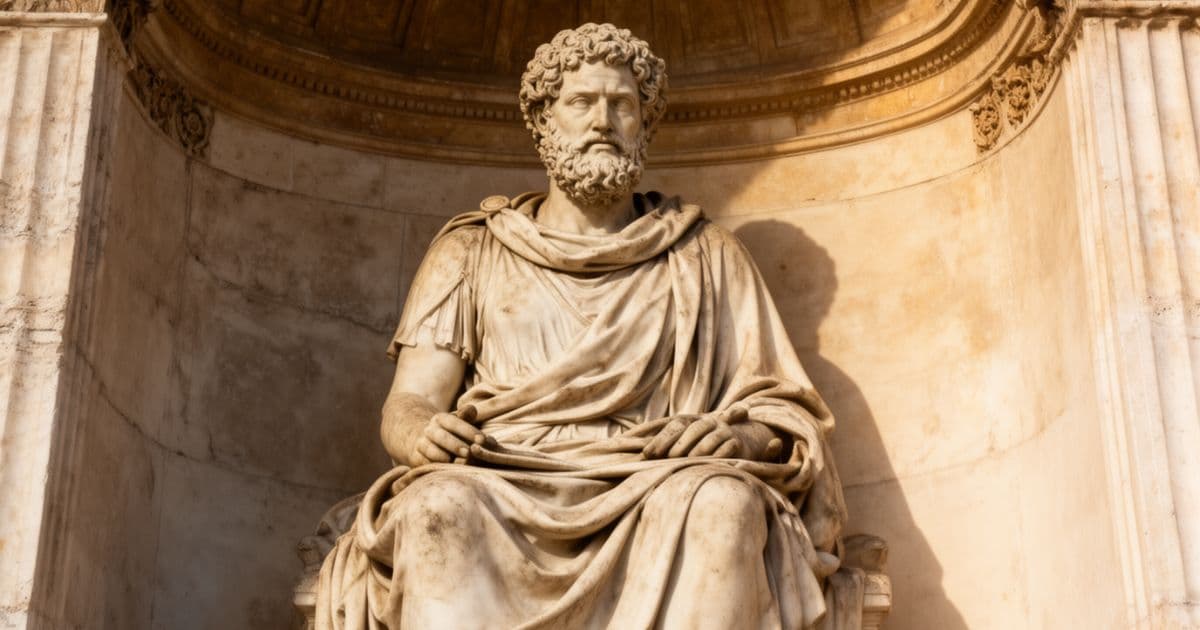
Available in paperback, hardcover, and e-book formats
Let's Analyse the Pattern
The false belief that your starting circumstances determine your ultimate worth and potential.
Why This Matters
Connect literature to life
This chapter teaches how to distinguish between what you can't control (your background) and what you can control (your development).
Practice This Today
This week, notice when you or others judge capability based on background rather than performance, and practice evaluating ideas and contributions on their merit alone.
Now let's explore the literary elements.
Key Quotes & Analysis
"All men, if traced back to their original source, spring from the gods."
Context: When explaining why pedigrees don't matter in the grand scheme of things
Seneca argues that if you go back far enough, everyone has the same divine origin. This levels the playing field completely - no one's bloodline is actually superior to anyone else's.
In Today's Words:
We're all human beings with the same basic worth - nobody's family tree makes them better than you.
"Philosophy neither rejects nor selects anyone; its light shines for all."
Context: Contrasting philosophy with exclusive social institutions that bar people based on class
Unlike Roman society's rigid class system, wisdom and virtue are available to everyone. Philosophy doesn't check your credentials at the door - it welcomes anyone willing to learn and grow.
In Today's Words:
Wisdom doesn't care about your background - anyone can develop it if they're willing to put in the work.
"Philosophy did not find Plato already a nobleman; it made him one."
Context: Explaining how true nobility comes from character development, not birth
This flips the entire concept of nobility on its head. Instead of being born noble, you become noble through developing wisdom and virtue. It's an active choice, not a passive inheritance.
In Today's Words:
Plato wasn't born special - he became special by working on himself and his character.
Thematic Threads
Class
In This Chapter
Seneca directly confronts class anxiety, arguing that true nobility comes from character, not bloodlines or wealth
Development
Builds on earlier discussions of wealth's proper role, now addressing the psychological prison of class consciousness
In Your Life:
You might catch yourself assuming someone's background determines their capability or feeling limited by your own origins
Identity
In This Chapter
Explores how we construct self-worth—through inherited status versus developed virtue and wisdom
Development
Deepens previous themes about authentic self-definition versus external validation
In Your Life:
You might notice how much of your identity comes from things you didn't choose versus things you've built
Social Expectations
In This Chapter
Challenges society's hierarchy system that values birth circumstances over personal development
Development
Continues critique of social pressures while offering concrete alternative values
In Your Life:
You might recognize how social expectations based on background limit both you and others around you
Personal Growth
In This Chapter
Philosophy presented as the great equalizer that transforms anyone willing to engage with it seriously
Development
Reinforces growth mindset themes while addressing barriers to believing growth is possible
In Your Life:
You might realize that your capacity for wisdom and character development isn't limited by your starting point
Happiness
In This Chapter
Reveals why people fail to find happiness despite desperately wanting it—they mistake the tools for the goal
Development
Introduced here as new thread connecting to broader Stoic themes about what truly matters
In Your Life:
You might notice how accumulating things or status creates more anxiety rather than the peace you're seeking
You now have the context. Time to form your own thoughts.
Discussion Questions
- 1
What specific insecurity was Lucilius struggling with, and how did Seneca respond to his concern about being a 'nobody'?
analysis • surface - 2
Why does Seneca argue that philosophy is 'the great equalizer'? What examples does he use to support this claim?
analysis • medium - 3
Where do you see people today judging others based on background rather than character or capability? What are some specific examples from work, school, or social situations?
application • medium - 4
When someone tries to make you feel inferior because of your background or credentials, what strategies could you use to maintain confidence in your own worth?
application • deep - 5
What does this chapter reveal about why people chase status symbols and external validation instead of focusing on character development?
reflection • deep
Critical Thinking Exercise
Trace Your Origin Story Impact
Write down three beliefs you have about yourself based on your background—family, education, social class, or region. For each belief, identify whether it empowers or limits you. Then rewrite each limiting belief as a neutral starting point rather than a permanent boundary. Finally, list one action you could take this week that ignores your background and focuses purely on what you can contribute.
Consider:
- •Notice which beliefs feel 'obviously true' but might actually be learned limitations
- •Consider how your background has both helped and hindered your growth
- •Think about people you admire who succeeded despite humble beginnings
Journaling Prompt
Write about a time when someone dismissed your ideas or capabilities based on your background. How did it feel, and how would you handle that situation differently now?
Coming Up Next...
Chapter 45: Focus Over Fancy Word Games
Next, Seneca tackles the problem of overthinking and intellectual showing off. He'll explain why getting caught up in clever arguments and complex theories can actually distance you from wisdom and practical living.