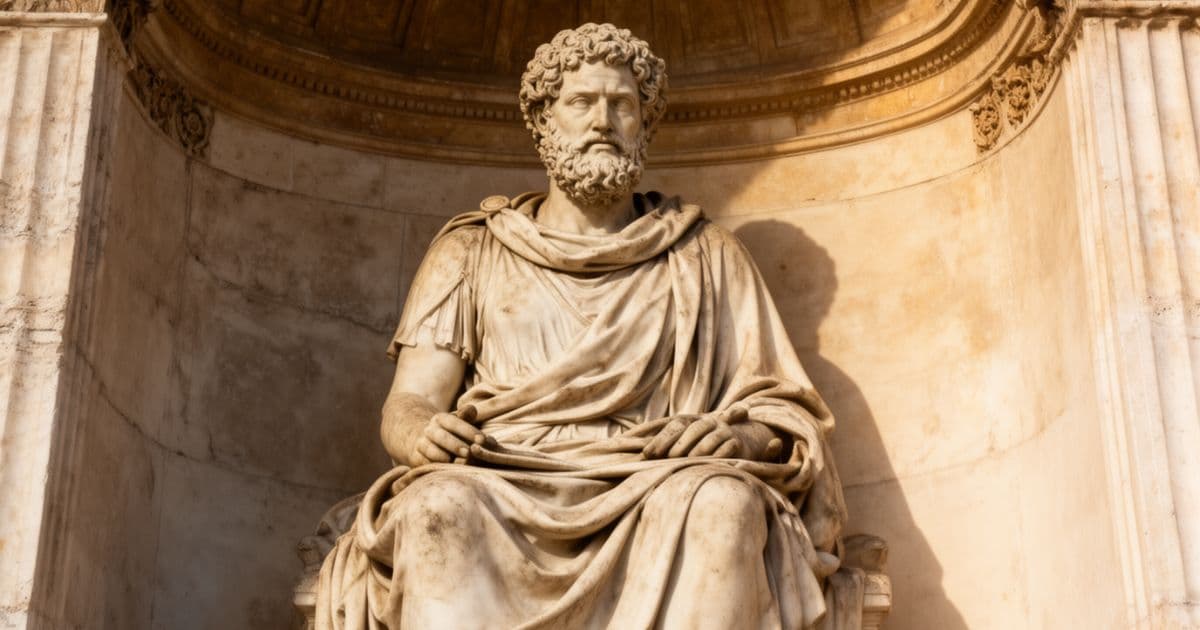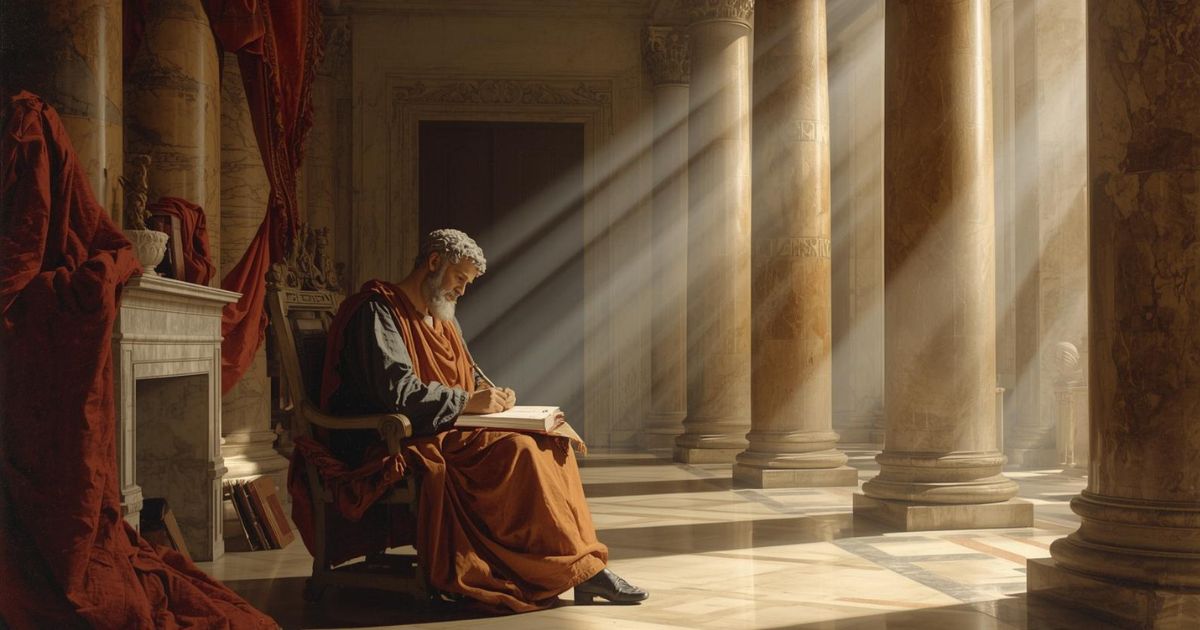
An excerpt from the original text.(complete · 1090 words)
←etter 40. On the proper style for a philosopher's discourseMoral letters to Luciliusby Seneca, translated by Richard Mott GummereLetter 41. On the god within usLetter 42. On values→483011Moral letters to Lucilius — Letter 41. On the god within usRichard Mott GummereSeneca XLI. ON THE GOD WITHIN US 1. You are doing an excellent thing, one which will be wholesome for you, if, as you write me, you are persisting in your effort to attain sound understanding; it is foolish to pray for this when you can acquire it from yourself. We do not need to uplift our hands towards heaven, or to beg the keeper of a temple to let us approach his idol’s ear, as if in this way our prayers were more likely to be heard. God is near you, he is with you, he is within you. 2. This is what I mean, Lucilius: a holy spirit indwells within us, one who marks our good and bad deeds, and is our guardian. As we treat this spirit, so are we treated by it. Indeed, no man can be good without the help of God. Can one rise superior to fortune unless God helps him to rise? He it is that gives noble and upright counsel. In each good man A god doth dwell, but what god know we not.[1] 3. If ever you have come upon a grove that is full of ancient trees which have grown to an unusual height, shutting out a view of the sky by a veil of pleached and intertwining branches, then the loftiness of the forest, the seclusion of the spot, and your marvel at the thick unbroken shade in the midst of the open spaces, will prove to you the presence of deity. Or if a cave, made by the deep crumbling of the rocks, holds up a mountain on its arch, a place not built with hands but hollowed out into such spaciousness by natural causes, your soul will be deeply moved by a certain intimation of the existence of God. We worship the sources of mighty rivers; we erect altars at places where great streams burst suddenly from hidden sources; we adore springs of hot water as divine, and consecrate certain pools because of their dark waters or their immeasurable depth. 4. If you see a man who is unterrified in the midst of dangers, untouched by desires, happy in adversity, peaceful amid the storm, who looks down upon men from a higher plane, and views the gods on a footing of equality, will not a feeling of reverence for him steal over you? Will you not say: “This quality is too great and too lofty to be regarded as resembling this petty body in which it dwells? A divine power has descended upon that man.” 5. When a soul rises superior to other souls, when it is under control, when it passes through every experience as if it were of small account, when it smiles at our fears and at our prayers, it is stirred by a force from heaven. A thing like this cannot stand upright unless it be propped by the divine. Therefore, a greater part of it abides in that place from whence it came down to earth. Just as the rays of the sun do indeed touch the earth, but still abide at the source from which they are sent; even so the great and hallowed soul, which has come down in order that we may have a nearer knowledge of divinity, does indeed associate with us, but still cleaves to its origin; on that source it depends, thither it turns its gaze and strives to go, and it concerns itself with our doings only as a being superior to ourselves. 6. What, then, is such a soul? One which is resplendent with no external good, but only with its own. For what is more foolish than to praise in a man the qualities which come from without? And what is more insane than to marvel at characteristics which may at the next instant be passed on to someone else? A golden bit does not make a better horse. The lion with gilded mane, in process of being trained and forced by weariness to endure the decoration, is sent into the arena in quite a different way from the wild lion whose spirit is unbroken; the latter, indeed, bold in his attack, as nature wished him to be, impressive because of his wild appearance,—and it is his glory that none can look upon him without fear,—is favoured[2] in preference to the other lion, that languid and gilded brute. 7. No man ought to glory except in that which is his own. We praise a vine if it makes the shoots teem with increase, if by its weight it bends to the ground the very poles which hold its fruit; would any man prefer to this vine one from which golden grapes and golden leaves hang down? In a vine the virtue peculiarly its own is fertility; in man also we should praise that which is his own. Suppose that he has a retinue of comely slaves and a beautiful house, that his farm is large and large his income; none of these things is in the man himself; they are all on the outside. 8. Praise the quality in him which cannot be given or snatched away, that which is the peculiar property of the man. Do you ask what this is? It is soul, and reason brought to perfection in the soul. For man is a reasoning animal. Therefore, man’s highest good is attained, if he has fulfilled the good for which nature designed him at birth. 9. And what is it which this reason demands of him? The easiest thing in the world,—to live in accordance with his own nature. But this is turned into a hard task by the general madness of mankind; we push one another into vice. And how can a man be recalled to salvation, when he has none to restrain him, and all mankind to urge him on? Farewell. ↑ Vergil, Aeneid, viii. 352,Hoc nemus, hune, inquit, frondoso vertice collem,Quis deus incertum est, habitat deus,and cf. Quintillian, i. 10. 88, where he is speaking of Ennius, whom “sicut sacros vetustate lucos adoremus, in quibus grandia et antiqua robora iam non tantum habent speciem quantem religionem.” ↑ The spectators of the fight, which is to take place between the two lions, applaud the wild lion and bet on him.
Master this chapter. Complete your experience
Purchase the complete book to access all chapters and support classic literature
As an Amazon Associate, we earn a small commission from qualifying purchases at no additional cost to you.
Available in paperback, hardcover, and e-book formats
Let's Analyse the Pattern
We seek worth and guidance from external sources while ignoring our most reliable compass—our inner wisdom and moral intuition.
Why This Matters
Connect literature to life
This chapter teaches how to recognize when you're being praised or valued for superficial reasons versus your actual character and competence.
Practice This Today
This week, notice when compliments focus on how you look, what you own, or how well you follow rules versus recognition of your skills, integrity, or positive impact on others.
Now let's explore the literary elements.
Key Quotes & Analysis
"God is near you, he is with you, he is within you."
Context: Seneca is telling Lucilius that he doesn't need to pray to distant gods or visit temples for guidance.
This quote challenges the idea that wisdom and strength come from outside sources. Seneca argues that everything we need to navigate life is already inside us, waiting to be accessed and trusted.
In Today's Words:
You already have everything you need inside you - stop looking everywhere else for answers.
"A holy spirit indwells within us, one who marks our good and bad deeds, and is our guardian."
Context: Explaining how our inner moral compass works as both witness and guide for our actions.
This isn't about religious doctrine but about recognizing that we have an internal system for knowing right from wrong. This inner voice keeps track of our choices and helps us course-correct when needed.
In Today's Words:
You have an inner voice that knows when you're being true to yourself and when you're not - listen to it.
"In each good man a god doth dwell, but what god know we not."
Context: Describing how truly good people seem to have something divine about them.
Seneca suggests that when someone lives authentically from their inner wisdom, they radiate a kind of power that's hard to define but impossible to ignore. It's not about perfection but about alignment with your true nature.
In Today's Words:
There's something special about people who are genuinely themselves - you can feel it even if you can't explain it.
Thematic Threads
Identity
In This Chapter
Seneca argues our true identity comes from our soul and character, not external possessions or social status
Development
Building on earlier themes about self-knowledge and authentic living
In Your Life:
You might catch yourself defining your worth by your job title, income, or what others think rather than your actual values and character
Class
In This Chapter
Criticizes valuing people for their wealth, slaves, or property rather than their inner qualities
Development
Continues Seneca's critique of social hierarchies based on external markers
In Your Life:
You see this when people treat you differently based on your job, car, or neighborhood rather than who you actually are
Social Expectations
In This Chapter
Society pushes us toward artificial values and vice, making authentic living nearly impossible
Development
Deepens the theme of societal pressure corrupting natural wisdom
In Your Life:
You feel this pressure to appear successful on social media or keep up with others' lifestyle choices even when it doesn't align with your values
Personal Growth
In This Chapter
The divine spark within us serves as our moral guardian and guide for development
Development
Introduces the concept of inner wisdom as the foundation for growth
In Your Life:
You have moments when your gut tells you something is right or wrong, even when logic or peer pressure suggests otherwise
Human Relationships
In This Chapter
We should value people for their authentic nature, like respecting a wild lion over one dressed in gold
Development
Extends relationship themes to focus on seeing people's true worth
In Your Life:
You might find yourself more impressed by someone's genuine kindness than their expensive clothes or fancy job title
You now have the context. Time to form your own thoughts.
Discussion Questions
- 1
According to Seneca, where should we look for guidance and validation in life, and why does he think most people look in the wrong places?
analysis • surface - 2
Why does Seneca compare praising someone for their wealth to admiring a horse for its golden bridle rather than its natural strength?
analysis • medium - 3
Think about social media or workplace dynamics - where do you see people seeking external validation instead of trusting their inner wisdom?
application • medium - 4
Describe a time when you knew something was right or wrong in your gut, but external pressures made you doubt yourself. How would you handle that situation differently now?
application • deep - 5
If everyone has this 'divine spark' or inner compass, why do you think it's so hard for people to trust and follow it in modern life?
reflection • deep
Critical Thinking Exercise
Map Your Internal vs External Compass
Draw two columns on paper: 'What My Inner Voice Says' and 'What External Voices Say.' Pick a current decision you're facing or a recent choice you made. Fill in both columns honestly. Notice where they align and where they conflict. This exercise helps you recognize the difference between your authentic guidance system and outside pressure.
Consider:
- •Your inner voice might be quieter but more consistent than external opinions
- •External voices often reflect other people's fears, expectations, or agendas
- •The choice that feels right internally usually leads to less regret long-term
Journaling Prompt
Write about a time when you followed your inner compass despite external pressure. What was the outcome? How did it feel different from times when you ignored your gut instincts?
Coming Up Next...
Chapter 42: The True Cost of Everything
Having explored the divine within us, Seneca next turns to a practical question: how can we tell if someone is truly good? He warns Lucilius about being too quick to trust new friends and reveals the difference between genuine virtue and mere appearances.