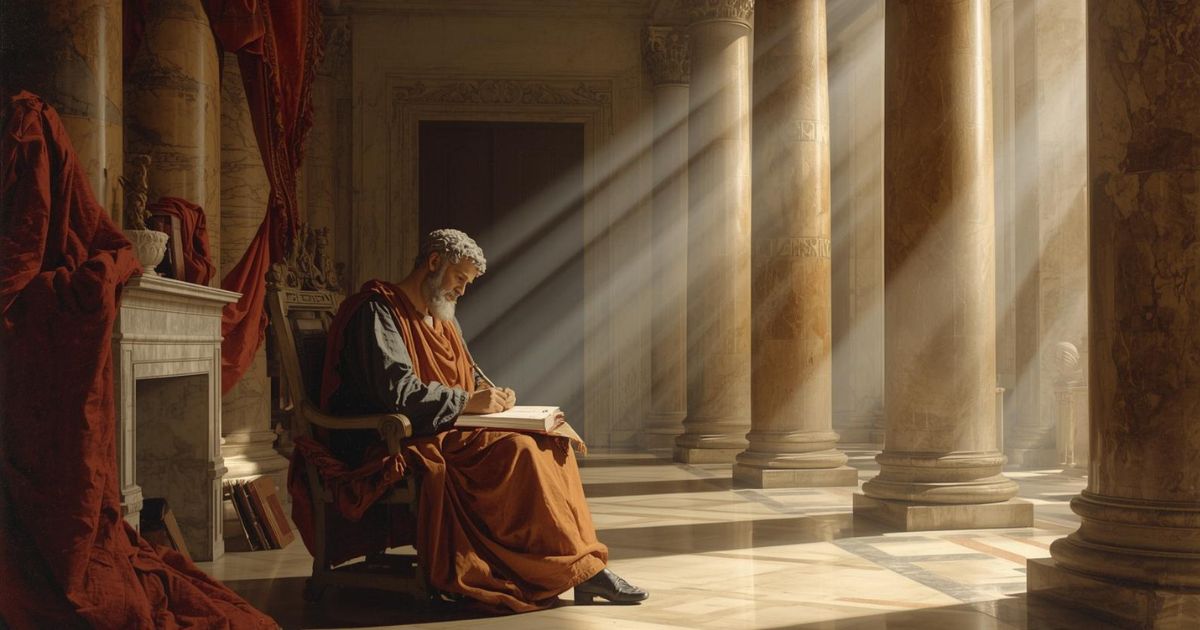
An excerpt from the original text.(complete · 1371 words)
←etter 35. On the friendship of kindred mindsMoral letters to Luciliusby Seneca, translated by Richard Mott GummereLetter 36. On the value of retirementLetter 37. On allegiance to virtue→483005Moral letters to Lucilius — Letter 36. On the value of retirementRichard Mott GummereSeneca XXXVI. ON THE VALUE OF RETIREMENT 1. Encourage your friend to despise stout-heartedly those who upbraid him because he has sought the shade of retirement and has abdicated his career of honours, and, though he might have attained more, has preferred tranquillity to them all. Let him prove daily to these detractors how wisely he has looked out for his own interests. Those whom men envy will continue to march past him; some will be pushed out of the ranks, and others will fall. Prosperity is a turbulent thing; it torments itself. It stirs the brain in more ways than one, goading men on to various aims,—some to power, and others to high living. Some it puffs up; others it slackens and wholly enervates. 2. “But,” the retort comes, “so-and-so carries his prosperity well.” Yes; just as he carries his liquor. So you need not let this class of men persuade you that one who is besieged by the crowd is happy; they run to him as crowds rush for a pool of water, rendering it muddy while they drain it. But you say: “Men call our friend a trifler and a sluggard.” There are men, you know, whose speech is awry, who use the contrary[1] terms. They called him happy; what of it? Was he happy? 3. Even the fact that to certain persons he seems a man of a very rough and gloomy cast of mind, does not trouble me. Aristo[2] used to say that he preferred a youth of stern disposition to one who was a jolly fellow and agreeable to the crowd. “For,” he added, “wine which, when new, seemed harsh and sour, becomes good wine; but that which tasted well at the vintage cannot stand age.” So let them call him stern and a foe to his own advancement. It is just this sternness that will go well when it is aged, provided only that he continues to cherish virtue and to absorb thoroughly the studies which make for culture,—not those with which it is sufficient for a man to sprinkle himself, but those in which the mind should be steeped. 4. Now is the time to learn. “What? Is there any time when a man should not learn?” By no means; but just as it is creditable for every age to study, so it is not creditable for every age to be instructed. An old man learning his A B C is a disgraceful and absurd object; the young man must store up, the old man must use. You will therefore be doing a thing most helpful to yourself if you make this friend of yours as good a man as possible; those kindnesses, they tell us, are to be both sought for and bestowed, which benefit the giver no less than the receiver; and they are unquestionably the best kind. 5. Finally, he has no longer any freedom in the matter; he has pledged his word. And it is less disgraceful to compound with a creditor than to compound with a promising future. To pay his debt of money, the business man must have a prosperous voyage, the farmer must have fruitful fields and kindly weather; but the debt which your friend owes can be completely paid by mere goodwill. 6. Fortune has no jurisdiction over character. Let him so regulate his character that in perfect peace he may bring to perfection that spirit within him which feels neither loss nor gain, but remains in the same attitude, no matter how things fall out. A spirit like this, if it is heaped with worldly goods, rises superior to its wealth; if, on the other hand, chance has stripped him of a part of his wealth, or even all, it is not impaired. 7. If your friend had been born in Parthia, he would have begun, when a child, to bend the bow; if in Germany, he would forthwith have been brandishing his slender spear; if he had been born in the days of our forefathers, he would have learned to ride a horse and smite his enemy hand to hand. These are the occupations which the system of each race recommends to the individual,—yes, prescribes for him. 8. To what, then, shall this friend[3] of yours devote his attention? I say, let him learn that which is helpful against all weapons, against every kind of foe,—contempt of death; because no one doubts that death has in it something that inspires terror, so that it shocks even our souls, which nature has so moulded that they love their own existence; for otherwise[4] there would be no need to prepare ourselves, and to whet our courage, to face that towards which we should move with a sort of voluntary instinct, precisely as all men tend to preserve their existence. 9. No man learns a thing in order that, if necessity arises, he may lie down with composure upon a bed of roses; but he steels his courage to this end,—that he may not surrender his plighted faith to torture, and that, if need be, he may some day stay out his watch in the trenches, even though wounded, without even leaning on his spear; because sleep is likely to creep over men who support themselves by any prop whatsoever. In death there is nothing harmful; for there must exist something to which it is harmful.[5] 10. And yet, if you are possessed by so great a craving for a longer life, reflect that none of the objects which vanish from our gaze and are re-absorbed into the world of things, from which they have come forth and are soon to come forth again, is annihilated; they merely end their course and do not perish. And death, which we fear and shrink from, merely interrupts life, but does not steal it away; the time will return when we shall be restored to the light of day; and many men would object to this, were they not brought back in forgetfulness of the past. 11. But I mean to show you later,[6] with more care, that everything which seems to perish merely changes. Since you are destined to return, you ought to depart with a tranquil mind. Mark how the round of the universe repeats its course; you will see that no star in our firmament is extinguished, but that they all set and rise in alternation. Summer has gone, but another year will bring it again; winter lies low, but will be restored by its own proper months; night has overwhelmed the sun, but day will soon rout the night again. The wandering stars retrace their former courses; a part of the sky is rising unceasingly, and a part is sinking. 12. One word more, and then I shall stop; infants, and boys, and those who have gone mad, have no fear of death, and it is most shameful if reason cannot afford us that peace of mind to which they have been brought by their folly. Farewell. ↑ i.e., they are no more correct now, when they called him a trifler, than they were before, when they called him happy. ↑ Aristo of Chios, Frag. 388 von Armin. ↑ As a Roman, living in an age when philosophy was recommended and prescribed. ↑ i.e., if death inspired no terror. ↑ And since after death we do not exist, death cannot be harmful to us. Seneca has in mind the argument of Epicurus (Diogenes Laertius, x. 124–5): “Therefore the most dread-inspiring of all evils, death, is nothing to us; for when we exist; death is not present in us, and when death is present, then we do not exist. Therefore it does not concern either the living or the dead; for to the living it has no existence, and the dead do not themselves exist.” Lucretius uses this argument, concluding it with (iii. 830): Nil igitur mors est ad nos neque pertinet hilum. ↑ For example, in Ep. lxxvii.
Master this chapter. Complete your experience
Purchase the complete book to access all chapters and support classic literature
As an Amazon Associate, we earn a small commission from qualifying purchases at no additional cost to you.
Available in paperback, hardcover, and e-book formats
Let's Analyse the Pattern
Society punishes those who refuse to play status games, but walking away from toxic competition is often the wisest choice.
Why This Matters
Connect literature to life
This chapter teaches how to recognize when society punishes strategic retreats while celebrating self-destructive advancement.
Practice This Today
This week, notice when someone gets criticized for setting boundaries or choosing stability over status—ask yourself if they might be the only one thinking clearly.
Now let's explore the literary elements.
Key Quotes & Analysis
"Prosperity is a turbulent thing; it torments itself."
Context: Explaining why his friend was smart to avoid the rat race
This reveals that success isn't peaceful—it creates its own problems and anxieties. Seneca shows that what looks like winning is actually a form of suffering that people inflict on themselves.
In Today's Words:
Success is exhausting—the more you get, the more stressed out you become trying to keep it all together.
"Just as he carries his liquor."
Context: Responding to people who say someone 'handles prosperity well'
This analogy cuts through the illusion that some people are immune to the corrupting effects of wealth and power. Even if they look fine on the outside, the damage is still happening.
In Today's Words:
Just because someone doesn't look drunk doesn't mean the alcohol isn't poisoning them.
"They run to him as crowds rush for a pool of water, rendering it muddy while they drain it."
Context: Describing how crowds ruin what they seek
This image shows how popularity destroys the very thing people are attracted to. The successful person becomes a resource that gets depleted by everyone wanting a piece of them.
In Today's Words:
Everyone wants to get close to successful people, but all that attention ends up ruining what made them special in the first place.
Thematic Threads
Social Expectations
In This Chapter
Seneca defends his friend's choice to retire against social criticism and labels of laziness
Development
Building on earlier themes of independence, now explicitly addressing social pressure to conform
In Your Life:
You might feel this when family questions your career choices or friends pressure you to keep up with their lifestyle
Class
In This Chapter
The distinction between those who chase prosperity and those who choose wisdom over wealth
Development
Continues Seneca's critique of material pursuits, now focusing on the social dynamics of success
In Your Life:
You see this in workplace hierarchies where climbing the ladder often means sacrificing what matters most to you
Personal Growth
In This Chapter
Deep learning that 'soaks into your bones' versus superficial knowledge for social display
Development
Evolving from individual self-improvement to distinguishing authentic growth from performance
In Your Life:
This shows up when you choose real skill development over credentials that just look good on paper
Identity
In This Chapter
The friend's identity as someone who chose retirement over career advancement despite social judgment
Development
Expanding on self-definition themes to include resistance to external pressure
In Your Life:
You experience this when you have to decide whether to be who others expect or who you actually are
Human Relationships
In This Chapter
Seneca's loyalty in defending his friend against critics and social pressure
Development
Introduced here as theme of supporting others who make unconventional but wise choices
In Your Life:
This appears when you need to decide whether to defend someone making unpopular but smart decisions
You now have the context. Time to form your own thoughts.
Discussion Questions
- 1
Why do people call Seneca's friend lazy for choosing retirement over career advancement?
analysis • surface - 2
What does Seneca mean when he compares prosperity to a violent storm, and why does he think people who 'handle success well' are like people who can hold their liquor?
analysis • medium - 3
Where do you see this pattern today - people being criticized for stepping away from status games or refusing to chase conventional success?
application • medium - 4
Think about a time when you felt pressure to pursue something everyone else thought you should want. How would you handle that situation differently after reading this chapter?
application • deep - 5
Why does Seneca connect mastering 'contempt of death' to becoming truly free? What does this reveal about how fear controls our choices?
reflection • deep
Critical Thinking Exercise
Map Your Own Status Traps
Make a list of three opportunities or expectations in your life that everyone thinks you should pursue. For each one, write down what it would cost you that you can't get back, what compromises you'd have to make, and what you'd have to defend afterward. Then identify which ones serve your actual values versus which ones just impress other people.
Consider:
- •Consider both obvious costs (time, money) and hidden costs (stress, relationships, personal integrity)
- •Think about the difference between what you genuinely want and what you think you should want
- •Remember that saying no to one thing means saying yes to something else - what would you gain by stepping away?
Journaling Prompt
Write about a time when you chose the path that disappointed others but felt right to you. What did you learn about yourself? How did it turn out in the long run?
Coming Up Next...
Chapter 37: The Soldier's Oath to Virtue
In the next letter, Seneca explores what it means to make a promise to live virtuously and why breaking that commitment to yourself is worse than defaulting on any financial debt. He'll reveal why your word to yourself is the strongest chain that binds you to wisdom.