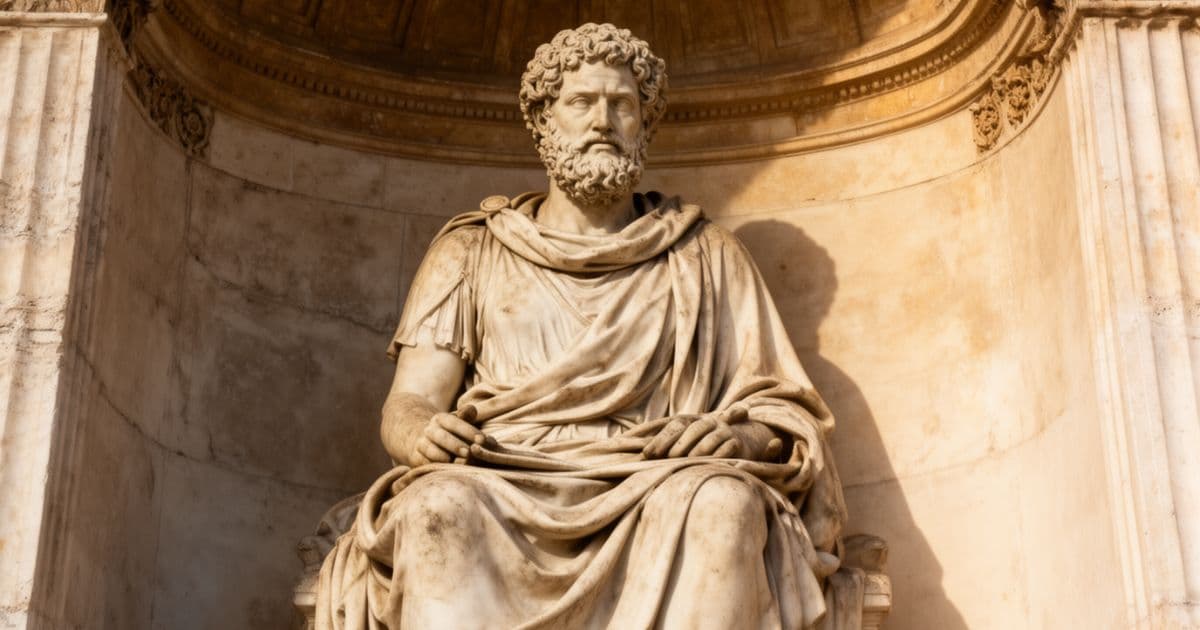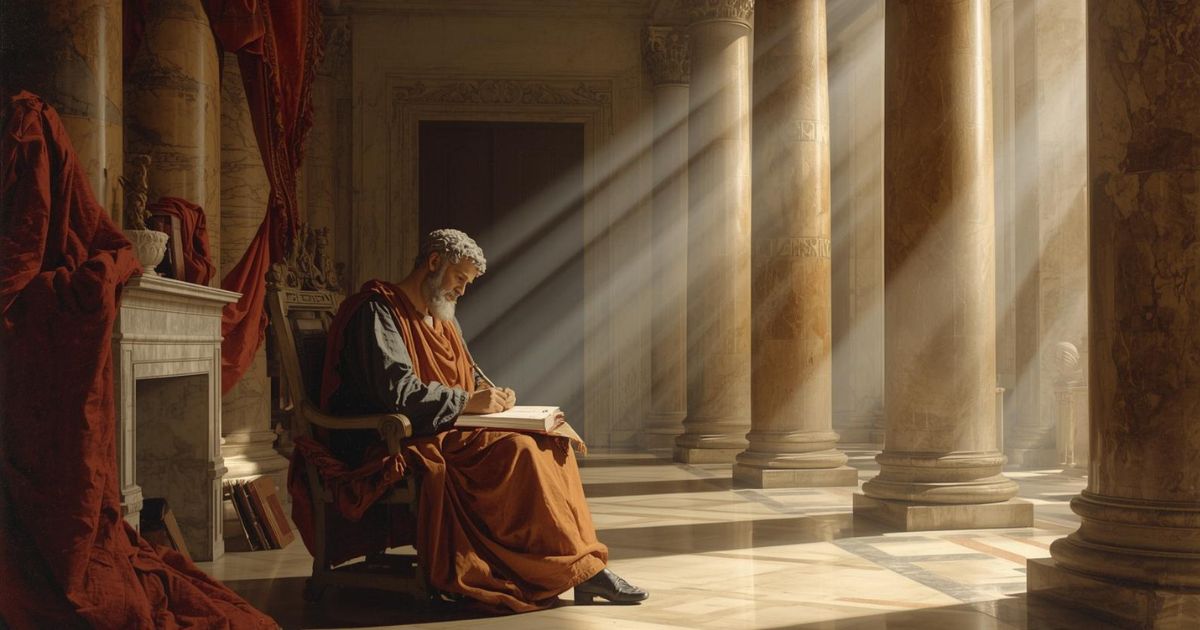
An excerpt from the original text.(complete · 1420 words)
←etter 18. On festivals and fastingMoral letters to Luciliusby Seneca, translated by Richard Mott GummereLetter 19. On worldliness and retirementLetter 20. On practising what you preach→482855Moral letters to Lucilius — Letter 19. On worldliness and retirementRichard Mott GummereSeneca XIX. ON WORLDLINESS AND RETIREMENT 1. I leap for joy whenever I receive letters from you. For they fill me with hope; they are now not mere assurances concerning you, but guarantees. And I beg and pray you to proceed in this course; for what better request could I make of a friend than one which is to be made for his own sake? If possible, withdraw yourself from all the business of which you speak; and if you cannot do this, tear yourself away. We have dissipated enough of our time already; let us in old age begin to pack up our baggage. 2. Surely there is nothing in this that men can begrudge us. We have spent our lives on the high seas; let us die in harbour. Not that I would advise you to try to win fame by your retirement; one’s retirement should neither be paraded nor concealed. Not concealed, I say, for I shall not go so far in urging you as to expect you to condemn all men as mad and then seek out for yourself a hiding-place and oblivion; rather make this your business, that your retirement be not conspicuous, though it should be obvious. 3. In the second place, while those whose choice is unhampered from the start will deliberate on that other question, whether they wish to pass their lives in obscurity, in your case there is not a free choice. Your ability and energy have thrust you into the work of the world; so have the charm of your writings and the friendships you have made with famous and notable men. Renown has already taken you by storm. You may sink yourself into the depths of obscurity and utterly hide yourself; yet your earlier acts will reveal you. 4. You cannot keep lurking in the dark; much of the old gleam will follow you wherever you fly. Peace you can claim for yourself without being disliked by anyone, without any sense of loss, and without any pangs of spirit. For what will you leave behind you that you can imagine yourself reluctant to leave? Your clients? But none of these men courts you for yourself; they merely court something from you. People used to hunt friends, but now they hunt pelf; if a lonely old man changes his will, the morning-caller transfers himself to another door. Great things cannot be bought for small sums; so reckon up whether it is preferable to leave your own true self, or merely some of your belongings. 5. Would that you had had the privilege of growing old amid the limited circumstances of your origin, and that fortune had not raised you to such heights! You were removed far from the sight of wholesome living by your swift rise to prosperity, by your province, by your position as procurator,[1] and by all that such things promise; you will next acquire more important duties and after them still more. And what will be the result? 6. Why wait until there is nothing left for you to crave? That time will never come. We hold that there is a succession of causes, from which fate is woven; similarly, you may be sure, there is a succession in our desires; for one begins where its predecessor ends. You have been thrust into an existence which will never of itself put an end to your wretchedness and your slavery. Withdraw your chafed neck from the yoke; it is better that it should be cut off once for all, than galled for ever. 7. If you retreat to privacy, everything will be on a smaller scale, but you will be satisfied abundantly; in your present condition, however, there is no satisfaction in the plenty which is heaped upon you on all sides. Would you rather be poor and sated, or rich and hungry? Prosperity is not only greedy, but it also lies exposed to the greed of others. And as long as nothing satisfies you, you yourself cannot satisfy others. 8. “But,” you say, “how can I take my leave?” Any way you please. Reflect how many hazards you have ventured for the sake of money, and how much toil you have undertaken for a title! You must dare something to gain leisure, also,—or else grow old amid the worries of procuratorships[2] abroad and subsequently of civil duties at home, living in turmoil and in ever fresh floods of responsibilities, which no man has ever succeeded in avoiding by unobtrusiveness or by seclusion of life. For what bearing on the case has your personal desire for a secluded life? Your position in the world desires the opposite! What if, even now, you allow that position to grow greater? But all that is added to your successes will be added to your fears. 9. At this point I should like to quote a saying of Maecenas, who spoke the truth when he stood on the very summit:[3] “There’s thunder even on the loftiest peaks.” If you ask me in what book these words are found, they occur in the volume entitled Prometheus.[4] He simply meant to say that these lofty peaks have their tops surrounded with thunder-storms. But is any power worth so high a price that a man like you would ever, in order to obtain it, adopt a style so debauched as that?[5] Maecenas was indeed a man of parts, who would have left a great pattern for Roman oratory to follow, had his good fortune not made him effeminate,—nay, had it not emasculated him! An end like his awaits you also, unless you forthwith shorten sail and,—as Maecenas was not willing to do until it was too late,—hug the shore! 10. This saying of Maecenas’s might have squared my account with you; but I feel sure, knowing you, that you will get out an injunction against me, and that you will be unwilling to accept payment of my debt in such crude and debased currency. However that may be, I shall draw on the account of Epicurus.[6] He says: “You must reflect carefully beforehand with whom you are to eat and drink, rather than what you are to eat and drink. For a dinner of meats without the company of a friend is like the life of a lion or a wolf.” 11. This privilege will not be yours unless you withdraw from the world; otherwise, you will have as guests only those whom your slave-secretary[7] sorts out from the throng of callers. It is, however, a mistake to select your friend in the reception-hall or to test him at the dinner-table. The most serious misfortune for a busy man who is overwhelmed by his possessions is, that he believes men to be his friends when he himself is not a friend to them, and that he deems his favours to be effective in winning friends, although, in the case of certain men, the more they owe, the more they hate. A trifling debt makes a man your debtor; a large one makes him an enemy. 12. “What,” you say, “do not kindnesses establish friendships?” They do, if one has had the privilege of choosing those who are to receive them, and if they are placed judiciously, instead of being scattered broadcast. Therefore, while you are beginning to call your mind your own, meantime apply this maxim of the wise: consider that it is more important who receives a thing, than what it is he receives. Farewell. ↑ See the introduction, p. ix. ↑ The procurator did the work of a quaestor in an imperial province. Positions at Rome to which Lucilius might succeed were such as praefectus annonae, in charge of the grain supply, or praefectus urbi, Director of Public Safety, and others. ↑ And therefore could speak with authority on this point. ↑ Perhaps a tragedy, although Seneca uses the word liber to describe it. Maecenas wrote a Symposium, a work De cultu suo, Octavia, some stray verse, and perhaps some history. See Seneca, Epp. xcii. and ci. ↑ Seneca whimsically pretends to assume that eccentric literary style and high political position go hand in hand. See also the following sentence. ↑ Epicurus, Frag. 542 Usener. ↑ A slave kept by every prominant Roman to identify the master’s friends and dependants.
Master this chapter. Complete your experience
Purchase the complete book to access all chapters and support classic literature
As an Amazon Associate, we earn a small commission from qualifying purchases at no additional cost to you.
Available in paperback, hardcover, and e-book formats
Let's Analyse the Pattern
The Success Trap - When Achievement Becomes Prison
Achievement creates obligations and appetites that can enslave you more completely than failure ever could.
Why This Matters
Connect literature to life
This chapter teaches how to identify when achievements become prisons rather than freedoms.
Practice This Today
This week, notice when opportunities feel more like obligations—ask yourself if you're choosing your commitments or if they're choosing you.
Now let's explore the literary elements.
Key Quotes & Analysis
"We have dissipated enough of our time already; let us in old age begin to pack up our baggage."
Context: Seneca urges Lucilius to start preparing for retirement from public life
This quote captures the urgency Seneca feels about not wasting more precious time. The 'baggage' metaphor suggests life is a journey and it's time to prepare for the next phase rather than staying stuck in the current one.
In Today's Words:
We've wasted enough time already - let's start getting our lives in order and prepare to move on.
"We have spent our lives on the high seas; let us die in harbour."
Context: Explaining why retirement makes sense after a life of public service and struggle
The nautical metaphor contrasts the turbulent, dangerous life of public service with the peace and safety of retirement. It suggests they've earned the right to rest after weathering life's storms.
In Today's Words:
We've been through enough chaos and stress - let's finish our lives in peace.
"There is thunder even on the loftiest peaks."
Context: Warning about the dangers that come with high position and power
This metaphor reveals that success doesn't provide safety - in fact, it often makes you more vulnerable to attacks and downfall. The higher your status, the bigger target you become.
In Today's Words:
The more successful you get, the more problems come your way.
Thematic Threads
Class
In This Chapter
Seneca acknowledges that stepping away from success is harder when you've achieved public recognition—your class position makes withdrawal more complicated
Development
Builds on earlier discussions of how social position affects your choices and obligations
In Your Life:
The higher you climb at work or in your community, the more people expect from you and the harder it becomes to say no
Identity
In This Chapter
Success becomes so central to who Lucilius is that stepping away feels like losing himself entirely
Development
Deepens the theme of how external achievements can hijack our sense of self
In Your Life:
When your job title or achievements become your identity, any threat to them feels like a threat to your very existence
Social Expectations
In This Chapter
The people around Lucilius expect continued access to his influence and generosity—stepping back means disappointing many
Development
Expands on how others' expectations can trap us in roles we no longer want
In Your Life:
Family, coworkers, and community members often resist when you try to establish boundaries or reduce your commitments
Human Relationships
In This Chapter
Seneca distinguishes between true friends and clients who only want favors—success attracts the wrong kind of attention
Development
Continues exploring how to identify genuine versus transactional relationships
In Your Life:
When you're in a position to help others, it becomes harder to tell who genuinely cares about you versus who just wants something
Personal Growth
In This Chapter
True growth means having the courage to step away from external validation and choose inner satisfaction over endless achievement
Development
Builds on the theme that real wisdom often requires going against social expectations
In Your Life:
Sometimes the most mature choice is to stop climbing the ladder and focus on what actually makes you fulfilled
You now have the context. Time to form your own thoughts.
Discussion Questions
- 1
According to Seneca, why is it harder for Lucilius to retire than it would be for someone who never achieved success?
analysis • surface - 2
What does Seneca mean when he says the people around successful Lucilius aren't real friends but 'clients'? How does success change relationships?
analysis • medium - 3
Think about someone you know who seems trapped by their own success—always busy, always stressed, can't step away. What patterns do you recognize from Seneca's description?
application • medium - 4
Seneca argues there's never a 'right time' to step back because obligations multiply. If you were advising someone in this trap, how would you help them find the courage to reclaim their life?
application • deep - 5
Why do you think humans keep chasing more even when 'more' makes them miserable? What does this reveal about how we're wired?
reflection • deep
Critical Thinking Exercise
Map Your Success Trap
Draw or list your current obligations, responsibilities, and commitments. Circle the ones you actively chose versus those that just accumulated over time. Then identify which relationships in your life are transactional (people who want something from you) versus genuine (people who care about your wellbeing). Finally, imagine stepping back from one major obligation—what would you fear losing, and what might you gain?
Consider:
- •Be honest about which commitments you actually enjoy versus those you do from habit or pressure
- •Notice if your identity has become too tied to being needed or being busy
- •Consider whether your current pace is sustainable for the next five years
Journaling Prompt
Write about a time when you achieved something you really wanted, only to discover it came with unexpected costs or obligations. What did that teach you about the relationship between success and freedom?
Coming Up Next...
Chapter 20: Walk the Walk, Don't Just Talk
In the next letter, Seneca shifts focus from advice about retirement to a more personal challenge: living up to your own philosophical principles. He'll explore the gap between knowing what's right and actually doing it.