Amplified ClassicsAmplified Classics
Literature MattersLife IndexEducators
Sign inSign up
Jane Eyre - The Reunion at Ferndean

Charlotte Brontë

Jane Eyre

The Reunion at Ferndean

Home›Books›Jane Eyre›Chapter 37
Back to Jane Eyre
15 min•Jane Eyre•Chapter 37 of 37

What You'll Learn

How Brontë uses Gothic setting to mirror character psychology and create dramatic tension

The symbolic significance of Rochester's physical transformation and its connection to moral redemption

Jane's evolution from dependent child to independent woman making autonomous choices in love

Previous
37 of 37

Summary

The Reunion at Ferndean

Jane Eyre by Charlotte Brontë

0:000:00

Jane arrives at Ferndean, Rochester's remote and desolate manor house, after learning of the fire at Thornfield and Rochester's injuries. The Gothic setting—described as buried deep in dark woods with decaying walls—reflects the somber mood and Rochester's current state. The house serves as a perfect backdrop for this pivotal reunion, isolated from society and stripped of all pretension. When Jane first observes Rochester from hiding, she sees a dramatically changed man. He is now blind and has lost his left hand in the fire that destroyed Thornfield while he attempted to save his wife Bertha. Brontë's description compares him to 'some wronged and fettered wild beast' and 'that sightless Samson,' emphasizing both his physical vulnerability and his continued inner strength. His groping movements and dependence on others mark a stark contrast to his former commanding presence. The chapter builds tremendous dramatic tension as Jane watches Rochester unobserved, wrestling with her emotions. She notes that while his physical form remains strong, his countenance shows desperation and brooding. Yet rather than fear him in his 'blind ferocity,' she feels a mixture of hope and sorrow, longing to comfort him but restraining herself from immediate revelation. The scene culminates in Jane's entrance to the parlour, where she serves Rochester water while concealing her identity. The moment is charged with dramatic irony—Rochester senses something different but cannot identify what. Pilot the dog's excited reaction provides the only hint of Jane's presence. The chapter ends on a cliffhanger as Rochester begins to question who this mysterious visitor might be, setting up the emotional climax of their reunion.

Share it with friends

Previous Chapter
GO ADS FREE — JOIN US

An excerpt from the original text.(~346 words)

T

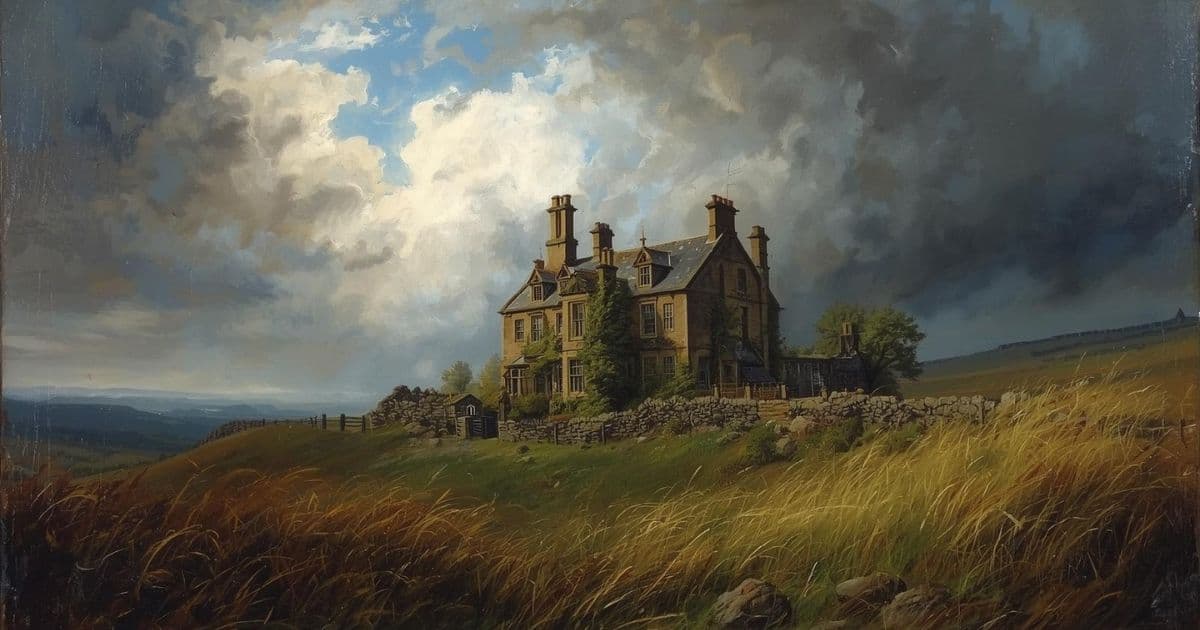
he manor-house of Ferndean was a building of considerable antiquity, moderate size, and no architectural pretensions, deep buried in a wood. I had heard of it before. Mr. Rochester often spoke of it, and sometimes went there. His father had purchased the estate for the sake of the game covers. He would have let the house, but could find no tenant, in consequence of its ineligible and insalubrious site. Ferndean then remained uninhabited and unfurnished, with the exception of some two or three r

Jane arrives at Ferndean, Rochester's remote and desolate manor house, after learning of the fire at Thornfield and Rochester's injuries. The Gothic setting—described as buried deep in dark woods with decaying walls—reflects the somber mood and Rochester's current state. The house serves as a perfect backdrop for this pivotal reunion, isolated from society and stripped of all pretension.

When Jane first observes Rochester from hiding, she sees a dramatically changed man. He is now blind and has lost his left hand in the fire that destroyed Thornfield while he attempted to save his wife Bertha. Brontë's description compares him to 'some wronged and fettered wild beast' and 'that sightless Samson,' emphasizing both his physical vulnerability and his continued inner strength. His groping movements and dependence on others mark a stark contrast to his former commanding presence.

The chapter builds tremendous dramatic tension as Jane watches Rochester unobserved, wrestling with her emotions. She notes that while his physical form remains strong, his countenance shows desperation and brooding. Yet rather than fear him in his 'blind ferocity,' she feels a mixture of hope and sorrow, longing to comfort him but restraining herself from immediate revelation.

The scene culminates in Jane's entrance to the parlour, where she serves Rochester water while concealing her identity. The moment is charged with dramatic irony—Rochester senses something different but cannot identify what. Pilot the dog's excited reaction provides the only hint of Jane's presence. The chapter ends on a cliffhanger as Rochester begins to question who this mysterious visitor might be, setting up the emotional climax of their reunion.

Master this chapter. Complete your experience

Purchase the complete book to access all chapters and support classic literature

Read Free on GutenbergBuy at Powell'sBuy on Amazon

As an Amazon Associate, we earn a small commission from qualifying purchases at no additional cost to you.

Available in paperback, hardcover, and e-book formats

GO ADS FREE — JOIN US

Intelligence Amplifier™ Analysis

Deep pattern analysis in progress. Our AI is identifying timeless insights and modern applications.

Why This Matters

Connect literature to life

Literary Insight

This chapter demonstrates how true love requires equality and choice rather than dependence or desperation

Today's Relevance

In our modern discussions of healthy relationships, Jane's return to Rochester only after achieving independence and only after his pride has been humbled offers a powerful model of partnership based on mutual respect rather than power imbalance.

Now let's explore the literary elements.

Terms to Know

ineligible and insalubrious

unsuitable and unhealthy; describing Ferndean's poor location that makes it undesirable to tenants

grange

a country house with farm buildings; here referring to Ferndean manor

sylvan dusk

the twilight darkness created by dense forest; emphasizes the Gothic, mysterious atmosphere

sightless Samson

biblical reference to the strong man who lost his sight; Rochester's blindness is compared to this figure of fallen power

Characters in This Chapter

Jane Eyre

Protagonist/Narrator

Now financially independent, she returns to Rochester by choice rather than necessity, demonstrating her growth into full autonomy

Edward Rochester

Male protagonist

Physically diminished by blindness and injury but still psychologically complex; his suffering has humbled his former arrogance

John and Mary

Servants at Ferndean

Former Thornfield servants who now care for Rochester in his reduced circumstances, providing continuity and witness to his transformation

Key Quotes & Analysis

"The caged eagle, whose gold-ringed eyes cruelty has extinguished, might look as looked that sightless Samson."

— Jane (narrator)

Context: Jane's first observation of the changed Rochester, using powerful metaphors to convey both his diminished state and retained nobility

"And, reader, do you think I feared him in his blind ferocity?—if you do, you little know me."

— Jane (narrator)

Context: Jane directly addresses the reader, asserting her courage and deep understanding of Rochester despite his changed condition

"Can there be life here?"

— Jane

Context: Jane's question upon seeing the desolate Ferndean, which operates on multiple levels—literal life in the house and metaphorical life/hope for their relationship

Thematic Threads

Independence and Equality

In This Chapter

Development

In Your Life:

When have you had to stand your ground about being treated as an equal in a relationship, even when it felt uncomfortable or risky?

Moral Redemption

In This Chapter

Development

In Your Life:

Think of a time when you hurt someone you cared about - what did it take for you to truly make amends and rebuild that trust?

Social Class

In This Chapter

Development

In Your Life:

Have you ever felt pressure to change who you are or compromise your values to fit in with a different social or economic group?

You now have the context. Time to form your own thoughts.

Discussion Questions

  1. 1

    How does the Gothic setting of Ferndean serve the novel's themes beyond just creating atmosphere?

  2. 2

    What is the significance of Rochester's physical transformation, and how does it relate to his moral journey?

  3. 3

    Why does Brontë have Jane observe Rochester secretly before revealing herself, and what does this tell us about her character development?

Critical Thinking Exercise

Compare Jane's position at the beginning of the novel (orphaned, dependent, powerless) with her position in this chapter (independent, financially secure, making autonomous choices). Analyze how this transformation affects the power dynamics between Jane and Rochester, and argue whether their relationship can now be truly equal.

Previous
The Mysterious Call
Contents

Continue Exploring

Jane Eyre Study GuideTeaching ResourcesEssential Life IndexBrowse by ThemeAll Books
Identity & Self-DiscoveryLove & RelationshipsSocial Class & Status

You Might Also Like

The Strange Case of Dr Jekyll and Mr Hyde cover

The Strange Case of Dr Jekyll and Mr Hyde

Robert Louis Stevenson

Explores identity & self

Wuthering Heights cover

Wuthering Heights

Emily Brontë

Explores identity & self

Great Expectations cover

Great Expectations

Charles Dickens

Explores identity & self

Frankenstein cover

Frankenstein

Mary Shelley

Explores identity & self

Browse all 47+ books

Share This Chapter

Know someone who'd enjoy this? Spread the wisdom!

TwitterFacebookLinkedInEmail

Read ad-free with Prestige

Get rid of ads, unlock study guides and downloads, and support free access for everyone.

Subscribe to PrestigeCreate free account
Intelligence Amplifier
Intelligence Amplifier™Powering Amplified Classics

Exploring human-AI collaboration through books, essays, and philosophical dialogues. Classic literature transformed into navigational maps for modern life.

2025 Books

→ The Amplified Human Spirit→ The Alarming Rise of Stupidity Amplified→ San Francisco: The AI Capital of the World
Visit intelligenceamplifier.org
hello@amplifiedclassics.com

AC Originals

→ The Last Chapter First→ You Are Not Lost→ The Lit of Love→ The Wealth Paradox
Arvintech
arvintechAmplify your Mind
Visit at arvintech.com

Navigate

  • Home
  • Library
  • Essential Life Index
  • How It Works
  • Subscribe
  • Account
  • About
  • Contact
  • Authors
  • Suggest a Book

Made For You

  • Students
  • Educators
  • Families
  • Readers
  • Finding Purpose

Newsletter

Weekly insights from the classics.

Amplify Your Mind

Legal

  • Privacy Policy
  • Terms of Service
  • Cookie Policy
  • Accessibility

Why Public Domain?

We focus on public domain classics because these timeless works belong to everyone. No paywalls, no restrictions—just wisdom that has stood the test of centuries, freely accessible to all readers.

Public domain books have shaped humanity's understanding of love, justice, ambition, and the human condition. By amplifying these works, we help preserve and share literature that truly belongs to the world.

© 2025 Amplified Classics™. All Rights Reserved.

Intelligence Amplifier™ and Amplified Classics™ are proprietary trademarks of Arvin Lioanag.

Copyright Protection: All original content, analyses, discussion questions, pedagogical frameworks, and methodology are protected by U.S. and international copyright law. Unauthorized reproduction, distribution, web scraping, or use for AI training is strictly prohibited. See our Copyright Notice for details.

Disclaimer: The information provided on this website is for general informational and educational purposes only and does not constitute professional, legal, financial, or technical advice. While we strive to ensure accuracy and relevance, we make no warranties regarding completeness, reliability, or suitability. Any reliance on such information is at your own risk. We are not liable for any losses or damages arising from use of this site. By using this site, you agree to these terms.