An excerpt from the original text.(complete · 2566 words)
TREATS OF THE SUBLIME FAVOURS GOD BESTOWS ON SOULS WHICH HAVE ENTERED
THE SEVENTH MANSIONS. THE AUTHOR SHOWS THE DIFFERENCE SHE BELIEVES TO
EXIST BETWEEN SOUL AND SPIRIT ALTHOUGH THEY ARE BOTH ONE. THIS CHAPTER
CONTAINS SOME NOTEWORTHY THINGS.
1. Sublime mysteries of these mansions. 2. St. Teresa abashed at
treating such subjects. 3. Our Lord introduces His bride into His
presence chamber. 4. Darkness of a soul in mortal sin. 5. Intercession
for sinners. 6. The soul an interior world. 7. The spiritual nuptials.
8. Former favours differ from spiritual nuptials. 9. The Blessed
Trinity revealed to the soul. 10. Permanence of Its presence in the
soul. 11. The effects. 12. This presence is not always equally
realized. 13. It is beyond the soul's control. 14. The centre of the
soul remains calm. 15. The soul and the spirit distinct though united.
16. The soul and its faculties not identical.
1. You may think, sisters, that so much has been said of this spiritual
journey that nothing remains to be added. That would be a great
mistake: God's immensity has no limits, neither have His works;
therefore, who can recount His mercies and His greatness? [392] It is
impossible, so do not be amazed at what I write about them which is but
a cipher of what remains untold concerning God. He has shown great
mercy in communicating these mysteries to one who could recount them to
us, for as we learn more of His intercourse with creatures, we ought to
praise Him more fervently and to esteem more highly the soul in which
He so delights. Each of us possesses a soul but we do not realize its
value as made in the image of God, therefore we fail to understand the
important secrets it contains. May His Majesty be pleased to guide my
pen and to teach me to say somewhat of the much there is to tell of His
revelations to the souls He leads into this mansion. I have begged Him
earnestly to help me, since He sees that my object is to reveal His
mercies for the praise and glory of His name. I hope He will grant this
favour, if not for my own sake, at least for yours, sisters--so that
you may discover how vital it is for you to put no obstacle in the way
of the Spiritual Marriage of the Bridegroom with your soul which
brings, as you will learn, such signal blessings with it.
2. O great God! surely such a miserable creature as myself should
tremble at the thought of speaking on such a subject so far beyond
anything I deserve to understand. Indeed I felt abashed and doubted
whether it would not be better to finish writing about this Mansion in
a few words, lest people might imagine that I am recounting my personal
experience. I was overwhelmed with shame for, knowing what I am, it is
a terrible undertaking. On the other hand, this fear seemed but a
temptation and weakness: even if I should be misjudged, so long as God
is but a little better praised and known, let all the world revile me.
Besides, I may be dead before this book is seen. May He Who lives and
shall live to all eternity be praised! Amen.
3. When our Lord is pleased to take pity on the sufferings, both past
and present, endured through her longing for Him by this soul which He
has spiritually taken for His bride, He, before consummating the
celestial marriage, brings her into this His mansion or presence
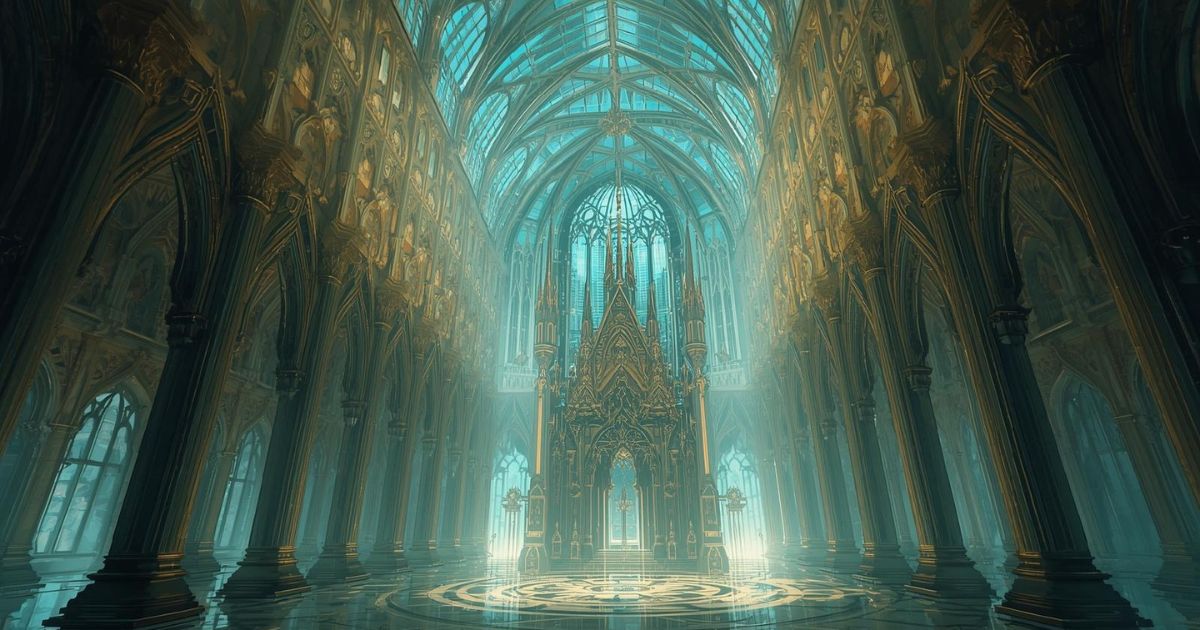
chamber. This is the seventh Mansion, for as He has a dwelling-place in
heaven, so has He in the soul, where none but He may abide and which
may be termed a second heaven.
4. It is important, sisters, that we should not fancy the soul to be in
darkness. As we are accustomed to believe there is no light but that
which is exterior, we imagine that the soul is wrapt in obscurity. This
is indeed the case with a soul out of the state of grace, [393] not,
however, through any defer in the Sun of Justice which remains within
it and gives it being, but the soul itself is incapable of receiving
the light, as I think I said in speaking of the first Mansion. [394]
A certain person was given to understand that such unfortunate souls
are, as it were, imprisoned in a gloomy dungeon, chained hand and foot
and unable to perform any meritorious action: they are also both blind
and dumb. Well may we pity them when we reflect that we ourselves were
once in the same state and that God may show them mercy also.
5. Let us, then, sisters, be most zealous in interceding for them and
never neglect it. To pray for a soul in mortal sin is a far more
profitable form of almsgiving than it would be to help a Christian whom
we saw with hands strongly fettered behind his back, tied to a post and
dying of hunger--not for want of food, because plenty of the choicest
delicacies lay near him, but because he was unable to put them into his
mouth, although he was extremely exhausted and on the point of dying,
and that not a temporal death, but an eternal one. Would it not be
extremely cruel of us to stand looking at him, and give him nothing to
eat? What if by your prayers you could loose his bonds? Now you
understand.
6. For the love of God I implore you constantly to remember in your
prayers souls in a like case. We are not speaking now of them but of
others who, by the mercy of God, have done penance for their sins and
are in a state of grace. You must not think of the soul as
insignificant and petty but as an interior world containing the number
of beautiful mansions you have seen; as indeed it should, since in the
centre of the soul there is a mansion reserved for God Himself.
7. When His Majesty deigns to bestow on the soul the grace of these
divine nuptials, He brings it into His presence chamber and does not
treat it as before, when He put it into a trance. I believe He then
united it to Himself, as also during the prayer of union; but then only
the superior part was affected and the soul did not feel called to
enter its own centre as it does in this mansion. Here it matters little
whether it is in the one way or the other.
8. In the former favours our Lord unites the spirit to Himself and
makes it both blind and dumb like St. Paul after his conversion, [395]
thus preventing its knowing whence or how it enjoys this grace, for
the supreme delight of the spirit is to realize its nearness to God.
During the actual moment of divine union the soul feels nothing, all
its powers being entirely lost. But now He acts differently: our
pitiful God removes the scales from its eyes [396] letting it see and
understand somewhat of the grace received in a strange and wonderful
manner in this mansion by means of intellectual vision.
9. By some mysterious manifestation of the truth, the three Persons of
the most Blessed Trinity reveal themselves, preceded by an illumination
which shines on the spirit like a most dazzling cloud of light. [397]
The three Persons are distinct from one another; a sublime knowledge is
infused into the soul, imbuing it with a certainty of the truth that
the Three are of one substance, power, and knowledge and are one God.
Thus that which we hold as a doctrine of faith, the soul now, so to
speak, understands by sight, though it beholds the Blessed Trinity
neither by the eyes of the body nor of the soul, this being no
imaginary vision. All the Three Persons here communicate Themselves to
the soul, speak to it and make it understand the words of our Lord in
the Gospel that He and the Father and the Holy Ghost will come and make
their abode with the soul which loves Him and keeps His commandments.
[398]
10. O my God, how different from merely hearing and believing these
words is it to realize their truth in this way! Day by day a growing
astonishment takes possession of this soul, for the three Persons of
the Blessed Trinity seem never to depart; it sees with certainty, in
the way I have described, that They dwell far within its own centre and
depths; though for want of learning it cannot describe how, it is
conscious of the indwelling of these divine Companions.
11. You may fancy that such a person is beside herself and that her
mind is too inebriated to care for anything else. On the contrary, she
is far more active than before in all that concerns God's service, and
when at leisure she enjoys this blessed companionship. Unless she first
deserts God, I believe He will never cease to make her clearly sensible
of His presence: she feels confident, as indeed she may, that He will
never so fail her as to allow her to lose this favour after once
bestowing it; at the same time, she is more careful than before to
avoid offending Him in any way.
12. This presence is not always so entirely realized, that is, so
distinctly manifest, as at first, or as it is at times when God renews
this favour, otherwise the recipient could not possibly attend to
anything else nor live in society. Although not always seen by so clear
a light, yet whenever she reflects on it she feels the companionship of
the Blessed Trinity. This is as if, when we were with other people in a
very well lighted room, some one were to darken it by closing the
shutters; we should feel certain that the others were still there,
though we were unable to see them. [399]
13. You may ask: Could she not bring back the light and see them
again?' [400] This is not in her power; when our Lord chooses, He
will open the shutters of the understanding: He shows her great mercy
in never quitting her and in making her realize it so clearly. His
divine Majesty seems to be preparing His bride for greater things by
this divine companionship which clearly helps perfection in every way
and makes her lose the fear she sometimes felt when other graces were
granted her.
14. A certain person so favoured found she had improved in all virtues:
whatever were her trials or labours, the centre of her soul seemed
never moved from its resting-place. Thus in a manner her soul appeared
divided: a short time after God had done her this favour, while
undergoing great sufferings, she complained of her soul as Martha did
of Mary, [401] reproaching it with enjoying solitary peace while
leaving her so full of troubles and occupations that she could not keep
it company.
15. This may seem extravagant to you, daughters, yet though the soul is
known to be undivided, it is fact and no fancy and often happens.
Interior effects show for certain that there is a positive difference
between the soul and the spirit, although they are one with each other.
[402] There is an extremely subtle distinction between them, so that
sometimes they seem to at in a different manner from one another, as
does the knowledge given to them by God.
16. It also appears to me that the soul and its faculties are not
identical. There are so many and such transcendental mysteries within
us, that it would be presumption for me to attempt to explain them. If
by God's mercy we enter heaven we shall understand these secrets.
__________________________________________________________________
[392] Ps. cxliv. 3: Magnitudinis ejus non est finis.'
[393] See the Saint's description of a soul in the state of sin, Rel,
iii. 13. (towards the end).
[394] Supra, M. i, ch. ii. 1.
[395] Acts ix. 8: Surrexit autem Saulus de terra, apertisque oculis
nihil videbat.' There is, however, nothing to imply that he was dumb as
well as blind.
[396] Acts ix. 18: Et confestim ceciderunt ab oculis ejus tamquam
squamæ, et visum recepit.' Way of Perf.. ch. xxviii. 11.
[397] Rel. iii. 6; v. 6-8; viii. 20, 21; ix. 12, 17, 19. Deposition by
Fr. Giles Gonzalez, S.J., Provincial of Old Castile, afterwards
Assistant--General in Rome: While the holy Mother lived at the convent
of the Incarnation of Avila [as prioress], I often spoke with her, and
once I remember she asked me: "What am I to do, Father? Whenever I
recollect myself I realize that already in this life the Three Persons
of the Blessed Trinity may be seen, and that They accompany me and
assist me in the management of my affairs."' (Fuente, Obras, vol. vi.
p. 280.) 'Doña Maria Enriquez, Duchess of Alva, said that St. Teresa
made known to her many revelations she had received from our Lord, and
that she (the duchess) held in her possession three paintings of the
Blessed Trinity made according to the description of the holy Mother,
who, while they were being done, effaced with her own hand those
portions which the painter failed to design conformably to the vision
she had had.' (Fuente, l.c. p. 297.)
[398] St. John xiv. 23: Si quis diligit me, sermonem meum servabit, et
Pater meus diliget eum, et ad eum veniemus, et mansionem apud eum
faciemus.'
[399] One of the Saint's favourite comparisons. See Life, ch. xxvii. 7.
Castle, M. vi. ch. viii. 3. Rel. vii. 26.
[400] 'Though the soul be always in the high estate of marriage since
God has placed it there, nevertheless, actual union in all its powers
is not continuous, though the substantial union is. In this substantial
union the powers of the soul are most frequently in union, and drink of
His cellar, the understanding by knowledge, the will by love, etc. We
are not therefore to suppose that the soul, when saying it went out,
has ceased from its substantial or essential union with God, but only
from the union of its faculties, which is not, and cannot be, permanent
in this life.' (St. John of the Cross, Spiritual Canticle, stanza xxvi.
9. On the words: In the inner cellar of my Beloved have I drunk, and
when I went forth').
[401] St. Luke x. 40. Excl. v. 2, 3. Way of Perf. ch. xv. 4; xxxi. 4.
Rel. viii. 6. Concept. ch. vii. 4.
[402] Life, ch. xviii. 4. The distinction between soul and spirit, to
be found in the Epistle to the Hebrews, iv. 12, according to Cornelius
a Lapide (ad loc.) consists in this, that the term soul comprises the
faculties, senses, and passions, whereas the term spirit denotes the
substance of the soul independently of its powers. In the inferior
degrees of the Mystical life God operates through the faculties, while
in the Mystical marriage He acts directly on the substance of the soul.
St. Teresa is not quite consistent in the use of these terms, which is
not surprising, as she owns that she does not quite understand this
subtle distinction.
__________________________________________________________________
Master this chapter. Complete your experience
Purchase the complete book to access all chapters and support classic literature
As an Amazon Associate, we earn a small commission from qualifying purchases at no additional cost to you.
Available in paperback, hardcover, and e-book formats
Let's Analyse the Pattern
True mastery creates inner peace that enhances rather than escapes from practical effectiveness.
Why This Matters
Connect literature to life
This chapter teaches how to maintain high effectiveness without burnout by developing an internal anchor point that remains calm regardless of external pressure.
Practice This Today
This week, before entering stressful situations, take three deep breaths and imagine part of yourself sitting peacefully in a quiet room while your active self handles the immediate task.
Now let's explore the literary elements.
Key Quotes & Analysis
"God's immensity has no limits, neither have His works; therefore, who can recount His mercies and His greatness?"
Context: Opening the chapter by acknowledging there's always more to discover about God
Teresa establishes humility from the start, admitting that no human explanation can fully capture divine mystery. This makes her teaching accessible rather than authoritative - she's sharing what she can, not claiming to know everything.
In Today's Words:
There's always more to learn about life's deepest mysteries than any one person can explain.
"The soul is like someone in a large room who, though the shutters are closed and it is dark, knows that others are present."
Context: Describing how the soul knows the Trinity is present even when not actively thinking about it
This brilliant metaphor makes mystical experience relatable by comparing it to ordinary human awareness. You don't have to see or think about people to know they're there - it's a natural, effortless knowing.
In Today's Words:
You just know they're there, like sensing someone else is home even when you can't see them.
"Sometimes the soul complains like Martha against Mary, especially when it has many occupations."
Context: Explaining the internal tension between the peaceful and active parts of the soul
Teresa acknowledges that even in the highest spiritual state, there's still internal conflict. The practical side can resent the peaceful side, making this advanced experience surprisingly relatable to anyone juggling responsibilities.
In Today's Words:
Part of you gets annoyed that another part gets to be calm while you're stressed about everything that needs doing.
Thematic Threads
Integration
In This Chapter
Teresa discovers that spiritual marriage divides the soul—one part rests with God while another handles daily responsibilities
Development
Culmination of the journey through all seven mansions—the final achievement is not escape but enhanced engagement
In Your Life:
You might find that your best work comes when you've cultivated a quiet center that remains untouched by workplace drama.
Service
In This Chapter
The highest spiritual state makes Teresa more devoted to helping others, not less engaged with the world
Development
Evolution from earlier self-focused spiritual practices to outward-directed action
In Your Life:
You might notice that personal growth only feels complete when it enables you to serve others more effectively.
Mystery
In This Chapter
Teresa admits she doesn't fully understand these experiences even while living them
Development
Growing acceptance throughout the book that some realities transcend complete comprehension
In Your Life:
You might find peace in accepting that some of your most meaningful experiences can't be fully explained or controlled.
Practicality
In This Chapter
The soul's contemplative part sometimes conflicts with its active part, like Martha resenting Mary
Development
Final resolution of the tension between spiritual life and practical responsibilities
In Your Life:
You might struggle with balancing self-care and productivity, feeling guilty for rest while knowing you need it.
Presence
In This Chapter
God's permanent residence in the soul is known like sensing others in a dark room—immediate and undeniable
Development
Evolution from seeking God's visits to recognizing God's constant presence
In Your Life:
You might discover that your most important relationships are felt as presence rather than constant conversation.
You now have the context. Time to form your own thoughts.
Discussion Questions
- 1
What does Teresa mean when she describes the soul as 'divided' - one part at rest with God, another part handling daily responsibilities?
analysis • surface - 2
Why does Teresa say that reaching the highest spiritual state makes someone more effective in daily life, not less?
analysis • medium - 3
Where do you see this pattern of 'divided attention' working successfully in modern life - people who stay calm under pressure while still getting things done?
application • medium - 4
How could you create your own version of this 'unshakeable center' that helps you handle stress without becoming disconnected from your responsibilities?
application • deep - 5
What does Teresa's final mansion teach us about the relationship between inner peace and outer effectiveness?
reflection • deep
Critical Thinking Exercise
Design Your Divided Soul
Think about your most stressful regular situation - a difficult coworker, managing kids' schedules, or dealing with demanding customers. Map out how you could create Teresa's 'divided soul' approach: one part of you that stays calm and centered, while another part handles the practical demands. What specific practices could help you build this internal anchor point?
Consider:
- •What triggers usually knock you off balance in this situation?
- •What small daily practice could help you build inner stability?
- •How would staying centered change how you respond to the stress?
Journaling Prompt
Write about a time when you successfully stayed calm during chaos. What was different about your mindset that day? How could you recreate that state more consistently?
Coming Up Next...
Chapter 24: The Deepest Union: Marriage vs. Betrothal
Having explored the deepest mysteries of the soul's union with God, Teresa will next examine the practical effects and ongoing challenges of living in this transformed state.