
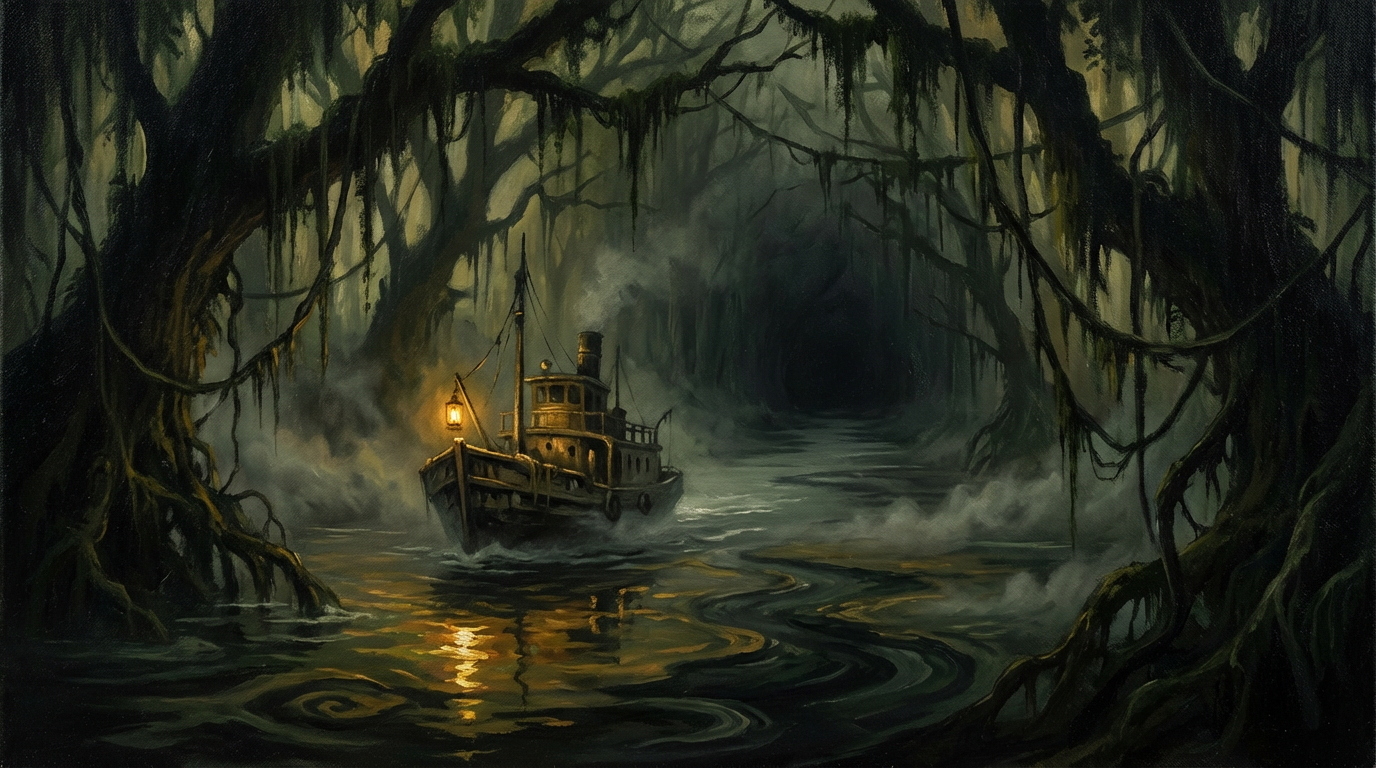
An excerpt from the original text.(complete · 12053 words)
“ne evening as I was lying flat on the deck of my steamboat, I heard
voices approaching—and there were the nephew and the uncle strolling
along the bank. I laid my head on my arm again, and had nearly lost
myself in a doze, when somebody said in my ear, as it were: ‘I am as
harmless as a little child, but I don’t like to be dictated to. Am I
the manager—or am I not? I was ordered to send him there. It’s
incredible.’ ... I became aware that the two were standing on the shore
alongside the forepart of the steamboat, just below my head. I did not
move; it did not occur to me to move: I was sleepy. ‘It is
unpleasant,’ grunted the uncle. ‘He has asked the Administration to be
sent there,’ said the other, ‘with the idea of showing what he could
do; and I was instructed accordingly. Look at the influence that man
must have. Is it not frightful?’ They both agreed it was frightful,
then made several bizarre remarks: ‘Make rain and fine weather—one
man—the Council—by the nose’—bits of absurd sentences that got the
better of my drowsiness, so that I had pretty near the whole of my wits
about me when the uncle said, ‘The climate may do away with this
difficulty for you. Is he alone there?’ ‘Yes,’ answered the manager;
‘he sent his assistant down the river with a note to me in these terms:
“Clear this poor devil out of the country, and don’t bother sending
more of that sort. I had rather be alone than have the kind of men you
can dispose of with me.” It was more than a year ago. Can you imagine
such impudence!’ ‘Anything since then?’ asked the other hoarsely.
‘Ivory,’ jerked the nephew; ‘lots of it—prime sort—lots—most annoying,
from him.’ ‘And with that?’ questioned the heavy rumble. ‘Invoice,’ was
the reply fired out, so to speak. Then silence. They had been talking
about Kurtz.
“I was broad awake by this time, but, lying perfectly at ease, remained
still, having no inducement to change my position. ‘How did that ivory
come all this way?’ growled the elder man, who seemed very vexed. The
other explained that it had come with a fleet of canoes in charge of an
English half-caste clerk Kurtz had with him; that Kurtz had apparently
intended to return himself, the station being by that time bare of
goods and stores, but after coming three hundred miles, had suddenly
decided to go back, which he started to do alone in a small dugout with
four paddlers, leaving the half-caste to continue down the river with
the ivory. The two fellows there seemed astounded at anybody attempting
such a thing. They were at a loss for an adequate motive. As to me, I
seemed to see Kurtz for the first time. It was a distinct glimpse: the
dugout, four paddling savages, and the lone white man turning his back
suddenly on the headquarters, on relief, on thoughts of home—perhaps;
setting his face towards the depths of the wilderness, towards his
empty and desolate station. I did not know the motive. Perhaps he was
just simply a fine fellow who stuck to his work for its own sake. His
name, you understand, had not been pronounced once. He was ‘that man.’
The half-caste, who, as far as I could see, had conducted a difficult
trip with great prudence and pluck, was invariably alluded to as ‘that
scoundrel.’ The ‘scoundrel’ had reported that the ‘man’ had been very
ill—had recovered imperfectly.... The two below me moved away then a
few paces, and strolled back and forth at some little distance. I
heard: ‘Military post—doctor—two hundred miles—quite alone
now—unavoidable delays—nine months—no news—strange rumours.’ They
approached again, just as the manager was saying, ‘No one, as far as I
know, unless a species of wandering trader—a pestilential fellow,
snapping ivory from the natives.’ Who was it they were talking about
now? I gathered in snatches that this was some man supposed to be in
Kurtz’s district, and of whom the manager did not approve. ‘We will not
be free from unfair competition till one of these fellows is hanged for
an example,’ he said. ‘Certainly,’ grunted the other; ‘get him hanged!
Why not? Anything—anything can be done in this country. That’s what I
say; nobody here, you understand, here, can endanger your position.
And why? You stand the climate—you outlast them all. The danger is in
Europe; but there before I left I took care to—’ They moved off and
whispered, then their voices rose again. ‘The extraordinary series of
delays is not my fault. I did my best.’ The fat man sighed. ‘Very sad.’
‘And the pestiferous absurdity of his talk,’ continued the other; ‘he
bothered me enough when he was here. “Each station should be like a
beacon on the road towards better things, a centre for trade of course,
but also for humanizing, improving, instructing.” Conceive you—that
ass! And he wants to be manager! No, it’s—’ Here he got choked by
excessive indignation, and I lifted my head the least bit. I was
surprised to see how near they were—right under me. I could have spat
upon their hats. They were looking on the ground, absorbed in thought.
The manager was switching his leg with a slender twig: his sagacious
relative lifted his head. ‘You have been well since you came out this
time?’ he asked. The other gave a start. ‘Who? I? Oh! Like a charm—like
a charm. But the rest—oh, my goodness! All sick. They die so quick,
too, that I haven’t the time to send them out of the country—it’s
incredible!’ ‘Hm’m. Just so,’ grunted the uncle. ‘Ah! my boy, trust to
this—I say, trust to this.’ I saw him extend his short flipper of an
arm for a gesture that took in the forest, the creek, the mud, the
river—seemed to beckon with a dishonouring flourish before the sunlit
face of the land a treacherous appeal to the lurking death, to the
hidden evil, to the profound darkness of its heart. It was so startling
that I leaped to my feet and looked back at the edge of the forest, as
though I had expected an answer of some sort to that black display of
confidence. You know the foolish notions that come to one sometimes.
The high stillness confronted these two figures with its ominous
patience, waiting for the passing away of a fantastic invasion.
“They swore aloud together—out of sheer fright, I believe—then
pretending not to know anything of my existence, turned back to the
station. The sun was low; and leaning forward side by side, they seemed
to be tugging painfully uphill their two ridiculous shadows of unequal
length, that trailed behind them slowly over the tall grass without
bending a single blade.
“In a few days the Eldorado Expedition went into the patient
wilderness, that closed upon it as the sea closes over a diver. Long
afterwards the news came that all the donkeys were dead. I know nothing
as to the fate of the less valuable animals. They, no doubt, like the
rest of us, found what they deserved. I did not inquire. I was then
rather excited at the prospect of meeting Kurtz very soon. When I say
very soon I mean it comparatively. It was just two months from the day
we left the creek when we came to the bank below Kurtz’s station.
“Going up that river was like traveling back to the earliest beginnings
of the world, when vegetation rioted on the earth and the big trees
were kings. An empty stream, a great silence, an impenetrable forest.
The air was warm, thick, heavy, sluggish. There was no joy in the
brilliance of sunshine. The long stretches of the waterway ran on,
deserted, into the gloom of overshadowed distances. On silvery
sand-banks hippos and alligators sunned themselves side by side. The
broadening waters flowed through a mob of wooded islands; you lost your
way on that river as you would in a desert, and butted all day long
against shoals, trying to find the channel, till you thought yourself
bewitched and cut off for ever from everything you had known
once—somewhere—far away—in another existence perhaps. There were
moments when one’s past came back to one, as it will sometimes when you
have not a moment to spare for yourself; but it came in the shape of an
unrestful and noisy dream, remembered with wonder amongst the
overwhelming realities of this strange world of plants, and water, and
silence. And this stillness of life did not in the least resemble a
peace. It was the stillness of an implacable force brooding over an
inscrutable intention. It looked at you with a vengeful aspect. I got
used to it afterwards; I did not see it any more; I had no time. I had
to keep guessing at the channel; I had to discern, mostly by
inspiration, the signs of hidden banks; I watched for sunken stones; I
was learning to clap my teeth smartly before my heart flew out, when I
shaved by a fluke some infernal sly old snag that would have ripped the
life out of the tin-pot steamboat and drowned all the pilgrims; I had
to keep a lookout for the signs of dead wood we could cut up in the
night for next day’s steaming. When you have to attend to things of
that sort, to the mere incidents of the surface, the reality—the
reality, I tell you—fades. The inner truth is hidden—luckily, luckily.
But I felt it all the same; I felt often its mysterious stillness
watching me at my monkey tricks, just as it watches you fellows
performing on your respective tight-ropes for—what is it? half-a-crown
a tumble—”
“Try to be civil, Marlow,” growled a voice, and I knew there was at
least one listener awake besides myself.
“I beg your pardon. I forgot the heartache which makes up the rest of
the price. And indeed what does the price matter, if the trick be well
done? You do your tricks very well. And I didn’t do badly either, since
I managed not to sink that steamboat on my first trip. It’s a wonder to
me yet. Imagine a blindfolded man set to drive a van over a bad road. I
sweated and shivered over that business considerably, I can tell you.
After all, for a seaman, to scrape the bottom of the thing that’s
supposed to float all the time under his care is the unpardonable sin.
No one may know of it, but you never forget the thump—eh? A blow on the
very heart. You remember it, you dream of it, you wake up at night and
think of it—years after—and go hot and cold all over. I don’t pretend
to say that steamboat floated all the time. More than once she had to
wade for a bit, with twenty cannibals splashing around and pushing. We
had enlisted some of these chaps on the way for a crew. Fine
fellows—cannibals—in their place. They were men one could work with,
and I am grateful to them. And, after all, they did not eat each other
before my face: they had brought along a provision of hippo-meat which
went rotten, and made the mystery of the wilderness stink in my
nostrils. Phoo! I can sniff it now. I had the manager on board and
three or four pilgrims with their staves—all complete. Sometimes we
came upon a station close by the bank, clinging to the skirts of the
unknown, and the white men rushing out of a tumble-down hovel, with
great gestures of joy and surprise and welcome, seemed very strange—had
the appearance of being held there captive by a spell. The word ivory
would ring in the air for a while—and on we went again into the
silence, along empty reaches, round the still bends, between the high
walls of our winding way, reverberating in hollow claps the ponderous
beat of the stern-wheel. Trees, trees, millions of trees, massive,
immense, running up high; and at their foot, hugging the bank against
the stream, crept the little begrimed steamboat, like a sluggish beetle
crawling on the floor of a lofty portico. It made you feel very small,
very lost, and yet it was not altogether depressing, that feeling.
After all, if you were small, the grimy beetle crawled on—which was
just what you wanted it to do. Where the pilgrims imagined it crawled
to I don’t know. To some place where they expected to get something. I
bet! For me it crawled towards Kurtz—exclusively; but when the
steam-pipes started leaking we crawled very slow. The reaches opened
before us and closed behind, as if the forest had stepped leisurely
across the water to bar the way for our return. We penetrated deeper
and deeper into the heart of darkness. It was very quiet there. At
night sometimes the roll of drums behind the curtain of trees would run
up the river and remain sustained faintly, as if hovering in the air
high over our heads, till the first break of day. Whether it meant war,
peace, or prayer we could not tell. The dawns were heralded by the
descent of a chill stillness; the wood-cutters slept, their fires
burned low; the snapping of a twig would make you start. We were
wanderers on a prehistoric earth, on an earth that wore the aspect of
an unknown planet. We could have fancied ourselves the first of men
taking possession of an accursed inheritance, to be subdued at the cost
of profound anguish and of excessive toil. But suddenly, as we
struggled round a bend, there would be a glimpse of rush walls, of
peaked grass-roofs, a burst of yells, a whirl of black limbs, a mass of
hands clapping, of feet stamping, of bodies swaying, of eyes rolling,
under the droop of heavy and motionless foliage. The steamer toiled
along slowly on the edge of a black and incomprehensible frenzy. The
prehistoric man was cursing us, praying to us, welcoming us—who could
tell? We were cut off from the comprehension of our surroundings; we
glided past like phantoms, wondering and secretly appalled, as sane men
would be before an enthusiastic outbreak in a madhouse. We could not
understand because we were too far and could not remember because we
were travelling in the night of first ages, of those ages that are
gone, leaving hardly a sign—and no memories.
“The earth seemed unearthly. We are accustomed to look upon the
shackled form of a conquered monster, but there—there you could look at
a thing monstrous and free. It was unearthly, and the men were—No, they
were not inhuman. Well, you know, that was the worst of it—this
suspicion of their not being inhuman. It would come slowly to one. They
howled and leaped, and spun, and made horrid faces; but what thrilled
you was just the thought of their humanity—like yours—the thought of
your remote kinship with this wild and passionate uproar. Ugly. Yes, it
was ugly enough; but if you were man enough you would admit to yourself
that there was in you just the faintest trace of a response to the
terrible frankness of that noise, a dim suspicion of there being a
meaning in it which you—you so remote from the night of first
ages—could comprehend. And why not? The mind of man is capable of
anything—because everything is in it, all the past as well as all the
future. What was there after all? Joy, fear, sorrow, devotion, valour,
rage—who can tell?—but truth—truth stripped of its cloak of time. Let
the fool gape and shudder—the man knows, and can look on without a
wink. But he must at least be as much of a man as these on the shore.
He must meet that truth with his own true stuff—with his own inborn
strength. Principles won’t do. Acquisitions, clothes, pretty rags—rags
that would fly off at the first good shake. No; you want a deliberate
belief. An appeal to me in this fiendish row—is there? Very well; I
hear; I admit, but I have a voice, too, and for good or evil mine is
the speech that cannot be silenced. Of course, a fool, what with sheer
fright and fine sentiments, is always safe. Who’s that grunting? You
wonder I didn’t go ashore for a howl and a dance? Well, no—I didn’t.
Fine sentiments, you say? Fine sentiments, be hanged! I had no time. I
had to mess about with white-lead and strips of woolen blanket helping
to put bandages on those leaky steam-pipes—I tell you. I had to watch
the steering, and circumvent those snags, and get the tin-pot along by
hook or by crook. There was surface-truth enough in these things to
save a wiser man. And between whiles I had to look after the savage who
was fireman. He was an improved specimen; he could fire up a vertical
boiler. He was there below me, and, upon my word, to look at him was as
edifying as seeing a dog in a parody of breeches and a feather hat,
walking on his hind-legs. A few months of training had done for that
really fine chap. He squinted at the steam-gauge and at the water-gauge
with an evident effort of intrepidity—and he had filed teeth, too, the
poor devil, and the wool of his pate shaved into queer patterns, and
three ornamental scars on each of his cheeks. He ought to have been
clapping his hands and stamping his feet on the bank, instead of which
he was hard at work, a thrall to strange witchcraft, full of improving
knowledge. He was useful because he had been instructed; and what he
knew was this—that should the water in that transparent thing
disappear, the evil spirit inside the boiler would get angry through
the greatness of his thirst, and take a terrible vengeance. So he
sweated and fired up and watched the glass fearfully (with an impromptu
charm, made of rags, tied to his arm, and a piece of polished bone, as
big as a watch, stuck flatways through his lower lip), while the wooded
banks slipped past us slowly, the short noise was left behind, the
interminable miles of silence—and we crept on, towards Kurtz. But the
snags were thick, the water was treacherous and shallow, the boiler
seemed indeed to have a sulky devil in it, and thus neither that
fireman nor I had any time to peer into our creepy thoughts.
“Some fifty miles below the Inner Station we came upon a hut of reeds,
an inclined and melancholy pole, with the unrecognizable tatters of
what had been a flag of some sort flying from it, and a neatly stacked
wood-pile. This was unexpected. We came to the bank, and on the stack
of firewood found a flat piece of board with some faded pencil-writing
on it. When deciphered it said: ‘Wood for you. Hurry up. Approach
cautiously.’ There was a signature, but it was illegible—not Kurtz—a
much longer word. ‘Hurry up.’ Where? Up the river? ‘Approach
cautiously.’ We had not done so. But the warning could not have been
meant for the place where it could be only found after approach.
Something was wrong above. But what—and how much? That was the
question. We commented adversely upon the imbecility of that
telegraphic style. The bush around said nothing, and would not let us
look very far, either. A torn curtain of red twill hung in the doorway
of the hut, and flapped sadly in our faces. The dwelling was
dismantled; but we could see a white man had lived there not very long
ago. There remained a rude table—a plank on two posts; a heap of
rubbish reposed in a dark corner, and by the door I picked up a book.
It had lost its covers, and the pages had been thumbed into a state of
extremely dirty softness; but the back had been lovingly stitched
afresh with white cotton thread, which looked clean yet. It was an
extraordinary find. Its title was, An Inquiry into some Points of
Seamanship, by a man Towser, Towson—some such name—Master in his
Majesty’s Navy. The matter looked dreary reading enough, with
illustrative diagrams and repulsive tables of figures, and the copy was
sixty years old. I handled this amazing antiquity with the greatest
possible tenderness, lest it should dissolve in my hands. Within,
Towson or Towser was inquiring earnestly into the breaking strain of
ships’ chains and tackle, and other such matters. Not a very
enthralling book; but at the first glance you could see there a
singleness of intention, an honest concern for the right way of going
to work, which made these humble pages, thought out so many years ago,
luminous with another than a professional light. The simple old sailor,
with his talk of chains and purchases, made me forget the jungle and
the pilgrims in a delicious sensation of having come upon something
unmistakably real. Such a book being there was wonderful enough; but
still more astounding were the notes pencilled in the margin, and
plainly referring to the text. I couldn’t believe my eyes! They were in
cipher! Yes, it looked like cipher. Fancy a man lugging with him a book
of that description into this nowhere and studying it—and making
notes—in cipher at that! It was an extravagant mystery.
“I had been dimly aware for some time of a worrying noise, and when I
lifted my eyes I saw the wood-pile was gone, and the manager, aided by
all the pilgrims, was shouting at me from the riverside. I slipped the
book into my pocket. I assure you to leave off reading was like tearing
myself away from the shelter of an old and solid friendship.
“I started the lame engine ahead. ‘It must be this miserable
trader—this intruder,’ exclaimed the manager, looking back malevolently
at the place we had left. ‘He must be English,’ I said. ‘It will not
save him from getting into trouble if he is not careful,’ muttered the
manager darkly. I observed with assumed innocence that no man was safe
from trouble in this world.
“The current was more rapid now, the steamer seemed at her last gasp,
the stern-wheel flopped languidly, and I caught myself listening on
tiptoe for the next beat of the boat, for in sober truth I expected the
wretched thing to give up every moment. It was like watching the last
flickers of a life. But still we crawled. Sometimes I would pick out a
tree a little way ahead to measure our progress towards Kurtz by, but I
lost it invariably before we got abreast. To keep the eyes so long on
one thing was too much for human patience. The manager displayed a
beautiful resignation. I fretted and fumed and took to arguing with
myself whether or no I would talk openly with Kurtz; but before I could
come to any conclusion it occurred to me that my speech or my silence,
indeed any action of mine, would be a mere futility. What did it matter
what any one knew or ignored? What did it matter who was manager? One
gets sometimes such a flash of insight. The essentials of this affair
lay deep under the surface, beyond my reach, and beyond my power of
meddling.
“Towards the evening of the second day we judged ourselves about eight
miles from Kurtz’s station. I wanted to push on; but the manager looked
grave, and told me the navigation up there was so dangerous that it
would be advisable, the sun being very low already, to wait where we
were till next morning. Moreover, he pointed out that if the warning to
approach cautiously were to be followed, we must approach in
daylight—not at dusk or in the dark. This was sensible enough. Eight
miles meant nearly three hours’ steaming for us, and I could also see
suspicious ripples at the upper end of the reach. Nevertheless, I was
annoyed beyond expression at the delay, and most unreasonably, too,
since one night more could not matter much after so many months. As we
had plenty of wood, and caution was the word, I brought up in the
middle of the stream. The reach was narrow, straight, with high sides
like a railway cutting. The dusk came gliding into it long before the
sun had set. The current ran smooth and swift, but a dumb immobility
sat on the banks. The living trees, lashed together by the creepers and
every living bush of the undergrowth, might have been changed into
stone, even to the slenderest twig, to the lightest leaf. It was not
sleep—it seemed unnatural, like a state of trance. Not the faintest
sound of any kind could be heard. You looked on amazed, and began to
suspect yourself of being deaf—then the night came suddenly, and struck
you blind as well. About three in the morning some large fish leaped,
and the loud splash made me jump as though a gun had been fired. When
the sun rose there was a white fog, very warm and clammy, and more
blinding than the night. It did not shift or drive; it was just there,
standing all round you like something solid. At eight or nine, perhaps,
it lifted as a shutter lifts. We had a glimpse of the towering
multitude of trees, of the immense matted jungle, with the blazing
little ball of the sun hanging over it—all perfectly still—and then the
white shutter came down again, smoothly, as if sliding in greased
grooves. I ordered the chain, which we had begun to heave in, to be
paid out again. Before it stopped running with a muffled rattle, a cry,
a very loud cry, as of infinite desolation, soared slowly in the opaque
air. It ceased. A complaining clamour, modulated in savage discords,
filled our ears. The sheer unexpectedness of it made my hair stir under
my cap. I don’t know how it struck the others: to me it seemed as
though the mist itself had screamed, so suddenly, and apparently from
all sides at once, did this tumultuous and mournful uproar arise. It
culminated in a hurried outbreak of almost intolerably excessive
shrieking, which stopped short, leaving us stiffened in a variety of
silly attitudes, and obstinately listening to the nearly as appalling
and excessive silence. ‘Good God! What is the meaning—’ stammered at my
elbow one of the pilgrims—a little fat man, with sandy hair and red
whiskers, who wore sidespring boots, and pink pyjamas tucked into his
socks. Two others remained open-mouthed a whole minute, then dashed
into the little cabin, to rush out incontinently and stand darting
scared glances, with Winchesters at ‘ready’ in their hands. What we
could see was just the steamer we were on, her outlines blurred as
though she had been on the point of dissolving, and a misty strip of
water, perhaps two feet broad, around her—and that was all. The rest of
the world was nowhere, as far as our eyes and ears were concerned. Just
nowhere. Gone, disappeared; swept off without leaving a whisper or a
shadow behind.
“I went forward, and ordered the chain to be hauled in short, so as to
be ready to trip the anchor and move the steamboat at once if
necessary. ‘Will they attack?’ whispered an awed voice. ‘We will be all
butchered in this fog,’ murmured another. The faces twitched with the
strain, the hands trembled slightly, the eyes forgot to wink. It was
very curious to see the contrast of expressions of the white men and of
the black fellows of our crew, who were as much strangers to that part
of the river as we, though their homes were only eight hundred miles
away. The whites, of course greatly discomposed, had besides a curious
look of being painfully shocked by such an outrageous row. The others
had an alert, naturally interested expression; but their faces were
essentially quiet, even those of the one or two who grinned as they
hauled at the chain. Several exchanged short, grunting phrases, which
seemed to settle the matter to their satisfaction. Their headman, a
young, broad-chested black, severely draped in dark-blue fringed
cloths, with fierce nostrils and his hair all done up artfully in oily
ringlets, stood near me. ‘Aha!’ I said, just for good fellowship’s
sake. ‘Catch ’im,’ he snapped, with a bloodshot widening of his eyes
and a flash of sharp teeth—‘catch ’im. Give ’im to us.’ ‘To you, eh?’ I
asked; ‘what would you do with them?’ ‘Eat ’im!’ he said curtly, and,
leaning his elbow on the rail, looked out into the fog in a dignified
and profoundly pensive attitude. I would no doubt have been properly
horrified, had it not occurred to me that he and his chaps must be very
hungry: that they must have been growing increasingly hungry for at
least this month past. They had been engaged for six months (I don’t
think a single one of them had any clear idea of time, as we at the end
of countless ages have. They still belonged to the beginnings of
time—had no inherited experience to teach them as it were), and of
course, as long as there was a piece of paper written over in
accordance with some farcical law or other made down the river, it
didn’t enter anybody’s head to trouble how they would live. Certainly
they had brought with them some rotten hippo-meat, which couldn’t have
lasted very long, anyway, even if the pilgrims hadn’t, in the midst of
a shocking hullabaloo, thrown a considerable quantity of it overboard.
It looked like a high-handed proceeding; but it was really a case of
legitimate self-defence. You can’t breathe dead hippo waking, sleeping,
and eating, and at the same time keep your precarious grip on
existence. Besides that, they had given them every week three pieces of
brass wire, each about nine inches long; and the theory was they were
to buy their provisions with that currency in riverside villages. You
can see how that worked. There were either no villages, or the people
were hostile, or the director, who like the rest of us fed out of tins,
with an occasional old he-goat thrown in, didn’t want to stop the
steamer for some more or less recondite reason. So, unless they
swallowed the wire itself, or made loops of it to snare the fishes
with, I don’t see what good their extravagant salary could be to them.
I must say it was paid with a regularity worthy of a large and
honourable trading company. For the rest, the only thing to eat—though
it didn’t look eatable in the least—I saw in their possession was a few
lumps of some stuff like half-cooked dough, of a dirty lavender colour,
they kept wrapped in leaves, and now and then swallowed a piece of, but
so small that it seemed done more for the looks of the thing than for
any serious purpose of sustenance. Why in the name of all the gnawing
devils of hunger they didn’t go for us—they were thirty to five—and
have a good tuck-in for once, amazes me now when I think of it. They
were big powerful men, with not much capacity to weigh the
consequences, with courage, with strength, even yet, though their skins
were no longer glossy and their muscles no longer hard. And I saw that
something restraining, one of those human secrets that baffle
probability, had come into play there. I looked at them with a swift
quickening of interest—not because it occurred to me I might be eaten
by them before very long, though I own to you that just then I
perceived—in a new light, as it were—how unwholesome the pilgrims
looked, and I hoped, yes, I positively hoped, that my aspect was not
so—what shall I say?—so—unappetizing: a touch of fantastic vanity which
fitted well with the dream-sensation that pervaded all my days at that
time. Perhaps I had a little fever, too. One can’t live with one’s
finger everlastingly on one’s pulse. I had often ‘a little fever,’ or a
little touch of other things—the playful paw-strokes of the wilderness,
the preliminary trifling before the more serious onslaught which came
in due course. Yes; I looked at them as you would on any human being,
with a curiosity of their impulses, motives, capacities, weaknesses,
when brought to the test of an inexorable physical necessity.
Restraint! What possible restraint? Was it superstition, disgust,
patience, fear—or some kind of primitive honour? No fear can stand up
to hunger, no patience can wear it out, disgust simply does not exist
where hunger is; and as to superstition, beliefs, and what you may call
principles, they are less than chaff in a breeze. Don’t you know the
devilry of lingering starvation, its exasperating torment, its black
thoughts, its sombre and brooding ferocity? Well, I do. It takes a man
all his inborn strength to fight hunger properly. It’s really easier to
face bereavement, dishonour, and the perdition of one’s soul—than this
kind of prolonged hunger. Sad, but true. And these chaps, too, had no
earthly reason for any kind of scruple. Restraint! I would just as soon
have expected restraint from a hyena prowling amongst the corpses of a
battlefield. But there was the fact facing me—the fact dazzling, to be
seen, like the foam on the depths of the sea, like a ripple on an
unfathomable enigma, a mystery greater—when I thought of it—than the
curious, inexplicable note of desperate grief in this savage clamour
that had swept by us on the river-bank, behind the blind whiteness of
the fog.
“Two pilgrims were quarrelling in hurried whispers as to which bank.
‘Left.’ ‘no, no; how can you? Right, right, of course.’ ‘It is very
serious,’ said the manager’s voice behind me; ‘I would be desolated if
anything should happen to Mr. Kurtz before we came up.’ I looked at
him, and had not the slightest doubt he was sincere. He was just the
kind of man who would wish to preserve appearances. That was his
restraint. But when he muttered something about going on at once, I did
not even take the trouble to answer him. I knew, and he knew, that it
was impossible. Were we to let go our hold of the bottom, we would be
absolutely in the air—in space. We wouldn’t be able to tell where we
were going to—whether up or down stream, or across—till we fetched
against one bank or the other—and then we wouldn’t know at first which
it was. Of course I made no move. I had no mind for a smash-up. You
couldn’t imagine a more deadly place for a shipwreck. Whether we
drowned at once or not, we were sure to perish speedily in one way or
another. ‘I authorize you to take all the risks,’ he said, after a
short silence. ‘I refuse to take any,’ I said shortly; which was just
the answer he expected, though its tone might have surprised him.
‘Well, I must defer to your judgment. You are captain,’ he said with
marked civility. I turned my shoulder to him in sign of my
appreciation, and looked into the fog. How long would it last? It was
the most hopeless lookout. The approach to this Kurtz grubbing for
ivory in the wretched bush was beset by as many dangers as though he
had been an enchanted princess sleeping in a fabulous castle. ‘Will
they attack, do you think?’ asked the manager, in a confidential tone.
“I did not think they would attack, for several obvious reasons. The
thick fog was one. If they left the bank in their canoes they would get
lost in it, as we would be if we attempted to move. Still, I had also
judged the jungle of both banks quite impenetrable—and yet eyes were in
it, eyes that had seen us. The riverside bushes were certainly very
thick; but the undergrowth behind was evidently penetrable. However,
during the short lift I had seen no canoes anywhere in the
reach—certainly not abreast of the steamer. But what made the idea of
attack inconceivable to me was the nature of the noise—of the cries we
had heard. They had not the fierce character boding immediate hostile
intention. Unexpected, wild, and violent as they had been, they had
given me an irresistible impression of sorrow. The glimpse of the
steamboat had for some reason filled those savages with unrestrained
grief. The danger, if any, I expounded, was from our proximity to a
great human passion let loose. Even extreme grief may ultimately vent
itself in violence—but more generally takes the form of apathy....
“You should have seen the pilgrims stare! They had no heart to grin, or
even to revile me: but I believe they thought me gone mad—with fright,
maybe. I delivered a regular lecture. My dear boys, it was no good
bothering. Keep a lookout? Well, you may guess I watched the fog for
the signs of lifting as a cat watches a mouse; but for anything else
our eyes were of no more use to us than if we had been buried miles
deep in a heap of cotton-wool. It felt like it, too—choking, warm,
stifling. Besides, all I said, though it sounded extravagant, was
absolutely true to fact. What we afterwards alluded to as an attack was
really an attempt at repulse. The action was very far from being
aggressive—it was not even defensive, in the usual sense: it was
undertaken under the stress of desperation, and in its essence was
purely protective.
“It developed itself, I should say, two hours after the fog lifted, and
its commencement was at a spot, roughly speaking, about a mile and a
half below Kurtz’s station. We had just floundered and flopped round a
bend, when I saw an islet, a mere grassy hummock of bright green, in
the middle of the stream. It was the only thing of the kind; but as we
opened the reach more, I perceived it was the head of a long sand-bank,
or rather of a chain of shallow patches stretching down the middle of
the river. They were discoloured, just awash, and the whole lot was
seen just under the water, exactly as a man’s backbone is seen running
down the middle of his back under the skin. Now, as far as I did see, I
could go to the right or to the left of this. I didn’t know either
channel, of course. The banks looked pretty well alike, the depth
appeared the same; but as I had been informed the station was on the
west side, I naturally headed for the western passage.
“No sooner had we fairly entered it than I became aware it was much
narrower than I had supposed. To the left of us there was the long
uninterrupted shoal, and to the right a high, steep bank heavily
overgrown with bushes. Above the bush the trees stood in serried ranks.
The twigs overhung the current thickly, and from distance to distance a
large limb of some tree projected rigidly over the stream. It was then
well on in the afternoon, the face of the forest was gloomy, and a
broad strip of shadow had already fallen on the water. In this shadow
we steamed up—very slowly, as you may imagine. I sheered her well
inshore—the water being deepest near the bank, as the sounding-pole
informed me.
“One of my hungry and forbearing friends was sounding in the bows just
below me. This steamboat was exactly like a decked scow. On the deck,
there were two little teakwood houses, with doors and windows. The
boiler was in the fore-end, and the machinery right astern. Over the
whole there was a light roof, supported on stanchions. The funnel
projected through that roof, and in front of the funnel a small cabin
built of light planks served for a pilot-house. It contained a couch,
two camp-stools, a loaded Martini-Henry leaning in one corner, a tiny
table, and the steering-wheel. It had a wide door in front and a broad
shutter at each side. All these were always thrown open, of course. I
spent my days perched up there on the extreme fore-end of that roof,
before the door. At night I slept, or tried to, on the couch. An
athletic black belonging to some coast tribe and educated by my poor
predecessor, was the helmsman. He sported a pair of brass earrings,
wore a blue cloth wrapper from the waist to the ankles, and thought all
the world of himself. He was the most unstable kind of fool I had ever
seen. He steered with no end of a swagger while you were by; but if he
lost sight of you, he became instantly the prey of an abject funk, and
would let that cripple of a steamboat get the upper hand of him in a
minute.
“I was looking down at the sounding-pole, and feeling much annoyed to
see at each try a little more of it stick out of that river, when I saw
my poleman give up on the business suddenly, and stretch himself flat
on the deck, without even taking the trouble to haul his pole in. He
kept hold on it though, and it trailed in the water. At the same time
the fireman, whom I could also see below me, sat down abruptly before
his furnace and ducked his head. I was amazed. Then I had to look at
the river mighty quick, because there was a snag in the fairway.
Sticks, little sticks, were flying about—thick: they were whizzing
before my nose, dropping below me, striking behind me against my
pilot-house. All this time the river, the shore, the woods, were very
quiet—perfectly quiet. I could only hear the heavy splashing thump of
the stern-wheel and the patter of these things. We cleared the snag
clumsily. Arrows, by Jove! We were being shot at! I stepped in quickly
to close the shutter on the landside. That fool-helmsman, his hands on
the spokes, was lifting his knees high, stamping his feet, champing his
mouth, like a reined-in horse. Confound him! And we were staggering
within ten feet of the bank. I had to lean right out to swing the heavy
shutter, and I saw a face amongst the leaves on the level with my own,
looking at me very fierce and steady; and then suddenly, as though a
veil had been removed from my eyes, I made out, deep in the tangled
gloom, naked breasts, arms, legs, glaring eyes—the bush was swarming
with human limbs in movement, glistening of bronze colour. The twigs
shook, swayed, and rustled, the arrows flew out of them, and then the
shutter came to. ‘Steer her straight,’ I said to the helmsman. He held
his head rigid, face forward; but his eyes rolled, he kept on lifting
and setting down his feet gently, his mouth foamed a little. ‘Keep
quiet!’ I said in a fury. I might just as well have ordered a tree not
to sway in the wind. I darted out. Below me there was a great scuffle
of feet on the iron deck; confused exclamations; a voice screamed, ‘Can
you turn back?’ I caught sight of a V-shaped ripple on the water ahead.
What? Another snag! A fusillade burst out under my feet. The pilgrims
had opened with their Winchesters, and were simply squirting lead into
that bush. A deuce of a lot of smoke came up and drove slowly forward.
I swore at it. Now I couldn’t see the ripple or the snag either. I
stood in the doorway, peering, and the arrows came in swarms. They
might have been poisoned, but they looked as though they wouldn’t kill
a cat. The bush began to howl. Our wood-cutters raised a warlike whoop;
the report of a rifle just at my back deafened me. I glanced over my
shoulder, and the pilot-house was yet full of noise and smoke when I
made a dash at the wheel. The fool-nigger had dropped everything, to
throw the shutter open and let off that Martini-Henry. He stood before
the wide opening, glaring, and I yelled at him to come back, while I
straightened the sudden twist out of that steamboat. There was no room
to turn even if I had wanted to, the snag was somewhere very near ahead
in that confounded smoke, there was no time to lose, so I just crowded
her into the bank—right into the bank, where I knew the water was deep.
“We tore slowly along the overhanging bushes in a whirl of broken twigs
and flying leaves. The fusillade below stopped short, as I had foreseen
it would when the squirts got empty. I threw my head back to a glinting
whizz that traversed the pilot-house, in at one shutter-hole and out at
the other. Looking past that mad helmsman, who was shaking the empty
rifle and yelling at the shore, I saw vague forms of men running bent
double, leaping, gliding, distinct, incomplete, evanescent. Something
big appeared in the air before the shutter, the rifle went overboard,
and the man stepped back swiftly, looked at me over his shoulder in an
extraordinary, profound, familiar manner, and fell upon my feet. The
side of his head hit the wheel twice, and the end of what appeared a
long cane clattered round and knocked over a little camp-stool. It
looked as though after wrenching that thing from somebody ashore he had
lost his balance in the effort. The thin smoke had blown away, we were
clear of the snag, and looking ahead I could see that in another
hundred yards or so I would be free to sheer off, away from the bank;
but my feet felt so very warm and wet that I had to look down. The man
had rolled on his back and stared straight up at me; both his hands
clutched that cane. It was the shaft of a spear that, either thrown or
lunged through the opening, had caught him in the side, just below the
ribs; the blade had gone in out of sight, after making a frightful
gash; my shoes were full; a pool of blood lay very still, gleaming
dark-red under the wheel; his eyes shone with an amazing lustre. The
fusillade burst out again. He looked at me anxiously, gripping the
spear like something precious, with an air of being afraid I would try
to take it away from him. I had to make an effort to free my eyes from
his gaze and attend to the steering. With one hand I felt above my head
for the line of the steam whistle, and jerked out screech after screech
hurriedly. The tumult of angry and warlike yells was checked instantly,
and then from the depths of the woods went out such a tremulous and
prolonged wail of mournful fear and utter despair as may be imagined to
follow the flight of the last hope from the earth. There was a great
commotion in the bush; the shower of arrows stopped, a few dropping
shots rang out sharply—then silence, in which the languid beat of the
stern-wheel came plainly to my ears. I put the helm hard a-starboard at
the moment when the pilgrim in pink pyjamas, very hot and agitated,
appeared in the doorway. ‘The manager sends me—’ he began in an
official tone, and stopped short. ‘Good God!’ he said, glaring at the
wounded man.
“We two whites stood over him, and his lustrous and inquiring glance
enveloped us both. I declare it looked as though he would presently put
to us some questions in an understandable language; but he died without
uttering a sound, without moving a limb, without twitching a muscle.
Only in the very last moment, as though in response to some sign we
could not see, to some whisper we could not hear, he frowned heavily,
and that frown gave to his black death-mask an inconceivably sombre,
brooding, and menacing expression. The lustre of inquiring glance faded
swiftly into vacant glassiness. ‘Can you steer?’ I asked the agent
eagerly. He looked very dubious; but I made a grab at his arm, and he
understood at once I meant him to steer whether or no. To tell you the
truth, I was morbidly anxious to change my shoes and socks. ‘He is
dead,’ murmured the fellow, immensely impressed. ‘No doubt about it,’
said I, tugging like mad at the shoe-laces. ‘And by the way, I suppose
Mr. Kurtz is dead as well by this time.’
“For the moment that was the dominant thought. There was a sense of
extreme disappointment, as though I had found out I had been striving
after something altogether without a substance. I couldn’t have been
more disgusted if I had travelled all this way for the sole purpose of
talking with Mr. Kurtz. Talking with... I flung one shoe overboard, and
became aware that that was exactly what I had been looking forward to—a
talk with Kurtz. I made the strange discovery that I had never imagined
him as doing, you know, but as discoursing. I didn’t say to myself,
‘Now I will never see him,’ or ‘Now I will never shake him by the
hand,’ but, ‘Now I will never hear him.’ The man presented himself as a
voice. Not of course that I did not connect him with some sort of
action. Hadn’t I been told in all the tones of jealousy and admiration
that he had collected, bartered, swindled, or stolen more ivory than
all the other agents together? That was not the point. The point was in
his being a gifted creature, and that of all his gifts the one that
stood out preeminently, that carried with it a sense of real presence,
was his ability to talk, his words—the gift of expression, the
bewildering, the illuminating, the most exalted and the most
contemptible, the pulsating stream of light, or the deceitful flow from
the heart of an impenetrable darkness.
“The other shoe went flying unto the devil-god of that river. I
thought, ‘By Jove! it’s all over. We are too late; he has vanished—the
gift has vanished, by means of some spear, arrow, or club. I will never
hear that chap speak after all’—and my sorrow had a startling
extravagance of emotion, even such as I had noticed in the howling
sorrow of these savages in the bush. I couldn’t have felt more of
lonely desolation somehow, had I been robbed of a belief or had missed
my destiny in life.... Why do you sigh in this beastly way, somebody?
Absurd? Well, absurd. Good Lord! mustn’t a man ever—Here, give me some
tobacco.”...
There was a pause of profound stillness, then a match flared, and
Marlow’s lean face appeared, worn, hollow, with downward folds and
dropped eyelids, with an aspect of concentrated attention; and as he
took vigorous draws at his pipe, it seemed to retreat and advance out
of the night in the regular flicker of tiny flame. The match went out.
“Absurd!” he cried. “This is the worst of trying to tell.... Here you
all are, each moored with two good addresses, like a hulk with two
anchors, a butcher round one corner, a policeman round another,
excellent appetites, and temperature normal—you hear—normal from year’s
end to year’s end. And you say, Absurd! Absurd be—exploded! Absurd! My
dear boys, what can you expect from a man who out of sheer nervousness
had just flung overboard a pair of new shoes! Now I think of it, it is
amazing I did not shed tears. I am, upon the whole, proud of my
fortitude. I was cut to the quick at the idea of having lost the
inestimable privilege of listening to the gifted Kurtz. Of course I was
wrong. The privilege was waiting for me. Oh, yes, I heard more than
enough. And I was right, too. A voice. He was very little more than a
voice. And I heard—him—it—this voice—other voices—all of them were so
little more than voices—and the memory of that time itself lingers
around me, impalpable, like a dying vibration of one immense jabber,
silly, atrocious, sordid, savage, or simply mean, without any kind of
sense. Voices, voices—even the girl herself—now—”
He was silent for a long time.
“I laid the ghost of his gifts at last with a lie,” he began, suddenly.
“Girl! What? Did I mention a girl? Oh, she is out of it—completely.
They—the women, I mean—are out of it—should be out of it. We must help
them to stay in that beautiful world of their own, lest ours gets
worse. Oh, she had to be out of it. You should have heard the
disinterred body of Mr. Kurtz saying, ‘My Intended.’ You would have
perceived directly then how completely she was out of it. And the lofty
frontal bone of Mr. Kurtz! They say the hair goes on growing sometimes,
but this—ah—specimen, was impressively bald. The wilderness had patted
him on the head, and, behold, it was like a ball—an ivory ball; it had
caressed him, and—lo!—he had withered; it had taken him, loved him,
embraced him, got into his veins, consumed his flesh, and sealed his
soul to its own by the inconceivable ceremonies of some devilish
initiation. He was its spoiled and pampered favourite. Ivory? I should
think so. Heaps of it, stacks of it. The old mud shanty was bursting
with it. You would think there was not a single tusk left either above
or below the ground in the whole country. ‘Mostly fossil,’ the manager
had remarked, disparagingly. It was no more fossil than I am; but they
call it fossil when it is dug up. It appears these niggers do bury the
tusks sometimes—but evidently they couldn’t bury this parcel deep
enough to save the gifted Mr. Kurtz from his fate. We filled the
steamboat with it, and had to pile a lot on the deck. Thus he could see
and enjoy as long as he could see, because the appreciation of this
favour had remained with him to the last. You should have heard him
say, ‘My ivory.’ Oh, yes, I heard him. ‘My Intended, my ivory, my
station, my river, my—’ everything belonged to him. It made me hold my
breath in expectation of hearing the wilderness burst into a prodigious
peal of laughter that would shake the fixed stars in their places.
Everything belonged to him—but that was a trifle. The thing was to know
what he belonged to, how many powers of darkness claimed him for their
own. That was the reflection that made you creepy all over. It was
impossible—it was not good for one either—trying to imagine. He had
taken a high seat amongst the devils of the land—I mean literally. You
can’t understand. How could you?—with solid pavement under your feet,
surrounded by kind neighbours ready to cheer you or to fall on you,
stepping delicately between the butcher and the policeman, in the holy
terror of scandal and gallows and lunatic asylums—how can you imagine
what particular region of the first ages a man’s untrammelled feet may
take him into by the way of solitude—utter solitude without a
policeman—by the way of silence—utter silence, where no warning voice
of a kind neighbour can be heard whispering of public opinion? These
little things make all the great difference. When they are gone you
must fall back upon your own innate strength, upon your own capacity
for faithfulness. Of course you may be too much of a fool to go
wrong—too dull even to know you are being assaulted by the powers of
darkness. I take it, no fool ever made a bargain for his soul with the
devil; the fool is too much of a fool, or the devil too much of a
devil—I don’t know which. Or you may be such a thunderingly exalted
creature as to be altogether deaf and blind to anything but heavenly
sights and sounds. Then the earth for you is only a standing place—and
whether to be like this is your loss or your gain I won’t pretend to
say. But most of us are neither one nor the other. The earth for us is
a place to live in, where we must put up with sights, with sounds, with
smells, too, by Jove!—breathe dead hippo, so to speak, and not be
contaminated. And there, don’t you see? Your strength comes in, the
faith in your ability for the digging of unostentatious holes to bury
the stuff in—your power of devotion, not to yourself, but to an
obscure, back-breaking business. And that’s difficult enough. Mind, I
am not trying to excuse or even explain—I am trying to account to
myself for—for—Mr. Kurtz—for the shade of Mr. Kurtz. This initiated
wraith from the back of Nowhere honoured me with its amazing confidence
before it vanished altogether. This was because it could speak English
to me. The original Kurtz had been educated partly in England, and—as
he was good enough to say himself—his sympathies were in the right
place. His mother was half-English, his father was half-French. All
Europe contributed to the making of Kurtz; and by and by I learned
that, most appropriately, the International Society for the Suppression
of Savage Customs had intrusted him with the making of a report, for
its future guidance. And he had written it, too. I’ve seen it. I’ve
read it. It was eloquent, vibrating with eloquence, but too
high-strung, I think. Seventeen pages of close writing he had found
time for! But this must have been before his—let us say—nerves, went
wrong, and caused him to preside at certain midnight dances ending with
unspeakable rites, which—as far as I reluctantly gathered from what I
heard at various times—were offered up to him—do you understand?—to Mr.
Kurtz himself. But it was a beautiful piece of writing. The opening
paragraph, however, in the light of later information, strikes me now
as ominous. He began with the argument that we whites, from the point
of development we had arrived at, ‘must necessarily appear to them
[savages] in the nature of supernatural beings—we approach them with
the might of a deity,’ and so on, and so on. ‘By the simple exercise of
our will we can exert a power for good practically unbounded,’ etc.,
etc. From that point he soared and took me with him. The peroration was
magnificent, though difficult to remember, you know. It gave me the
notion of an exotic Immensity ruled by an august Benevolence. It made
me tingle with enthusiasm. This was the unbounded power of eloquence—of
words—of burning noble words. There were no practical hints to
interrupt the magic current of phrases, unless a kind of note at the
foot of the last page, scrawled evidently much later, in an unsteady
hand, may be regarded as the exposition of a method. It was very
simple, and at the end of that moving appeal to every altruistic
sentiment it blazed at you, luminous and terrifying, like a flash of
lightning in a serene sky: ‘Exterminate all the brutes!’ The curious
part was that he had apparently forgotten all about that valuable
postscriptum, because, later on, when he in a sense came to himself, he
repeatedly entreated me to take good care of ‘my pamphlet’ (he called
it), as it was sure to have in the future a good influence upon his
career. I had full information about all these things, and, besides, as
it turned out, I was to have the care of his memory. I’ve done enough
for it to give me the indisputable right to lay it, if I choose, for an
everlasting rest in the dust-bin of progress, amongst all the sweepings
and, figuratively speaking, all the dead cats of civilization. But
then, you see, I can’t choose. He won’t be forgotten. Whatever he was,
he was not common. He had the power to charm or frighten rudimentary
souls into an aggravated witch-dance in his honour; he could also fill
the small souls of the pilgrims with bitter misgivings: he had one
devoted friend at least, and he had conquered one soul in the world
that was neither rudimentary nor tainted with self-seeking. No; I can’t
forget him, though I am not prepared to affirm the fellow was exactly
worth the life we lost in getting to him. I missed my late helmsman
awfully—I missed him even while his body was still lying in the
pilot-house. Perhaps you will think it passing strange this regret for
a savage who was no more account than a grain of sand in a black
Sahara. Well, don’t you see, he had done something, he had steered; for
months I had him at my back—a help—an instrument. It was a kind of
partnership. He steered for me—I had to look after him, I worried about
his deficiencies, and thus a subtle bond had been created, of which I
only became aware when it was suddenly broken. And the intimate
profundity of that look he gave me when he received his hurt remains to
this day in my memory—like a claim of distant kinship affirmed in a
supreme moment.
“Poor fool! If he had only left that shutter alone. He had no
restraint, no restraint—just like Kurtz—a tree swayed by the wind. As
soon as I had put on a dry pair of slippers, I dragged him out, after
first jerking the spear out of his side, which operation I confess I
performed with my eyes shut tight. His heels leaped together over the
little doorstep; his shoulders were pressed to my breast; I hugged him
from behind desperately. Oh! he was heavy, heavy; heavier than any man
on earth, I should imagine. Then without more ado I tipped him
overboard. The current snatched him as though he had been a wisp of
grass, and I saw the body roll over twice before I lost sight of it for
ever. All the pilgrims and the manager were then congregated on the
awning-deck about the pilot-house, chattering at each other like a
flock of excited magpies, and there was a scandalized murmur at my
heartless promptitude. What they wanted to keep that body hanging about
for I can’t guess. Embalm it, maybe. But I had also heard another, and
a very ominous, murmur on the deck below. My friends the wood-cutters
were likewise scandalized, and with a better show of reason—though I
admit that the reason itself was quite inadmissible. Oh, quite! I had
made up my mind that if my late helmsman was to be eaten, the fishes
alone should have him. He had been a very second-rate helmsman while
alive, but now he was dead he might have become a first-class
temptation, and possibly cause some startling trouble. Besides, I was
anxious to take the wheel, the man in pink pyjamas showing himself a
hopeless duffer at the business.
“This I did directly the simple funeral was over. We were going
half-speed, keeping right in the middle of the stream, and I listened
to the talk about me. They had given up Kurtz, they had given up the
station; Kurtz was dead, and the station had been burnt—and so on—and
so on. The red-haired pilgrim was beside himself with the thought that
at least this poor Kurtz had been properly avenged. ‘Say! We must have
made a glorious slaughter of them in the bush. Eh? What do you think?
Say?’ He positively danced, the bloodthirsty little gingery beggar. And
he had nearly fainted when he saw the wounded man! I could not help
saying, ‘You made a glorious lot of smoke, anyhow.’ I had seen, from
the way the tops of the bushes rustled and flew, that almost all the
shots had gone too high. You can’t hit anything unless you take aim and
fire from the shoulder; but these chaps fired from the hip with their
eyes shut. The retreat, I maintained—and I was right—was caused by the
screeching of the steam whistle. Upon this they forgot Kurtz, and began
to howl at me with indignant protests.
“The manager stood by the wheel murmuring confidentially about the
necessity of getting well away down the river before dark at all
events, when I saw in the distance a clearing on the riverside and the
outlines of some sort of building. ‘What’s this?’ I asked. He clapped
his hands in wonder. ‘The station!’ he cried. I edged in at once, still
going half-speed.
“Through my glasses I saw the slope of a hill interspersed with rare
trees and perfectly free from undergrowth. A long decaying building on
the summit was half buried in the high grass; the large holes in the
peaked roof gaped black from afar; the jungle and the woods made a
background. There was no enclosure or fence of any kind; but there had
been one apparently, for near the house half-a-dozen slim posts
remained in a row, roughly trimmed, and with their upper ends
ornamented with round carved balls. The rails, or whatever there had
been between, had disappeared. Of course the forest surrounded all
that. The river-bank was clear, and on the waterside I saw a white man
under a hat like a cart-wheel beckoning persistently with his whole
arm. Examining the edge of the forest above and below, I was almost
certain I could see movements—human forms gliding here and there. I
steamed past prudently, then stopped the engines and let her drift
down. The man on the shore began to shout, urging us to land. ‘We have
been attacked,’ screamed the manager. ‘I know—I know. It’s all right,’
yelled back the other, as cheerful as you please. ‘Come along. It’s all
right. I am glad.’
“His aspect reminded me of something I had seen—something funny I had
seen somewhere. As I manoeuvred to get alongside, I was asking myself,
‘What does this fellow look like?’ Suddenly I got it. He looked like a
harlequin. His clothes had been made of some stuff that was brown
holland probably, but it was covered with patches all over, with bright
patches, blue, red, and yellow—patches on the back, patches on the
front, patches on elbows, on knees; coloured binding around his jacket,
scarlet edging at the bottom of his trousers; and the sunshine made him
look extremely gay and wonderfully neat withal, because you could see
how beautifully all this patching had been done. A beardless, boyish
face, very fair, no features to speak of, nose peeling, little blue
eyes, smiles and frowns chasing each other over that open countenance
like sunshine and shadow on a wind-swept plain. ‘Look out, captain!’ he
cried; ‘there’s a snag lodged in here last night.’ What! Another snag?
I confess I swore shamefully. I had nearly holed my cripple, to finish
off that charming trip. The harlequin on the bank turned his little
pug-nose up to me. ‘You English?’ he asked, all smiles. ‘Are you?’ I
shouted from the wheel. The smiles vanished, and he shook his head as
if sorry for my disappointment. Then he brightened up. ‘Never mind!’ he
cried encouragingly. ‘Are we in time?’ I asked. ‘He is up there,’ he
replied, with a toss of the head up the hill, and becoming gloomy all
of a sudden. His face was like the autumn sky, overcast one moment and
bright the next.
“When the manager, escorted by the pilgrims, all of them armed to the
teeth, had gone to the house this chap came on board. ‘I say, I don’t
like this. These natives are in the bush,’ I said. He assured me
earnestly it was all right. ‘They are simple people,’ he added; ‘well,
I am glad you came. It took me all my time to keep them off.’ ‘But you
said it was all right,’ I cried. ‘Oh, they meant no harm,’ he said; and
as I stared he corrected himself, ‘Not exactly.’ Then vivaciously, ‘My
faith, your pilot-house wants a clean-up!’ In the next breath he
advised me to keep enough steam on the boiler to blow the whistle in
case of any trouble. ‘One good screech will do more for you than all
your rifles. They are simple people,’ he repeated. He rattled away at
such a rate he quite overwhelmed me. He seemed to be trying to make up
for lots of silence, and actually hinted, laughing, that such was the
case. ‘Don’t you talk with Mr. Kurtz?’ I said. ‘You don’t talk with
that man—you listen to him,’ he exclaimed with severe exaltation. ‘But
now—’ He waved his arm, and in the twinkling of an eye was in the
uttermost depths of despondency. In a moment he came up again with a
jump, possessed himself of both my hands, shook them continuously,
while he gabbled: ‘Brother sailor... honour... pleasure... delight...
introduce myself... Russian... son of an arch-priest... Government of
Tambov... What? Tobacco! English tobacco; the excellent English
tobacco! Now, that’s brotherly. Smoke? Where’s a sailor that does not
smoke?”
“The pipe soothed him, and gradually I made out he had run away from
school, had gone to sea in a Russian ship; ran away again; served some
time in English ships; was now reconciled with the arch-priest. He made
a point of that. ‘But when one is young one must see things, gather
experience, ideas; enlarge the mind.’ ‘Here!’ I interrupted. ‘You can
never tell! Here I met Mr. Kurtz,’ he said, youthfully solemn and
reproachful. I held my tongue after that. It appears he had persuaded a
Dutch trading-house on the coast to fit him out with stores and goods,
and had started for the interior with a light heart and no more idea of
what would happen to him than a baby. He had been wandering about that
river for nearly two years alone, cut off from everybody and
everything. ‘I am not so young as I look. I am twenty-five,’ he said.
‘At first old Van Shuyten would tell me to go to the devil,’ he
narrated with keen enjoyment; ‘but I stuck to him, and talked and
talked, till at last he got afraid I would talk the hind-leg off his
favourite dog, so he gave me some cheap things and a few guns, and told
me he hoped he would never see my face again. Good old Dutchman, Van
Shuyten. I’ve sent him one small lot of ivory a year ago, so that he
can’t call me a little thief when I get back. I hope he got it. And for
the rest I don’t care. I had some wood stacked for you. That was my old
house. Did you see?’
“I gave him Towson’s book. He made as though he would kiss me, but
restrained himself. ‘The only book I had left, and I thought I had lost
it,’ he said, looking at it ecstatically. ‘So many accidents happen to
a man going about alone, you know. Canoes get upset sometimes—and
sometimes you’ve got to clear out so quick when the people get angry.’
He thumbed the pages. ‘You made notes in Russian?’ I asked. He nodded.
‘I thought they were written in cipher,’ I said. He laughed, then
became serious. ‘I had lots of trouble to keep these people off,’ he
said. ‘Did they want to kill you?’ I asked. ‘Oh, no!’ he cried, and
checked himself. ‘Why did they attack us?’ I pursued. He hesitated,
then said shamefacedly, ‘They don’t want him to go.’ ‘Don’t they?’ I
said curiously. He nodded a nod full of mystery and wisdom. ‘I tell
you,’ he cried, ‘this man has enlarged my mind.’ He opened his arms
wide, staring at me with his little blue eyes that were perfectly
round.”
Master this chapter. Complete your experience
Purchase the complete book to access all chapters and support classic literature
As an Amazon Associate, we earn a small commission from qualifying purchases at no additional cost to you.
Available in paperback, hardcover, and e-book formats
Let's Analyse the Pattern
When serving multiple masters becomes impossible, the choice you make reveals your true values and transforms who you become.
Why This Matters
Connect literature to life
This chapter teaches how to recognize when people are positioning themselves against each other for advancement or survival.
Practice This Today
This week, notice when colleagues speak differently about the same person depending on who's listening—that's the loyalty mapping in action.
Now let's explore the literary elements.
Key Quotes & Analysis
"The word 'ivory' rang in the air, was whispered, was sighed. You would think they were praying to it."
Context: Describing the obsessive focus on profit at the trading station
This shows how the pursuit of wealth has become a religion for the colonizers. The repetition and religious language reveals how greed corrupts everything it touches.
In Today's Words:
Everyone was obsessed with making money - it was all they could talk about or think about.
"He had enlarged his mind."
Context: Explaining Kurtz's influence and transformation in the wilderness
This phrase suggests Kurtz has transcended normal human limitations, but it's ambiguous whether this expansion is enlightenment or madness. The Russian sees it as positive growth.
In Today's Words:
He opened his mind to new possibilities and ways of thinking.
"Restraint! What possible restraint?"
Context: Wondering why the cannibals don't attack the Europeans despite being starved
Marlow recognizes that the African crew members show more moral discipline than the supposedly civilized Europeans. Their self-control challenges racist assumptions about civilization.
In Today's Words:
How do they have such self-control when they could easily overpower us?
"They don't want him to go."
Context: Explaining why the locals attacked the steamboat
This reveals that Kurtz has become so important to the local people that they'll fight to keep him. The attack wasn't aggression but protection of someone they value.
In Today's Words:
They're trying to stop him from leaving because they need him here.
Thematic Threads
Power
In This Chapter
Power corrupts through isolation—Kurtz becomes godlike to locals, the manager schemes in shadows, everyone fears direct confrontation
Development
Evolved from corporate hierarchy to personal transformation and worship
In Your Life:
You might see this when someone gets promoted and suddenly treats old friends differently
Identity
In This Chapter
Extreme circumstances strip away social masks—the Russian becomes a devotee, Kurtz becomes a deity, Marlow becomes a witness
Development
Deepened from social expectations to complete personality transformation
In Your Life:
You might discover who you really are during a family crisis or job loss
Class
In This Chapter
European 'civilization' crumbles in the wilderness—educated men become savages, 'primitive' people show more restraint than their employers
Development
Evolved from social climbing to complete role reversal
In Your Life:
You might notice how people's true character shows when they think no one important is watching
Loyalty
In This Chapter
Conflicting allegiances tear everyone apart—company vs. humanity, survival vs. dignity, civilization vs. transformation
Development
Introduced here as the central conflict
In Your Life:
You face this when your boss asks you to do something that goes against your values
Isolation
In This Chapter
Physical separation from civilization changes people fundamentally—Kurtz becomes unrecognizable, the Russian loses touch with reality
Development
Deepened from loneliness to complete psychological transformation
In Your Life:
You might see this in yourself during long periods of working alone or caring for someone sick
You now have the context. Time to form your own thoughts.
Discussion Questions
- 1
The manager and his nephew hope the wilderness will eliminate Kurtz for them. What does this tell us about how they handle competition?
analysis • surface - 2
The cannibals on Marlow's crew are starving but show restraint. The Russian trader abandons civilization to follow Kurtz. What drives people to make choices that seem to go against their own interests?
analysis • medium - 3
Where do you see people today caught between competing loyalties - like choosing between job security and doing what's right, or supporting family expectations versus personal dreams?
application • medium - 4
If you were in Marlow's position, witnessing the manager's scheming while depending on him for your mission, how would you handle the competing pressures?
application • deep - 5
This chapter shows people making radically different choices under pressure. What does this reveal about how extreme situations expose who we really are underneath our everyday roles?
reflection • deep
Critical Thinking Exercise
Map Your Competing Loyalties
Think of a current situation where you feel pulled in different directions by competing loyalties. Draw three columns: What each choice protects, what each choice costs, and which choice reflects who you want to be. This isn't about finding the 'right' answer - it's about making conscious choices instead of letting others force your hand.
Consider:
- •Notice which loyalty feels most urgent versus which feels most important long-term
- •Consider what you'd advise a friend facing the same choice
- •Ask yourself what values you want to be known for when the pressure is off
Journaling Prompt
Write about a time when you had to choose between competing loyalties. What did your choice reveal about your true priorities? How did that decision shape who you became?
Coming Up Next...
Chapter 3: Into the Heart of Darkness
Marlow finally meets the legendary Kurtz face to face, but the man he encounters may be far from the idealistic reformer everyone expected. The true horror of what Kurtz has become in his isolation is about to be revealed.



