
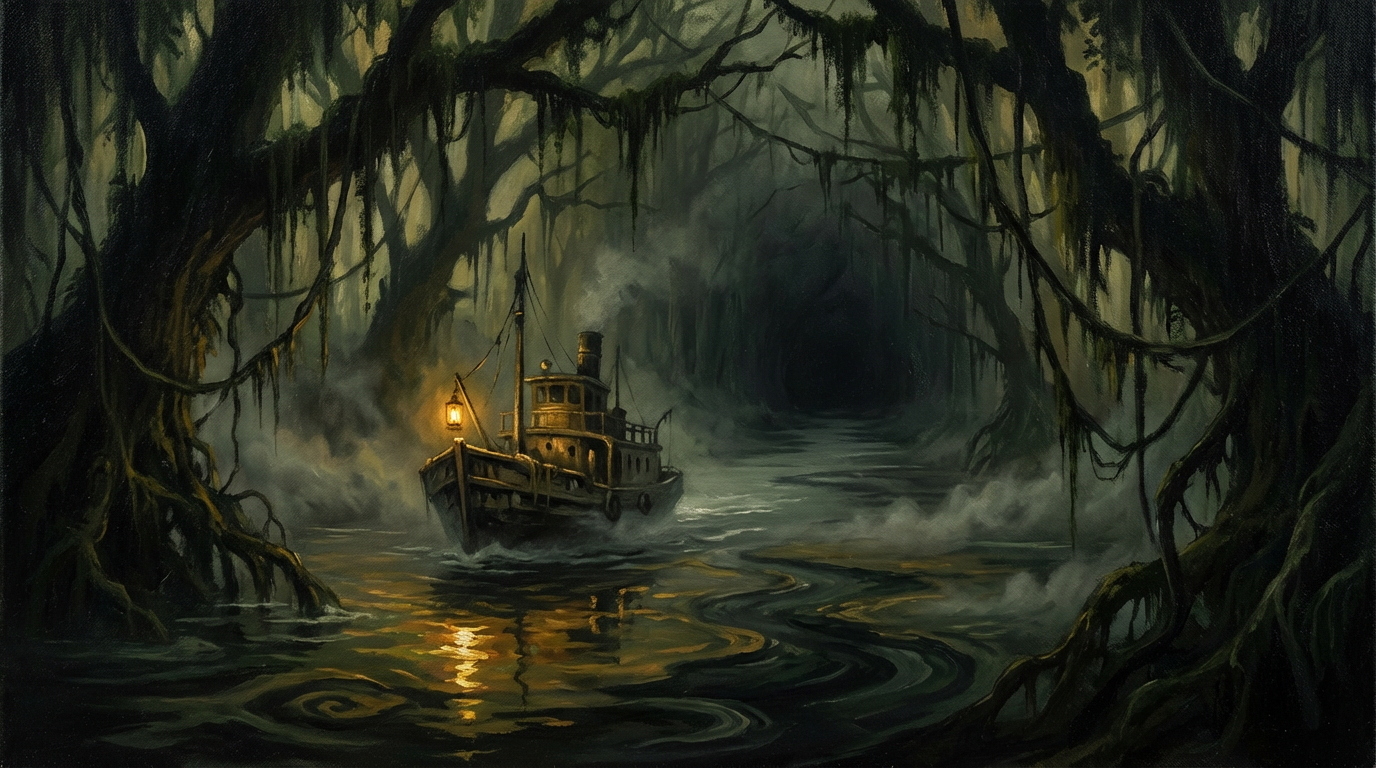
An excerpt from the original text.(complete · 14258 words)
he Nellie, a cruising yawl, swung to her anchor without a flutter of
the sails, and was at rest. The flood had made, the wind was nearly
calm, and being bound down the river, the only thing for it was to come
to and wait for the turn of the tide.
The sea-reach of the Thames stretched before us like the beginning of
an interminable waterway. In the offing the sea and the sky were welded
together without a joint, and in the luminous space the tanned sails of
the barges drifting up with the tide seemed to stand still in red
clusters of canvas sharply peaked, with gleams of varnished sprits. A
haze rested on the low shores that ran out to sea in vanishing
flatness. The air was dark above Gravesend, and farther back still
seemed condensed into a mournful gloom, brooding motionless over the
biggest, and the greatest, town on earth.
The Director of Companies was our captain and our host. We four
affectionately watched his back as he stood in the bows looking to
seaward. On the whole river there was nothing that looked half so
nautical. He resembled a pilot, which to a seaman is trustworthiness
personified. It was difficult to realize his work was not out there in
the luminous estuary, but behind him, within the brooding gloom.
Between us there was, as I have already said somewhere, the bond of the
sea. Besides holding our hearts together through long periods of
separation, it had the effect of making us tolerant of each other’s
yarns—and even convictions. The Lawyer—the best of old fellows—had,
because of his many years and many virtues, the only cushion on deck,
and was lying on the only rug. The Accountant had brought out already a
box of dominoes, and was toying architecturally with the bones. Marlow
sat cross-legged right aft, leaning against the mizzen-mast. He had
sunken cheeks, a yellow complexion, a straight back, an ascetic aspect,
and, with his arms dropped, the palms of hands outwards, resembled an
idol. The director, satisfied the anchor had good hold, made his way
aft and sat down amongst us. We exchanged a few words lazily.
Afterwards there was silence on board the yacht. For some reason or
other we did not begin that game of dominoes. We felt meditative, and
fit for nothing but placid staring. The day was ending in a serenity of
still and exquisite brilliance. The water shone pacifically; the sky,
without a speck, was a benign immensity of unstained light; the very
mist on the Essex marsh was like a gauzy and radiant fabric, hung from
the wooded rises inland, and draping the low shores in diaphanous
folds. Only the gloom to the west, brooding over the upper reaches,
became more sombre every minute, as if angered by the approach of the
sun.
And at last, in its curved and imperceptible fall, the sun sank low,
and from glowing white changed to a dull red without rays and without
heat, as if about to go out suddenly, stricken to death by the touch of
that gloom brooding over a crowd of men.
Forthwith a change came over the waters, and the serenity became less
brilliant but more profound. The old river in its broad reach rested
unruffled at the decline of day, after ages of good service done to the
race that peopled its banks, spread out in the tranquil dignity of a
waterway leading to the uttermost ends of the earth. We looked at the
venerable stream not in the vivid flush of a short day that comes and
departs for ever, but in the august light of abiding memories. And
indeed nothing is easier for a man who has, as the phrase goes,
“followed the sea” with reverence and affection, than to evoke the
great spirit of the past upon the lower reaches of the Thames. The
tidal current runs to and fro in its unceasing service, crowded with
memories of men and ships it had borne to the rest of home or to the
battles of the sea. It had known and served all the men of whom the
nation is proud, from Sir Francis Drake to Sir John Franklin, knights
all, titled and untitled—the great knights-errant of the sea. It had
borne all the ships whose names are like jewels flashing in the night
of time, from the Golden Hind returning with her rotund flanks full
of treasure, to be visited by the Queen’s Highness and thus pass out of
the gigantic tale, to the Erebus and Terror, bound on other
conquests—and that never returned. It had known the ships and the men.
They had sailed from Deptford, from Greenwich, from Erith—the
adventurers and the settlers; kings’ ships and the ships of men on
’Change; captains, admirals, the dark “interlopers” of the Eastern
trade, and the commissioned “generals” of East India fleets. Hunters
for gold or pursuers of fame, they all had gone out on that stream,
bearing the sword, and often the torch, messengers of the might within
the land, bearers of a spark from the sacred fire. What greatness had
not floated on the ebb of that river into the mystery of an unknown
earth!... The dreams of men, the seed of commonwealths, the germs of
empires.
The sun set; the dusk fell on the stream, and lights began to appear
along the shore. The Chapman light-house, a three-legged thing erect on
a mud-flat, shone strongly. Lights of ships moved in the fairway—a
great stir of lights going up and going down. And farther west on the
upper reaches the place of the monstrous town was still marked
ominously on the sky, a brooding gloom in sunshine, a lurid glare under
the stars.
“And this also,” said Marlow suddenly, “has been one of the dark places
of the earth.”
He was the only man of us who still “followed the sea.” The worst that
could be said of him was that he did not represent his class. He was a
seaman, but he was a wanderer, too, while most seamen lead, if one may
so express it, a sedentary life. Their minds are of the stay-at-home
order, and their home is always with them—the ship; and so is their
country—the sea. One ship is very much like another, and the sea is
always the same. In the immutability of their surroundings the foreign
shores, the foreign faces, the changing immensity of life, glide past,
veiled not by a sense of mystery but by a slightly disdainful
ignorance; for there is nothing mysterious to a seaman unless it be the
sea itself, which is the mistress of his existence and as inscrutable
as Destiny. For the rest, after his hours of work, a casual stroll or a
casual spree on shore suffices to unfold for him the secret of a whole
continent, and generally he finds the secret not worth knowing. The
yarns of seamen have a direct simplicity, the whole meaning of which
lies within the shell of a cracked nut. But Marlow was not typical (if
his propensity to spin yarns be excepted), and to him the meaning of an
episode was not inside like a kernel but outside, enveloping the tale
which brought it out only as a glow brings out a haze, in the likeness
of one of these misty halos that sometimes are made visible by the
spectral illumination of moonshine.
His remark did not seem at all surprising. It was just like Marlow. It
was accepted in silence. No one took the trouble to grunt even; and
presently he said, very slow—“I was thinking of very old times, when
the Romans first came here, nineteen hundred years ago—the other day
.... Light came out of this river since—you say Knights? Yes; but it is
like a running blaze on a plain, like a flash of lightning in the
clouds. We live in the flicker—may it last as long as the old earth
keeps rolling! But darkness was here yesterday. Imagine the feelings of
a commander of a fine—what d’ye call ’em?—trireme in the Mediterranean,
ordered suddenly to the north; run overland across the Gauls in a
hurry; put in charge of one of these craft the legionaries—a wonderful
lot of handy men they must have been, too—used to build, apparently by
the hundred, in a month or two, if we may believe what we read. Imagine
him here—the very end of the world, a sea the colour of lead, a sky the
colour of smoke, a kind of ship about as rigid as a concertina—and
going up this river with stores, or orders, or what you like.
Sand-banks, marshes, forests, savages,—precious little to eat fit for a
civilized man, nothing but Thames water to drink. No Falernian wine
here, no going ashore. Here and there a military camp lost in a
wilderness, like a needle in a bundle of hay—cold, fog, tempests,
disease, exile, and death—death skulking in the air, in the water, in
the bush. They must have been dying like flies here. Oh, yes—he did it.
Did it very well, too, no doubt, and without thinking much about it
either, except afterwards to brag of what he had gone through in his
time, perhaps. They were men enough to face the darkness. And perhaps
he was cheered by keeping his eye on a chance of promotion to the fleet
at Ravenna by and by, if he had good friends in Rome and survived the
awful climate. Or think of a decent young citizen in a toga—perhaps too
much dice, you know—coming out here in the train of some prefect, or
tax-gatherer, or trader even, to mend his fortunes. Land in a swamp,
march through the woods, and in some inland post feel the savagery, the
utter savagery, had closed round him—all that mysterious life of the
wilderness that stirs in the forest, in the jungles, in the hearts of
wild men. There’s no initiation either into such mysteries. He has to
live in the midst of the incomprehensible, which is also detestable.
And it has a fascination, too, that goes to work upon him. The
fascination of the abomination—you know, imagine the growing regrets,
the longing to escape, the powerless disgust, the surrender, the hate.”
He paused.
“Mind,” he began again, lifting one arm from the elbow, the palm of the
hand outwards, so that, with his legs folded before him, he had the
pose of a Buddha preaching in European clothes and without a
lotus-flower—“Mind, none of us would feel exactly like this. What saves
us is efficiency—the devotion to efficiency. But these chaps were not
much account, really. They were no colonists; their administration was
merely a squeeze, and nothing more, I suspect. They were conquerors,
and for that you want only brute force—nothing to boast of, when you
have it, since your strength is just an accident arising from the
weakness of others. They grabbed what they could get for the sake of
what was to be got. It was just robbery with violence, aggravated
murder on a great scale, and men going at it blind—as is very proper
for those who tackle a darkness. The conquest of the earth, which
mostly means the taking it away from those who have a different
complexion or slightly flatter noses than ourselves, is not a pretty
thing when you look into it too much. What redeems it is the idea only.
An idea at the back of it; not a sentimental pretence but an idea; and
an unselfish belief in the idea—something you can set up, and bow down
before, and offer a sacrifice to....”
He broke off. Flames glided in the river, small green flames, red
flames, white flames, pursuing, overtaking, joining, crossing each
other—then separating slowly or hastily. The traffic of the great city
went on in the deepening night upon the sleepless river. We looked on,
waiting patiently—there was nothing else to do till the end of the
flood; but it was only after a long silence, when he said, in a
hesitating voice, “I suppose you fellows remember I did once turn
fresh-water sailor for a bit,” that we knew we were fated, before the
ebb began to run, to hear about one of Marlow’s inconclusive
experiences.
“I don’t want to bother you much with what happened to me personally,”
he began, showing in this remark the weakness of many tellers of tales
who seem so often unaware of what their audience would like best to
hear; “yet to understand the effect of it on me you ought to know how I
got out there, what I saw, how I went up that river to the place where
I first met the poor chap. It was the farthest point of navigation and
the culminating point of my experience. It seemed somehow to throw a
kind of light on everything about me—and into my thoughts. It was
sombre enough, too—and pitiful—not extraordinary in any way—not very
clear either. No, not very clear. And yet it seemed to throw a kind of
light.
“I had then, as you remember, just returned to London after a lot of
Indian Ocean, Pacific, China Seas—a regular dose of the East—six years
or so, and I was loafing about, hindering you fellows in your work and
invading your homes, just as though I had got a heavenly mission to
civilize you. It was very fine for a time, but after a bit I did get
tired of resting. Then I began to look for a ship—I should think the
hardest work on earth. But the ships wouldn’t even look at me. And I
got tired of that game, too.
“Now when I was a little chap I had a passion for maps. I would look
for hours at South America, or Africa, or Australia, and lose myself in
all the glories of exploration. At that time there were many blank
spaces on the earth, and when I saw one that looked particularly
inviting on a map (but they all look that) I would put my finger on it
and say, ‘When I grow up I will go there.’ The North Pole was one of
these places, I remember. Well, I haven’t been there yet, and shall not
try now. The glamour’s off. Other places were scattered about the
hemispheres. I have been in some of them, and... well, we won’t talk
about that. But there was one yet—the biggest, the most blank, so to
speak—that I had a hankering after.
“True, by this time it was not a blank space any more. It had got
filled since my boyhood with rivers and lakes and names. It had ceased
to be a blank space of delightful mystery—a white patch for a boy to
dream gloriously over. It had become a place of darkness. But there was
in it one river especially, a mighty big river, that you could see on
the map, resembling an immense snake uncoiled, with its head in the
sea, its body at rest curving afar over a vast country, and its tail
lost in the depths of the land. And as I looked at the map of it in a
shop-window, it fascinated me as a snake would a bird—a silly little
bird. Then I remembered there was a big concern, a Company for trade on
that river. Dash it all! I thought to myself, they can’t trade without
using some kind of craft on that lot of fresh water—steamboats! Why
shouldn’t I try to get charge of one? I went on along Fleet Street, but
could not shake off the idea. The snake had charmed me.
“You understand it was a Continental concern, that Trading society; but
I have a lot of relations living on the Continent, because it’s cheap
and not so nasty as it looks, they say.
“I am sorry to own I began to worry them. This was already a fresh
departure for me. I was not used to get things that way, you know. I
always went my own road and on my own legs where I had a mind to go. I
wouldn’t have believed it of myself; but, then—you see—I felt somehow I
must get there by hook or by crook. So I worried them. The men said ‘My
dear fellow,’ and did nothing. Then—would you believe it?—I tried the
women. I, Charlie Marlow, set the women to work—to get a job. Heavens!
Well, you see, the notion drove me. I had an aunt, a dear enthusiastic
soul. She wrote: ‘It will be delightful. I am ready to do anything,
anything for you. It is a glorious idea. I know the wife of a very high
personage in the Administration, and also a man who has lots of
influence with,’ etc. She was determined to make no end of fuss to get
me appointed skipper of a river steamboat, if such was my fancy.
“I got my appointment—of course; and I got it very quick. It appears
the Company had received news that one of their captains had been
killed in a scuffle with the natives. This was my chance, and it made
me the more anxious to go. It was only months and months afterwards,
when I made the attempt to recover what was left of the body, that I
heard the original quarrel arose from a misunderstanding about some
hens. Yes, two black hens. Fresleven—that was the fellow’s name, a
Dane—thought himself wronged somehow in the bargain, so he went ashore
and started to hammer the chief of the village with a stick. Oh, it
didn’t surprise me in the least to hear this, and at the same time to
be told that Fresleven was the gentlest, quietest creature that ever
walked on two legs. No doubt he was; but he had been a couple of years
already out there engaged in the noble cause, you know, and he probably
felt the need at last of asserting his self-respect in some way.
Therefore he whacked the old nigger mercilessly, while a big crowd of
his people watched him, thunderstruck, till some man—I was told the
chief’s son—in desperation at hearing the old chap yell, made a
tentative jab with a spear at the white man—and of course it went quite
easy between the shoulder-blades. Then the whole population cleared
into the forest, expecting all kinds of calamities to happen, while, on
the other hand, the steamer Fresleven commanded left also in a bad
panic, in charge of the engineer, I believe. Afterwards nobody seemed
to trouble much about Fresleven’s remains, till I got out and stepped
into his shoes. I couldn’t let it rest, though; but when an opportunity
offered at last to meet my predecessor, the grass growing through his
ribs was tall enough to hide his bones. They were all there. The
supernatural being had not been touched after he fell. And the village
was deserted, the huts gaped black, rotting, all askew within the
fallen enclosures. A calamity had come to it, sure enough. The people
had vanished. Mad terror had scattered them, men, women, and children,
through the bush, and they had never returned. What became of the hens
I don’t know either. I should think the cause of progress got them,
anyhow. However, through this glorious affair I got my appointment,
before I had fairly begun to hope for it.
“I flew around like mad to get ready, and before forty-eight hours I
was crossing the Channel to show myself to my employers, and sign the
contract. In a very few hours I arrived in a city that always makes me
think of a whited sepulchre. Prejudice no doubt. I had no difficulty in
finding the Company’s offices. It was the biggest thing in the town,
and everybody I met was full of it. They were going to run an over-sea
empire, and make no end of coin by trade.
“A narrow and deserted street in deep shadow, high houses, innumerable
windows with venetian blinds, a dead silence, grass sprouting between
the stones, imposing carriage archways right and left, immense double
doors standing ponderously ajar. I slipped through one of these cracks,
went up a swept and ungarnished staircase, as arid as a desert, and
opened the first door I came to. Two women, one fat and the other slim,
sat on straw-bottomed chairs, knitting black wool. The slim one got up
and walked straight at me—still knitting with downcast eyes—and only
just as I began to think of getting out of her way, as you would for a
somnambulist, stood still, and looked up. Her dress was as plain as an
umbrella-cover, and she turned round without a word and preceded me
into a waiting-room. I gave my name, and looked about. Deal table in
the middle, plain chairs all round the walls, on one end a large
shining map, marked with all the colours of a rainbow. There was a vast
amount of red—good to see at any time, because one knows that some real
work is done in there, a deuce of a lot of blue, a little green, smears
of orange, and, on the East Coast, a purple patch, to show where the
jolly pioneers of progress drink the jolly lager-beer. However, I
wasn’t going into any of these. I was going into the yellow. Dead in
the centre. And the river was there—fascinating—deadly—like a snake.
Ough! A door opened, a white-haired secretarial head, but wearing a
compassionate expression, appeared, and a skinny forefinger beckoned me
into the sanctuary. Its light was dim, and a heavy writing-desk
squatted in the middle. From behind that structure came out an
impression of pale plumpness in a frock-coat. The great man himself. He
was five feet six, I should judge, and had his grip on the handle-end
of ever so many millions. He shook hands, I fancy, murmured vaguely,
was satisfied with my French. Bon Voyage.
“In about forty-five seconds I found myself again in the waiting-room
with the compassionate secretary, who, full of desolation and sympathy,
made me sign some document. I believe I undertook amongst other things
not to disclose any trade secrets. Well, I am not going to.
“I began to feel slightly uneasy. You know I am not used to such
ceremonies, and there was something ominous in the atmosphere. It was
just as though I had been let into some conspiracy—I don’t
know—something not quite right; and I was glad to get out. In the outer
room the two women knitted black wool feverishly. People were arriving,
and the younger one was walking back and forth introducing them. The
old one sat on her chair. Her flat cloth slippers were propped up on a
foot-warmer, and a cat reposed on her lap. She wore a starched white
affair on her head, had a wart on one cheek, and silver-rimmed
spectacles hung on the tip of her nose. She glanced at me above the
glasses. The swift and indifferent placidity of that look troubled me.
Two youths with foolish and cheery countenances were being piloted
over, and she threw at them the same quick glance of unconcerned
wisdom. She seemed to know all about them and about me, too. An eerie
feeling came over me. She seemed uncanny and fateful. Often far away
there I thought of these two, guarding the door of Darkness, knitting
black wool as for a warm pall, one introducing, introducing
continuously to the unknown, the other scrutinizing the cheery and
foolish faces with unconcerned old eyes. Ave! Old knitter of black
wool. Morituri te salutant. Not many of those she looked at ever saw
her again—not half, by a long way.
“There was yet a visit to the doctor. ‘A simple formality,’ assured me
the secretary, with an air of taking an immense part in all my sorrows.
Accordingly a young chap wearing his hat over the left eyebrow, some
clerk I suppose—there must have been clerks in the business, though the
house was as still as a house in a city of the dead—came from somewhere
up-stairs, and led me forth. He was shabby and careless, with inkstains
on the sleeves of his jacket, and his cravat was large and billowy,
under a chin shaped like the toe of an old boot. It was a little too
early for the doctor, so I proposed a drink, and thereupon he developed
a vein of joviality. As we sat over our vermouths he glorified the
Company’s business, and by and by I expressed casually my surprise at
him not going out there. He became very cool and collected all at once.
‘I am not such a fool as I look, quoth Plato to his disciples,’ he said
sententiously, emptied his glass with great resolution, and we rose.
“The old doctor felt my pulse, evidently thinking of something else the
while. ‘Good, good for there,’ he mumbled, and then with a certain
eagerness asked me whether I would let him measure my head. Rather
surprised, I said Yes, when he produced a thing like calipers and got
the dimensions back and front and every way, taking notes carefully. He
was an unshaven little man in a threadbare coat like a gaberdine, with
his feet in slippers, and I thought him a harmless fool. ‘I always ask
leave, in the interests of science, to measure the crania of those
going out there,’ he said. ‘And when they come back, too?’ I asked.
‘Oh, I never see them,’ he remarked; ‘and, moreover, the changes take
place inside, you know.’ He smiled, as if at some quiet joke. ‘So you
are going out there. Famous. Interesting, too.’ He gave me a searching
glance, and made another note. ‘Ever any madness in your family?’ he
asked, in a matter-of-fact tone. I felt very annoyed. ‘Is that question
in the interests of science, too?’ ‘It would be,’ he said, without
taking notice of my irritation, ‘interesting for science to watch the
mental changes of individuals, on the spot, but...’ ‘Are you an
alienist?’ I interrupted. ‘Every doctor should be—a little,’ answered
that original, imperturbably. ‘I have a little theory which you
messieurs who go out there must help me to prove. This is my share in
the advantages my country shall reap from the possession of such a
magnificent dependency. The mere wealth I leave to others. Pardon my
questions, but you are the first Englishman coming under my
observation...’ I hastened to assure him I was not in the least
typical. ‘If I were,’ said I, ‘I wouldn’t be talking like this with
you.’ ‘What you say is rather profound, and probably erroneous,’ he
said, with a laugh. ‘Avoid irritation more than exposure to the sun.
Adieu. How do you English say, eh? Good-bye. Ah! Good-bye. Adieu.
In the tropics one must before everything keep calm.’... He lifted a
warning forefinger.... ‘Du calme, du calme.’
“One thing more remained to do—say good-bye to my excellent aunt. I
found her triumphant. I had a cup of tea—the last decent cup of tea for
many days—and in a room that most soothingly looked just as you would
expect a lady’s drawing-room to look, we had a long quiet chat by the
fireside. In the course of these confidences it became quite plain to
me I had been represented to the wife of the high dignitary, and
goodness knows to how many more people besides, as an exceptional and
gifted creature—a piece of good fortune for the Company—a man you don’t
get hold of every day. Good heavens! and I was going to take charge of
a two-penny-half-penny river-steamboat with a penny whistle attached!
It appeared, however, I was also one of the Workers, with a capital—you
know. Something like an emissary of light, something like a lower sort
of apostle. There had been a lot of such rot let loose in print and
talk just about that time, and the excellent woman, living right in the
rush of all that humbug, got carried off her feet. She talked about
‘weaning those ignorant millions from their horrid ways,’ till, upon my
word, she made me quite uncomfortable. I ventured to hint that the
Company was run for profit.
“‘You forget, dear Charlie, that the labourer is worthy of his hire,’
she said, brightly. It’s queer how out of touch with truth women are.
They live in a world of their own, and there has never been anything
like it, and never can be. It is too beautiful altogether, and if they
were to set it up it would go to pieces before the first sunset. Some
confounded fact we men have been living contentedly with ever since the
day of creation would start up and knock the whole thing over.
“After this I got embraced, told to wear flannel, be sure to write
often, and so on—and I left. In the street—I don’t know why—a queer
feeling came to me that I was an imposter. Odd thing that I, who used
to clear out for any part of the world at twenty-four hours’ notice,
with less thought than most men give to the crossing of a street, had a
moment—I won’t say of hesitation, but of startled pause, before this
commonplace affair. The best way I can explain it to you is by saying
that, for a second or two, I felt as though, instead of going to the
centre of a continent, I were about to set off for the centre of the
earth.
“I left in a French steamer, and she called in every blamed port they
have out there, for, as far as I could see, the sole purpose of landing
soldiers and custom-house officers. I watched the coast. Watching a
coast as it slips by the ship is like thinking about an enigma. There
it is before you—smiling, frowning, inviting, grand, mean, insipid, or
savage, and always mute with an air of whispering, ‘Come and find out.’
This one was almost featureless, as if still in the making, with an
aspect of monotonous grimness. The edge of a colossal jungle, so
dark-green as to be almost black, fringed with white surf, ran
straight, like a ruled line, far, far away along a blue sea whose
glitter was blurred by a creeping mist. The sun was fierce, the land
seemed to glisten and drip with steam. Here and there greyish-whitish
specks showed up clustered inside the white surf, with a flag flying
above them perhaps. Settlements some centuries old, and still no bigger
than pinheads on the untouched expanse of their background. We pounded
along, stopped, landed soldiers; went on, landed custom-house clerks to
levy toll in what looked like a God-forsaken wilderness, with a tin
shed and a flag-pole lost in it; landed more soldiers—to take care of
the custom-house clerks, presumably. Some, I heard, got drowned in the
surf; but whether they did or not, nobody seemed particularly to care.
They were just flung out there, and on we went. Every day the coast
looked the same, as though we had not moved; but we passed various
places—trading places—with names like Gran’ Bassam, Little Popo; names
that seemed to belong to some sordid farce acted in front of a sinister
back-cloth. The idleness of a passenger, my isolation amongst all these
men with whom I had no point of contact, the oily and languid sea, the
uniform sombreness of the coast, seemed to keep me away from the truth
of things, within the toil of a mournful and senseless delusion. The
voice of the surf heard now and then was a positive pleasure, like the
speech of a brother. It was something natural, that had its reason,
that had a meaning. Now and then a boat from the shore gave one a
momentary contact with reality. It was paddled by black fellows. You
could see from afar the white of their eyeballs glistening. They
shouted, sang; their bodies streamed with perspiration; they had faces
like grotesque masks—these chaps; but they had bone, muscle, a wild
vitality, an intense energy of movement, that was as natural and true
as the surf along their coast. They wanted no excuse for being there.
They were a great comfort to look at. For a time I would feel I
belonged still to a world of straightforward facts; but the feeling
would not last long. Something would turn up to scare it away. Once, I
remember, we came upon a man-of-war anchored off the coast. There
wasn’t even a shed there, and she was shelling the bush. It appears the
French had one of their wars going on thereabouts. Her ensign dropped
limp like a rag; the muzzles of the long six-inch guns stuck out all
over the low hull; the greasy, slimy swell swung her up lazily and let
her down, swaying her thin masts. In the empty immensity of earth, sky,
and water, there she was, incomprehensible, firing into a continent.
Pop, would go one of the six-inch guns; a small flame would dart and
vanish, a little white smoke would disappear, a tiny projectile would
give a feeble screech—and nothing happened. Nothing could happen. There
was a touch of insanity in the proceeding, a sense of lugubrious
drollery in the sight; and it was not dissipated by somebody on board
assuring me earnestly there was a camp of natives—he called them
enemies!—hidden out of sight somewhere.
“We gave her her letters (I heard the men in that lonely ship were
dying of fever at the rate of three a day) and went on. We called at
some more places with farcical names, where the merry dance of death
and trade goes on in a still and earthy atmosphere as of an overheated
catacomb; all along the formless coast bordered by dangerous surf, as
if Nature herself had tried to ward off intruders; in and out of
rivers, streams of death in life, whose banks were rotting into mud,
whose waters, thickened into slime, invaded the contorted mangroves,
that seemed to writhe at us in the extremity of an impotent despair.
Nowhere did we stop long enough to get a particularized impression, but
the general sense of vague and oppressive wonder grew upon me. It was
like a weary pilgrimage amongst hints for nightmares.
“It was upward of thirty days before I saw the mouth of the big river.
We anchored off the seat of the government. But my work would not begin
till some two hundred miles farther on. So as soon as I could I made a
start for a place thirty miles higher up.
“I had my passage on a little sea-going steamer. Her captain was a
Swede, and knowing me for a seaman, invited me on the bridge. He was a
young man, lean, fair, and morose, with lanky hair and a shuffling
gait. As we left the miserable little wharf, he tossed his head
contemptuously at the shore. ‘Been living there?’ he asked. I said,
‘Yes.’ ‘Fine lot these government chaps—are they not?’ he went on,
speaking English with great precision and considerable bitterness. ‘It
is funny what some people will do for a few francs a month. I wonder
what becomes of that kind when it goes upcountry?’ I said to him I
expected to see that soon. ‘So-o-o!’ he exclaimed. He shuffled athwart,
keeping one eye ahead vigilantly. ‘Don’t be too sure,’ he continued.
‘The other day I took up a man who hanged himself on the road. He was a
Swede, too.’ ‘Hanged himself! Why, in God’s name?’ I cried. He kept on
looking out watchfully. ‘Who knows? The sun too much for him, or the
country perhaps.’
“At last we opened a reach. A rocky cliff appeared, mounds of turned-up
earth by the shore, houses on a hill, others with iron roofs, amongst a
waste of excavations, or hanging to the declivity. A continuous noise
of the rapids above hovered over this scene of inhabited devastation. A
lot of people, mostly black and naked, moved about like ants. A jetty
projected into the river. A blinding sunlight drowned all this at times
in a sudden recrudescence of glare. ‘There’s your Company’s station,’
said the Swede, pointing to three wooden barrack-like structures on the
rocky slope. ‘I will send your things up. Four boxes did you say? So.
Farewell.’
“I came upon a boiler wallowing in the grass, then found a path leading
up the hill. It turned aside for the boulders, and also for an
undersized railway-truck lying there on its back with its wheels in the
air. One was off. The thing looked as dead as the carcass of some
animal. I came upon more pieces of decaying machinery, a stack of rusty
rails. To the left a clump of trees made a shady spot, where dark
things seemed to stir feebly. I blinked, the path was steep. A horn
tooted to the right, and I saw the black people run. A heavy and dull
detonation shook the ground, a puff of smoke came out of the cliff, and
that was all. No change appeared on the face of the rock. They were
building a railway. The cliff was not in the way or anything; but this
objectless blasting was all the work going on.
“A slight clinking behind me made me turn my head. Six black men
advanced in a file, toiling up the path. They walked erect and slow,
balancing small baskets full of earth on their heads, and the clink
kept time with their footsteps. Black rags were wound round their
loins, and the short ends behind waggled to and fro like tails. I could
see every rib, the joints of their limbs were like knots in a rope;
each had an iron collar on his neck, and all were connected together
with a chain whose bights swung between them, rhythmically clinking.
Another report from the cliff made me think suddenly of that ship of
war I had seen firing into a continent. It was the same kind of ominous
voice; but these men could by no stretch of imagination be called
enemies. They were called criminals, and the outraged law, like the
bursting shells, had come to them, an insoluble mystery from the sea.
All their meagre breasts panted together, the violently dilated
nostrils quivered, the eyes stared stonily uphill. They passed me
within six inches, without a glance, with that complete, deathlike
indifference of unhappy savages. Behind this raw matter one of the
reclaimed, the product of the new forces at work, strolled
despondently, carrying a rifle by its middle. He had a uniform jacket
with one button off, and seeing a white man on the path, hoisted his
weapon to his shoulder with alacrity. This was simple prudence, white
men being so much alike at a distance that he could not tell who I
might be. He was speedily reassured, and with a large, white, rascally
grin, and a glance at his charge, seemed to take me into partnership in
his exalted trust. After all, I also was a part of the great cause of
these high and just proceedings.
“Instead of going up, I turned and descended to the left. My idea was
to let that chain-gang get out of sight before I climbed the hill. You
know I am not particularly tender; I’ve had to strike and to fend off.
I’ve had to resist and to attack sometimes—that’s only one way of
resisting—without counting the exact cost, according to the demands of
such sort of life as I had blundered into. I’ve seen the devil of
violence, and the devil of greed, and the devil of hot desire; but, by
all the stars! these were strong, lusty, red-eyed devils, that swayed
and drove men—men, I tell you. But as I stood on this hillside, I
foresaw that in the blinding sunshine of that land I would become
acquainted with a flabby, pretending, weak-eyed devil of a rapacious
and pitiless folly. How insidious he could be, too, I was only to find
out several months later and a thousand miles farther. For a moment I
stood appalled, as though by a warning. Finally I descended the hill,
obliquely, towards the trees I had seen.
“I avoided a vast artificial hole somebody had been digging on the
slope, the purpose of which I found it impossible to divine. It wasn’t
a quarry or a sandpit, anyhow. It was just a hole. It might have been
connected with the philanthropic desire of giving the criminals
something to do. I don’t know. Then I nearly fell into a very narrow
ravine, almost no more than a scar in the hillside. I discovered that a
lot of imported drainage-pipes for the settlement had been tumbled in
there. There wasn’t one that was not broken. It was a wanton smash-up.
At last I got under the trees. My purpose was to stroll into the shade
for a moment; but no sooner within than it seemed to me I had stepped
into the gloomy circle of some Inferno. The rapids were near, and an
uninterrupted, uniform, headlong, rushing noise filled the mournful
stillness of the grove, where not a breath stirred, not a leaf moved,
with a mysterious sound—as though the tearing pace of the launched
earth had suddenly become audible.
“Black shapes crouched, lay, sat between the trees leaning against the
trunks, clinging to the earth, half coming out, half effaced within the
dim light, in all the attitudes of pain, abandonment, and despair.
Another mine on the cliff went off, followed by a slight shudder of the
soil under my feet. The work was going on. The work! And this was the
place where some of the helpers had withdrawn to die.
“They were dying slowly—it was very clear. They were not enemies, they
were not criminals, they were nothing earthly now—nothing but black
shadows of disease and starvation, lying confusedly in the greenish
gloom. Brought from all the recesses of the coast in all the legality
of time contracts, lost in uncongenial surroundings, fed on unfamiliar
food, they sickened, became inefficient, and were then allowed to crawl
away and rest. These moribund shapes were free as air—and nearly as
thin. I began to distinguish the gleam of the eyes under the trees.
Then, glancing down, I saw a face near my hand. The black bones
reclined at full length with one shoulder against the tree, and slowly
the eyelids rose and the sunken eyes looked up at me, enormous and
vacant, a kind of blind, white flicker in the depths of the orbs, which
died out slowly. The man seemed young—almost a boy—but you know with
them it’s hard to tell. I found nothing else to do but to offer him one
of my good Swede’s ship’s biscuits I had in my pocket. The fingers
closed slowly on it and held—there was no other movement and no other
glance. He had tied a bit of white worsted round his neck—Why? Where
did he get it? Was it a badge—an ornament—a charm—a propitiatory act?
Was there any idea at all connected with it? It looked startling round
his black neck, this bit of white thread from beyond the seas.
“Near the same tree two more bundles of acute angles sat with their
legs drawn up. One, with his chin propped on his knees, stared at
nothing, in an intolerable and appalling manner: his brother phantom
rested its forehead, as if overcome with a great weariness; and all
about others were scattered in every pose of contorted collapse, as in
some picture of a massacre or a pestilence. While I stood
horror-struck, one of these creatures rose to his hands and knees, and
went off on all-fours towards the river to drink. He lapped out of his
hand, then sat up in the sunlight, crossing his shins in front of him,
and after a time let his woolly head fall on his breastbone.
“I didn’t want any more loitering in the shade, and I made haste
towards the station. When near the buildings I met a white man, in such
an unexpected elegance of get-up that in the first moment I took him
for a sort of vision. I saw a high starched collar, white cuffs, a
light alpaca jacket, snowy trousers, a clean necktie, and varnished
boots. No hat. Hair parted, brushed, oiled, under a green-lined parasol
held in a big white hand. He was amazing, and had a penholder behind
his ear.
“I shook hands with this miracle, and I learned he was the Company’s
chief accountant, and that all the book-keeping was done at this
station. He had come out for a moment, he said, ‘to get a breath of
fresh air. The expression sounded wonderfully odd, with its suggestion
of sedentary desk-life. I wouldn’t have mentioned the fellow to you at
all, only it was from his lips that I first heard the name of the man
who is so indissolubly connected with the memories of that time.
Moreover, I respected the fellow. Yes; I respected his collars, his
vast cuffs, his brushed hair. His appearance was certainly that of a
hairdresser’s dummy; but in the great demoralization of the land he
kept up his appearance. That’s backbone. His starched collars and
got-up shirt-fronts were achievements of character. He had been out
nearly three years; and, later, I could not help asking him how he
managed to sport such linen. He had just the faintest blush, and said
modestly, ‘I’ve been teaching one of the native women about the
station. It was difficult. She had a distaste for the work.’ Thus this
man had verily accomplished something. And he was devoted to his books,
which were in apple-pie order.
“Everything else in the station was in a muddle—heads, things,
buildings. Strings of dusty niggers with splay feet arrived and
departed; a stream of manufactured goods, rubbishy cottons, beads, and
brass-wire sent into the depths of darkness, and in return came a
precious trickle of ivory.
“I had to wait in the station for ten days—an eternity. I lived in a
hut in the yard, but to be out of the chaos I would sometimes get into
the accountant’s office. It was built of horizontal planks, and so
badly put together that, as he bent over his high desk, he was barred
from neck to heels with narrow strips of sunlight. There was no need to
open the big shutter to see. It was hot there, too; big flies buzzed
fiendishly, and did not sting, but stabbed. I sat generally on the
floor, while, of faultless appearance (and even slightly scented),
perching on a high stool, he wrote, he wrote. Sometimes he stood up for
exercise. When a truckle-bed with a sick man (some invalid agent from
upcountry) was put in there, he exhibited a gentle annoyance. ‘The
groans of this sick person,’ he said, ‘distract my attention. And
without that it is extremely difficult to guard against clerical errors
in this climate.’
“One day he remarked, without lifting his head, ‘In the interior you
will no doubt meet Mr. Kurtz.’ On my asking who Mr. Kurtz was, he said
he was a first-class agent; and seeing my disappointment at this
information, he added slowly, laying down his pen, ‘He is a very
remarkable person.’ Further questions elicited from him that Mr. Kurtz
was at present in charge of a trading-post, a very important one, in
the true ivory-country, at ‘the very bottom of there. Sends in as much
ivory as all the others put together...’ He began to write again. The
sick man was too ill to groan. The flies buzzed in a great peace.
“Suddenly there was a growing murmur of voices and a great tramping of
feet. A caravan had come in. A violent babble of uncouth sounds burst
out on the other side of the planks. All the carriers were speaking
together, and in the midst of the uproar the lamentable voice of the
chief agent was heard ‘giving it up’ tearfully for the twentieth time
that day.... He rose slowly. ‘What a frightful row,’ he said. He
crossed the room gently to look at the sick man, and returning, said to
me, ‘He does not hear.’ ‘What! Dead?’ I asked, startled. ‘No, not yet,’
he answered, with great composure. Then, alluding with a toss of the
head to the tumult in the station-yard, ‘When one has got to make
correct entries, one comes to hate those savages—hate them to the
death.’ He remained thoughtful for a moment. ‘When you see Mr. Kurtz’
he went on, ‘tell him from me that everything here’—he glanced at the
deck—‘is very satisfactory. I don’t like to write to him—with those
messengers of ours you never know who may get hold of your letter—at
that Central Station.’ He stared at me for a moment with his mild,
bulging eyes. ‘Oh, he will go far, very far,’ he began again. ‘He will
be a somebody in the Administration before long. They, above—the
Council in Europe, you know—mean him to be.’
“He turned to his work. The noise outside had ceased, and presently in
going out I stopped at the door. In the steady buzz of flies the
homeward-bound agent was lying finished and insensible; the other, bent
over his books, was making correct entries of perfectly correct
transactions; and fifty feet below the doorstep I could see the still
tree-tops of the grove of death.
“Next day I left that station at last, with a caravan of sixty men, for
a two-hundred-mile tramp.
“No use telling you much about that. Paths, paths, everywhere; a
stamped-in network of paths spreading over the empty land, through the
long grass, through burnt grass, through thickets, down and up chilly
ravines, up and down stony hills ablaze with heat; and a solitude, a
solitude, nobody, not a hut. The population had cleared out a long time
ago. Well, if a lot of mysterious niggers armed with all kinds of
fearful weapons suddenly took to travelling on the road between Deal
and Gravesend, catching the yokels right and left to carry heavy loads
for them, I fancy every farm and cottage thereabouts would get empty
very soon. Only here the dwellings were gone, too. Still I passed
through several abandoned villages. There’s something pathetically
childish in the ruins of grass walls. Day after day, with the stamp and
shuffle of sixty pair of bare feet behind me, each pair under a 60-lb.
load. Camp, cook, sleep, strike camp, march. Now and then a carrier
dead in harness, at rest in the long grass near the path, with an empty
water-gourd and his long staff lying by his side. A great silence
around and above. Perhaps on some quiet night the tremor of far-off
drums, sinking, swelling, a tremor vast, faint; a sound weird,
appealing, suggestive, and wild—and perhaps with as profound a meaning
as the sound of bells in a Christian country. Once a white man in an
unbuttoned uniform, camping on the path with an armed escort of lank
Zanzibaris, very hospitable and festive—not to say drunk. Was looking
after the upkeep of the road, he declared. Can’t say I saw any road or
any upkeep, unless the body of a middle-aged negro, with a bullet-hole
in the forehead, upon which I absolutely stumbled three miles farther
on, may be considered as a permanent improvement. I had a white
companion, too, not a bad chap, but rather too fleshy and with the
exasperating habit of fainting on the hot hillsides, miles away from
the least bit of shade and water. Annoying, you know, to hold your own
coat like a parasol over a man’s head while he is coming to. I couldn’t
help asking him once what he meant by coming there at all. ‘To make
money, of course. What do you think?’ he said, scornfully. Then he got
fever, and had to be carried in a hammock slung under a pole. As he
weighed sixteen stone I had no end of rows with the carriers. They
jibbed, ran away, sneaked off with their loads in the night—quite a
mutiny. So, one evening, I made a speech in English with gestures, not
one of which was lost to the sixty pairs of eyes before me, and the
next morning I started the hammock off in front all right. An hour
afterwards I came upon the whole concern wrecked in a bush—man,
hammock, groans, blankets, horrors. The heavy pole had skinned his poor
nose. He was very anxious for me to kill somebody, but there wasn’t the
shadow of a carrier near. I remembered the old doctor—‘It would be
interesting for science to watch the mental changes of individuals, on
the spot.’ I felt I was becoming scientifically interesting. However,
all that is to no purpose. On the fifteenth day I came in sight of the
big river again, and hobbled into the Central Station. It was on a back
water surrounded by scrub and forest, with a pretty border of smelly
mud on one side, and on the three others enclosed by a crazy fence of
rushes. A neglected gap was all the gate it had, and the first glance
at the place was enough to let you see the flabby devil was running
that show. White men with long staves in their hands appeared languidly
from amongst the buildings, strolling up to take a look at me, and then
retired out of sight somewhere. One of them, a stout, excitable chap
with black moustaches, informed me with great volubility and many
digressions, as soon as I told him who I was, that my steamer was at
the bottom of the river. I was thunderstruck. What, how, why? Oh, it
was ‘all right.’ The ‘manager himself’ was there. All quite correct.
‘Everybody had behaved splendidly! splendidly!’—‘you must,’ he said in
agitation, ‘go and see the general manager at once. He is waiting!’
“I did not see the real significance of that wreck at once. I fancy I
see it now, but I am not sure—not at all. Certainly the affair was too
stupid—when I think of it—to be altogether natural. Still... But at the
moment it presented itself simply as a confounded nuisance. The steamer
was sunk. They had started two days before in a sudden hurry up the
river with the manager on board, in charge of some volunteer skipper,
and before they had been out three hours they tore the bottom out of
her on stones, and she sank near the south bank. I asked myself what I
was to do there, now my boat was lost. As a matter of fact, I had
plenty to do in fishing my command out of the river. I had to set about
it the very next day. That, and the repairs when I brought the pieces
to the station, took some months.
“My first interview with the manager was curious. He did not ask me to
sit down after my twenty-mile walk that morning. He was commonplace in
complexion, in features, in manners, and in voice. He was of middle
size and of ordinary build. His eyes, of the usual blue, were perhaps
remarkably cold, and he certainly could make his glance fall on one as
trenchant and heavy as an axe. But even at these times the rest of his
person seemed to disclaim the intention. Otherwise there was only an
indefinable, faint expression of his lips, something stealthy—a
smile—not a smile—I remember it, but I can’t explain. It was
unconscious, this smile was, though just after he had said something it
got intensified for an instant. It came at the end of his speeches like
a seal applied on the words to make the meaning of the commonest phrase
appear absolutely inscrutable. He was a common trader, from his youth
up employed in these parts—nothing more. He was obeyed, yet he inspired
neither love nor fear, nor even respect. He inspired uneasiness. That
was it! Uneasiness. Not a definite mistrust—just uneasiness—nothing
more. You have no idea how effective such a... a... faculty can be. He
had no genius for organizing, for initiative, or for order even. That
was evident in such things as the deplorable state of the station. He
had no learning, and no intelligence. His position had come to him—why?
Perhaps because he was never ill... He had served three terms of three
years out there... Because triumphant health in the general rout of
constitutions is a kind of power in itself. When he went home on leave
he rioted on a large scale—pompously. Jack ashore—with a difference—in
externals only. This one could gather from his casual talk. He
originated nothing, he could keep the routine going—that’s all. But he
was great. He was great by this little thing that it was impossible to
tell what could control such a man. He never gave that secret away.
Perhaps there was nothing within him. Such a suspicion made one
pause—for out there there were no external checks. Once when various
tropical diseases had laid low almost every ‘agent’ in the station, he
was heard to say, ‘Men who come out here should have no entrails.’ He
sealed the utterance with that smile of his, as though it had been a
door opening into a darkness he had in his keeping. You fancied you had
seen things—but the seal was on. When annoyed at meal-times by the
constant quarrels of the white men about precedence, he ordered an
immense round table to be made, for which a special house had to be
built. This was the station’s mess-room. Where he sat was the first
place—the rest were nowhere. One felt this to be his unalterable
conviction. He was neither civil nor uncivil. He was quiet. He allowed
his ‘boy’—an overfed young negro from the coast—to treat the white men,
under his very eyes, with provoking insolence.
“He began to speak as soon as he saw me. I had been very long on the
road. He could not wait. Had to start without me. The up-river stations
had to be relieved. There had been so many delays already that he did
not know who was dead and who was alive, and how they got on—and so on,
and so on. He paid no attention to my explanations, and, playing with a
stick of sealing-wax, repeated several times that the situation was
‘very grave, very grave.’ There were rumours that a very important
station was in jeopardy, and its chief, Mr. Kurtz, was ill. Hoped it
was not true. Mr. Kurtz was... I felt weary and irritable. Hang Kurtz,
I thought. I interrupted him by saying I had heard of Mr. Kurtz on the
coast. ‘Ah! So they talk of him down there,’ he murmured to himself.
Then he began again, assuring me Mr. Kurtz was the best agent he had,
an exceptional man, of the greatest importance to the Company;
therefore I could understand his anxiety. He was, he said, ‘very, very
uneasy.’ Certainly he fidgeted on his chair a good deal, exclaimed,
‘Ah, Mr. Kurtz!’ broke the stick of sealing-wax and seemed dumfounded
by the accident. Next thing he wanted to know ‘how long it would take
to’... I interrupted him again. Being hungry, you know, and kept on my
feet too. I was getting savage. ‘How can I tell?’ I said. ‘I haven’t
even seen the wreck yet—some months, no doubt.’ All this talk seemed to
me so futile. ‘Some months,’ he said. ‘Well, let us say three months
before we can make a start. Yes. That ought to do the affair.’ I flung
out of his hut (he lived all alone in a clay hut with a sort of
verandah) muttering to myself my opinion of him. He was a chattering
idiot. Afterwards I took it back when it was borne in upon me
startlingly with what extreme nicety he had estimated the time
requisite for the ‘affair.’
“I went to work the next day, turning, so to speak, my back on that
station. In that way only it seemed to me I could keep my hold on the
redeeming facts of life. Still, one must look about sometimes; and then
I saw this station, these men strolling aimlessly about in the sunshine
of the yard. I asked myself sometimes what it all meant. They wandered
here and there with their absurd long staves in their hands, like a lot
of faithless pilgrims bewitched inside a rotten fence. The word ‘ivory’
rang in the air, was whispered, was sighed. You would think they were
praying to it. A taint of imbecile rapacity blew through it all, like a
whiff from some corpse. By Jove! I’ve never seen anything so unreal in
my life. And outside, the silent wilderness surrounding this cleared
speck on the earth struck me as something great and invincible, like
evil or truth, waiting patiently for the passing away of this fantastic
invasion.
“Oh, these months! Well, never mind. Various things happened. One
evening a grass shed full of calico, cotton prints, beads, and I don’t
know what else, burst into a blaze so suddenly that you would have
thought the earth had opened to let an avenging fire consume all that
trash. I was smoking my pipe quietly by my dismantled steamer, and saw
them all cutting capers in the light, with their arms lifted high, when
the stout man with moustaches came tearing down to the river, a tin
pail in his hand, assured me that everybody was ‘behaving splendidly,
splendidly,’ dipped about a quart of water and tore back again. I
noticed there was a hole in the bottom of his pail.
“I strolled up. There was no hurry. You see the thing had gone off like
a box of matches. It had been hopeless from the very first. The flame
had leaped high, driven everybody back, lighted up everything—and
collapsed. The shed was already a heap of embers glowing fiercely. A
nigger was being beaten near by. They said he had caused the fire in
some way; be that as it may, he was screeching most horribly. I saw
him, later, for several days, sitting in a bit of shade looking very
sick and trying to recover himself; afterwards he arose and went
out—and the wilderness without a sound took him into its bosom again.
As I approached the glow from the dark I found myself at the back of
two men, talking. I heard the name of Kurtz pronounced, then the words,
‘take advantage of this unfortunate accident.’ One of the men was the
manager. I wished him a good evening. ‘Did you ever see anything like
it—eh? it is incredible,’ he said, and walked off. The other man
remained. He was a first-class agent, young, gentlemanly, a bit
reserved, with a forked little beard and a hooked nose. He was
stand-offish with the other agents, and they on their side said he was
the manager’s spy upon them. As to me, I had hardly ever spoken to him
before. We got into talk, and by and by we strolled away from the
hissing ruins. Then he asked me to his room, which was in the main
building of the station. He struck a match, and I perceived that this
young aristocrat had not only a silver-mounted dressing-case but also a
whole candle all to himself. Just at that time the manager was the only
man supposed to have any right to candles. Native mats covered the clay
walls; a collection of spears, assegais, shields, knives was hung up in
trophies. The business intrusted to this fellow was the making of
bricks—so I had been informed; but there wasn’t a fragment of a brick
anywhere in the station, and he had been there more than a
year—waiting. It seems he could not make bricks without something, I
don’t know what—straw maybe. Anyway, it could not be found there and as
it was not likely to be sent from Europe, it did not appear clear to me
what he was waiting for. An act of special creation perhaps. However,
they were all waiting—all the sixteen or twenty pilgrims of them—for
something; and upon my word it did not seem an uncongenial occupation,
from the way they took it, though the only thing that ever came to them
was disease—as far as I could see. They beguiled the time by
back-biting and intriguing against each other in a foolish kind of way.
There was an air of plotting about that station, but nothing came of
it, of course. It was as unreal as everything else—as the philanthropic
pretence of the whole concern, as their talk, as their government, as
their show of work. The only real feeling was a desire to get appointed
to a trading-post where ivory was to be had, so that they could earn
percentages. They intrigued and slandered and hated each other only on
that account—but as to effectually lifting a little finger—oh, no. By
heavens! there is something after all in the world allowing one man to
steal a horse while another must not look at a halter. Steal a horse
straight out. Very well. He has done it. Perhaps he can ride. But there
is a way of looking at a halter that would provoke the most charitable
of saints into a kick.
“I had no idea why he wanted to be sociable, but as we chatted in there
it suddenly occurred to me the fellow was trying to get at something—in
fact, pumping me. He alluded constantly to Europe, to the people I was
supposed to know there—putting leading questions as to my acquaintances
in the sepulchral city, and so on. His little eyes glittered like mica
discs—with curiosity—though he tried to keep up a bit of
superciliousness. At first I was astonished, but very soon I became
awfully curious to see what he would find out from me. I couldn’t
possibly imagine what I had in me to make it worth his while. It was
very pretty to see how he baffled himself, for in truth my body was
full only of chills, and my head had nothing in it but that wretched
steamboat business. It was evident he took me for a perfectly shameless
prevaricator. At last he got angry, and, to conceal a movement of
furious annoyance, he yawned. I rose. Then I noticed a small sketch in
oils, on a panel, representing a woman, draped and blindfolded,
carrying a lighted torch. The background was sombre—almost black. The
movement of the woman was stately, and the effect of the torchlight on
the face was sinister.
“It arrested me, and he stood by civilly, holding an empty half-pint
champagne bottle (medical comforts) with the candle stuck in it. To my
question he said Mr. Kurtz had painted this—in this very station more
than a year ago—while waiting for means to go to his trading post.
‘Tell me, pray,’ said I, ‘who is this Mr. Kurtz?’
“‘The chief of the Inner Station,’ he answered in a short tone, looking
away. ‘Much obliged,’ I said, laughing. ‘And you are the brickmaker of
the Central Station. Every one knows that.’ He was silent for a while.
‘He is a prodigy,’ he said at last. ‘He is an emissary of pity and
science and progress, and devil knows what else. We want,’ he began to
declaim suddenly, ‘for the guidance of the cause intrusted to us by
Europe, so to speak, higher intelligence, wide sympathies, a singleness
of purpose.’ ‘Who says that?’ I asked. ‘Lots of them,’ he replied.
‘Some even write that; and so he comes here, a special being, as you
ought to know.’ ‘Why ought I to know?’ I interrupted, really surprised.
He paid no attention. ‘Yes. Today he is chief of the best station, next
year he will be assistant-manager, two years more and... but I dare-say
you know what he will be in two years’ time. You are of the new
gang—the gang of virtue. The same people who sent him specially also
recommended you. Oh, don’t say no. I’ve my own eyes to trust.’ Light
dawned upon me. My dear aunt’s influential acquaintances were producing
an unexpected effect upon that young man. I nearly burst into a laugh.
‘Do you read the Company’s confidential correspondence?’ I asked. He
hadn’t a word to say. It was great fun. ‘When Mr. Kurtz,’ I continued,
severely, ‘is General Manager, you won’t have the opportunity.’
“He blew the candle out suddenly, and we went outside. The moon had
risen. Black figures strolled about listlessly, pouring water on the
glow, whence proceeded a sound of hissing; steam ascended in the
moonlight, the beaten nigger groaned somewhere. ‘What a row the brute
makes!’ said the indefatigable man with the moustaches, appearing near
us. ‘Serve him right. Transgression—punishment—bang! Pitiless,
pitiless. That’s the only way. This will prevent all conflagrations for
the future. I was just telling the manager...’ He noticed my companion,
and became crestfallen all at once. ‘Not in bed yet,’ he said, with a
kind of servile heartiness; ‘it’s so natural. Ha! Danger—agitation.’ He
vanished. I went on to the riverside, and the other followed me. I
heard a scathing murmur at my ear, ‘Heap of muffs—go to.’ The pilgrims
could be seen in knots gesticulating, discussing. Several had still
their staves in their hands. I verily believe they took these sticks to
bed with them. Beyond the fence the forest stood up spectrally in the
moonlight, and through that dim stir, through the faint sounds of that
lamentable courtyard, the silence of the land went home to one’s very
heart—its mystery, its greatness, the amazing reality of its concealed
life. The hurt nigger moaned feebly somewhere near by, and then fetched
a deep sigh that made me mend my pace away from there. I felt a hand
introducing itself under my arm. ‘My dear sir,’ said the fellow, ‘I
don’t want to be misunderstood, and especially by you, who will see Mr.
Kurtz long before I can have that pleasure. I wouldn’t like him to get
a false idea of my disposition....’
“I let him run on, this papier-mache Mephistopheles, and it seemed to
me that if I tried I could poke my forefinger through him, and would
find nothing inside but a little loose dirt, maybe. He, don’t you see,
had been planning to be assistant-manager by and by under the present
man, and I could see that the coming of that Kurtz had upset them both
not a little. He talked precipitately, and I did not try to stop him. I
had my shoulders against the wreck of my steamer, hauled up on the
slope like a carcass of some big river animal. The smell of mud, of
primeval mud, by Jove! was in my nostrils, the high stillness of
primeval forest was before my eyes; there were shiny patches on the
black creek. The moon had spread over everything a thin layer of
silver—over the rank grass, over the mud, upon the wall of matted
vegetation standing higher than the wall of a temple, over the great
river I could see through a sombre gap glittering, glittering, as it
flowed broadly by without a murmur. All this was great, expectant,
mute, while the man jabbered about himself. I wondered whether the
stillness on the face of the immensity looking at us two were meant as
an appeal or as a menace. What were we who had strayed in here? Could
we handle that dumb thing, or would it handle us? I felt how big, how
confoundedly big, was that thing that couldn’t talk, and perhaps was
deaf as well. What was in there? I could see a little ivory coming out
from there, and I had heard Mr. Kurtz was in there. I had heard enough
about it, too—God knows! Yet somehow it didn’t bring any image with
it—no more than if I had been told an angel or a fiend was in there. I
believed it in the same way one of you might believe there are
inhabitants in the planet Mars. I knew once a Scotch sailmaker who was
certain, dead sure, there were people in Mars. If you asked him for
some idea how they looked and behaved, he would get shy and mutter
something about ‘walking on all-fours.’ If you as much as smiled, he
would—though a man of sixty—offer to fight you. I would not have gone
so far as to fight for Kurtz, but I went for him near enough to a lie.
You know I hate, detest, and can’t bear a lie, not because I am
straighter than the rest of us, but simply because it appalls me. There
is a taint of death, a flavour of mortality in lies—which is exactly
what I hate and detest in the world—what I want to forget. It makes me
miserable and sick, like biting something rotten would do. Temperament,
I suppose. Well, I went near enough to it by letting the young fool
there believe anything he liked to imagine as to my influence in
Europe. I became in an instant as much of a pretence as the rest of the
bewitched pilgrims. This simply because I had a notion it somehow would
be of help to that Kurtz whom at the time I did not see—you understand.
He was just a word for me. I did not see the man in the name any more
than you do. Do you see him? Do you see the story? Do you see anything?
It seems to me I am trying to tell you a dream—making a vain attempt,
because no relation of a dream can convey the dream-sensation, that
commingling of absurdity, surprise, and bewilderment in a tremor of
struggling revolt, that notion of being captured by the incredible
which is of the very essence of dreams....”
He was silent for a while.
“... No, it is impossible; it is impossible to convey the
life-sensation of any given epoch of one’s existence—that which makes
its truth, its meaning—its subtle and penetrating essence. It is
impossible. We live, as we dream—alone....”
He paused again as if reflecting, then added:
“Of course in this you fellows see more than I could then. You see me,
whom you know....”
It had become so pitch dark that we listeners could hardly see one
another. For a long time already he, sitting apart, had been no more to
us than a voice. There was not a word from anybody. The others might
have been asleep, but I was awake. I listened, I listened on the watch
for the sentence, for the word, that would give me the clue to the
faint uneasiness inspired by this narrative that seemed to shape itself
without human lips in the heavy night-air of the river.
“... Yes—I let him run on,” Marlow began again, “and think what he
pleased about the powers that were behind me. I did! And there was
nothing behind me! There was nothing but that wretched, old, mangled
steamboat I was leaning against, while he talked fluently about ‘the
necessity for every man to get on.’ ‘And when one comes out here, you
conceive, it is not to gaze at the moon.’ Mr. Kurtz was a ‘universal
genius,’ but even a genius would find it easier to work with ‘adequate
tools—intelligent men.’ He did not make bricks—why, there was a
physical impossibility in the way—as I was well aware; and if he did
secretarial work for the manager, it was because ‘no sensible man
rejects wantonly the confidence of his superiors.’ Did I see it? I saw
it. What more did I want? What I really wanted was rivets, by heaven!
Rivets. To get on with the work—to stop the hole. Rivets I wanted.
There were cases of them down at the coast—cases—piled up—burst—split!
You kicked a loose rivet at every second step in that station-yard on
the hillside. Rivets had rolled into the grove of death. You could fill
your pockets with rivets for the trouble of stooping down—and there
wasn’t one rivet to be found where it was wanted. We had plates that
would do, but nothing to fasten them with. And every week the
messenger, a long negro, letter-bag on shoulder and staff in hand, left
our station for the coast. And several times a week a coast caravan
came in with trade goods—ghastly glazed calico that made you shudder
only to look at it, glass beads value about a penny a quart, confounded
spotted cotton handkerchiefs. And no rivets. Three carriers could have
brought all that was wanted to set that steamboat afloat.
“He was becoming confidential now, but I fancy my unresponsive attitude
must have exasperated him at last, for he judged it necessary to inform
me he feared neither God nor devil, let alone any mere man. I said I
could see that very well, but what I wanted was a certain quantity of
rivets—and rivets were what really Mr. Kurtz wanted, if he had only
known it. Now letters went to the coast every week.... ‘My dear sir,’
he cried, ‘I write from dictation.’ I demanded rivets. There was a
way—for an intelligent man. He changed his manner; became very cold,
and suddenly began to talk about a hippopotamus; wondered whether
sleeping on board the steamer (I stuck to my salvage night and day) I
wasn’t disturbed. There was an old hippo that had the bad habit of
getting out on the bank and roaming at night over the station grounds.
The pilgrims used to turn out in a body and empty every rifle they
could lay hands on at him. Some even had sat up o’ nights for him. All
this energy was wasted, though. ‘That animal has a charmed life,’ he
said; ‘but you can say this only of brutes in this country. No man—you
apprehend me?—no man here bears a charmed life.’ He stood there for a
moment in the moonlight with his delicate hooked nose set a little
askew, and his mica eyes glittering without a wink, then, with a curt
Good-night, he strode off. I could see he was disturbed and
considerably puzzled, which made me feel more hopeful than I had been
for days. It was a great comfort to turn from that chap to my
influential friend, the battered, twisted, ruined, tin-pot steamboat. I
clambered on board. She rang under my feet like an empty Huntley &
Palmer biscuit-tin kicked along a gutter; she was nothing so solid in
make, and rather less pretty in shape, but I had expended enough hard
work on her to make me love her. No influential friend would have
served me better. She had given me a chance to come out a bit—to find
out what I could do. No, I don’t like work. I had rather laze about and
think of all the fine things that can be done. I don’t like work—no man
does—but I like what is in the work—the chance to find yourself. Your
own reality—for yourself, not for others—what no other man can ever
know. They can only see the mere show, and never can tell what it
really means.
“I was not surprised to see somebody sitting aft, on the deck, with his
legs dangling over the mud. You see I rather chummed with the few
mechanics there were in that station, whom the other pilgrims naturally
despised—on account of their imperfect manners, I suppose. This was the
foreman—a boiler-maker by trade—a good worker. He was a lank, bony,
yellow-faced man, with big intense eyes. His aspect was worried, and
his head was as bald as the palm of my hand; but his hair in falling
seemed to have stuck to his chin, and had prospered in the new
locality, for his beard hung down to his waist. He was a widower with
six young children (he had left them in charge of a sister of his to
come out there), and the passion of his life was pigeon-flying. He was
an enthusiast and a connoisseur. He would rave about pigeons. After
work hours he used sometimes to come over from his hut for a talk about
his children and his pigeons; at work, when he had to crawl in the mud
under the bottom of the steamboat, he would tie up that beard of his in
a kind of white serviette he brought for the purpose. It had loops to
go over his ears. In the evening he could be seen squatted on the bank
rinsing that wrapper in the creek with great care, then spreading it
solemnly on a bush to dry.
“I slapped him on the back and shouted, ‘We shall have rivets!’ He
scrambled to his feet exclaiming, ‘No! Rivets!’ as though he couldn’t
believe his ears. Then in a low voice, ‘You... eh?’ I don’t know why we
behaved like lunatics. I put my finger to the side of my nose and
nodded mysteriously. ‘Good for you!’ he cried, snapped his fingers
above his head, lifting one foot. I tried a jig. We capered on the iron
deck. A frightful clatter came out of that hulk, and the virgin forest
on the other bank of the creek sent it back in a thundering roll upon
the sleeping station. It must have made some of the pilgrims sit up in
their hovels. A dark figure obscured the lighted doorway of the
manager’s hut, vanished, then, a second or so after, the doorway itself
vanished, too. We stopped, and the silence driven away by the stamping
of our feet flowed back again from the recesses of the land. The great
wall of vegetation, an exuberant and entangled mass of trunks,
branches, leaves, boughs, festoons, motionless in the moonlight, was
like a rioting invasion of soundless life, a rolling wave of plants,
piled up, crested, ready to topple over the creek, to sweep every
little man of us out of his little existence. And it moved not. A
deadened burst of mighty splashes and snorts reached us from afar, as
though an icthyosaurus had been taking a bath of glitter in the great
river. ‘After all,’ said the boiler-maker in a reasonable tone, ‘why
shouldn’t we get the rivets?’ Why not, indeed! I did not know of any
reason why we shouldn’t. ‘They’ll come in three weeks,’ I said
confidently.
“But they didn’t. Instead of rivets there came an invasion, an
infliction, a visitation. It came in sections during the next three
weeks, each section headed by a donkey carrying a white man in new
clothes and tan shoes, bowing from that elevation right and left to the
impressed pilgrims. A quarrelsome band of footsore sulky niggers trod
on the heels of the donkey; a lot of tents, camp-stools, tin boxes,
white cases, brown bales would be shot down in the courtyard, and the
air of mystery would deepen a little over the muddle of the station.
Five such instalments came, with their absurd air of disorderly flight
with the loot of innumerable outfit shops and provision stores, that,
one would think, they were lugging, after a raid, into the wilderness
for equitable division. It was an inextricable mess of things decent in
themselves but that human folly made look like the spoils of thieving.
“This devoted band called itself the Eldorado Exploring Expedition, and
I believe they were sworn to secrecy. Their talk, however, was the talk
of sordid buccaneers: it was reckless without hardihood, greedy without
audacity, and cruel without courage; there was not an atom of foresight
or of serious intention in the whole batch of them, and they did not
seem aware these things are wanted for the work of the world. To tear
treasure out of the bowels of the land was their desire, with no more
moral purpose at the back of it than there is in burglars breaking into
a safe. Who paid the expenses of the noble enterprise I don’t know; but
the uncle of our manager was leader of that lot.
“In exterior he resembled a butcher in a poor neighbourhood, and his
eyes had a look of sleepy cunning. He carried his fat paunch with
ostentation on his short legs, and during the time his gang infested
the station spoke to no one but his nephew. You could see these two
roaming about all day long with their heads close together in an
everlasting confab.
“I had given up worrying myself about the rivets. One’s capacity for
that kind of folly is more limited than you would suppose. I said
Hang!—and let things slide. I had plenty of time for meditation, and
now and then I would give some thought to Kurtz. I wasn’t very
interested in him. No. Still, I was curious to see whether this man,
who had come out equipped with moral ideas of some sort, would climb to
the top after all and how he would set about his work when there.”
Master this chapter. Complete your experience
Purchase the complete book to access all chapters and support classic literature
As an Amazon Associate, we earn a small commission from qualifying purchases at no additional cost to you.
Available in paperback, hardcover, and e-book formats
Let's Analyse the Pattern
People use moral language and good intentions to justify and hide exploitative or harmful behavior from others and themselves.
Why This Matters
Connect literature to life
This chapter teaches how to recognize when organizations use moral language to hide harmful practices.
Practice This Today
This week, notice when your workplace, school, or local institution talks about their values—then observe whether their actions match their words.
Now let's explore the literary elements.
Key Quotes & Analysis
"The conquest of the earth, which mostly means the taking it away from those who have a different complexion or slightly flatter noses than ourselves, is not a pretty thing when you look into it too much."
Context: Marlow reflects on the nature of colonialism as he begins his story
This quote cuts through the noble rhetoric of the 'civilizing mission' to reveal colonialism's brutal reality: stealing land based on racial differences. Marlow sees through the propaganda from the start.
In Today's Words:
Taking over other people's countries because they look different from us isn't something you want to examine too closely.
"It's queer how out of touch with truth women are. They live in a world of their own, and there has never been anything like it, and never can be."
Context: Marlow comments on his aunt's naive belief in the civilizing mission
This reveals Marlow's sexist assumption that women can't handle harsh realities, while also showing how the colonial system depends on people back home not knowing the truth about what's really happening.
In Today's Words:
Women just don't get how the real world works - they believe the pretty lies because they can't handle the truth.
"When you have to attend to things of that sort, to the mere incidents of the surface, the reality - the reality, I tell you - fades."
Context: The accountant explains how he maintains his focus on bookkeeping despite the suffering around him
This shows how bureaucratic routine and paperwork can make people disconnect from the human consequences of their work. The 'reality' of human suffering becomes invisible when you focus only on procedures.
In Today's Words:
When you're busy dealing with paperwork and daily tasks, you stop seeing the real impact of what you're doing.
Thematic Threads
Power
In This Chapter
The trading company wields unchecked power over African people and resources, justified by 'civilizing mission' rhetoric
Development
Introduced here
In Your Life:
You might see this when bosses make decisions that hurt workers while claiming it's 'for the good of the company.'
Deception
In This Chapter
Multiple layers of lies: the company's noble mission hiding profit extraction, the accountant's pristine appearance hiding surrounding death
Development
Introduced here
In Your Life:
You might encounter this when people present perfect facades while their actual lives or work are falling apart.
Class
In This Chapter
Clear hierarchy between European colonizers and African workers, with different rules and treatment for each group
Development
Introduced here
In Your Life:
You might see this in workplaces where management has different standards and privileges than front-line workers.
Identity
In This Chapter
Marlow begins questioning what civilization actually means when he sees the reality behind the rhetoric
Development
Introduced here
In Your Life:
You might experience this when you realize an organization or person you believed in doesn't match their stated values.
Isolation
In This Chapter
Marlow feels increasingly alone as he witnesses horrors that others ignore or justify
Development
Introduced here
In Your Life:
You might feel this when you're the only one willing to acknowledge problems that everyone else pretends don't exist.
You now have the context. Time to form your own thoughts.
Discussion Questions
- 1
What specific examples of suffering does Marlow witness at the coastal station, and how do the company officials respond to this suffering?
analysis • surface - 2
Why does the accountant maintain his pristine appearance while workers are dying around him? What does this tell us about how people protect themselves from uncomfortable truths?
analysis • medium - 3
Where have you seen people or organizations use noble language like 'helping' or 'improving lives' while their actions cause harm? What were the real motivations?
application • medium - 4
When someone at work or in your community starts talking about a grand mission to help people, what warning signs would you look for to spot potential exploitation?
application • deep - 5
What does this chapter suggest about how good people can participate in harmful systems? How do we protect ourselves from becoming the accountant?
reflection • deep
Critical Thinking Exercise
Decode the Mission Statement
Find a mission statement from your workplace, a company you know, or a political organization. Read it carefully, then research what this organization actually does day-to-day. Write down the noble language they use, then list the concrete actions and results. Look for gaps between the stated mission and the real impact.
Consider:
- •Pay attention to vague words like 'excellence,' 'empowerment,' or 'innovation' - what do they actually mean in practice?
- •Notice who benefits most from the organization's activities versus who bears the costs
- •Consider whether the people making decisions face the same consequences as those affected by their choices
Journaling Prompt
Write about a time when you used noble language to justify something you did that you now realize was more about your own benefit than helping others. What did you learn about your own capacity for self-deception?
Coming Up Next...
Chapter 2: Into the Heart of Darkness
At the Central Station, Marlow encounters the enigmatic manager and begins to understand the complex web of rivalries and corruption surrounding the legendary Kurtz. As he works to repair his damaged steamboat, strange incidents and mysterious conversations hint at darker truths about what awaits him upriver.



