An excerpt from the original text.(complete · 4716 words)
r. Pumblechook’s premises in the High Street of the market town, were
of a peppercorny and farinaceous character, as the premises of a
cornchandler and seedsman should be. It appeared to me that he must be
a very happy man indeed, to have so many little drawers in his shop;
and I wondered when I peeped into one or two on the lower tiers, and
saw the tied-up brown paper packets inside, whether the flower-seeds
and bulbs ever wanted of a fine day to break out of those jails, and
bloom.
It was in the early morning after my arrival that I entertained this
speculation. On the previous night, I had been sent straight to bed in
an attic with a sloping roof, which was so low in the corner where the
bedstead was, that I calculated the tiles as being within a foot of my
eyebrows. In the same early morning, I discovered a singular affinity
between seeds and corduroys. Mr. Pumblechook wore corduroys, and so did
his shopman; and somehow, there was a general air and flavour about the
corduroys, so much in the nature of seeds, and a general air and
flavour about the seeds, so much in the nature of corduroys, that I
hardly knew which was which. The same opportunity served me for
noticing that Mr. Pumblechook appeared to conduct his business by
looking across the street at the saddler, who appeared to transact
his business by keeping his eye on the coachmaker, who appeared to
get on in life by putting his hands in his pockets and contemplating
the baker, who in his turn folded his arms and stared at the grocer,
who stood at his door and yawned at the chemist. The watchmaker, always
poring over a little desk with a magnifying-glass at his eye, and
always inspected by a group of smock-frocks poring over him through the
glass of his shop-window, seemed to be about the only person in the
High Street whose trade engaged his attention.
Mr. Pumblechook and I breakfasted at eight o’clock in the parlour
behind the shop, while the shopman took his mug of tea and hunch of
bread and butter on a sack of peas in the front premises. I considered
Mr. Pumblechook wretched company. Besides being possessed by my
sister’s idea that a mortifying and penitential character ought to be
imparted to my diet,—besides giving me as much crumb as possible in
combination with as little butter, and putting such a quantity of warm
water into my milk that it would have been more candid to have left the
milk out altogether,—his conversation consisted of nothing but
arithmetic. On my politely bidding him Good-morning, he said,
pompously, “Seven times nine, boy?” And how should I be able to
answer, dodged in that way, in a strange place, on an empty stomach! I
was hungry, but before I had swallowed a morsel, he began a running sum
that lasted all through the breakfast. “Seven?” “And four?” “And
eight?” “And six?” “And two?” “And ten?” And so on. And after each
figure was disposed of, it was as much as I could do to get a bite or a
sup, before the next came; while he sat at his ease guessing nothing,
and eating bacon and hot roll, in (if I may be allowed the expression)
a gorging and gormandizing manner.
For such reasons, I was very glad when ten o’clock came and we started
for Miss Havisham’s; though I was not at all at my ease regarding the
manner in which I should acquit myself under that lady’s roof. Within a
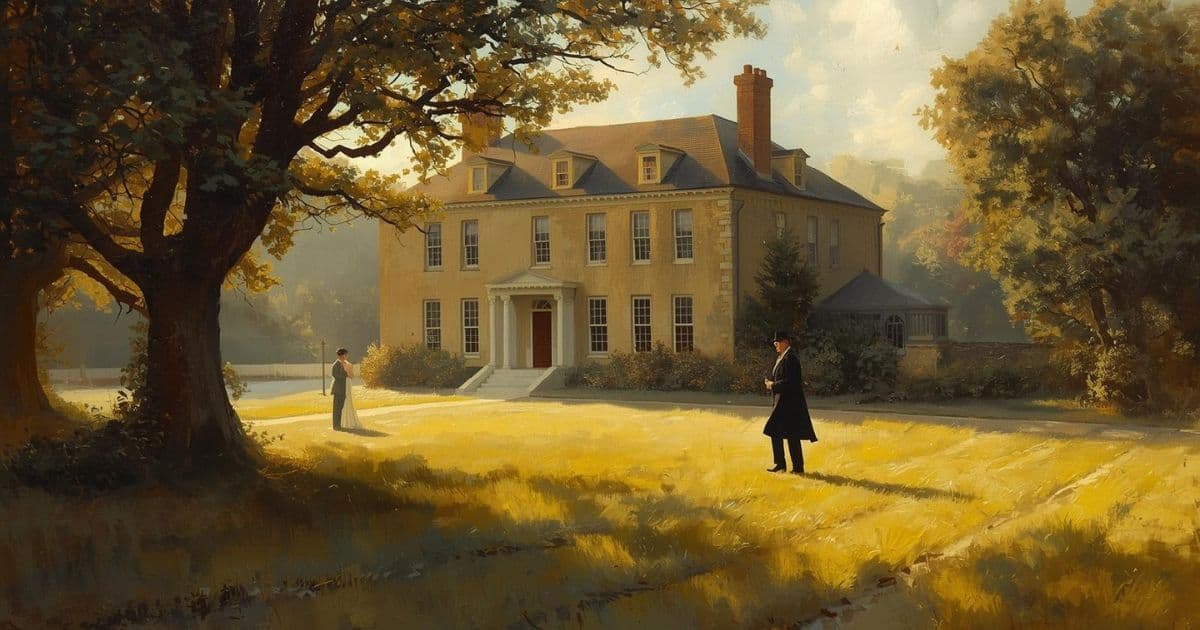
quarter of an hour we came to Miss Havisham’s house, which was of old
brick, and dismal, and had a great many iron bars to it. Some of the
windows had been walled up; of those that remained, all the lower were
rustily barred. There was a courtyard in front, and that was barred; so
we had to wait, after ringing the bell, until some one should come to
open it. While we waited at the gate, I peeped in (even then Mr.
Pumblechook said, “And fourteen?” but I pretended not to hear him), and
saw that at the side of the house there was a large brewery. No brewing
was going on in it, and none seemed to have gone on for a long long
time.
A window was raised, and a clear voice demanded “What name?” To which
my conductor replied, “Pumblechook.” The voice returned, “Quite right,”
and the window was shut again, and a young lady came across the
court-yard, with keys in her hand.
“This,” said Mr. Pumblechook, “is Pip.”
“This is Pip, is it?” returned the young lady, who was very pretty and
seemed very proud; “come in, Pip.”
Mr. Pumblechook was coming in also, when she stopped him with the gate.
“Oh!” she said. “Did you wish to see Miss Havisham?”
“If Miss Havisham wished to see me,” returned Mr. Pumblechook,
discomfited.
“Ah!” said the girl; “but you see she don’t.”
She said it so finally, and in such an undiscussible way, that Mr.
Pumblechook, though in a condition of ruffled dignity, could not
protest. But he eyed me severely,—as if I had done anything to
him!—and departed with the words reproachfully delivered: “Boy! Let
your behaviour here be a credit unto them which brought you up by
hand!” I was not free from apprehension that he would come back to
propound through the gate, “And sixteen?” But he didn’t.
My young conductress locked the gate, and we went across the courtyard.
It was paved and clean, but grass was growing in every crevice. The
brewery buildings had a little lane of communication with it, and the
wooden gates of that lane stood open, and all the brewery beyond stood
open, away to the high enclosing wall; and all was empty and disused.
The cold wind seemed to blow colder there than outside the gate; and it
made a shrill noise in howling in and out at the open sides of the
brewery, like the noise of wind in the rigging of a ship at sea.
She saw me looking at it, and she said, “You could drink without hurt
all the strong beer that’s brewed there now, boy.”
“I should think I could, miss,” said I, in a shy way.
“Better not try to brew beer there now, or it would turn out sour, boy;
don’t you think so?”
“It looks like it, miss.”
“Not that anybody means to try,” she added, “for that’s all done with,
and the place will stand as idle as it is till it falls. As to strong
beer, there’s enough of it in the cellars already, to drown the Manor
House.”
[Illustration]
“Is that the name of this house, miss?”
“One of its names, boy.”
“It has more than one, then, miss?”
“One more. Its other name was Satis; which is Greek, or Latin, or
Hebrew, or all three—or all one to me—for enough.”
“Enough House,” said I; “that’s a curious name, miss.”
“Yes,” she replied; “but it meant more than it said. It meant, when it
was given, that whoever had this house could want nothing else. They
must have been easily satisfied in those days, I should think. But
don’t loiter, boy.”
Though she called me “boy” so often, and with a carelessness that was
far from complimentary, she was of about my own age. She seemed much
older than I, of course, being a girl, and beautiful and
self-possessed; and she was as scornful of me as if she had been
one-and-twenty, and a queen.
We went into the house by a side door, the great front entrance had two
chains across it outside,—and the first thing I noticed was, that the
passages were all dark, and that she had left a candle burning there.
She took it up, and we went through more passages and up a staircase,
and still it was all dark, and only the candle lighted us.
At last we came to the door of a room, and she said, “Go in.”
I answered, more in shyness than politeness, “After you, miss.”
To this she returned: “Don’t be ridiculous, boy; I am not going in.”
And scornfully walked away, and—what was worse—took the candle with
her.
This was very uncomfortable, and I was half afraid. However, the only
thing to be done being to knock at the door, I knocked, and was told
from within to enter. I entered, therefore, and found myself in a
pretty large room, well lighted with wax candles. No glimpse of
daylight was to be seen in it. It was a dressing-room, as I supposed
from the furniture, though much of it was of forms and uses then quite
unknown to me. But prominent in it was a draped table with a gilded
looking-glass, and that I made out at first sight to be a fine lady’s
dressing-table.
Whether I should have made out this object so soon if there had been no
fine lady sitting at it, I cannot say. In an arm-chair, with an elbow
resting on the table and her head leaning on that hand, sat the
strangest lady I have ever seen, or shall ever see.
She was dressed in rich materials,—satins, and lace, and silks,—all of
white. Her shoes were white. And she had a long white veil dependent
from her hair, and she had bridal flowers in her hair, but her hair was
white. Some bright jewels sparkled on her neck and on her hands, and
some other jewels lay sparkling on the table. Dresses, less splendid
than the dress she wore, and half-packed trunks, were scattered about.
She had not quite finished dressing, for she had but one shoe on,—the
other was on the table near her hand,—her veil was but half arranged,
her watch and chain were not put on, and some lace for her bosom lay
with those trinkets, and with her handkerchief, and gloves, and some
flowers, and a Prayer-Book all confusedly heaped about the
looking-glass.
It was not in the first few moments that I saw all these things, though
I saw more of them in the first moments than might be supposed. But I
saw that everything within my view which ought to be white, had been
white long ago, and had lost its lustre and was faded and yellow. I saw
that the bride within the bridal dress had withered like the dress, and
like the flowers, and had no brightness left but the brightness of her
sunken eyes. I saw that the dress had been put upon the rounded figure
of a young woman, and that the figure upon which it now hung loose had
shrunk to skin and bone. Once, I had been taken to see some ghastly
waxwork at the Fair, representing I know not what impossible personage
lying in state. Once, I had been taken to one of our old marsh churches
to see a skeleton in the ashes of a rich dress that had been dug out of
a vault under the church pavement. Now, waxwork and skeleton seemed to
have dark eyes that moved and looked at me. I should have cried out, if
I could.
“Who is it?” said the lady at the table.
“Pip, ma’am.”
“Pip?”
“Mr. Pumblechook’s boy, ma’am. Come—to play.”
“Come nearer; let me look at you. Come close.”
It was when I stood before her, avoiding her eyes, that I took note of
the surrounding objects in detail, and saw that her watch had stopped
at twenty minutes to nine, and that a clock in the room had stopped at
twenty minutes to nine.
“Look at me,” said Miss Havisham. “You are not afraid of a woman who
has never seen the sun since you were born?”
I regret to state that I was not afraid of telling the enormous lie
comprehended in the answer “No.”
“Do you know what I touch here?” she said, laying her hands, one upon
the other, on her left side.
“Yes, ma’am.” (It made me think of the young man.)
“What do I touch?”
“Your heart.”
“Broken!”
She uttered the word with an eager look, and with strong emphasis, and
with a weird smile that had a kind of boast in it. Afterwards she kept
her hands there for a little while, and slowly took them away as if
they were heavy.
“I am tired,” said Miss Havisham. “I want diversion, and I have done
with men and women. Play.”
I think it will be conceded by my most disputatious reader, that she
could hardly have directed an unfortunate boy to do anything in the
wide world more difficult to be done under the circumstances.
“I sometimes have sick fancies,” she went on, “and I have a sick fancy
that I want to see some play. There, there!” with an impatient movement
of the fingers of her right hand; “play, play, play!”
For a moment, with the fear of my sister’s working me before my eyes, I
had a desperate idea of starting round the room in the assumed
character of Mr. Pumblechook’s chaise-cart. But I felt myself so
unequal to the performance that I gave it up, and stood looking at Miss
Havisham in what I suppose she took for a dogged manner, inasmuch as
she said, when we had taken a good look at each other,—
“Are you sullen and obstinate?”
“No, ma’am, I am very sorry for you, and very sorry I can’t play just
now. If you complain of me I shall get into trouble with my sister, so
I would do it if I could; but it’s so new here, and so strange, and so
fine,—and melancholy—.” I stopped, fearing I might say too much, or had
already said it, and we took another look at each other.
Before she spoke again, she turned her eyes from me, and looked at the
dress she wore, and at the dressing-table, and finally at herself in
the looking-glass.
“So new to him,” she muttered, “so old to me; so strange to him, so
familiar to me; so melancholy to both of us! Call Estella.”
As she was still looking at the reflection of herself, I thought she
was still talking to herself, and kept quiet.
“Call Estella,” she repeated, flashing a look at me. “You can do that.
Call Estella. At the door.”
To stand in the dark in a mysterious passage of an unknown house,
bawling Estella to a scornful young lady neither visible nor
responsive, and feeling it a dreadful liberty so to roar out her name,
was almost as bad as playing to order. But she answered at last, and
her light came along the dark passage like a star.
Miss Havisham beckoned her to come close, and took up a jewel from the
table, and tried its effect upon her fair young bosom and against her
pretty brown hair. “Your own, one day, my dear, and you will use it
well. Let me see you play cards with this boy.”
“With this boy? Why, he is a common labouring-boy!”
I thought I overheard Miss Havisham answer,—only it seemed so
unlikely,—“Well? You can break his heart.”
“What do you play, boy?” asked Estella of myself, with the greatest
disdain.
“Nothing but beggar my neighbour, miss.”
“Beggar him,” said Miss Havisham to Estella. So we sat down to cards.
It was then I began to understand that everything in the room had
stopped, like the watch and the clock, a long time ago. I noticed that
Miss Havisham put down the jewel exactly on the spot from which she had
taken it up. As Estella dealt the cards, I glanced at the
dressing-table again, and saw that the shoe upon it, once white, now
yellow, had never been worn. I glanced down at the foot from which the
shoe was absent, and saw that the silk stocking on it, once white, now
yellow, had been trodden ragged. Without this arrest of everything,
this standing still of all the pale decayed objects, not even the
withered bridal dress on the collapsed form could have looked so like
grave-clothes, or the long veil so like a shroud.
So she sat, corpse-like, as we played at cards; the frillings and
trimmings on her bridal dress, looking like earthy paper. I knew
nothing then of the discoveries that are occasionally made of bodies
buried in ancient times, which fall to powder in the moment of being
distinctly seen; but, I have often thought since, that she must have
looked as if the admission of the natural light of day would have
struck her to dust.
“He calls the knaves Jacks, this boy!” said Estella with disdain,
before our first game was out. “And what coarse hands he has! And what
thick boots!”
I had never thought of being ashamed of my hands before; but I began to
consider them a very indifferent pair. Her contempt for me was so
strong, that it became infectious, and I caught it.
She won the game, and I dealt. I misdealt, as was only natural, when I
knew she was lying in wait for me to do wrong; and she denounced me for
a stupid, clumsy labouring-boy.
“You say nothing of her,” remarked Miss Havisham to me, as she looked
on. “She says many hard things of you, but you say nothing of her. What
do you think of her?”
“I don’t like to say,” I stammered.
“Tell me in my ear,” said Miss Havisham, bending down.
“I think she is very proud,” I replied, in a whisper.
“Anything else?”
“I think she is very pretty.”
“Anything else?”
“I think she is very insulting.” (She was looking at me then with a
look of supreme aversion.)
“Anything else?”
“I think I should like to go home.”
“And never see her again, though she is so pretty?”
“I am not sure that I shouldn’t like to see her again, but I should
like to go home now.”
“You shall go soon,” said Miss Havisham, aloud. “Play the game out.”
Saving for the one weird smile at first, I should have felt almost sure
that Miss Havisham’s face could not smile. It had dropped into a
watchful and brooding expression,—most likely when all the things about
her had become transfixed,—and it looked as if nothing could ever lift
it up again. Her chest had dropped, so that she stooped; and her voice
had dropped, so that she spoke low, and with a dead lull upon her;
altogether, she had the appearance of having dropped body and soul,
within and without, under the weight of a crushing blow.
I played the game to an end with Estella, and she beggared me. She
threw the cards down on the table when she had won them all, as if she
despised them for having been won of me.
“When shall I have you here again?” said Miss Havisham. “Let me think.”
I was beginning to remind her that to-day was Wednesday, when she
checked me with her former impatient movement of the fingers of her
right hand.
“There, there! I know nothing of days of the week; I know nothing of
weeks of the year. Come again after six days. You hear?”
“Yes, ma’am.”
“Estella, take him down. Let him have something to eat, and let him
roam and look about him while he eats. Go, Pip.”
I followed the candle down, as I had followed the candle up, and she
stood it in the place where we had found it. Until she opened the side
entrance, I had fancied, without thinking about it, that it must
necessarily be night-time. The rush of the daylight quite confounded
me, and made me feel as if I had been in the candlelight of the strange
room many hours.
“You are to wait here, you boy,” said Estella; and disappeared and
closed the door.
I took the opportunity of being alone in the courtyard to look at my
coarse hands and my common boots. My opinion of those accessories was
not favourable. They had never troubled me before, but they troubled me
now, as vulgar appendages. I determined to ask Joe why he had ever
taught me to call those picture-cards Jacks, which ought to be called
knaves. I wished Joe had been rather more genteelly brought up, and
then I should have been so too.
She came back, with some bread and meat and a little mug of beer. She
put the mug down on the stones of the yard, and gave me the bread and
meat without looking at me, as insolently as if I were a dog in
disgrace. I was so humiliated, hurt, spurned, offended, angry, sorry,—I
cannot hit upon the right name for the smart—God knows what its name
was,—that tears started to my eyes. The moment they sprang there, the
girl looked at me with a quick delight in having been the cause of
them. This gave me power to keep them back and to look at her: so, she
gave a contemptuous toss—but with a sense, I thought, of having made
too sure that I was so wounded—and left me.
But when she was gone, I looked about me for a place to hide my face
in, and got behind one of the gates in the brewery-lane, and leaned my
sleeve against the wall there, and leaned my forehead on it and cried.
As I cried, I kicked the wall, and took a hard twist at my hair; so
bitter were my feelings, and so sharp was the smart without a name,
that needed counteraction.
My sister’s bringing up had made me sensitive. In the little world in
which children have their existence whosoever brings them up, there is
nothing so finely perceived and so finely felt as injustice. It may be
only small injustice that the child can be exposed to; but the child is
small, and its world is small, and its rocking-horse stands as many
hands high, according to scale, as a big-boned Irish hunter. Within
myself, I had sustained, from my babyhood, a perpetual conflict with
injustice. I had known, from the time when I could speak, that my
sister, in her capricious and violent coercion, was unjust to me. I had
cherished a profound conviction that her bringing me up by hand gave
her no right to bring me up by jerks. Through all my punishments,
disgraces, fasts, and vigils, and other penitential performances, I had
nursed this assurance; and to my communing so much with it, in a
solitary and unprotected way, I in great part refer the fact that I was
morally timid and very sensitive.
I got rid of my injured feelings for the time by kicking them into the
brewery wall, and twisting them out of my hair, and then I smoothed my
face with my sleeve, and came from behind the gate. The bread and meat
were acceptable, and the beer was warming and tingling, and I was soon
in spirits to look about me.
To be sure, it was a deserted place, down to the pigeon-house in the
brewery-yard, which had been blown crooked on its pole by some high
wind, and would have made the pigeons think themselves at sea, if there
had been any pigeons there to be rocked by it. But there were no
pigeons in the dove-cot, no horses in the stable, no pigs in the sty,
no malt in the storehouse, no smells of grains and beer in the copper
or the vat. All the uses and scents of the brewery might have
evaporated with its last reek of smoke. In a by-yard, there was a
wilderness of empty casks, which had a certain sour remembrance of
better days lingering about them; but it was too sour to be accepted as
a sample of the beer that was gone,—and in this respect I remember
those recluses as being like most others.
Behind the furthest end of the brewery, was a rank garden with an old
wall; not so high but that I could struggle up and hold on long enough
to look over it, and see that the rank garden was the garden of the
house, and that it was overgrown with tangled weeds, but that there was
a track upon the green and yellow paths, as if some one sometimes
walked there, and that Estella was walking away from me even then. But
she seemed to be everywhere. For when I yielded to the temptation
presented by the casks, and began to walk on them, I saw her walking
on them at the end of the yard of casks. She had her back towards me,
and held her pretty brown hair spread out in her two hands, and never
looked round, and passed out of my view directly. So, in the brewery
itself,—by which I mean the large paved lofty place in which they used
to make the beer, and where the brewing utensils still were. When I
first went into it, and, rather oppressed by its gloom, stood near the
door looking about me, I saw her pass among the extinguished fires, and
ascend some light iron stairs, and go out by a gallery high overhead,
as if she were going out into the sky.
It was in this place, and at this moment, that a strange thing happened
to my fancy. I thought it a strange thing then, and I thought it a
stranger thing long afterwards. I turned my eyes—a little dimmed by
looking up at the frosty light—towards a great wooden beam in a low
nook of the building near me on my right hand, and I saw a figure
hanging there by the neck. A figure all in yellow white, with but one
shoe to the feet; and it hung so, that I could see that the faded
trimmings of the dress were like earthy paper, and that the face was
Miss Havisham’s, with a movement going over the whole countenance as if
she were trying to call to me. In the terror of seeing the figure, and
in the terror of being certain that it had not been there a moment
before, I at first ran from it, and then ran towards it. And my terror
was greatest of all when I found no figure there.
Nothing less than the frosty light of the cheerful sky, the sight of
people passing beyond the bars of the court-yard gate, and the reviving
influence of the rest of the bread and meat and beer, would have
brought me round. Even with those aids, I might not have come to myself
as soon as I did, but that I saw Estella approaching with the keys, to
let me out. She would have some fair reason for looking down upon me, I
thought, if she saw me frightened; and she would have no fair reason.
She gave me a triumphant glance in passing me, as if she rejoiced that
my hands were so coarse and my boots were so thick, and she opened the
gate, and stood holding it. I was passing out without looking at her,
when she touched me with a taunting hand.
“Why don’t you cry?”
“Because I don’t want to.”
“You do,” said she. “You have been crying till you are half blind, and
you are near crying again now.”
She laughed contemptuously, pushed me out, and locked the gate upon me.
I went straight to Mr. Pumblechook’s, and was immensely relieved to
find him not at home. So, leaving word with the shopman on what day I
was wanted at Miss Havisham’s again, I set off on the four-mile walk to
our forge; pondering, as I went along, on all I had seen, and deeply
revolving that I was a common labouring-boy; that my hands were coarse;
that my boots were thick; that I had fallen into a despicable habit of
calling knaves Jacks; that I was much more ignorant than I had
considered myself last night, and generally that I was in a low-lived
bad way.
Master this chapter. Complete your experience
Purchase the complete book to access all chapters and support classic literature
As an Amazon Associate, we earn a small commission from qualifying purchases at no additional cost to you.
Available in paperback, hardcover, and e-book formats
Let's Analyse the Pattern
The moment when exposure to someone else's perceived superiority transforms your contentment into shame about things you never questioned before.
Why This Matters
Connect literature to life
This chapter teaches how to recognize when someone uses social positioning to make you feel inferior and question your worth.
Practice This Today
This week, notice when someone makes you suddenly ashamed of something you were fine with before—ask yourself if this shame is borrowed or earned.
Now let's explore the literary elements.
Key Quotes & Analysis
"He calls the knaves, Jacks, this boy!"
Context: When Pip uses the common term for face cards during their card game
This small detail becomes huge in Pip's mind. Estella seizes on his working-class vocabulary to humiliate him. It shows how class markers can be found in the smallest details of speech and behavior.
In Today's Words:
Look how he talks - so obvious he's not one of us!
"What coarse hands he has! And what thick boots!"
Context: Her first assessment of Pip when they meet
Estella immediately identifies the physical markers of Pip's working-class life. His hands show manual labor, his boots are practical rather than fashionable. She weaponizes his appearance against him.
In Today's Words:
Ew, look at his rough hands and cheap shoes - so obvious he's poor.
"I had never thought of being ashamed of my hands before; but I began to consider them a very indifferent pair."
Context: After Estella's cruel comments about his appearance
This shows the exact moment Pip's self-image shatters. Things he never questioned about himself suddenly become sources of shame. One encounter has changed how he sees himself forever.
In Today's Words:
I never cared about my hands before, but now I thought they looked awful.
"I was so humiliated, hurt, spurned, offended, angry, sorry... that tears started to my eyes."
Context: After the card game, when Pip goes outside alone
Dickens captures the overwhelming emotional impact of class humiliation. It's not just hurt feelings - it's a fundamental attack on Pip's sense of self-worth that will drive his actions for the rest of the novel.
In Today's Words:
I felt so embarrassed and angry and hurt that I started crying.
Thematic Threads
Class
In This Chapter
Estella's casual cruelty reveals the gulf between social classes—she doesn't just have more money, she has the confidence to judge others as naturally inferior
Development
Introduced here as the central conflict that will drive Pip's transformation
In Your Life:
You might recognize this when someone's tone or assumptions make you suddenly conscious of your background, education, or circumstances.
Identity
In This Chapter
Pip's sense of self crumbles in minutes—his hands, boots, and speech suddenly feel wrong when seen through Estella's eyes
Development
Introduced here as Pip begins questioning everything about himself
In Your Life:
You might feel this when a single comment makes you doubt things about yourself you'd never questioned before.
Ambition
In This Chapter
The seeds of Pip's great expectations are planted through humiliation—he wants to become 'uncommon' to prove Estella wrong
Development
Introduced here as desire born from shame rather than genuine aspiration
In Your Life:
You might notice this when your goals are more about proving others wrong than pursuing what actually fulfills you.
Appearance vs Reality
In This Chapter
Satis House looks grand but is actually rotting—the stopped clocks and yellowed wedding dress suggest wealth that masks decay
Development
Introduced here as the false allure of status and wealth
In Your Life:
You might see this when impressive exteriors hide dysfunction, debt, or unhappiness underneath.
You now have the context. Time to form your own thoughts.
Discussion Questions
- 1
What specific things does Estella criticize about Pip, and how does he react to her comments?
analysis • surface - 2
Why does Pip suddenly feel ashamed of things he never noticed before, like his hands and boots?
analysis • medium - 3
Where do you see this pattern today - someone feeling ashamed of their normal life after encountering a different social class?
application • medium - 4
How would you help someone who just experienced what Pip did - feeling suddenly inadequate after a cruel comparison?
application • deep - 5
What does this chapter reveal about how our self-image depends on who we compare ourselves to?
reflection • deep
Critical Thinking Exercise
Rewrite the Scene from Estella's Perspective
Write a few paragraphs describing the card game from Estella's point of view. What might she be thinking and feeling? What has shaped her attitude toward people like Pip? This exercise helps you understand how privilege can create blind spots and casual cruelty.
Consider:
- •Consider what Estella has been taught about social class and her place in it
- •Think about whether her cruelty comes from confidence or insecurity
- •Notice how environment and upbringing shape our automatic judgments of others
Journaling Prompt
Write about a time when someone made you feel ashamed of something you'd never questioned before. How did that experience change you, and what would you tell your younger self now?
Coming Up Next...
Chapter 9: The Weight of Lies and Shame
Back home, Pip faces his sister's relentless questioning about his mysterious visit. But how can he possibly explain what he's experienced - and will his newfound shame about his humble origins change how he sees his own family?