An excerpt from the original text.(complete · 4840 words)
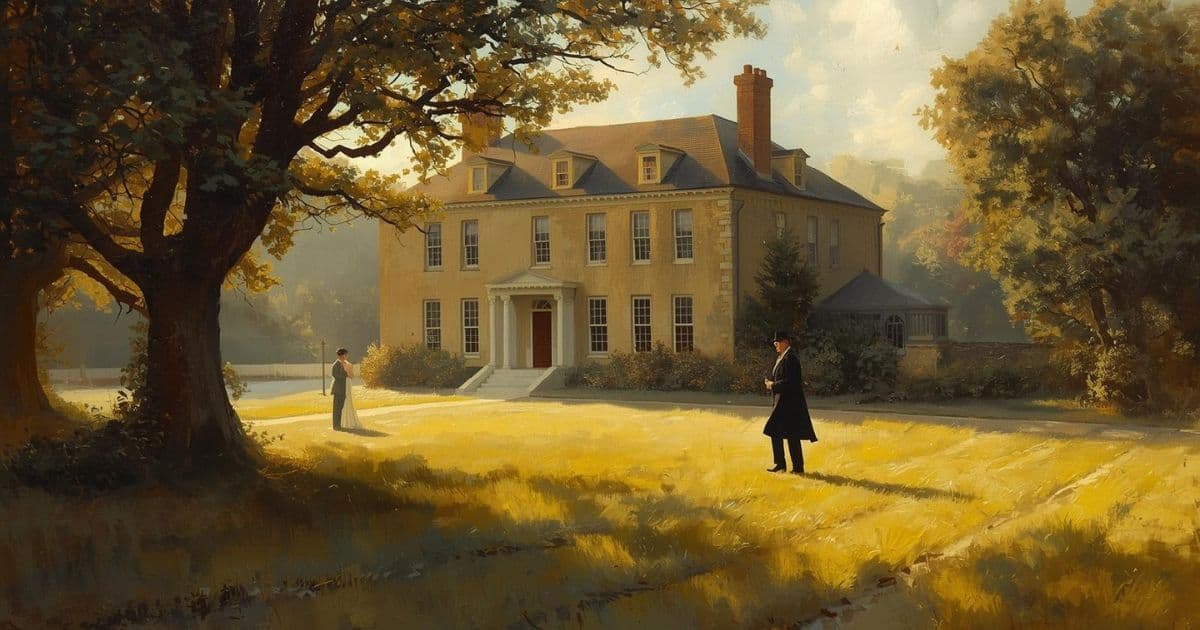
that staid old house near the Green at Richmond should ever come to
be haunted when I am dead, it will be haunted, surely, by my ghost. O
the many, many nights and days through which the unquiet spirit within
me haunted that house when Estella lived there! Let my body be where it
would, my spirit was always wandering, wandering, wandering, about that
house.
The lady with whom Estella was placed, Mrs. Brandley by name, was a
widow, with one daughter several years older than Estella. The mother
looked young, and the daughter looked old; the mother’s complexion was
pink, and the daughter’s was yellow; the mother set up for frivolity,
and the daughter for theology. They were in what is called a good
position, and visited, and were visited by, numbers of people. Little,
if any, community of feeling subsisted between them and Estella, but
the understanding was established that they were necessary to her, and
that she was necessary to them. Mrs. Brandley had been a friend of Miss
Havisham’s before the time of her seclusion.
In Mrs. Brandley’s house and out of Mrs. Brandley’s house, I suffered
every kind and degree of torture that Estella could cause me. The
nature of my relations with her, which placed me on terms of
familiarity without placing me on terms of favour, conduced to my
distraction. She made use of me to tease other admirers, and she turned
the very familiarity between herself and me to the account of putting a
constant slight on my devotion to her. If I had been her secretary,
steward, half-brother, poor relation,—if I had been a younger brother
of her appointed husband,—I could not have seemed to myself further
from my hopes when I was nearest to her. The privilege of calling her
by her name and hearing her call me by mine became, under the
circumstances an aggravation of my trials; and while I think it likely
that it almost maddened her other lovers, I know too certainly that it
almost maddened me.
She had admirers without end. No doubt my jealousy made an admirer of
every one who went near her; but there were more than enough of them
without that.
I saw her often at Richmond, I heard of her often in town, and I used
often to take her and the Brandleys on the water; there were picnics,
fête days, plays, operas, concerts, parties, all sorts of pleasures,
through which I pursued her,—and they were all miseries to me. I never
had one hour’s happiness in her society, and yet my mind all round the
four-and-twenty hours was harping on the happiness of having her with
me unto death.
Throughout this part of our intercourse,—and it lasted, as will
presently be seen, for what I then thought a long time,—she habitually
reverted to that tone which expressed that our association was forced
upon us. There were other times when she would come to a sudden check
in this tone and in all her many tones, and would seem to pity me.
“Pip, Pip,” she said one evening, coming to such a check, when we sat
apart at a darkening window of the house in Richmond; “will you never
take warning?”
“Of what?”
“Of me.”
“Warning not to be attracted by you, do you mean, Estella?”
“Do I mean! If you don’t know what I mean, you are blind.”
I should have replied that Love was commonly reputed blind, but for the
reason that I always was restrained—and this was not the least of my
miseries—by a feeling that it was ungenerous to press myself upon her,
when she knew that she could not choose but obey Miss Havisham. My
dread always was, that this knowledge on her part laid me under a heavy
disadvantage with her pride, and made me the subject of a rebellious
struggle in her bosom.
“At any rate,” said I, “I have no warning given me just now, for you
wrote to me to come to you, this time.”
“That’s true,” said Estella, with a cold careless smile that always
chilled me.
After looking at the twilight without, for a little while, she went on
to say:—
“The time has come round when Miss Havisham wishes to have me for a day
at Satis. You are to take me there, and bring me back, if you will. She
would rather I did not travel alone, and objects to receiving my maid,
for she has a sensitive horror of being talked of by such people. Can
you take me?”
“Can I take you, Estella!”
“You can then? The day after to-morrow, if you please. You are to pay
all charges out of my purse. You hear the condition of your going?”
“And must obey,” said I.
This was all the preparation I received for that visit, or for others
like it; Miss Havisham never wrote to me, nor had I ever so much as
seen her handwriting. We went down on the next day but one, and we
found her in the room where I had first beheld her, and it is needless
to add that there was no change in Satis House.
She was even more dreadfully fond of Estella than she had been when I
last saw them together; I repeat the word advisedly, for there was
something positively dreadful in the energy of her looks and embraces.
She hung upon Estella’s beauty, hung upon her words, hung upon her
gestures, and sat mumbling her own trembling fingers while she looked
at her, as though she were devouring the beautiful creature she had
reared.
From Estella she looked at me, with a searching glance that seemed to
pry into my heart and probe its wounds. “How does she use you, Pip; how
does she use you?” she asked me again, with her witch-like eagerness,
even in Estella’s hearing. But, when we sat by her flickering fire at
night, she was most weird; for then, keeping Estella’s hand drawn
through her arm and clutched in her own hand, she extorted from her, by
dint of referring back to what Estella had told her in her regular
letters, the names and conditions of the men whom she had fascinated;
and as Miss Havisham dwelt upon this roll, with the intensity of a mind
mortally hurt and diseased, she sat with her other hand on her crutch
stick, and her chin on that, and her wan bright eyes glaring at me, a
very spectre.
I saw in this, wretched though it made me, and bitter the sense of
dependence and even of degradation that it awakened,—I saw in this that
Estella was set to wreak Miss Havisham’s revenge on men, and that she
was not to be given to me until she had gratified it for a term. I saw
in this, a reason for her being beforehand assigned to me. Sending her
out to attract and torment and do mischief, Miss Havisham sent her with
the malicious assurance that she was beyond the reach of all admirers,
and that all who staked upon that cast were secured to lose. I saw in
this that I, too, was tormented by a perversion of ingenuity, even
while the prize was reserved for me. I saw in this the reason for my
being staved off so long and the reason for my late guardian’s
declining to commit himself to the formal knowledge of such a scheme.
In a word, I saw in this Miss Havisham as I had her then and there
before my eyes, and always had had her before my eyes; and I saw in
this, the distinct shadow of the darkened and unhealthy house in which
her life was hidden from the sun.
The candles that lighted that room of hers were placed in sconces on
the wall. They were high from the ground, and they burnt with the
steady dulness of artificial light in air that is seldom renewed. As I
looked round at them, and at the pale gloom they made, and at the
stopped clock, and at the withered articles of bridal dress upon the
table and the ground, and at her own awful figure with its ghostly
reflection thrown large by the fire upon the ceiling and the wall, I
saw in everything the construction that my mind had come to, repeated
and thrown back to me. My thoughts passed into the great room across
the landing where the table was spread, and I saw it written, as it
were, in the falls of the cobwebs from the centre-piece, in the
crawlings of the spiders on the cloth, in the tracks of the mice as
they betook their little quickened hearts behind the panels, and in the
gropings and pausings of the beetles on the floor.
It happened on the occasion of this visit that some sharp words arose
between Estella and Miss Havisham. It was the first time I had ever
seen them opposed.
We were seated by the fire, as just now described, and Miss Havisham
still had Estella’s arm drawn through her own, and still clutched
Estella’s hand in hers, when Estella gradually began to detach herself.
She had shown a proud impatience more than once before, and had rather
endured that fierce affection than accepted or returned it.
“What!” said Miss Havisham, flashing her eyes upon her, “are you tired
of me?”
“Only a little tired of myself,” replied Estella, disengaging her arm,
and moving to the great chimney-piece, where she stood looking down at
the fire.
“Speak the truth, you ingrate!” cried Miss Havisham, passionately
striking her stick upon the floor; “you are tired of me.”
Estella looked at her with perfect composure, and again looked down at
the fire. Her graceful figure and her beautiful face expressed a
self-possessed indifference to the wild heat of the other, that was
almost cruel.
“You stock and stone!” exclaimed Miss Havisham. “You cold, cold heart!”
“What?” said Estella, preserving her attitude of indifference as she
leaned against the great chimney-piece and only moving her eyes; “do
you reproach me for being cold? You?”
“Are you not?” was the fierce retort.
“You should know,” said Estella. “I am what you have made me. Take all
the praise, take all the blame; take all the success, take all the
failure; in short, take me.”
“O, look at her, look at her!” cried Miss Havisham, bitterly; “Look at
her so hard and thankless, on the hearth where she was reared! Where I
took her into this wretched breast when it was first bleeding from its
stabs, and where I have lavished years of tenderness upon her!”
[Illustration]
“At least I was no party to the compact,” said Estella, “for if I could
walk and speak, when it was made, it was as much as I could do. But
what would you have? You have been very good to me, and I owe
everything to you. What would you have?”
“Love,” replied the other.
“You have it.”
“I have not,” said Miss Havisham.
“Mother by adoption,” retorted Estella, never departing from the easy
grace of her attitude, never raising her voice as the other did, never
yielding either to anger or tenderness,—“mother by adoption, I have
said that I owe everything to you. All I possess is freely yours. All
that you have given me, is at your command to have again. Beyond that,
I have nothing. And if you ask me to give you, what you never gave me,
my gratitude and duty cannot do impossibilities.”
“Did I never give her love!” cried Miss Havisham, turning wildly to me.
“Did I never give her a burning love, inseparable from jealousy at all
times, and from sharp pain, while she speaks thus to me! Let her call
me mad, let her call me mad!”
“Why should I call you mad,” returned Estella, “I, of all people? Does
any one live, who knows what set purposes you have, half as well as I
do? Does any one live, who knows what a steady memory you have, half as
well as I do? I who have sat on this same hearth on the little stool
that is even now beside you there, learning your lessons and looking up
into your face, when your face was strange and frightened me!”
“Soon forgotten!” moaned Miss Havisham. “Times soon forgotten!”
“No, not forgotten,” retorted Estella,—“not forgotten, but treasured up
in my memory. When have you found me false to your teaching? When have
you found me unmindful of your lessons? When have you found me giving
admission here,” she touched her bosom with her hand, “to anything that
you excluded? Be just to me.”
“So proud, so proud!” moaned Miss Havisham, pushing away her grey hair
with both her hands.
“Who taught me to be proud?” returned Estella. “Who praised me when I
learnt my lesson?”
“So hard, so hard!” moaned Miss Havisham, with her former action.
“Who taught me to be hard?” returned Estella. “Who praised me when I
learnt my lesson?”
“But to be proud and hard to me!” Miss Havisham quite shrieked, as
she stretched out her arms. “Estella, Estella, Estella, to be proud and
hard to me!”
Estella looked at her for a moment with a kind of calm wonder, but was
not otherwise disturbed; when the moment was past, she looked down at
the fire again.
“I cannot think,” said Estella, raising her eyes after a silence “why
you should be so unreasonable when I come to see you after a
separation. I have never forgotten your wrongs and their causes. I have
never been unfaithful to you or your schooling. I have never shown any
weakness that I can charge myself with.”
“Would it be weakness to return my love?” exclaimed Miss Havisham. “But
yes, yes, she would call it so!”
“I begin to think,” said Estella, in a musing way, after another moment
of calm wonder, “that I almost understand how this comes about. If you
had brought up your adopted daughter wholly in the dark confinement of
these rooms, and had never let her know that there was such a thing as
the daylight by which she had never once seen your face,—if you had
done that, and then, for a purpose had wanted her to understand the
daylight and know all about it, you would have been disappointed and
angry?”
Miss Havisham, with her head in her hands, sat making a low moaning,
and swaying herself on her chair, but gave no answer.
“Or,” said Estella,—“which is a nearer case,—if you had taught her,
from the dawn of her intelligence, with your utmost energy and might,
that there was such a thing as daylight, but that it was made to be her
enemy and destroyer, and she must always turn against it, for it had
blighted you and would else blight her;—if you had done this, and then,
for a purpose, had wanted her to take naturally to the daylight and she
could not do it, you would have been disappointed and angry?”
Miss Havisham sat listening (or it seemed so, for I could not see her
face), but still made no answer.
“So,” said Estella, “I must be taken as I have been made. The success
is not mine, the failure is not mine, but the two together make me.”
Miss Havisham had settled down, I hardly knew how, upon the floor,
among the faded bridal relics with which it was strewn. I took
advantage of the moment—I had sought one from the first—to leave the
room, after beseeching Estella’s attention to her, with a movement of
my hand. When I left, Estella was yet standing by the great
chimney-piece, just as she had stood throughout. Miss Havisham’s grey
hair was all adrift upon the ground, among the other bridal wrecks, and
was a miserable sight to see.
It was with a depressed heart that I walked in the starlight for an
hour and more, about the courtyard, and about the brewery, and about
the ruined garden. When I at last took courage to return to the room, I
found Estella sitting at Miss Havisham’s knee, taking up some stitches
in one of those old articles of dress that were dropping to pieces, and
of which I have often been reminded since by the faded tatters of old
banners that I have seen hanging up in cathedrals. Afterwards, Estella
and I played at cards, as of yore,—only we were skilful now, and played
French games,—and so the evening wore away, and I went to bed.
I lay in that separate building across the courtyard. It was the first
time I had ever lain down to rest in Satis House, and sleep refused to
come near me. A thousand Miss Havishams haunted me. She was on this
side of my pillow, on that, at the head of the bed, at the foot, behind
the half-opened door of the dressing-room, in the dressing-room, in the
room overhead, in the room beneath,—everywhere. At last, when the night
was slow to creep on towards two o’clock, I felt that I absolutely
could no longer bear the place as a place to lie down in, and that I
must get up. I therefore got up and put on my clothes, and went out
across the yard into the long stone passage, designing to gain the
outer courtyard and walk there for the relief of my mind. But I was no
sooner in the passage than I extinguished my candle; for I saw Miss
Havisham going along it in a ghostly manner, making a low cry. I
followed her at a distance, and saw her go up the staircase. She
carried a bare candle in her hand, which she had probably taken from
one of the sconces in her own room, and was a most unearthly object by
its light. Standing at the bottom of the staircase, I felt the mildewed
air of the feast-chamber, without seeing her open the door, and I heard
her walking there, and so across into her own room, and so across again
into that, never ceasing the low cry. After a time, I tried in the dark
both to get out, and to go back, but I could do neither until some
streaks of day strayed in and showed me where to lay my hands. During
the whole interval, whenever I went to the bottom of the staircase, I
heard her footstep, saw her light pass above, and heard her ceaseless
low cry.
Before we left next day, there was no revival of the difference between
her and Estella, nor was it ever revived on any similar occasion; and
there were four similar occasions, to the best of my remembrance. Nor,
did Miss Havisham’s manner towards Estella in anywise change, except
that I believed it to have something like fear infused among its former
characteristics.
It is impossible to turn this leaf of my life, without putting Bentley
Drummle’s name upon it; or I would, very gladly.
On a certain occasion when the Finches were assembled in force, and
when good feeling was being promoted in the usual manner by nobody’s
agreeing with anybody else, the presiding Finch called the Grove to
order, forasmuch as Mr. Drummle had not yet toasted a lady; which,
according to the solemn constitution of the society, it was the brute’s
turn to do that day. I thought I saw him leer in an ugly way at me
while the decanters were going round, but as there was no love lost
between us, that might easily be. What was my indignant surprise when
he called upon the company to pledge him to “Estella!”
“Estella who?” said I.
“Never you mind,” retorted Drummle.
“Estella of where?” said I. “You are bound to say of where.” Which he
was, as a Finch.
“Of Richmond, gentlemen,” said Drummle, putting me out of the question,
“and a peerless beauty.”
Much he knew about peerless beauties, a mean, miserable idiot! I
whispered Herbert.
“I know that lady,” said Herbert, across the table, when the toast had
been honoured.
“Do you?” said Drummle.
“And so do I,” I added, with a scarlet face.
“Do you?” said Drummle. “O, Lord!”
This was the only retort—except glass or crockery—that the heavy
creature was capable of making; but, I became as highly incensed by it
as if it had been barbed with wit, and I immediately rose in my place
and said that I could not but regard it as being like the honourable
Finch’s impudence to come down to that Grove,—we always talked about
coming down to that Grove, as a neat Parliamentary turn of
expression,—down to that Grove, proposing a lady of whom he knew
nothing. Mr. Drummle, upon this, starting up, demanded what I meant by
that? Whereupon I made him the extreme reply that I believed he knew
where I was to be found.
Whether it was possible in a Christian country to get on without blood,
after this, was a question on which the Finches were divided. The
debate upon it grew so lively, indeed, that at least six more
honourable members told six more, during the discussion, that they
believed they knew where they were to be found. However, it was
decided at last (the Grove being a Court of Honour) that if Mr. Drummle
would bring never so slight a certificate from the lady, importing that
he had the honour of her acquaintance, Mr. Pip must express his regret,
as a gentleman and a Finch, for “having been betrayed into a warmth
which.” Next day was appointed for the production (lest our honour
should take cold from delay), and next day Drummle appeared with a
polite little avowal in Estella’s hand, that she had had the honour of
dancing with him several times. This left me no course but to regret
that I had been “betrayed into a warmth which,” and on the whole to
repudiate, as untenable, the idea that I was to be found anywhere.
Drummle and I then sat snorting at one another for an hour, while the
Grove engaged in indiscriminate contradiction, and finally the
promotion of good feeling was declared to have gone ahead at an amazing
rate.
I tell this lightly, but it was no light thing to me. For, I cannot
adequately express what pain it gave me to think that Estella should
show any favour to a contemptible, clumsy, sulky booby, so very far
below the average. To the present moment, I believe it to have been
referable to some pure fire of generosity and disinterestedness in my
love for her, that I could not endure the thought of her stooping to
that hound. No doubt I should have been miserable whomsoever she had
favoured; but a worthier object would have caused me a different kind
and degree of distress.
It was easy for me to find out, and I did soon find out, that Drummle
had begun to follow her closely, and that she allowed him to do it. A
little while, and he was always in pursuit of her, and he and I crossed
one another every day. He held on, in a dull persistent way, and
Estella held him on; now with encouragement, now with discouragement,
now almost flattering him, now openly despising him, now knowing him
very well, now scarcely remembering who he was.
The Spider, as Mr. Jaggers had called him, was used to lying in wait,
however, and had the patience of his tribe. Added to that, he had a
blockhead confidence in his money and in his family greatness, which
sometimes did him good service,—almost taking the place of
concentration and determined purpose. So, the Spider, doggedly watching
Estella, outwatched many brighter insects, and would often uncoil
himself and drop at the right nick of time.
At a certain Assembly Ball at Richmond (there used to be Assembly Balls
at most places then), where Estella had outshone all other beauties,
this blundering Drummle so hung about her, and with so much toleration
on her part, that I resolved to speak to her concerning him. I took the
next opportunity; which was when she was waiting for Mrs. Blandley to
take her home, and was sitting apart among some flowers, ready to go. I
was with her, for I almost always accompanied them to and from such
places.
“Are you tired, Estella?”
“Rather, Pip.”
“You should be.”
“Say rather, I should not be; for I have my letter to Satis House to
write, before I go to sleep.”
“Recounting to-night’s triumph?” said I. “Surely a very poor one,
Estella.”
“What do you mean? I didn’t know there had been any.”
“Estella,” said I, “do look at that fellow in the corner yonder, who is
looking over here at us.”
“Why should I look at him?” returned Estella, with her eyes on me
instead. “What is there in that fellow in the corner yonder,—to use
your words,—that I need look at?”
“Indeed, that is the very question I want to ask you,” said I. “For he
has been hovering about you all night.”
“Moths, and all sorts of ugly creatures,” replied Estella, with a
glance towards him, “hover about a lighted candle. Can the candle help
it?”
“No,” I returned; “but cannot the Estella help it?”
“Well!” said she, laughing, after a moment, “perhaps. Yes. Anything you
like.”
“But, Estella, do hear me speak. It makes me wretched that you should
encourage a man so generally despised as Drummle. You know he is
despised.”
“Well?” said she.
“You know he is as ungainly within as without. A deficient,
ill-tempered, lowering, stupid fellow.”
“Well?” said she.
“You know he has nothing to recommend him but money and a ridiculous
roll of addle-headed predecessors; now, don’t you?”
“Well?” said she again; and each time she said it, she opened her
lovely eyes the wider.
To overcome the difficulty of getting past that monosyllable, I took it
from her, and said, repeating it with emphasis, “Well! Then, that is
why it makes me wretched.”
Now, if I could have believed that she favoured Drummle with any idea
of making me—me—wretched, I should have been in better heart about it;
but in that habitual way of hers, she put me so entirely out of the
question, that I could believe nothing of the kind.
“Pip,” said Estella, casting her glance over the room, “don’t be
foolish about its effect on you. It may have its effect on others, and
may be meant to have. It’s not worth discussing.”
“Yes it is,” said I, “because I cannot bear that people should say,
‘she throws away her graces and attractions on a mere boor, the lowest
in the crowd.’”
“I can bear it,” said Estella.
“Oh! don’t be so proud, Estella, and so inflexible.”
“Calls me proud and inflexible in this breath!” said Estella, opening
her hands. “And in his last breath reproached me for stooping to a
boor!”
“There is no doubt you do,” said I, something hurriedly, “for I have
seen you give him looks and smiles this very night, such as you never
give to—me.”
“Do you want me then,” said Estella, turning suddenly with a fixed and
serious, if not angry, look, “to deceive and entrap you?”
“Do you deceive and entrap him, Estella?”
“Yes, and many others,—all of them but you. Here is Mrs. Brandley. I’ll
say no more.”
And now that I have given the one chapter to the theme that so filled
my heart, and so often made it ache and ache again, I pass on
unhindered, to the event that had impended over me longer yet; the
event that had begun to be prepared for, before I knew that the world
held Estella, and in the days when her baby intelligence was receiving
its first distortions from Miss Havisham’s wasting hands.
In the Eastern story, the heavy slab that was to fall on the bed of
state in the flush of conquest was slowly wrought out of the quarry,
the tunnel for the rope to hold it in its place was slowly carried
through the leagues of rock, the slab was slowly raised and fitted in
the roof, the rope was rove to it and slowly taken through the miles of
hollow to the great iron ring. All being made ready with much labour,
and the hour come, the sultan was aroused in the dead of the night, and
the sharpened axe that was to sever the rope from the great iron ring
was put into his hand, and he struck with it, and the rope parted and
rushed away, and the ceiling fell. So, in my case; all the work, near
and afar, that tended to the end, had been accomplished; and in an
instant the blow was struck, and the roof of my stronghold dropped upon
me.
Master this chapter. Complete your experience
Purchase the complete book to access all chapters and support classic literature
As an Amazon Associate, we earn a small commission from qualifying purchases at no additional cost to you.
Available in paperback, hardcover, and e-book formats
Let's Analyse the Pattern
The Weapon Maker's Curse
When you shape someone into an emotional weapon for revenge, you become their primary victim because weapons cannot discriminate between targets.
Why This Matters
Connect literature to life
This chapter teaches how to recognize when someone's coldness toward you is actually about their own unhealed wounds and someone else's agenda.
Practice This Today
This week, notice when someone's harsh treatment feels disproportionate to your interaction - ask yourself what pain they might be carrying from someone else.
Now let's explore the literary elements.
Key Quotes & Analysis
"I am what you have made me. Take all the praise, take all the blame; take all the success, take all the failure; in short, take me."
Context: Estella coldly tells Miss Havisham that she is exactly the unloving person she was raised to be
This is Estella's devastating truth bomb to Miss Havisham. She's saying 'you wanted a weapon, you got one - but weapons don't have feelings.' It shows how cycles of hurt create more victims, not justice.
In Today's Words:
You made me this way, so don't complain about what you created.
"So hard, so hard! What have I done? What have I done?"
Context: Miss Havisham's anguished realization that her revenge plot has backfired completely
This shows Miss Havisham finally understanding that her need for revenge has destroyed everyone, including herself. She's created a monster she can't control and lost any chance of real love or happiness.
In Today's Words:
Oh God, what have I done to everyone, including myself?
"You will get me out of your thoughts in a week."
Context: Estella dismissively tells Pip he'll get over her quickly
This shows Estella's complete inability to understand real love or emotional attachment. She can't fathom that Pip's feelings are genuine because she's never experienced genuine emotion herself.
In Today's Words:
You'll forget about me and move on in no time.
Thematic Threads
Revenge
In This Chapter
Miss Havisham's revenge plot backfires spectacularly as Estella cannot love her creator any more than her victims
Development
Evolution from mysterious benefactor motives to revealed devastating consequences of using people as instruments of vengeance
In Your Life:
You might see this when holding grudges ends up poisoning your own relationships more than hurting your target.
Identity
In This Chapter
Estella declares she is exactly what Miss Havisham made her to be—incapable of genuine feeling
Development
Builds on Pip's identity crisis by showing how others can be molded into false selves for someone else's agenda
In Your Life:
You might recognize this when you realize you've been performing a role others expected rather than being authentic.
Love
In This Chapter
Estella reveals she deceives all her suitors except Pip, yet cannot love him either due to her emotional programming
Development
Deepens from Pip's unrequited love to expose how love cannot exist where emotional capacity has been systematically destroyed
In Your Life:
You might see this when someone claims they 'don't know how to love' due to their upbringing or past trauma.
Class
In This Chapter
Estella chooses the brutish Drummle over Pip, showing how class trumps character in her calculated choices
Development
Continues theme of how social status influences romantic choices, but now reveals it as deliberate manipulation rather than natural preference
In Your Life:
You might notice this when people choose partners based on status or security rather than genuine connection.
Manipulation
In This Chapter
The full scope of Miss Havisham's manipulation is revealed—she used both Pip and Estella as pawns in her revenge scheme
Development
Escalates from hints of mysterious motives to full exposure of a decades-long manipulation campaign
In Your Life:
You might recognize this when you realize someone has been pulling strings behind the scenes to orchestrate your choices.
You now have the context. Time to form your own thoughts.
Discussion Questions
- 1
What does Estella tell Miss Havisham about why she can't love her, and how does Miss Havisham react to this revelation?
analysis • surface - 2
Why does Miss Havisham's plan to use Estella as revenge against men end up hurting Miss Havisham herself the most?
analysis • medium - 3
Where do you see this pattern today - people who create harsh environments to 'toughen others up' but then wonder why no one shows them warmth?
application • medium - 4
If you were Pip's friend watching him pursue someone who openly admits she's incapable of love, what would you tell him and how would you approach that conversation?
application • deep - 5
What does this chapter reveal about how the way we treat others programs them to treat us back?
reflection • deep
Critical Thinking Exercise
Map Your Relationship Patterns
Think about a relationship where you feel like you're not getting the warmth, respect, or attention you want. Write down how you typically interact with that person - your tone, your level of openness, what you withhold or freely give. Then honestly assess: are you modeling the behavior you want to receive back?
Consider:
- •Consider whether you're withholding trust or warmth as protection
- •Notice if you're trying to 'teach lessons' through emotional distance
- •Look for ways you might be programming the very behavior you dislike
Journaling Prompt
Write about a time when someone treated you exactly the way you had been treating them, and you suddenly realized the connection. How did that awareness change your approach?
Coming Up Next...
Chapter 39: The Convict's Return
Pip's twenty-third birthday has passed, and he's living independently in London's Temple district. The mysterious benefactor who has funded his gentleman's education is about to reveal themselves, bringing shocking truths that will shatter everything Pip believed about his great expectations.