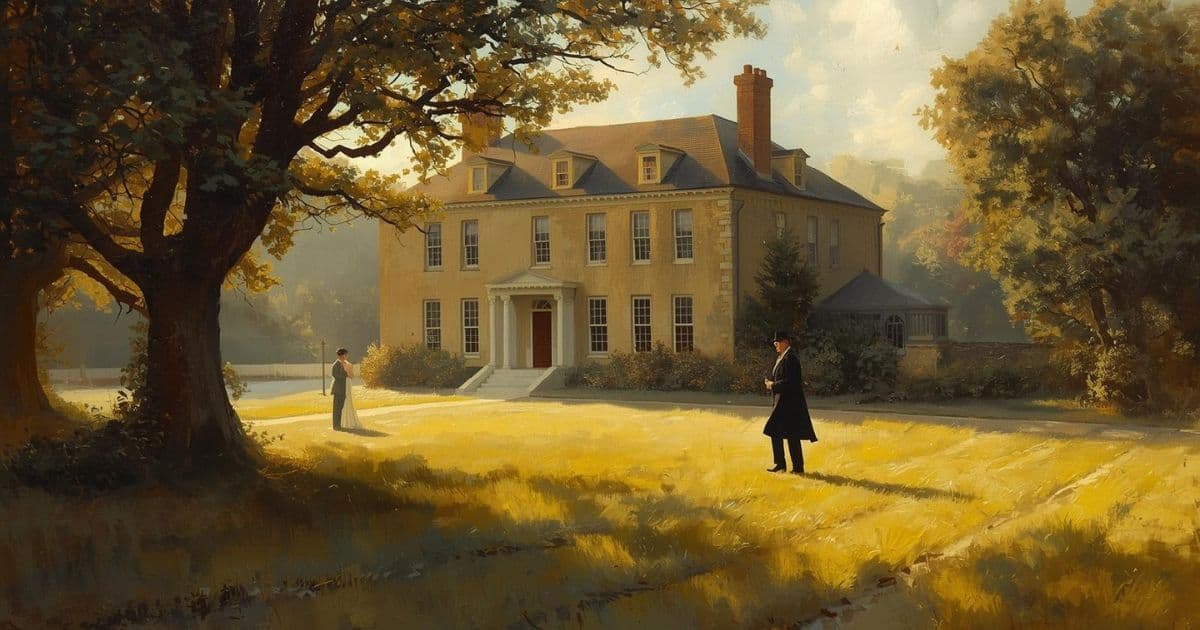
An excerpt from the original text.(complete · 4890 words)
etimes in the morning I was up and out. It was too early yet to go to
Miss Havisham’s, so I loitered into the country on Miss Havisham’s side
of town,—which was not Joe’s side; I could go there to-morrow,—thinking
about my patroness, and painting brilliant pictures of her plans for
me.
She had adopted Estella, she had as good as adopted me, and it could
not fail to be her intention to bring us together. She reserved it for
me to restore the desolate house, admit the sunshine into the dark
rooms, set the clocks a-going and the cold hearths a-blazing, tear down
the cobwebs, destroy the vermin,—in short, do all the shining deeds of
the young Knight of romance, and marry the Princess. I had stopped to
look at the house as I passed; and its seared red brick walls, blocked
windows, and strong green ivy clasping even the stacks of chimneys with
its twigs and tendons, as if with sinewy old arms, had made up a rich
attractive mystery, of which I was the hero. Estella was the
inspiration of it, and the heart of it, of course. But, though she had
taken such strong possession of me, though my fancy and my hope were so
set upon her, though her influence on my boyish life and character had
been all-powerful, I did not, even that romantic morning, invest her
with any attributes save those she possessed. I mention this in this
place, of a fixed purpose, because it is the clue by which I am to be
followed into my poor labyrinth. According to my experience, the
conventional notion of a lover cannot be always true. The unqualified
truth is, that when I loved Estella with the love of a man, I loved her
simply because I found her irresistible. Once for all; I knew to my
sorrow, often and often, if not always, that I loved her against
reason, against promise, against peace, against hope, against
happiness, against all discouragement that could be. Once for all; I
loved her none the less because I knew it, and it had no more influence
in restraining me than if I had devoutly believed her to be human
perfection.
I so shaped out my walk as to arrive at the gate at my old time. When I
had rung at the bell with an unsteady hand, I turned my back upon the
gate, while I tried to get my breath and keep the beating of my heart
moderately quiet. I heard the side-door open, and steps come across the
courtyard; but I pretended not to hear, even when the gate swung on its
rusty hinges.
Being at last touched on the shoulder, I started and turned. I started
much more naturally then, to find myself confronted by a man in a sober
grey dress. The last man I should have expected to see in that place of
porter at Miss Havisham’s door.
“Orlick!”
“Ah, young master, there’s more changes than yours. But come in, come
in. It’s opposed to my orders to hold the gate open.”
I entered and he swung it, and locked it, and took the key out. “Yes!”
said he, facing round, after doggedly preceding me a few steps towards
the house. “Here I am!”
“How did you come here?”
“I come here,” he retorted, “on my legs. I had my box brought alongside
me in a barrow.”
“Are you here for good?”
“I ain’t here for harm, young master, I suppose?”
I was not so sure of that. I had leisure to entertain the retort in my
mind, while he slowly lifted his heavy glance from the pavement, up my
legs and arms, to my face.
“Then you have left the forge?” I said.
“Do this look like a forge?” replied Orlick, sending his glance all
round him with an air of injury. “Now, do it look like it?”
I asked him how long he had left Gargery’s forge?
“One day is so like another here,” he replied, “that I don’t know
without casting it up. However, I come here some time since you left.”
“I could have told you that, Orlick.”
“Ah!” said he, dryly. “But then you’ve got to be a scholar.”
By this time we had come to the house, where I found his room to be one
just within the side-door, with a little window in it looking on the
courtyard. In its small proportions, it was not unlike the kind of
place usually assigned to a gate-porter in Paris. Certain keys were
hanging on the wall, to which he now added the gate key; and his
patchwork-covered bed was in a little inner division or recess. The
whole had a slovenly, confined, and sleepy look, like a cage for a
human dormouse; while he, looming dark and heavy in the shadow of a
corner by the window, looked like the human dormouse for whom it was
fitted up,—as indeed he was.
“I never saw this room before,” I remarked; “but there used to be no
Porter here.”
“No,” said he; “not till it got about that there was no protection on
the premises, and it come to be considered dangerous, with convicts and
Tag and Rag and Bobtail going up and down. And then I was recommended
to the place as a man who could give another man as good as he brought,
and I took it. It’s easier than bellowsing and hammering.—That’s
loaded, that is.”
My eye had been caught by a gun with a brass-bound stock over the
chimney-piece, and his eye had followed mine.
“Well,” said I, not desirous of more conversation, “shall I go up to
Miss Havisham?”
“Burn me, if I know!” he retorted, first stretching himself and then
shaking himself; “my orders ends here, young master. I give this here
bell a rap with this here hammer, and you go on along the passage till
you meet somebody.”
“I am expected, I believe?”
“Burn me twice over, if I can say!” said he.
Upon that, I turned down the long passage which I had first trodden in
my thick boots, and he made his bell sound. At the end of the passage,
while the bell was still reverberating, I found Sarah Pocket, who
appeared to have now become constitutionally green and yellow by reason
of me.
“Oh!” said she. “You, is it, Mr. Pip?”
“It is, Miss Pocket. I am glad to tell you that Mr. Pocket and family
are all well.”
“Are they any wiser?” said Sarah, with a dismal shake of the head;
“they had better be wiser, than well. Ah, Matthew, Matthew! You know
your way, sir?”
Tolerably, for I had gone up the staircase in the dark, many a time. I
ascended it now, in lighter boots than of yore, and tapped in my old
way at the door of Miss Havisham’s room. “Pip’s rap,” I heard her say,
immediately; “come in, Pip.”
She was in her chair near the old table, in the old dress, with her two
hands crossed on her stick, her chin resting on them, and her eyes on
the fire. Sitting near her, with the white shoe, that had never been
worn, in her hand, and her head bent as she looked at it, was an
elegant lady whom I had never seen.
“Come in, Pip,” Miss Havisham continued to mutter, without looking
round or up; “come in, Pip, how do you do, Pip? so you kiss my hand as
if I were a queen, eh?—Well?”
She looked up at me suddenly, only moving her eyes, and repeated in a
grimly playful manner,—
“Well?”
“I heard, Miss Havisham,” said I, rather at a loss, “that you were so
kind as to wish me to come and see you, and I came directly.”
“Well?”
The lady whom I had never seen before, lifted up her eyes and looked
archly at me, and then I saw that the eyes were Estella’s eyes. But she
was so much changed, was so much more beautiful, so much more womanly,
in all things winning admiration, had made such wonderful advance, that
I seemed to have made none. I fancied, as I looked at her, that I
slipped hopelessly back into the coarse and common boy again. O the
sense of distance and disparity that came upon me, and the
inaccessibility that came about her!
She gave me her hand. I stammered something about the pleasure I felt
in seeing her again, and about my having looked forward to it, for a
long, long time.
“Do you find her much changed, Pip?” asked Miss Havisham, with her
greedy look, and striking her stick upon a chair that stood between
them, as a sign to me to sit down there.
“When I came in, Miss Havisham, I thought there was nothing of Estella
in the face or figure; but now it all settles down so curiously into
the old—”
“What? You are not going to say into the old Estella?” Miss Havisham
interrupted. “She was proud and insulting, and you wanted to go away
from her. Don’t you remember?”
I said confusedly that that was long ago, and that I knew no better
then, and the like. Estella smiled with perfect composure, and said she
had no doubt of my having been quite right, and of her having been very
disagreeable.
“Is he changed?” Miss Havisham asked her.
“Very much,” said Estella, looking at me.
“Less coarse and common?” said Miss Havisham, playing with Estella’s
hair.
Estella laughed, and looked at the shoe in her hand, and laughed again,
and looked at me, and put the shoe down. She treated me as a boy still,
but she lured me on.
We sat in the dreamy room among the old strange influences which had so
wrought upon me, and I learnt that she had but just come home from
France, and that she was going to London. Proud and wilful as of old,
she had brought those qualities into such subjection to her beauty that
it was impossible and out of nature—or I thought so—to separate them
from her beauty. Truly it was impossible to dissociate her presence
from all those wretched hankerings after money and gentility that had
disturbed my boyhood,—from all those ill-regulated aspirations that had
first made me ashamed of home and Joe,—from all those visions that had
raised her face in the glowing fire, struck it out of the iron on the
anvil, extracted it from the darkness of night to look in at the wooden
window of the forge, and flit away. In a word, it was impossible for me
to separate her, in the past or in the present, from the innermost life
of my life.
It was settled that I should stay there all the rest of the day, and
return to the hotel at night, and to London to-morrow. When we had
conversed for a while, Miss Havisham sent us two out to walk in the
neglected garden: on our coming in by and by, she said, I should wheel
her about a little, as in times of yore.
So, Estella and I went out into the garden by the gate through which I
had strayed to my encounter with the pale young gentleman, now Herbert;
I, trembling in spirit and worshipping the very hem of her dress; she,
quite composed and most decidedly not worshipping the hem of mine. As
we drew near to the place of encounter, she stopped and said,—
“I must have been a singular little creature to hide and see that fight
that day; but I did, and I enjoyed it very much.”
“You rewarded me very much.”
“Did I?” she replied, in an incidental and forgetful way. “I remember I
entertained a great objection to your adversary, because I took it ill
that he should be brought here to pester me with his company.”
“He and I are great friends now.”
“Are you? I think I recollect though, that you read with his father?”
“Yes.”
I made the admission with reluctance, for it seemed to have a boyish
look, and she already treated me more than enough like a boy.
“Since your change of fortune and prospects, you have changed your
companions,” said Estella.
“Naturally,” said I.
“And necessarily,” she added, in a haughty tone; “what was fit company
for you once, would be quite unfit company for you now.”
In my conscience, I doubt very much whether I had any lingering
intention left of going to see Joe; but if I had, this observation put
it to flight.
“You had no idea of your impending good fortune, in those times?” said
Estella, with a slight wave of her hand, signifying in the fighting
times.
“Not the least.”
The air of completeness and superiority with which she walked at my
side, and the air of youthfulness and submission with which I walked at
hers, made a contrast that I strongly felt. It would have rankled in me
more than it did, if I had not regarded myself as eliciting it by being
so set apart for her and assigned to her.
The garden was too overgrown and rank for walking in with ease, and
after we had made the round of it twice or thrice, we came out again
into the brewery yard. I showed her to a nicety where I had seen her
walking on the casks, that first old day, and she said, with a cold and
careless look in that direction, “Did I?” I reminded her where she had
come out of the house and given me my meat and drink, and she said, “I
don’t remember.” “Not remember that you made me cry?” said I. “No,”
said she, and shook her head and looked about her. I verily believe
that her not remembering and not minding in the least, made me cry
again, inwardly,—and that is the sharpest crying of all.
“You must know,” said Estella, condescending to me as a brilliant and
beautiful woman might, “that I have no heart,—if that has anything to
do with my memory.”
I got through some jargon to the effect that I took the liberty of
doubting that. That I knew better. That there could be no such beauty
without it.
“Oh! I have a heart to be stabbed in or shot in, I have no doubt,” said
Estella, “and of course if it ceased to beat I should cease to be. But
you know what I mean. I have no softness there,
no—sympathy—sentiment—nonsense.”
What was it that was borne in upon my mind when she stood still and
looked attentively at me? Anything that I had seen in Miss Havisham?
No. In some of her looks and gestures there was that tinge of
resemblance to Miss Havisham which may often be noticed to have been
acquired by children, from grown person with whom they have been much
associated and secluded, and which, when childhood is passed, will
produce a remarkable occasional likeness of expression between faces
that are otherwise quite different. And yet I could not trace this to
Miss Havisham. I looked again, and though she was still looking at me,
the suggestion was gone.
What was it?
“I am serious,” said Estella, not so much with a frown (for her brow
was smooth) as with a darkening of her face; “if we are to be thrown
much together, you had better believe it at once. No!” imperiously
stopping me as I opened my lips. “I have not bestowed my tenderness
anywhere. I have never had any such thing.”
In another moment we were in the brewery, so long disused, and she
pointed to the high gallery where I had seen her going out on that same
first day, and told me she remembered to have been up there, and to
have seen me standing scared below. As my eyes followed her white hand,
again the same dim suggestion that I could not possibly grasp crossed
me. My involuntary start occasioned her to lay her hand upon my arm.
Instantly the ghost passed once more and was gone.
What was it?
“What is the matter?” asked Estella. “Are you scared again?”
“I should be, if I believed what you said just now,” I replied, to turn
it off.
“Then you don’t? Very well. It is said, at any rate. Miss Havisham will
soon be expecting you at your old post, though I think that might be
laid aside now, with other old belongings. Let us make one more round
of the garden, and then go in. Come! You shall not shed tears for my
cruelty to-day; you shall be my Page, and give me your shoulder.”
Her handsome dress had trailed upon the ground. She held it in one hand
now, and with the other lightly touched my shoulder as we walked. We
walked round the ruined garden twice or thrice more, and it was all in
bloom for me. If the green and yellow growth of weed in the chinks of
the old wall had been the most precious flowers that ever blew, it
could not have been more cherished in my remembrance.
There was no discrepancy of years between us to remove her far from me;
we were of nearly the same age, though of course the age told for more
in her case than in mine; but the air of inaccessibility which her
beauty and her manner gave her, tormented me in the midst of my
delight, and at the height of the assurance I felt that our patroness
had chosen us for one another. Wretched boy!
At last we went back into the house, and there I heard, with surprise,
that my guardian had come down to see Miss Havisham on business, and
would come back to dinner. The old wintry branches of chandeliers in
the room where the mouldering table was spread had been lighted while
we were out, and Miss Havisham was in her chair and waiting for me.
It was like pushing the chair itself back into the past, when we began
the old slow circuit round about the ashes of the bridal feast. But, in
the funereal room, with that figure of the grave fallen back in the
chair fixing its eyes upon her, Estella looked more bright and
beautiful than before, and I was under stronger enchantment.
The time so melted away, that our early dinner-hour drew close at hand,
and Estella left us to prepare herself. We had stopped near the centre
of the long table, and Miss Havisham, with one of her withered arms
stretched out of the chair, rested that clenched hand upon the yellow
cloth. As Estella looked back over her shoulder before going out at the
door, Miss Havisham kissed that hand to her, with a ravenous intensity
that was of its kind quite dreadful.
Then, Estella being gone and we two left alone, she turned to me, and
said in a whisper,—
“Is she beautiful, graceful, well-grown? Do you admire her?”
“Everybody must who sees her, Miss Havisham.”
She drew an arm round my neck, and drew my head close down to hers as
she sat in the chair. “Love her, love her, love her! How does she use
you?”
Before I could answer (if I could have answered so difficult a question
at all) she repeated, “Love her, love her, love her! If she favours
you, love her. If she wounds you, love her. If she tears your heart to
pieces,—and as it gets older and stronger it will tear deeper,—love
her, love her, love her!”
Never had I seen such passionate eagerness as was joined to her
utterance of these words. I could feel the muscles of the thin arm
round my neck swell with the vehemence that possessed her.
“Hear me, Pip! I adopted her, to be loved. I bred her and educated her,
to be loved. I developed her into what she is, that she might be loved.
Love her!”
She said the word often enough, and there could be no doubt that she
meant to say it; but if the often repeated word had been hate instead
of love—despair—revenge—dire death—it could not have sounded from her
lips more like a curse.
“I’ll tell you,” said she, in the same hurried passionate whisper,
“what real love is. It is blind devotion, unquestioning
self-humiliation, utter submission, trust and belief against yourself
and against the whole world, giving up your whole heart and soul to the
smiter—as I did!”
When she came to that, and to a wild cry that followed that, I caught
her round the waist. For she rose up in the chair, in her shroud of a
dress, and struck at the air as if she would as soon have struck
herself against the wall and fallen dead.
All this passed in a few seconds. As I drew her down into her chair, I
was conscious of a scent that I knew, and turning, saw my guardian in
the room.
He always carried (I have not yet mentioned it, I think) a
pocket-handkerchief of rich silk and of imposing proportions, which was
of great value to him in his profession. I have seen him so terrify a
client or a witness by ceremoniously unfolding this pocket-handkerchief
as if he were immediately going to blow his nose, and then pausing, as
if he knew he should not have time to do it before such client or
witness committed himself, that the self-committal has followed
directly, quite as a matter of course. When I saw him in the room he
had this expressive pocket-handkerchief in both hands, and was looking
at us. On meeting my eye, he said plainly, by a momentary and silent
pause in that attitude, “Indeed? Singular!” and then put the
handkerchief to its right use with wonderful effect.
Miss Havisham had seen him as soon as I, and was (like everybody else)
afraid of him. She made a strong attempt to compose herself, and
stammered that he was as punctual as ever.
“As punctual as ever,” he repeated, coming up to us. “(How do you do,
Pip? Shall I give you a ride, Miss Havisham? Once round?) And so you
are here, Pip?”
I told him when I had arrived, and how Miss Havisham had wished me to
come and see Estella. To which he replied, “Ah! Very fine young lady!”
Then he pushed Miss Havisham in her chair before him, with one of his
large hands, and put the other in his trousers-pocket as if the pocket
were full of secrets.
“Well, Pip! How often have you seen Miss Estella before?” said he, when
he came to a stop.
“How often?”
“Ah! How many times? Ten thousand times?”
“Oh! Certainly not so many.”
“Twice?”
“Jaggers,” interposed Miss Havisham, much to my relief, “leave my Pip
alone, and go with him to your dinner.”
He complied, and we groped our way down the dark stairs together. While
we were still on our way to those detached apartments across the paved
yard at the back, he asked me how often I had seen Miss Havisham eat
and drink; offering me a breadth of choice, as usual, between a hundred
times and once.
I considered, and said, “Never.”
“And never will, Pip,” he retorted, with a frowning smile. “She has
never allowed herself to be seen doing either, since she lived this
present life of hers. She wanders about in the night, and then lays
hands on such food as she takes.”
“Pray, sir,” said I, “may I ask you a question?”
“You may,” said he, “and I may decline to answer it. Put your
question.”
“Estella’s name. Is it Havisham or—?” I had nothing to add.
“Or what?” said he.
“Is it Havisham?”
“It is Havisham.”
This brought us to the dinner-table, where she and Sarah Pocket awaited
us. Mr. Jaggers presided, Estella sat opposite to him, I faced my green
and yellow friend. We dined very well, and were waited on by a
maid-servant whom I had never seen in all my comings and goings, but
who, for anything I know, had been in that mysterious house the whole
time. After dinner a bottle of choice old port was placed before my
guardian (he was evidently well acquainted with the vintage), and the
two ladies left us.
Anything to equal the determined reticence of Mr. Jaggers under that
roof I never saw elsewhere, even in him. He kept his very looks to
himself, and scarcely directed his eyes to Estella’s face once during
dinner. When she spoke to him, he listened, and in due course answered,
but never looked at her, that I could see. On the other hand, she often
looked at him, with interest and curiosity, if not distrust, but his
face never showed the least consciousness. Throughout dinner he took a
dry delight in making Sarah Pocket greener and yellower, by often
referring in conversation with me to my expectations; but here, again,
he showed no consciousness, and even made it appear that he
extorted—and even did extort, though I don’t know how—those references
out of my innocent self.
And when he and I were left alone together, he sat with an air upon him
of general lying by in consequence of information he possessed, that
really was too much for me. He cross-examined his very wine when he had
nothing else in hand. He held it between himself and the candle, tasted
the port, rolled it in his mouth, swallowed it, looked at his glass
again, smelt the port, tried it, drank it, filled again, and
cross-examined the glass again, until I was as nervous as if I had
known the wine to be telling him something to my disadvantage. Three or
four times I feebly thought I would start conversation; but whenever he
saw me going to ask him anything, he looked at me with his glass in his
hand, and rolling his wine about in his mouth, as if requesting me to
take notice that it was of no use, for he couldn’t answer.
I think Miss Pocket was conscious that the sight of me involved her in
the danger of being goaded to madness, and perhaps tearing off her
cap,—which was a very hideous one, in the nature of a muslin mop,—and
strewing the ground with her hair,—which assuredly had never grown on
her head. She did not appear when we afterwards went up to Miss
Havisham’s room, and we four played at whist. In the interval, Miss
Havisham, in a fantastic way, had put some of the most beautiful jewels
from her dressing-table into Estella’s hair, and about her bosom and
arms; and I saw even my guardian look at her from under his thick
eyebrows, and raise them a little, when her loveliness was before him,
with those rich flushes of glitter and colour in it.
[Illustration]
Of the manner and extent to which he took our trumps into custody, and
came out with mean little cards at the ends of hands, before which the
glory of our Kings and Queens was utterly abased, I say nothing; nor,
of the feeling that I had, respecting his looking upon us personally in
the light of three very obvious and poor riddles that he had found out
long ago. What I suffered from, was the incompatibility between his
cold presence and my feelings towards Estella. It was not that I knew I
could never bear to speak to him about her, that I knew I could never
bear to hear him creak his boots at her, that I knew I could never bear
to see him wash his hands of her; it was, that my admiration should be
within a foot or two of him,—it was, that my feelings should be in the
same place with him,—that, was the agonizing circumstance.
We played until nine o’clock, and then it was arranged that when
Estella came to London I should be forewarned of her coming and should
meet her at the coach; and then I took leave of her, and touched her
and left her.
My guardian lay at the Boar in the next room to mine. Far into the
night, Miss Havisham’s words, “Love her, love her, love her!” sounded
in my ears. I adapted them for my own repetition, and said to my
pillow, “I love her, I love her, I love her!” hundreds of times. Then,
a burst of gratitude came upon me, that she should be destined for me,
once the blacksmith’s boy. Then I thought if she were, as I feared, by
no means rapturously grateful for that destiny yet, when would she
begin to be interested in me? When should I awaken the heart within her
that was mute and sleeping now?
Ah me! I thought those were high and great emotions. But I never
thought there was anything low and small in my keeping away from Joe,
because I knew she would be contemptuous of him. It was but a day gone,
and Joe had brought the tears into my eyes; they had soon dried, God
forgive me! soon dried.
Master this chapter. Complete your experience
Purchase the complete book to access all chapters and support classic literature
As an Amazon Associate, we earn a small commission from qualifying purchases at no additional cost to you.
Available in paperback, hardcover, and e-book formats
Let's Analyse the Pattern
Using someone's genuine feelings as a tool to control and harm them through calculated emotional manipulation.
Why This Matters
Connect literature to life
This chapter reveals how intermittent reinforcement creates addiction-like attachment patterns.
Practice This Today
This week, notice when someone gives you just enough attention to keep you chasing but never enough to satisfy you—then step back and ask what they gain from keeping you off-balance.
Now let's explore the literary elements.
Key Quotes & Analysis
"Love her, love her, love her! If she favours you, love her. If she wounds you, love her. If she tears your heart to pieces—and as it gets older and stronger it will tear deeper—love her, love her, love her!"
Context: She commands Pip to love Estella unconditionally, regardless of how Estella treats him
This reveals Miss Havisham's twisted psychology - she's programming Pip for heartbreak as revenge against all men. The repetitive, almost hypnotic phrasing shows how she's trying to override his rational thinking with obsessive emotion.
In Today's Words:
Love her no matter what she does to you, even when she destroys you completely
"I have no heart—if that has anything to do with my memory."
Context: When Pip asks if she remembers their childhood moments together
Estella admits she's been trained to feel nothing genuine. This isn't natural cruelty but manufactured emptiness - she's as much a victim of Miss Havisham's revenge plot as Pip is, just playing a different role.
In Today's Words:
I don't feel anything real for anyone, so no, I don't remember those moments mattering
"I loved her against reason, against promise, against peace, against hope, against happiness, against all discouragement that could be."
Context: Pip describes his obsessive love for Estella despite knowing it's destructive
This captures the essence of toxic obsession disguised as love. Pip recognizes his feelings go against everything logical and healthy, yet he can't stop. The repetitive 'against' structure shows how completely this dominates his thinking.
In Today's Words:
I was obsessed with her even though I knew it was bad for me and would never work out
Thematic Threads
Manufactured Desire
In This Chapter
Miss Havisham deliberately creates Estella as an object of desire specifically designed to cause pain
Development
Evolved from childhood games to adult psychological warfare
In Your Life:
You might see this in relationships where someone keeps you guessing about their feelings to maintain power.
Shame-Based Obsession
In This Chapter
Pip's shame about his origins makes him desperate to win Estella's approval to prove his worth
Development
His class consciousness has intensified since gaining wealth, making him more vulnerable
In Your Life:
You might chase approval from people who represent what you think you lack about yourself.
Inherited Trauma
In This Chapter
Miss Havisham passes her pain to Estella, who inflicts it on others in an endless cycle
Development
The wedding dress trauma now has a second generation victim and perpetrator
In Your Life:
You might find yourself repeating patterns of hurt that were done to you, even unconsciously.
Recognition Blindness
In This Chapter
Pip sees the manipulation clearly but cannot stop participating because his ego believes he'll be different
Development
His self-awareness has grown but his emotional control has weakened
In Your Life:
You might continue harmful patterns even when you intellectually understand they're bad for you.
Calculated Cruelty
In This Chapter
Estella's coldness isn't natural personality but trained behavior designed to maximize emotional damage
Development
Introduced here as the adult version of childhood teasing
In Your Life:
You might encounter people whose meanness feels too precise to be accidental.
You now have the context. Time to form your own thoughts.
Discussion Questions
- 1
What does Miss Havisham mean when she commands Pip to 'love her, love her, love her!' about Estella, and why does she reveal that she raised Estella specifically to break men's hearts?
analysis • surface - 2
Why does Pip continue pursuing Estella even after she tells him she has no heart and treats him with cruelty? What makes someone chase after someone who openly rejects them?
analysis • medium - 3
Where do you see this pattern of 'intermittent reinforcement' in modern relationships, workplaces, or social media - where someone gives just enough attention to keep you hooked but never enough to satisfy you?
application • medium - 4
How would you recognize if someone was using your feelings against you, and what boundaries would you set to protect your emotional energy from this kind of manipulation?
application • deep - 5
What does this chapter reveal about how past trauma can turn victims into perpetrators, and how can understanding this cycle help us break it in our own lives?
reflection • deep
Critical Thinking Exercise
Map the Manipulation Triangle
Draw a triangle with Miss Havisham at the top, Estella and Pip at the bottom corners. For each person, write what they want, what they're getting, and what they're giving up. Then identify one relationship in your life where you might be in a similar dynamic - as the manipulator, the weapon, or the victim.
Consider:
- •Notice how each person thinks they're getting something valuable from this arrangement
- •Consider how Miss Havisham's past pain doesn't justify her current choices
- •Look for patterns where someone benefits from keeping you emotionally off-balance
Journaling Prompt
Write about a time when you realized someone was using your feelings to control your behavior. How did you recognize the pattern, and what did you do to protect yourself?
Coming Up Next...
Chapter 30: The Sting of Public Humiliation
Pip confides his concerns about Orlick to Jaggers, but his guardian's cynical response reveals uncomfortable truths about trust and human nature. Meanwhile, new developments threaten the careful balance of secrets surrounding Pip's mysterious benefactor.