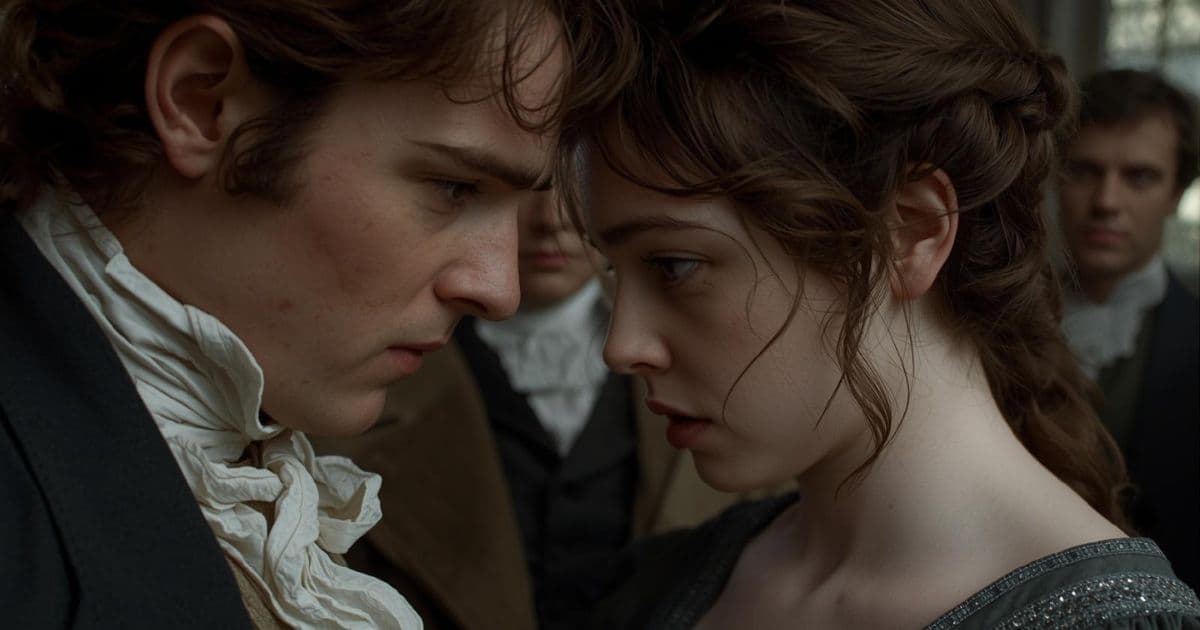
An excerpt from the original text.(complete · 4693 words)
r. Knightley might quarrel with her, but Emma could not quarrel with
herself. He was so much displeased, that it was longer than usual
before he came to Hartfield again; and when they did meet, his grave
looks shewed that she was not forgiven. She was sorry, but could not
repent. On the contrary, her plans and proceedings were more and more
justified and endeared to her by the general appearances of the next
few days.
The Picture, elegantly framed, came safely to hand soon after Mr.
Elton’s return, and being hung over the mantelpiece of the common
sitting-room, he got up to look at it, and sighed out his half
sentences of admiration just as he ought; and as for Harriet’s
feelings, they were visibly forming themselves into as strong and
steady an attachment as her youth and sort of mind admitted. Emma was
soon perfectly satisfied of Mr. Martin’s being no otherwise remembered,
than as he furnished a contrast with Mr. Elton, of the utmost advantage
to the latter.
Her views of improving her little friend’s mind, by a great deal of
useful reading and conversation, had never yet led to more than a few
first chapters, and the intention of going on to-morrow. It was much
easier to chat than to study; much pleasanter to let her imagination
range and work at Harriet’s fortune, than to be labouring to enlarge
her comprehension or exercise it on sober facts; and the only literary
pursuit which engaged Harriet at present, the only mental provision she
was making for the evening of life, was the collecting and transcribing
all the riddles of every sort that she could meet with, into a thin
quarto of hot-pressed paper, made up by her friend, and ornamented with
ciphers and trophies.
In this age of literature, such collections on a very grand scale are
not uncommon. Miss Nash, head-teacher at Mrs. Goddard’s, had written
out at least three hundred; and Harriet, who had taken the first hint
of it from her, hoped, with Miss Woodhouse’s help, to get a great many
more. Emma assisted with her invention, memory and taste; and as
Harriet wrote a very pretty hand, it was likely to be an arrangement of
the first order, in form as well as quantity.
Mr. Woodhouse was almost as much interested in the business as the
girls, and tried very often to recollect something worth their putting
in. “So many clever riddles as there used to be when he was young—he
wondered he could not remember them! but he hoped he should in time.”
And it always ended in “Kitty, a fair but frozen maid.”
His good friend Perry, too, whom he had spoken to on the subject, did
not at present recollect any thing of the riddle kind; but he had
desired Perry to be upon the watch, and as he went about so much,
something, he thought, might come from that quarter.
It was by no means his daughter’s wish that the intellects of Highbury
in general should be put under requisition. Mr. Elton was the only one
whose assistance she asked. He was invited to contribute any really
good enigmas, charades, or conundrums that he might recollect; and she
had the pleasure of seeing him most intently at work with his
recollections; and at the same time, as she could perceive, most
earnestly careful that nothing ungallant, nothing that did not breathe
a compliment to the sex should pass his lips. They owed to him their
two or three politest puzzles; and the joy and exultation with which at
last he recalled, and rather sentimentally recited, that well-known
charade,
My first doth affliction denote,
Which my second is destin’d to feel
And my whole is the best antidote
That affliction to soften and heal.—
made her quite sorry to acknowledge that they had transcribed it some
pages ago already.
“Why will not you write one yourself for us, Mr. Elton?” said she;
“that is the only security for its freshness; and nothing could be
easier to you.”
“Oh no! he had never written, hardly ever, any thing of the kind in his
life. The stupidest fellow! He was afraid not even Miss Woodhouse”—he
stopt a moment—“or Miss Smith could inspire him.”
The very next day however produced some proof of inspiration. He called
for a few moments, just to leave a piece of paper on the table
containing, as he said, a charade, which a friend of his had addressed
to a young lady, the object of his admiration, but which, from his
manner, Emma was immediately convinced must be his own.
“I do not offer it for Miss Smith’s collection,” said he. “Being my
friend’s, I have no right to expose it in any degree to the public eye,
but perhaps you may not dislike looking at it.”
The speech was more to Emma than to Harriet, which Emma could
understand. There was deep consciousness about him, and he found it
easier to meet her eye than her friend’s. He was gone the next
moment:—after another moment’s pause,
“Take it,” said Emma, smiling, and pushing the paper towards
Harriet—“it is for you. Take your own.”
But Harriet was in a tremor, and could not touch it; and Emma, never
loth to be first, was obliged to examine it herself.
To Miss——
CHARADE.
My first displays the wealth and pomp of kings,
Lords of the earth! their luxury and ease.
Another view of man, my second brings,
Behold him there, the monarch of the seas!
But ah! united, what reverse we have!
Man’s boasted power and freedom, all are flown;
Lord of the earth and sea, he bends a slave,
And woman, lovely woman, reigns alone.
Thy ready wit the word will soon supply,
May its approval beam in that soft eye!
She cast her eye over it, pondered, caught the meaning, read it through
again to be quite certain, and quite mistress of the lines, and then
passing it to Harriet, sat happily smiling, and saying to herself,
while Harriet was puzzling over the paper in all the confusion of hope
and dulness, “Very well, Mr. Elton, very well indeed. I have read worse
charades. Courtship—a very good hint. I give you credit for it. This
is feeling your way. This is saying very plainly—‘Pray, Miss Smith,
give me leave to pay my addresses to you. Approve my charade and my
intentions in the same glance.’
May its approval beam in that soft eye!
Harriet exactly. Soft is the very word for her eye—of all epithets, the
justest that could be given.
Thy ready wit the word will soon supply.
Humph—Harriet’s ready wit! All the better. A man must be very much in
love, indeed, to describe her so. Ah! Mr. Knightley, I wish you had the
benefit of this; I think this would convince you. For once in your life
you would be obliged to own yourself mistaken. An excellent charade
indeed! and very much to the purpose. Things must come to a crisis soon
now.”
She was obliged to break off from these very pleasant observations,
which were otherwise of a sort to run into great length, by the
eagerness of Harriet’s wondering questions.
“What can it be, Miss Woodhouse?—what can it be? I have not an idea—I
cannot guess it in the least. What can it possibly be? Do try to find
it out, Miss Woodhouse. Do help me. I never saw any thing so hard. Is
it kingdom? I wonder who the friend was—and who could be the young
lady. Do you think it is a good one? Can it be woman?
And woman, lovely woman, reigns alone.
Can it be Neptune?
Behold him there, the monarch of the seas!
Or a trident? or a mermaid? or a shark? Oh, no! shark is only one
syllable. It must be very clever, or he would not have brought it. Oh!
Miss Woodhouse, do you think we shall ever find it out?”
“Mermaids and sharks! Nonsense! My dear Harriet, what are you thinking
of? Where would be the use of his bringing us a charade made by a
friend upon a mermaid or a shark? Give me the paper and listen.
For Miss ———, read Miss Smith.
My first displays the wealth and pomp of kings,
Lords of the earth! their luxury and ease.
That is court.
Another view of man, my second brings;
Behold him there, the monarch of the seas!
That is ship;—plain as it can be.—Now for the cream.
But ah! united, (courtship, you know,) what reverse we have!
Man’s boasted power and freedom, all are flown.
Lord of the earth and sea, he bends a slave,
And woman, lovely woman, reigns alone.
A very proper compliment!—and then follows the application, which I
think, my dear Harriet, you cannot find much difficulty in
comprehending. Read it in comfort to yourself. There can be no doubt of
its being written for you and to you.”
Harriet could not long resist so delightful a persuasion. She read the
concluding lines, and was all flutter and happiness. She could not
speak. But she was not wanted to speak. It was enough for her to feel.
Emma spoke for her.
“There is so pointed, and so particular a meaning in this compliment,”
said she, “that I cannot have a doubt as to Mr. Elton’s intentions. You
are his object—and you will soon receive the completest proof of it. I
thought it must be so. I thought I could not be so deceived; but now,
it is clear; the state of his mind is as clear and decided, as my
wishes on the subject have been ever since I knew you. Yes, Harriet,
just so long have I been wanting the very circumstance to happen that
has happened. I could never tell whether an attachment between you and
Mr. Elton were most desirable or most natural. Its probability and its
eligibility have really so equalled each other! I am very happy. I
congratulate you, my dear Harriet, with all my heart. This is an
attachment which a woman may well feel pride in creating. This is a
connexion which offers nothing but good. It will give you every thing
that you want—consideration, independence, a proper home—it will fix
you in the centre of all your real friends, close to Hartfield and to
me, and confirm our intimacy for ever. This, Harriet, is an alliance
which can never raise a blush in either of us.”
“Dear Miss Woodhouse!”—and “Dear Miss Woodhouse,” was all that Harriet,
with many tender embraces could articulate at first; but when they did
arrive at something more like conversation, it was sufficiently clear
to her friend that she saw, felt, anticipated, and remembered just as
she ought. Mr. Elton’s superiority had very ample acknowledgment.
“Whatever you say is always right,” cried Harriet, “and therefore I
suppose, and believe, and hope it must be so; but otherwise I could not
have imagined it. It is so much beyond any thing I deserve. Mr. Elton,
who might marry any body! There cannot be two opinions about him. He
is so very superior. Only think of those sweet verses—‘To Miss ———.’
Dear me, how clever!—Could it really be meant for me?”
“I cannot make a question, or listen to a question about that. It is a
certainty. Receive it on my judgment. It is a sort of prologue to the
play, a motto to the chapter; and will be soon followed by
matter-of-fact prose.”
“It is a sort of thing which nobody could have expected. I am sure, a
month ago, I had no more idea myself!—The strangest things do take
place!”
“When Miss Smiths and Mr. Eltons get acquainted—they do indeed—and
really it is strange; it is out of the common course that what is so
evidently, so palpably desirable—what courts the pre-arrangement of
other people, should so immediately shape itself into the proper form.
You and Mr. Elton are by situation called together; you belong to one
another by every circumstance of your respective homes. Your marrying
will be equal to the match at Randalls. There does seem to be a
something in the air of Hartfield which gives love exactly the right
direction, and sends it into the very channel where it ought to flow.
The course of true love never did run smooth—
A Hartfield edition of Shakespeare would have a long note on that
passage.”
“That Mr. Elton should really be in love with me,—me, of all people,
who did not know him, to speak to him, at Michaelmas! And he, the very
handsomest man that ever was, and a man that every body looks up to,
quite like Mr. Knightley! His company so sought after, that every body
says he need not eat a single meal by himself if he does not chuse it;
that he has more invitations than there are days in the week. And so
excellent in the Church! Miss Nash has put down all the texts he has
ever preached from since he came to Highbury. Dear me! When I look back
to the first time I saw him! How little did I think!—The two Abbots and
I ran into the front room and peeped through the blind when we heard he
was going by, and Miss Nash came and scolded us away, and staid to look
through herself; however, she called me back presently, and let me look
too, which was very good-natured. And how beautiful we thought he
looked! He was arm-in-arm with Mr. Cole.”
“This is an alliance which, whoever—whatever your friends may be, must
be agreeable to them, provided at least they have common sense; and we
are not to be addressing our conduct to fools. If they are anxious to
see you happily married, here is a man whose amiable character gives
every assurance of it;—if they wish to have you settled in the same
country and circle which they have chosen to place you in, here it will
be accomplished; and if their only object is that you should, in the
common phrase, be well married, here is the comfortable fortune, the
respectable establishment, the rise in the world which must satisfy
them.”
“Yes, very true. How nicely you talk; I love to hear you. You
understand every thing. You and Mr. Elton are one as clever as the
other. This charade!—If I had studied a twelvemonth, I could never have
made any thing like it.”
“I thought he meant to try his skill, by his manner of declining it
yesterday.”
“I do think it is, without exception, the best charade I ever read.”
“I never read one more to the purpose, certainly.”
“It is as long again as almost all we have had before.”
“I do not consider its length as particularly in its favour. Such
things in general cannot be too short.”
Harriet was too intent on the lines to hear. The most satisfactory
comparisons were rising in her mind.
“It is one thing,” said she, presently—her cheeks in a glow—“to have
very good sense in a common way, like every body else, and if there is
any thing to say, to sit down and write a letter, and say just what you
must, in a short way; and another, to write verses and charades like
this.”
Emma could not have desired a more spirited rejection of Mr. Martin’s
prose.
“Such sweet lines!” continued Harriet—“these two last!—But how shall I
ever be able to return the paper, or say I have found it out?—Oh! Miss
Woodhouse, what can we do about that?”
“Leave it to me. You do nothing. He will be here this evening, I dare
say, and then I will give it him back, and some nonsense or other will
pass between us, and you shall not be committed.—Your soft eyes shall
chuse their own time for beaming. Trust to me.”
“Oh! Miss Woodhouse, what a pity that I must not write this beautiful
charade into my book! I am sure I have not got one half so good.”
“Leave out the two last lines, and there is no reason why you should
not write it into your book.”
“Oh! but those two lines are”—
—“The best of all. Granted;—for private enjoyment; and for private
enjoyment keep them. They are not at all the less written you know,
because you divide them. The couplet does not cease to be, nor does its
meaning change. But take it away, and all appropriation ceases, and a
very pretty gallant charade remains, fit for any collection. Depend
upon it, he would not like to have his charade slighted, much better
than his passion. A poet in love must be encouraged in both capacities,
or neither. Give me the book, I will write it down, and then there can
be no possible reflection on you.”
Harriet submitted, though her mind could hardly separate the parts, so
as to feel quite sure that her friend were not writing down a
declaration of love. It seemed too precious an offering for any degree
of publicity.
“I shall never let that book go out of my own hands,” said she.
“Very well,” replied Emma; “a most natural feeling; and the longer it
lasts, the better I shall be pleased. But here is my father coming: you
will not object to my reading the charade to him. It will be giving him
so much pleasure! He loves any thing of the sort, and especially any
thing that pays woman a compliment. He has the tenderest spirit of
gallantry towards us all!—You must let me read it to him.”
Harriet looked grave.
“My dear Harriet, you must not refine too much upon this charade.—You
will betray your feelings improperly, if you are too conscious and too
quick, and appear to affix more meaning, or even quite all the meaning
which may be affixed to it. Do not be overpowered by such a little
tribute of admiration. If he had been anxious for secrecy, he would not
have left the paper while I was by; but he rather pushed it towards me
than towards you. Do not let us be too solemn on the business. He has
encouragement enough to proceed, without our sighing out our souls over
this charade.”
“Oh! no—I hope I shall not be ridiculous about it. Do as you please.”
Mr. Woodhouse came in, and very soon led to the subject again, by the
recurrence of his very frequent inquiry of “Well, my dears, how does
your book go on?—Have you got any thing fresh?”
“Yes, papa; we have something to read you, something quite fresh. A
piece of paper was found on the table this morning—(dropt, we suppose,
by a fairy)—containing a very pretty charade, and we have just copied
it in.”
She read it to him, just as he liked to have any thing read, slowly and
distinctly, and two or three times over, with explanations of every
part as she proceeded—and he was very much pleased, and, as she had
foreseen, especially struck with the complimentary conclusion.
“Aye, that’s very just, indeed, that’s very properly said. Very true.
‘Woman, lovely woman.’ It is such a pretty charade, my dear, that I can
easily guess what fairy brought it.—Nobody could have written so
prettily, but you, Emma.”
Emma only nodded, and smiled.—After a little thinking, and a very
tender sigh, he added,
“Ah! it is no difficulty to see who you take after! Your dear mother
was so clever at all those things! If I had but her memory! But I can
remember nothing;—not even that particular riddle which you have heard
me mention; I can only recollect the first stanza; and there are
several.
Kitty, a fair but frozen maid,
Kindled a flame I yet deplore,
The hood-wink’d boy I called to aid,
Though of his near approach afraid,
So fatal to my suit before.
And that is all that I can recollect of it—but it is very clever all
the way through. But I think, my dear, you said you had got it.”
“Yes, papa, it is written out in our second page. We copied it from the
Elegant Extracts. It was Garrick’s, you know.”
“Aye, very true.—I wish I could recollect more of it.
Kitty, a fair but frozen maid.
The name makes me think of poor Isabella; for she was very near being
christened Catherine after her grandmama. I hope we shall have her here
next week. Have you thought, my dear, where you shall put her—and what
room there will be for the children?”
“Oh! yes—she will have her own room, of course; the room she always
has;—and there is the nursery for the children,—just as usual, you
know. Why should there be any change?”
“I do not know, my dear—but it is so long since she was here!—not since
last Easter, and then only for a few days.—Mr. John Knightley’s being a
lawyer is very inconvenient.—Poor Isabella!—she is sadly taken away
from us all!—and how sorry she will be when she comes, not to see Miss
Taylor here!”
“She will not be surprized, papa, at least.”
“I do not know, my dear. I am sure I was very much surprized when I
first heard she was going to be married.”
“We must ask Mr. and Mrs. Weston to dine with us, while Isabella is
here.”
“Yes, my dear, if there is time.—But—(in a very depressed tone)—she is
coming for only one week. There will not be time for any thing.”
“It is unfortunate that they cannot stay longer—but it seems a case of
necessity. Mr. John Knightley must be in town again on the 28th, and we
ought to be thankful, papa, that we are to have the whole of the time
they can give to the country, that two or three days are not to be
taken out for the Abbey. Mr. Knightley promises to give up his claim
this Christmas—though you know it is longer since they were with him,
than with us.”
“It would be very hard, indeed, my dear, if poor Isabella were to be
anywhere but at Hartfield.”
Mr. Woodhouse could never allow for Mr. Knightley’s claims on his
brother, or any body’s claims on Isabella, except his own. He sat
musing a little while, and then said,
“But I do not see why poor Isabella should be obliged to go back so
soon, though he does. I think, Emma, I shall try and persuade her to
stay longer with us. She and the children might stay very well.”
“Ah! papa—that is what you never have been able to accomplish, and I do
not think you ever will. Isabella cannot bear to stay behind her
husband.”
This was too true for contradiction. Unwelcome as it was, Mr. Woodhouse
could only give a submissive sigh; and as Emma saw his spirits affected
by the idea of his daughter’s attachment to her husband, she
immediately led to such a branch of the subject as must raise them.
“Harriet must give us as much of her company as she can while my
brother and sister are here. I am sure she will be pleased with the
children. We are very proud of the children, are not we, papa? I wonder
which she will think the handsomest, Henry or John?”
“Aye, I wonder which she will. Poor little dears, how glad they will be
to come. They are very fond of being at Hartfield, Harriet.”
“I dare say they are, sir. I am sure I do not know who is not.”
“Henry is a fine boy, but John is very like his mama. Henry is the
eldest, he was named after me, not after his father. John, the second,
is named after his father. Some people are surprized, I believe, that
the eldest was not, but Isabella would have him called Henry, which I
thought very pretty of her. And he is a very clever boy, indeed. They
are all remarkably clever; and they have so many pretty ways. They will
come and stand by my chair, and say, ‘Grandpapa, can you give me a bit
of string?’ and once Henry asked me for a knife, but I told him knives
were only made for grandpapas. I think their father is too rough with
them very often.”
“He appears rough to you,” said Emma, “because you are so very gentle
yourself; but if you could compare him with other papas, you would not
think him rough. He wishes his boys to be active and hardy; and if they
misbehave, can give them a sharp word now and then; but he is an
affectionate father—certainly Mr. John Knightley is an affectionate
father. The children are all fond of him.”
“And then their uncle comes in, and tosses them up to the ceiling in a
very frightful way!”
“But they like it, papa; there is nothing they like so much. It is such
enjoyment to them, that if their uncle did not lay down the rule of
their taking turns, whichever began would never give way to the other.”
“Well, I cannot understand it.”
“That is the case with us all, papa. One half of the world cannot
understand the pleasures of the other.”
Later in the morning, and just as the girls were going to separate in
preparation for the regular four o’clock dinner, the hero of this
inimitable charade walked in again. Harriet turned away; but Emma could
receive him with the usual smile, and her quick eye soon discerned in
his the consciousness of having made a push—of having thrown a die; and
she imagined he was come to see how it might turn up. His ostensible
reason, however, was to ask whether Mr. Woodhouse’s party could be made
up in the evening without him, or whether he should be in the smallest
degree necessary at Hartfield. If he were, every thing else must give
way; but otherwise his friend Cole had been saying so much about his
dining with him—had made such a point of it, that he had promised him
conditionally to come.
Emma thanked him, but could not allow of his disappointing his friend
on their account; her father was sure of his rubber. He re-urged—she
re-declined; and he seemed then about to make his bow, when taking the
paper from the table, she returned it—
“Oh! here is the charade you were so obliging as to leave with us;
thank you for the sight of it. We admired it so much, that I have
ventured to write it into Miss Smith’s collection. Your friend will not
take it amiss I hope. Of course I have not transcribed beyond the first
eight lines.”
Mr. Elton certainly did not very well know what to say. He looked
rather doubtingly—rather confused; said something about
“honour,”—glanced at Emma and at Harriet, and then seeing the book open
on the table, took it up, and examined it very attentively. With the
view of passing off an awkward moment, Emma smilingly said,
“You must make my apologies to your friend; but so good a charade must
not be confined to one or two. He may be sure of every woman’s
approbation while he writes with such gallantry.”
“I have no hesitation in saying,” replied Mr. Elton, though hesitating
a good deal while he spoke; “I have no hesitation in saying—at least if
my friend feels at all as I do—I have not the smallest doubt that,
could he see his little effusion honoured as I see it, (looking at
the book again, and replacing it on the table), he would consider it as
the proudest moment of his life.”
After this speech he was gone as soon as possible. Emma could not think
it too soon; for with all his good and agreeable qualities, there was a
sort of parade in his speeches which was very apt to incline her to
laugh. She ran away to indulge the inclination, leaving the tender and
the sublime of pleasure to Harriet’s share.
Master this chapter. Complete your experience
Purchase the complete book to access all chapters and support classic literature
As an Amazon Associate, we earn a small commission from qualifying purchases at no additional cost to you.
Available in paperback, hardcover, and e-book formats
Let's Analyse the Pattern
The Confirmation Bias Trap
When we're invested in being right, we unconsciously filter information to support our existing beliefs while dismissing contradictory evidence.
Why This Matters
Connect literature to life
This chapter teaches how invested minds filter evidence to support existing beliefs, missing contradictory information hiding in plain sight.
Practice This Today
This week, notice when you feel certain about someone's motivations—then actively look for one piece of evidence that contradicts your theory.
Now let's explore the literary elements.
Key Quotes & Analysis
"She was sorry, but could not repent."
Context: Emma reflects on Mr. Knightley's anger about her interference with Harriet
This perfectly captures Emma's character - she knows she's upset someone she respects, but she's not actually sorry for what she did. She feels bad about the conflict but not about her actions, which shows how convinced she is of her own rightness.
In Today's Words:
She felt bad that he was mad, but she wasn't going to admit she was wrong.
"It was much easier to chat than to study; much pleasanter to let her imagination range and work at Harriet's fortune, than to be labouring to enlarge her comprehension."
Context: Describing how Emma and Harriet's educational plans keep getting sidetracked
This reveals how Emma prefers fantasy and social manipulation to actual work. She'd rather play with romantic scenarios than do the hard work of real education or self-improvement.
In Today's Words:
It was way more fun to gossip and daydream about Harriet's love life than actually crack open a book.
"My first displays the wealth and pomp of kings, Lords of the earth! their luxury and ease."
Context: Reading his charade that spells out 'COURTSHIP'
Mr. Elton is showing off his literary skills while supposedly declaring romantic intentions. The elaborate style reveals his vanity and desire to impress, though who he's really trying to impress remains unclear.
In Today's Words:
He's basically sliding into someone's DMs with an overly complicated pickup line that shows how clever he thinks he is.
Thematic Threads
Self-Deception
In This Chapter
Emma convinces herself Mr. Elton's charade proves her matchmaking success, interpreting every detail as confirmation
Development
Evolving from earlier social misjudgments into active self-justification
In Your Life:
You might recognize this when you keep defending a decision everyone else questions, finding reasons why you're still right.
Class Assumptions
In This Chapter
Emma assumes she can engineer relationships between people of different social positions without consequence
Development
Building on her earlier dismissal of social boundaries as obstacles to her plans
In Your Life:
This appears when you try to fix situations between people without understanding the power dynamics at play.
Performance vs Reality
In This Chapter
Mr. Elton's elaborate charade creates theatrical romance while masking his true intentions
Development
Introduced here as a new layer of social performance
In Your Life:
You see this in dating apps, job interviews, or any situation where people perform the expected role rather than showing authentic interest.
Intellectual Pride
In This Chapter
Emma feels vindicated against Mr. Knightley's earlier criticism, using the charade as proof she was right
Development
Escalating from defensive reactions to active point-scoring
In Your Life:
This emerges when you find yourself more focused on proving you were right than on whether the situation is actually working.
Misdirected Education
In This Chapter
Instead of serious reading, Emma and Harriet collect riddles and charades, mistaking entertainment for improvement
Development
Continuing the pattern of avoiding substantial learning in favor of pleasant activities
In Your Life:
You might recognize this when your self-improvement efforts focus more on feeling productive than creating real change.
You now have the context. Time to form your own thoughts.
Discussion Questions
- 1
What evidence does Emma use to convince herself that Mr. Elton's charade is meant for Harriet?
analysis • surface - 2
Why does Emma interpret Mr. Elton's nervous behavior as confirmation of her matchmaking theory rather than considering other explanations?
analysis • medium - 3
Where do you see people today filtering information to confirm what they already believe, especially in workplace conflicts or family disagreements?
application • medium - 4
How would you practice the 'evidence audit' when you feel certain about someone's motivations but others disagree with your interpretation?
application • deep - 5
What does Emma's confidence in her social engineering reveal about the relationship between investment in being right and ability to see clearly?
reflection • deep
Critical Thinking Exercise
Test Your Theory
Think of a situation where you feel certain about someone's motivations or intentions. Write down three pieces of evidence that support your theory, then brainstorm three alternative explanations for the same evidence. Finally, identify what specific information would prove your theory wrong.
Consider:
- •Focus on observable behaviors rather than assumed intentions
- •Consider how your emotional investment might shape what you notice
- •Ask what someone neutral would see in the same situation
Journaling Prompt
Write about a time when you were absolutely certain about someone's motivations but later discovered you were wrong. What evidence did you ignore or misinterpret, and how did your investment in being right affect your judgment?
Coming Up Next...
Chapter 10: The Art of Strategic Matchmaking
With Emma convinced that Mr. Elton's intentions are clear, the stage is set for the next phase of her matchmaking scheme. But will her confidence in reading romantic signals prove as accurate as she believes?