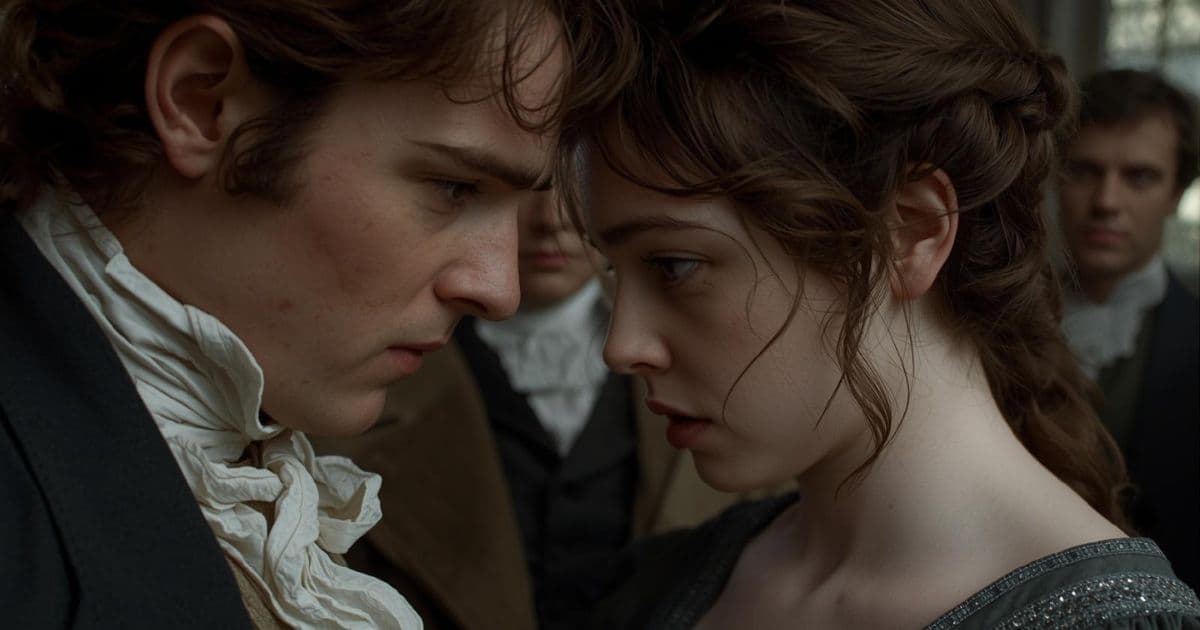
An excerpt from the original text.(complete · 2376 words)
he very day of Mr. Elton’s going to London produced a fresh occasion
for Emma’s services towards her friend. Harriet had been at Hartfield,
as usual, soon after breakfast; and, after a time, had gone home to
return again to dinner: she returned, and sooner than had been talked
of, and with an agitated, hurried look, announcing something
extraordinary to have happened which she was longing to tell. Half a
minute brought it all out. She had heard, as soon as she got back to
Mrs. Goddard’s, that Mr. Martin had been there an hour before, and
finding she was not at home, nor particularly expected, had left a
little parcel for her from one of his sisters, and gone away; and on
opening this parcel, she had actually found, besides the two songs
which she had lent Elizabeth to copy, a letter to herself; and this
letter was from him, from Mr. Martin, and contained a direct proposal
of marriage. “Who could have thought it? She was so surprized she did
not know what to do. Yes, quite a proposal of marriage; and a very good
letter, at least she thought so. And he wrote as if he really loved her
very much—but she did not know—and so, she was come as fast as she
could to ask Miss Woodhouse what she should do.—” Emma was half-ashamed
of her friend for seeming so pleased and so doubtful.
“Upon my word,” she cried, “the young man is determined not to lose any
thing for want of asking. He will connect himself well if he can.”
“Will you read the letter?” cried Harriet. “Pray do. I’d rather you
would.”
Emma was not sorry to be pressed. She read, and was surprized. The
style of the letter was much above her expectation. There were not
merely no grammatical errors, but as a composition it would not have
disgraced a gentleman; the language, though plain, was strong and
unaffected, and the sentiments it conveyed very much to the credit of
the writer. It was short, but expressed good sense, warm attachment,
liberality, propriety, even delicacy of feeling. She paused over it,
while Harriet stood anxiously watching for her opinion, with a “Well,
well,” and was at last forced to add, “Is it a good letter? or is it
too short?”
“Yes, indeed, a very good letter,” replied Emma rather slowly—“so good
a letter, Harriet, that every thing considered, I think one of his
sisters must have helped him. I can hardly imagine the young man whom I
saw talking with you the other day could express himself so well, if
left quite to his own powers, and yet it is not the style of a woman;
no, certainly, it is too strong and concise; not diffuse enough for a
woman. No doubt he is a sensible man, and I suppose may have a natural
talent for—thinks strongly and clearly—and when he takes a pen in hand,
his thoughts naturally find proper words. It is so with some men. Yes,
I understand the sort of mind. Vigorous, decided, with sentiments to a
certain point, not coarse. A better written letter, Harriet (returning
it,) than I had expected.”
“Well,” said the still waiting Harriet;—“well—and—and what shall I do?”
“What shall you do! In what respect? Do you mean with regard to this
letter?”
“Yes.”
“But what are you in doubt of? You must answer it of course—and
speedily.”
“Yes. But what shall I say? Dear Miss Woodhouse, do advise me.”
“Oh no, no! the letter had much better be all your own. You will
express yourself very properly, I am sure. There is no danger of your
not being intelligible, which is the first thing. Your meaning must be
unequivocal; no doubts or demurs: and such expressions of gratitude and
concern for the pain you are inflicting as propriety requires, will
present themselves unbidden to your mind, I am persuaded. You need
not be prompted to write with the appearance of sorrow for his
disappointment.”
“You think I ought to refuse him then,” said Harriet, looking down.
“Ought to refuse him! My dear Harriet, what do you mean? Are you in any
doubt as to that? I thought—but I beg your pardon, perhaps I have been
under a mistake. I certainly have been misunderstanding you, if you
feel in doubt as to the purport of your answer. I had imagined you
were consulting me only as to the wording of it.”
Harriet was silent. With a little reserve of manner, Emma continued:
“You mean to return a favourable answer, I collect.”
“No, I do not; that is, I do not mean—What shall I do? What would you
advise me to do? Pray, dear Miss Woodhouse, tell me what I ought to
do.”
“I shall not give you any advice, Harriet. I will have nothing to do
with it. This is a point which you must settle with your feelings.”
“I had no notion that he liked me so very much,” said Harriet,
contemplating the letter. For a little while Emma persevered in her
silence; but beginning to apprehend the bewitching flattery of that
letter might be too powerful, she thought it best to say,
“I lay it down as a general rule, Harriet, that if a woman doubts as
to whether she should accept a man or not, she certainly ought to
refuse him. If she can hesitate as to ‘Yes,’ she ought to say ‘No’
directly. It is not a state to be safely entered into with doubtful
feelings, with half a heart. I thought it my duty as a friend, and
older than yourself, to say thus much to you. But do not imagine that I
want to influence you.”
“Oh! no, I am sure you are a great deal too kind to—but if you would
just advise me what I had best do—No, no, I do not mean that—As you
say, one’s mind ought to be quite made up—One should not be
hesitating—It is a very serious thing.—It will be safer to say ‘No,’
perhaps.—Do you think I had better say ‘No?’”
“Not for the world,” said Emma, smiling graciously, “would I advise you
either way. You must be the best judge of your own happiness. If you
prefer Mr. Martin to every other person; if you think him the most
agreeable man you have ever been in company with, why should you
hesitate? You blush, Harriet.—Does any body else occur to you at this
moment under such a definition? Harriet, Harriet, do not deceive
yourself; do not be run away with by gratitude and compassion. At this
moment whom are you thinking of?”
The symptoms were favourable.—Instead of answering, Harriet turned away
confused, and stood thoughtfully by the fire; and though the letter was
still in her hand, it was now mechanically twisted about without
regard. Emma waited the result with impatience, but not without strong
hopes. At last, with some hesitation, Harriet said—
“Miss Woodhouse, as you will not give me your opinion, I must do as
well as I can by myself; and I have now quite determined, and really
almost made up my mind—to refuse Mr. Martin. Do you think I am right?”
“Perfectly, perfectly right, my dearest Harriet; you are doing just
what you ought. While you were at all in suspense I kept my feelings to
myself, but now that you are so completely decided I have no hesitation
in approving. Dear Harriet, I give myself joy of this. It would have
grieved me to lose your acquaintance, which must have been the
consequence of your marrying Mr. Martin. While you were in the smallest
degree wavering, I said nothing about it, because I would not
influence; but it would have been the loss of a friend to me. I could
not have visited Mrs. Robert Martin, of Abbey-Mill Farm. Now I am
secure of you for ever.”
Harriet had not surmised her own danger, but the idea of it struck her
forcibly.
“You could not have visited me!” she cried, looking aghast. “No, to be
sure you could not; but I never thought of that before. That would have
been too dreadful!—What an escape!—Dear Miss Woodhouse, I would not
give up the pleasure and honour of being intimate with you for any
thing in the world.”
“Indeed, Harriet, it would have been a severe pang to lose you; but it
must have been. You would have thrown yourself out of all good society.
I must have given you up.”
“Dear me!—How should I ever have borne it! It would have killed me
never to come to Hartfield any more!”
“Dear affectionate creature!—You banished to Abbey-Mill Farm!—You
confined to the society of the illiterate and vulgar all your life! I
wonder how the young man could have the assurance to ask it. He must
have a pretty good opinion of himself.”
“I do not think he is conceited either, in general,” said Harriet, her
conscience opposing such censure; “at least, he is very good natured,
and I shall always feel much obliged to him, and have a great regard
for—but that is quite a different thing from—and you know, though he
may like me, it does not follow that I should—and certainly I must
confess that since my visiting here I have seen people—and if one comes
to compare them, person and manners, there is no comparison at all,
one is so very handsome and agreeable. However, I do really think Mr.
Martin a very amiable young man, and have a great opinion of him; and
his being so much attached to me—and his writing such a letter—but as
to leaving you, it is what I would not do upon any consideration.”
“Thank you, thank you, my own sweet little friend. We will not be
parted. A woman is not to marry a man merely because she is asked, or
because he is attached to her, and can write a tolerable letter.”
“Oh no;—and it is but a short letter too.”
Emma felt the bad taste of her friend, but let it pass with a “very
true; and it would be a small consolation to her, for the clownish
manner which might be offending her every hour of the day, to know that
her husband could write a good letter.”
“Oh! yes, very. Nobody cares for a letter; the thing is, to be always
happy with pleasant companions. I am quite determined to refuse him.
But how shall I do? What shall I say?”
Emma assured her there would be no difficulty in the answer, and
advised its being written directly, which was agreed to, in the hope of
her assistance; and though Emma continued to protest against any
assistance being wanted, it was in fact given in the formation of every
sentence. The looking over his letter again, in replying to it, had
such a softening tendency, that it was particularly necessary to brace
her up with a few decisive expressions; and she was so very much
concerned at the idea of making him unhappy, and thought so much of
what his mother and sisters would think and say, and was so anxious
that they should not fancy her ungrateful, that Emma believed if the
young man had come in her way at that moment, he would have been
accepted after all.
This letter, however, was written, and sealed, and sent. The business
was finished, and Harriet safe. She was rather low all the evening, but
Emma could allow for her amiable regrets, and sometimes relieved them
by speaking of her own affection, sometimes by bringing forward the
idea of Mr. Elton.
“I shall never be invited to Abbey-Mill again,” was said in rather a
sorrowful tone.
“Nor, if you were, could I ever bear to part with you, my Harriet. You
are a great deal too necessary at Hartfield to be spared to
Abbey-Mill.”
“And I am sure I should never want to go there; for I am never happy
but at Hartfield.”
Some time afterwards it was, “I think Mrs. Goddard would be very much
surprized if she knew what had happened. I am sure Miss Nash would—for
Miss Nash thinks her own sister very well married, and it is only a
linen-draper.”
“One should be sorry to see greater pride or refinement in the teacher
of a school, Harriet. I dare say Miss Nash would envy you such an
opportunity as this of being married. Even this conquest would appear
valuable in her eyes. As to any thing superior for you, I suppose she
is quite in the dark. The attentions of a certain person can hardly be
among the tittle-tattle of Highbury yet. Hitherto I fancy you and I are
the only people to whom his looks and manners have explained
themselves.”
Harriet blushed and smiled, and said something about wondering that
people should like her so much. The idea of Mr. Elton was certainly
cheering; but still, after a time, she was tender-hearted again towards
the rejected Mr. Martin.
“Now he has got my letter,” said she softly. “I wonder what they are
all doing—whether his sisters know—if he is unhappy, they will be
unhappy too. I hope he will not mind it so very much.”
“Let us think of those among our absent friends who are more cheerfully
employed,” cried Emma. “At this moment, perhaps, Mr. Elton is shewing
your picture to his mother and sisters, telling how much more beautiful
is the original, and after being asked for it five or six times,
allowing them to hear your name, your own dear name.”
“My picture!—But he has left my picture in Bond-street.”
“Has he so!—Then I know nothing of Mr. Elton. No, my dear little modest
Harriet, depend upon it the picture will not be in Bond-street till
just before he mounts his horse to-morrow. It is his companion all this
evening, his solace, his delight. It opens his designs to his family,
it introduces you among them, it diffuses through the party those
pleasantest feelings of our nature, eager curiosity and warm
prepossession. How cheerful, how animated, how suspicious, how busy
their imaginations all are!”
Harriet smiled again, and her smiles grew stronger.
Master this chapter. Complete your experience
Purchase the complete book to access all chapters and support classic literature
As an Amazon Associate, we earn a small commission from qualifying purchases at no additional cost to you.
Available in paperback, hardcover, and e-book formats
Let's Analyse the Pattern
Using superior knowledge or status to control others' choices while convincing yourself you're acting in their best interest.
Why This Matters
Connect literature to life
This chapter teaches how to recognize when someone uses your fears and insecurities to control your decisions while claiming to help you.
Practice This Today
This week, notice when advice makes you feel smaller rather than more empowered—real guidance builds your confidence to choose, fake guidance manufactures the outcome someone else wants.
Now let's explore the literary elements.
Key Quotes & Analysis
"Upon my word, the young man is determined not to lose any thing for want of asking."
Context: Emma's reaction to learning Martin has proposed to Harriet
Emma's dismissive tone reveals her class prejudice. She can't believe a farmer would dare propose to someone she considers above his station, showing how she views relationships through social hierarchy rather than compatibility.
In Today's Words:
Well, he's certainly not shy about shooting above his weight.
"I lay it down as a general rule, Harriet, that if a woman doubts as to whether she should accept a man or not, she certainly ought to refuse him."
Context: Emma giving Harriet advice about the proposal
This sounds like wise advice but Emma is manipulating Harriet's uncertainty to get the outcome she wants. She's using Harriet's natural nervousness against her to control the decision.
In Today's Words:
If you have to think about it, the answer is no.
"It would be impossible for me to be visiting with you, if you were married to Mr. Martin."
Context: Emma explaining why Harriet should refuse Martin
Emma reveals her true motivation - maintaining her own social position. She's willing to sacrifice Harriet's happiness to avoid the social awkwardness of being connected to a farmer's family.
In Today's Words:
We couldn't hang out anymore if you married him - it would look bad for me.
"Oh! Miss Woodhouse, what shall I do? what shall I do?"
Context: Harriet seeking Emma's guidance about the proposal
Shows Harriet's complete dependence on Emma's judgment and her inability to trust her own feelings. This desperation makes her vulnerable to manipulation.
In Today's Words:
I have no idea what to do - you have to tell me!
Thematic Threads
Class Manipulation
In This Chapter
Emma uses class anxiety to control Harriet, threatening social exile if she marries below her station
Development
Builds on earlier class consciousness, now showing how class becomes a weapon of control
In Your Life:
You might see this when people use professional status, education, or social connections to pressure your decisions.
False Friendship
In This Chapter
Emma's friendship comes with conditions—Harriet must make choices that serve Emma's social experiment
Development
Deepens from Emma's initial interest in Harriet to reveal the transactional nature of their bond
In Your Life:
You might recognize this in relationships where support depends on making choices the other person approves of.
Authentic vs. Artificial
In This Chapter
Martin's genuine, heartfelt proposal contrasts sharply with Emma's manufactured romantic scenarios
Development
Introduces the tension between real feeling and social performance that will drive the plot
In Your Life:
You might face this choice between what feels right and what looks impressive to others.
Fear-Based Control
In This Chapter
Emma exploits Harriet's deepest fear—social isolation—to ensure compliance with her wishes
Development
Shows how Emma's influence operates through emotional manipulation rather than rational argument
In Your Life:
You might recognize when someone uses your fears or insecurities to push you toward their preferred outcome.
Self-Deception
In This Chapter
Emma convinces herself she's helping Harriet while clearly serving her own need to control and experiment
Development
Reveals Emma's growing ability to rationalize selfish behavior as altruistic guidance
In Your Life:
You might catch yourself justifying controlling behavior by claiming you know what's best for someone else.
You now have the context. Time to form your own thoughts.
Discussion Questions
- 1
What reasons does Emma give Harriet for rejecting Robert Martin's proposal, and what are her real motivations?
analysis • surface - 2
How does Emma use the advice 'if you have doubts, say no' to manipulate Harriet while appearing helpful?
analysis • medium - 3
Think about your workplace or family - when have you seen someone give advice that served their own interests more than the person they were 'helping'?
application • medium - 4
If you were Harriet's friend and noticed this manipulation happening, how would you help her recognize what was going on without attacking Emma directly?
application • deep - 5
What does this chapter reveal about how people can convince themselves they're being helpful when they're actually being controlling?
reflection • deep
Critical Thinking Exercise
Rewrite the Advice Scene
Imagine you're Harriet's coworker and she comes to you excited about Martin's proposal. Rewrite Emma's advice scene, but this time focus on helping Harriet think through her own feelings rather than steering her toward a predetermined outcome. What questions would you ask? How would you help her explore her options without imposing your judgment?
Consider:
- •What questions help someone clarify their own feelings versus leading them toward your preferred answer?
- •How can you acknowledge both the positives and concerns without dismissing either?
- •What's the difference between sharing information and applying emotional pressure?
Journaling Prompt
Write about a time when someone gave you advice that felt controlling rather than supportive. How did you recognize the difference? What would genuinely helpful guidance have looked like in that situation?
Coming Up Next...
Chapter 8: The Great Class Debate
With Martin's proposal rejected and Harriet's hopes now fixed on Mr. Elton, Emma's matchmaking scheme moves into its next phase. But Emma's confidence in reading people's hearts may be about to face its first real test.