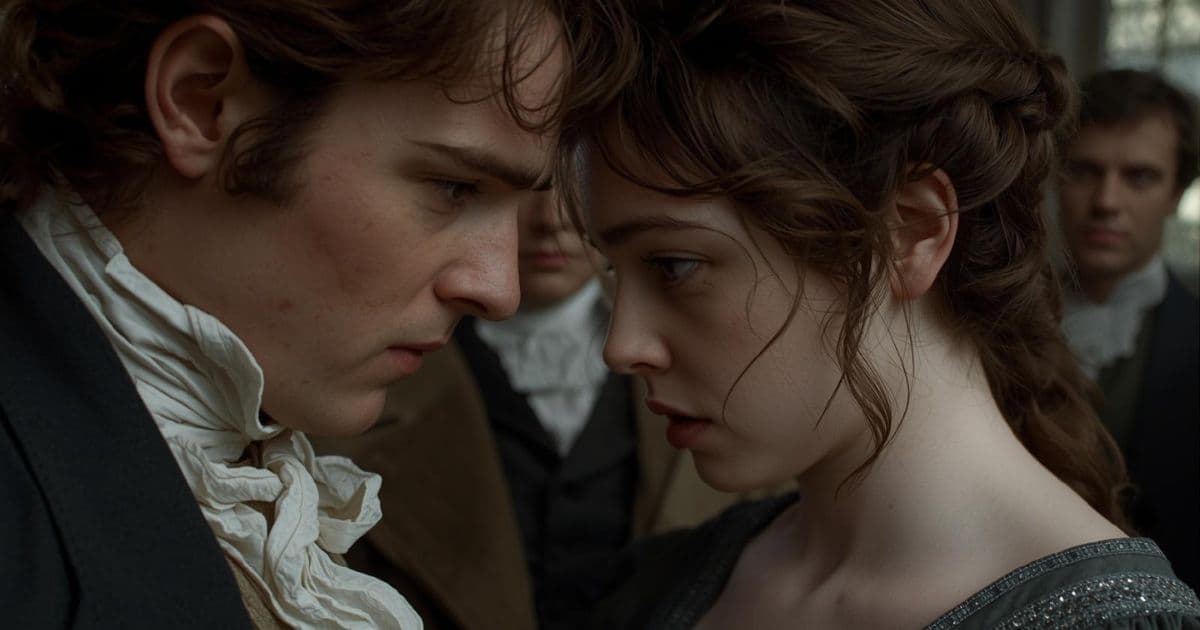
An excerpt from the original text.(complete · 3570 words)
hat totally different feelings did Emma take back into the house from
what she had brought out!—she had then been only daring to hope for a
little respite of suffering;—she was now in an exquisite flutter of
happiness, and such happiness moreover as she believed must still be
greater when the flutter should have passed away.
They sat down to tea—the same party round the same table—how often it
had been collected!—and how often had her eyes fallen on the same
shrubs in the lawn, and observed the same beautiful effect of the
western sun!—But never in such a state of spirits, never in any thing
like it; and it was with difficulty that she could summon enough of her
usual self to be the attentive lady of the house, or even the attentive
daughter.
Poor Mr. Woodhouse little suspected what was plotting against him in
the breast of that man whom he was so cordially welcoming, and so
anxiously hoping might not have taken cold from his ride.—Could he have
seen the heart, he would have cared very little for the lungs; but
without the most distant imagination of the impending evil, without the
slightest perception of any thing extraordinary in the looks or ways of
either, he repeated to them very comfortably all the articles of news
he had received from Mr. Perry, and talked on with much
self-contentment, totally unsuspicious of what they could have told him
in return.
As long as Mr. Knightley remained with them, Emma’s fever continued;
but when he was gone, she began to be a little tranquillised and
subdued—and in the course of the sleepless night, which was the tax for
such an evening, she found one or two such very serious points to
consider, as made her feel, that even her happiness must have some
alloy. Her father—and Harriet. She could not be alone without feeling
the full weight of their separate claims; and how to guard the comfort
of both to the utmost, was the question. With respect to her father, it
was a question soon answered. She hardly knew yet what Mr. Knightley
would ask; but a very short parley with her own heart produced the most
solemn resolution of never quitting her father.—She even wept over the
idea of it, as a sin of thought. While he lived, it must be only an
engagement; but she flattered herself, that if divested of the danger
of drawing her away, it might become an increase of comfort to him.—How
to do her best by Harriet, was of more difficult decision;—how to spare
her from any unnecessary pain; how to make her any possible atonement;
how to appear least her enemy?—On these subjects, her perplexity and
distress were very great—and her mind had to pass again and again
through every bitter reproach and sorrowful regret that had ever
surrounded it.—She could only resolve at last, that she would still
avoid a meeting with her, and communicate all that need be told by
letter; that it would be inexpressibly desirable to have her removed
just now for a time from Highbury, and—indulging in one scheme
more—nearly resolve, that it might be practicable to get an invitation
for her to Brunswick Square.—Isabella had been pleased with Harriet;
and a few weeks spent in London must give her some amusement.—She did
not think it in Harriet’s nature to escape being benefited by novelty
and variety, by the streets, the shops, and the children.—At any rate,
it would be a proof of attention and kindness in herself, from whom
every thing was due; a separation for the present; an averting of the
evil day, when they must all be together again.
She rose early, and wrote her letter to Harriet; an employment which
left her so very serious, so nearly sad, that Mr. Knightley, in walking
up to Hartfield to breakfast, did not arrive at all too soon; and half
an hour stolen afterwards to go over the same ground again with him,
literally and figuratively, was quite necessary to reinstate her in a
proper share of the happiness of the evening before.
He had not left her long, by no means long enough for her to have the
slightest inclination for thinking of any body else, when a letter was
brought her from Randalls—a very thick letter;—she guessed what it must
contain, and deprecated the necessity of reading it.—She was now in
perfect charity with Frank Churchill; she wanted no explanations, she
wanted only to have her thoughts to herself—and as for understanding
any thing he wrote, she was sure she was incapable of it.—It must be
waded through, however. She opened the packet; it was too surely so;—a
note from Mrs. Weston to herself, ushered in the letter from Frank to
Mrs. Weston.
“I have the greatest pleasure, my dear Emma, in forwarding to you the
enclosed. I know what thorough justice you will do it, and have
scarcely a doubt of its happy effect.—I think we shall never materially
disagree about the writer again; but I will not delay you by a long
preface.—We are quite well.—This letter has been the cure of all the
little nervousness I have been feeling lately.—I did not quite like
your looks on Tuesday, but it was an ungenial morning; and though you
will never own being affected by weather, I think every body feels a
north-east wind.—I felt for your dear father very much in the storm of
Tuesday afternoon and yesterday morning, but had the comfort of hearing
last night, by Mr. Perry, that it had not made him ill.
“Yours ever,
“A. W.”
[To Mrs. Weston.]
Windsor—July.
MY DEAR MADAM,
“If I made myself intelligible yesterday, this letter will be expected;
but expected or not, I know it will be read with candour and
indulgence.—You are all goodness, and I believe there will be need of
even all your goodness to allow for some parts of my past conduct.—But
I have been forgiven by one who had still more to resent. My courage
rises while I write. It is very difficult for the prosperous to be
humble. I have already met with such success in two applications for
pardon, that I may be in danger of thinking myself too sure of yours,
and of those among your friends who have had any ground of offence.—You
must all endeavour to comprehend the exact nature of my situation when
I first arrived at Randalls; you must consider me as having a secret
which was to be kept at all hazards. This was the fact. My right to
place myself in a situation requiring such concealment, is another
question. I shall not discuss it here. For my temptation to think it
a right, I refer every caviller to a brick house, sashed windows below,
and casements above, in Highbury. I dared not address her openly; my
difficulties in the then state of Enscombe must be too well known to
require definition; and I was fortunate enough to prevail, before we
parted at Weymouth, and to induce the most upright female mind in the
creation to stoop in charity to a secret engagement.—Had she refused, I
should have gone mad.—But you will be ready to say, what was your hope
in doing this?—What did you look forward to?—To any thing, every
thing—to time, chance, circumstance, slow effects, sudden bursts,
perseverance and weariness, health and sickness. Every possibility of
good was before me, and the first of blessings secured, in obtaining
her promises of faith and correspondence. If you need farther
explanation, I have the honour, my dear madam, of being your husband’s
son, and the advantage of inheriting a disposition to hope for good,
which no inheritance of houses or lands can ever equal the value
of.—See me, then, under these circumstances, arriving on my first visit
to Randalls;—and here I am conscious of wrong, for that visit might
have been sooner paid. You will look back and see that I did not come
till Miss Fairfax was in Highbury; and as you were the person
slighted, you will forgive me instantly; but I must work on my father’s
compassion, by reminding him, that so long as I absented myself from
his house, so long I lost the blessing of knowing you. My behaviour,
during the very happy fortnight which I spent with you, did not, I
hope, lay me open to reprehension, excepting on one point. And now I
come to the principal, the only important part of my conduct while
belonging to you, which excites my own anxiety, or requires very
solicitous explanation. With the greatest respect, and the warmest
friendship, do I mention Miss Woodhouse; my father perhaps will think I
ought to add, with the deepest humiliation.—A few words which dropped
from him yesterday spoke his opinion, and some censure I acknowledge
myself liable to.—My behaviour to Miss Woodhouse indicated, I believe,
more than it ought.—In order to assist a concealment so essential to
me, I was led on to make more than an allowable use of the sort of
intimacy into which we were immediately thrown.—I cannot deny that Miss
Woodhouse was my ostensible object—but I am sure you will believe the
declaration, that had I not been convinced of her indifference, I would
not have been induced by any selfish views to go on.—Amiable and
delightful as Miss Woodhouse is, she never gave me the idea of a young
woman likely to be attached; and that she was perfectly free from any
tendency to being attached to me, was as much my conviction as my
wish.—She received my attentions with an easy, friendly, goodhumoured
playfulness, which exactly suited me. We seemed to understand each
other. From our relative situation, those attentions were her due, and
were felt to be so.—Whether Miss Woodhouse began really to understand
me before the expiration of that fortnight, I cannot say;—when I called
to take leave of her, I remember that I was within a moment of
confessing the truth, and I then fancied she was not without suspicion;
but I have no doubt of her having since detected me, at least in some
degree.—She may not have surmised the whole, but her quickness must
have penetrated a part. I cannot doubt it. You will find, whenever the
subject becomes freed from its present restraints, that it did not take
her wholly by surprize. She frequently gave me hints of it. I remember
her telling me at the ball, that I owed Mrs. Elton gratitude for her
attentions to Miss Fairfax.—I hope this history of my conduct towards
her will be admitted by you and my father as great extenuation of what
you saw amiss. While you considered me as having sinned against Emma
Woodhouse, I could deserve nothing from either. Acquit me here, and
procure for me, when it is allowable, the acquittal and good wishes of
that said Emma Woodhouse, whom I regard with so much brotherly
affection, as to long to have her as deeply and as happily in love as
myself.—Whatever strange things I said or did during that fortnight,
you have now a key to. My heart was in Highbury, and my business was to
get my body thither as often as might be, and with the least suspicion.
If you remember any queernesses, set them all to the right account.—Of
the pianoforte so much talked of, I feel it only necessary to say, that
its being ordered was absolutely unknown to Miss F—, who would never
have allowed me to send it, had any choice been given her.—The delicacy
of her mind throughout the whole engagement, my dear madam, is much
beyond my power of doing justice to. You will soon, I earnestly hope,
know her thoroughly yourself.—No description can describe her. She must
tell you herself what she is—yet not by word, for never was there a
human creature who would so designedly suppress her own merit.—Since I
began this letter, which will be longer than I foresaw, I have heard
from her.—She gives a good account of her own health; but as she never
complains, I dare not depend. I want to have your opinion of her looks.
I know you will soon call on her; she is living in dread of the visit.
Perhaps it is paid already. Let me hear from you without delay; I am
impatient for a thousand particulars. Remember how few minutes I was at
Randalls, and in how bewildered, how mad a state: and I am not much
better yet; still insane either from happiness or misery. When I think
of the kindness and favour I have met with, of her excellence and
patience, and my uncle’s generosity, I am mad with joy: but when I
recollect all the uneasiness I occasioned her, and how little I deserve
to be forgiven, I am mad with anger. If I could but see her again!—But
I must not propose it yet. My uncle has been too good for me to
encroach.—I must still add to this long letter. You have not heard all
that you ought to hear. I could not give any connected detail
yesterday; but the suddenness, and, in one light, the unseasonableness
with which the affair burst out, needs explanation; for though the
event of the 26th ult., as you will conclude, immediately opened to me
the happiest prospects, I should not have presumed on such early
measures, but from the very particular circumstances, which left me not
an hour to lose. I should myself have shrunk from any thing so hasty,
and she would have felt every scruple of mine with multiplied strength
and refinement.—But I had no choice. The hasty engagement she had
entered into with that woman—Here, my dear madam, I was obliged to
leave off abruptly, to recollect and compose myself.—I have been
walking over the country, and am now, I hope, rational enough to make
the rest of my letter what it ought to be.—It is, in fact, a most
mortifying retrospect for me. I behaved shamefully. And here I can
admit, that my manners to Miss W., in being unpleasant to Miss F., were
highly blameable. She disapproved them, which ought to have been
enough.—My plea of concealing the truth she did not think
sufficient.—She was displeased; I thought unreasonably so: I thought
her, on a thousand occasions, unnecessarily scrupulous and cautious: I
thought her even cold. But she was always right. If I had followed her
judgment, and subdued my spirits to the level of what she deemed
proper, I should have escaped the greatest unhappiness I have ever
known.—We quarrelled.— Do you remember the morning spent at
Donwell?—There every little dissatisfaction that had occurred before
came to a crisis. I was late; I met her walking home by herself, and
wanted to walk with her, but she would not suffer it. She absolutely
refused to allow me, which I then thought most unreasonable. Now,
however, I see nothing in it but a very natural and consistent degree
of discretion. While I, to blind the world to our engagement, was
behaving one hour with objectionable particularity to another woman,
was she to be consenting the next to a proposal which might have made
every previous caution useless?—Had we been met walking together
between Donwell and Highbury, the truth must have been suspected.—I was
mad enough, however, to resent.—I doubted her affection. I doubted it
more the next day on Box Hill; when, provoked by such conduct on my
side, such shameful, insolent neglect of her, and such apparent
devotion to Miss W., as it would have been impossible for any woman of
sense to endure, she spoke her resentment in a form of words perfectly
intelligible to me.—In short, my dear madam, it was a quarrel blameless
on her side, abominable on mine; and I returned the same evening to
Richmond, though I might have staid with you till the next morning,
merely because I would be as angry with her as possible. Even then, I
was not such a fool as not to mean to be reconciled in time; but I was
the injured person, injured by her coldness, and I went away determined
that she should make the first advances.—I shall always congratulate
myself that you were not of the Box Hill party. Had you witnessed my
behaviour there, I can hardly suppose you would ever have thought well
of me again. Its effect upon her appears in the immediate resolution it
produced: as soon as she found I was really gone from Randalls, she
closed with the offer of that officious Mrs. Elton; the whole system of
whose treatment of her, by the bye, has ever filled me with indignation
and hatred. I must not quarrel with a spirit of forbearance which has
been so richly extended towards myself; but, otherwise, I should loudly
protest against the share of it which that woman has known.—‘Jane,’
indeed!—You will observe that I have not yet indulged myself in calling
her by that name, even to you. Think, then, what I must have endured in
hearing it bandied between the Eltons with all the vulgarity of
needless repetition, and all the insolence of imaginary superiority.
Have patience with me, I shall soon have done.—She closed with this
offer, resolving to break with me entirely, and wrote the next day to
tell me that we never were to meet again.—She felt the
engagement to be a source of repentance and misery
to each: she dissolved it.—This letter reached me on the very
morning of my poor aunt’s death. I answered it within an hour; but from
the confusion of my mind, and the multiplicity of business falling on
me at once, my answer, instead of being sent with all the many other
letters of that day, was locked up in my writing-desk; and I, trusting
that I had written enough, though but a few lines, to satisfy her,
remained without any uneasiness.—I was rather disappointed that I did
not hear from her again speedily; but I made excuses for her, and was
too busy, and—may I add?—too cheerful in my views to be captious.—We
removed to Windsor; and two days afterwards I received a parcel from
her, my own letters all returned!—and a few lines at the same time by
the post, stating her extreme surprize at not having had the smallest
reply to her last; and adding, that as silence on such a point could
not be misconstrued, and as it must be equally desirable to both to
have every subordinate arrangement concluded as soon as possible, she
now sent me, by a safe conveyance, all my letters, and requested, that
if I could not directly command hers, so as to send them to Highbury
within a week, I would forward them after that period to her at—: in
short, the full direction to Mr. Smallridge’s, near Bristol, stared me
in the face. I knew the name, the place, I knew all about it, and
instantly saw what she had been doing. It was perfectly accordant with
that resolution of character which I knew her to possess; and the
secrecy she had maintained, as to any such design in her former letter,
was equally descriptive of its anxious delicacy. For the world would
not she have seemed to threaten me.—Imagine the shock; imagine how,
till I had actually detected my own blunder, I raved at the blunders of
the post.—What was to be done?—One thing only.—I must speak to my
uncle. Without his sanction I could not hope to be listened to again.—I
spoke; circumstances were in my favour; the late event had softened
away his pride, and he was, earlier than I could have anticipated,
wholly reconciled and complying; and could say at last, poor man! with
a deep sigh, that he wished I might find as much happiness in the
marriage state as he had done.—I felt that it would be of a different
sort.—Are you disposed to pity me for what I must have suffered in
opening the cause to him, for my suspense while all was at stake?—No;
do not pity me till I reached Highbury, and saw how ill I had made her.
Do not pity me till I saw her wan, sick looks.—I reached Highbury at
the time of day when, from my knowledge of their late breakfast hour, I
was certain of a good chance of finding her alone.—I was not
disappointed; and at last I was not disappointed either in the object
of my journey. A great deal of very reasonable, very just displeasure I
had to persuade away. But it is done; we are reconciled, dearer, much
dearer, than ever, and no moment’s uneasiness can ever occur between us
again. Now, my dear madam, I will release you; but I could not conclude
before. A thousand and a thousand thanks for all the kindness you have
ever shewn me, and ten thousand for the attentions your heart will
dictate towards her.—If you think me in a way to be happier than I
deserve, I am quite of your opinion.—Miss W. calls me the child of good
fortune. I hope she is right.—In one respect, my good fortune is
undoubted, that of being able to subscribe myself,
Your obliged and affectionate Son,
F. C. WESTON CHURCHILL.
Master this chapter. Complete your experience
Purchase the complete book to access all chapters and support classic literature
As an Amazon Associate, we earn a small commission from qualifying purchases at no additional cost to you.
Available in paperback, hardcover, and e-book formats
Let's Analyse the Pattern
People wrap selfish choices in elaborate explanations that make them feel noble while consistently benefiting themselves at others' expense.
Why This Matters
Connect literature to life
This chapter teaches how to evaluate whether someone's apology is genuine accountability or elaborate self-justification.
Practice This Today
Next time someone gives you a long explanation for hurting you, ask: are they taking responsibility or just making their behavior sound reasonable?
Now let's explore the literary elements.
Key Quotes & Analysis
"What totally different feelings did Emma take back into the house from what she had brought out!"
Context: Opening line after Emma's engagement, contrasting her earlier despair with current joy
This shows how quickly life can change and how the same physical space can feel completely different based on our emotional state. Emma's world has been transformed in a single conversation.
In Today's Words:
Emma walked back into the house feeling like a completely different person than when she left.
"Poor Mr. Woodhouse little suspected what was plotting against him in the breast of that man whom he was so cordially welcoming"
Context: Describing Mr. Woodhouse's ignorance of Knightley's intentions while warmly greeting him
The irony highlights how major life changes often happen right under the noses of those most affected. The word 'plotting' suggests Emma sees her own happiness as somehow betraying her father.
In Today's Words:
Dad had no idea that the guy he was being so nice to was planning to take his daughter away.
"The hair was curled, and the maid sent away, and Emma sat down to think and be miserable"
Context: Emma alone in her room after the engagement, facing reality
Despite her happiness, Emma immediately confronts the practical and emotional complications her engagement creates. The contrast between getting prettied up and then feeling miserable shows how external appearances can mask internal turmoil.
In Today's Words:
After getting ready for bed, Emma finally had time to think about all the problems her good news was going to create.
Thematic Threads
Deception
In This Chapter
Frank's entire letter reveals how his 'romantic secrecy' was actually manipulation of everyone around him, using Emma as cover and lying to maintain his convenience
Development
Evolved from earlier hints about Frank's duplicity into full revelation of his systematic deception
In Your Life:
You might recognize this when someone's 'white lies' consistently benefit them while leaving you confused or hurt.
Responsibility
In This Chapter
Emma faces the real consequences of her happiness—she's hurt Harriet and must figure out how to handle her father's needs while building her own life
Development
Emma's growth from self-centered to considering her impact on others reaches full maturity
In Your Life:
You see this when your good news creates complications for people you care about and you have to navigate both joy and guilt.
Self-justification
In This Chapter
Frank's verbose letter shows someone more concerned with being forgiven than understanding the harm he caused, explaining away every selfish choice
Development
Introduced here as contrast to Emma's genuine self-reflection
In Your Life:
You might catch yourself doing this when you spend more energy explaining why you were right than considering if you were wrong.
Love's complications
In This Chapter
Both Emma and Frank discover that getting what you want romantically creates new problems—Emma must handle Harriet and her father, Frank nearly lost Jane through his games
Development
Deepens from earlier romantic confusion to show love's real-world consequences
In Your Life:
You experience this when finding love means disappointing other people or changing established relationships and routines.
Class privilege
In This Chapter
Frank's ability to play games with people's emotions stems partly from his social position—he can afford to be careless because he faces fewer real consequences
Development
Continues theme of how social position affects behavior and accountability
In Your Life:
You might notice this when people with more security or status can afford to be careless in ways that would devastate you.
You now have the context. Time to form your own thoughts.
Discussion Questions
- 1
What two major problems does Emma face after getting engaged, and how does she plan to solve them?
analysis • surface - 2
How does Frank Churchill justify his deceptive behavior in his letter, and what does this reveal about his character?
analysis • medium - 3
Think about someone you know who always has elaborate explanations for behavior that hurts others. What patterns do you notice?
application • medium - 4
When you've made choices that affected multiple people, how did you handle the aftermath? What would you do differently?
application • deep - 5
What's the difference between taking responsibility for harm you've caused versus just explaining why you did it?
reflection • deep
Critical Thinking Exercise
Spot the Beautiful Excuse
Think of a recent situation where someone gave you a lengthy explanation for why they couldn't follow through on something important to you. Write down their exact reasoning, then rewrite it as a simple, honest statement about what actually happened and what they prioritized instead.
Consider:
- •Look for explanations that focus more on the person's good intentions than the actual impact on others
- •Notice when someone spends more time justifying than apologizing or making things right
- •Pay attention to patterns - does this person always have elaborate reasons when things don't work out?
Journaling Prompt
Write about a time when you gave someone a beautiful excuse for your own behavior. What were you really protecting, and what would honest accountability have looked like?
Coming Up Next...
Chapter 51: Reading Between the Lines of Love
With Frank's confession in hand and her own heart settled, Emma must now face the delicate task of rebuilding relationships and managing the social fallout from all these romantic revelations.