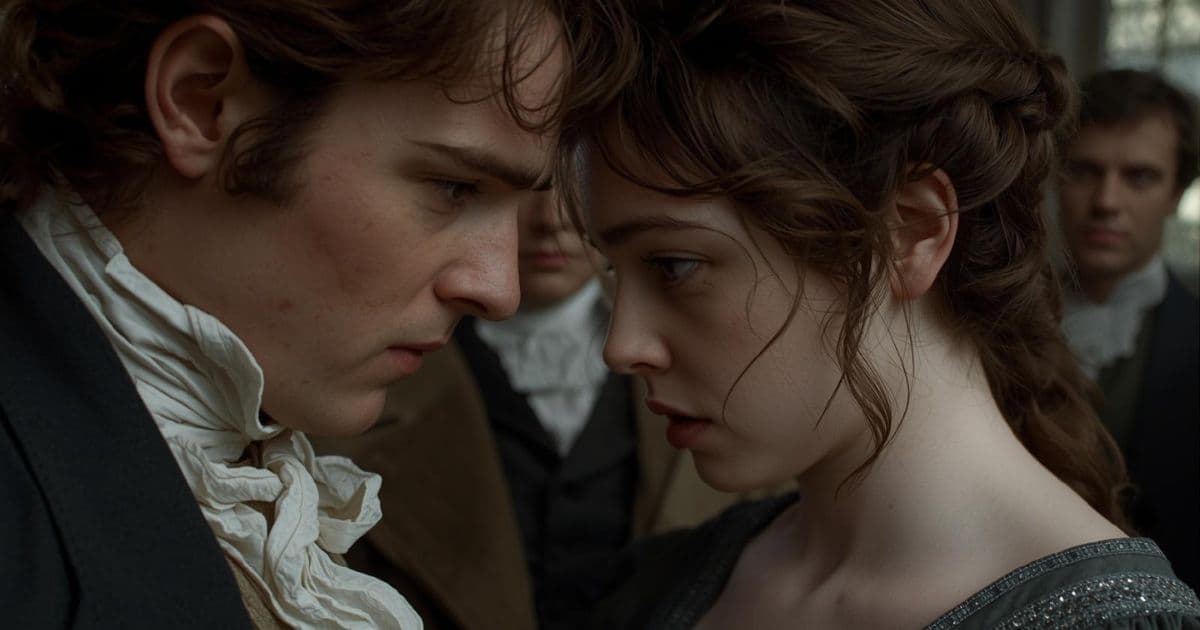
An excerpt from the original text.(complete · 3144 words)
mma did not repent her condescension in going to the Coles. The visit
afforded her many pleasant recollections the next day; and all that she
might be supposed to have lost on the side of dignified seclusion, must
be amply repaid in the splendour of popularity. She must have delighted
the Coles—worthy people, who deserved to be made happy!—And left a name
behind her that would not soon die away.
Perfect happiness, even in memory, is not common; and there were two
points on which she was not quite easy. She doubted whether she had not
transgressed the duty of woman by woman, in betraying her suspicions of
Jane Fairfax’s feelings to Frank Churchill. It was hardly right; but it
had been so strong an idea, that it would escape her, and his
submission to all that she told, was a compliment to her penetration,
which made it difficult for her to be quite certain that she ought to
have held her tongue.
The other circumstance of regret related also to Jane Fairfax; and
there she had no doubt. She did unfeignedly and unequivocally regret
the inferiority of her own playing and singing. She did most heartily
grieve over the idleness of her childhood—and sat down and practised
vigorously an hour and a half.
She was then interrupted by Harriet’s coming in; and if Harriet’s
praise could have satisfied her, she might soon have been comforted.
“Oh! if I could but play as well as you and Miss Fairfax!”
“Don’t class us together, Harriet. My playing is no more like her’s,
than a lamp is like sunshine.”
“Oh! dear—I think you play the best of the two. I think you play quite
as well as she does. I am sure I had much rather hear you. Every body
last night said how well you played.”
“Those who knew any thing about it, must have felt the difference. The
truth is, Harriet, that my playing is just good enough to be praised,
but Jane Fairfax’s is much beyond it.”
“Well, I always shall think that you play quite as well as she does, or
that if there is any difference nobody would ever find it out. Mr. Cole
said how much taste you had; and Mr. Frank Churchill talked a great
deal about your taste, and that he valued taste much more than
execution.”
“Ah! but Jane Fairfax has them both, Harriet.”
“Are you sure? I saw she had execution, but I did not know she had any
taste. Nobody talked about it. And I hate Italian singing.—There is no
understanding a word of it. Besides, if she does play so very well, you
know, it is no more than she is obliged to do, because she will have to
teach. The Coxes were wondering last night whether she would get into
any great family. How did you think the Coxes looked?”
“Just as they always do—very vulgar.”
“They told me something,” said Harriet rather hesitatingly; “but it is
nothing of any consequence.”
Emma was obliged to ask what they had told her, though fearful of its
producing Mr. Elton.
“They told me—that Mr. Martin dined with them last Saturday.”
“Oh!”
“He came to their father upon some business, and he asked him to stay
to dinner.”
“Oh!”
“They talked a great deal about him, especially Anne Cox. I do not know
what she meant, but she asked me if I thought I should go and stay
there again next summer.”
“She meant to be impertinently curious, just as such an Anne Cox should
be.”
“She said he was very agreeable the day he dined there. He sat by her
at dinner. Miss Nash thinks either of the Coxes would be very glad to
marry him.”
“Very likely.—I think they are, without exception, the most vulgar
girls in Highbury.”
Harriet had business at Ford’s.—Emma thought it most prudent to go with
her. Another accidental meeting with the Martins was possible, and in
her present state, would be dangerous.
Harriet, tempted by every thing and swayed by half a word, was always
very long at a purchase; and while she was still hanging over muslins
and changing her mind, Emma went to the door for amusement.—Much could
not be hoped from the traffic of even the busiest part of Highbury;—Mr.
Perry walking hastily by, Mr. William Cox letting himself in at the
office-door, Mr. Cole’s carriage-horses returning from exercise, or a
stray letter-boy on an obstinate mule, were the liveliest objects she
could presume to expect; and when her eyes fell only on the butcher
with his tray, a tidy old woman travelling homewards from shop with her
full basket, two curs quarrelling over a dirty bone, and a string of
dawdling children round the baker’s little bow-window eyeing the
gingerbread, she knew she had no reason to complain, and was amused
enough; quite enough still to stand at the door. A mind lively and at
ease, can do with seeing nothing, and can see nothing that does not
answer.
She looked down the Randalls road. The scene enlarged; two persons
appeared; Mrs. Weston and her son-in-law; they were walking into
Highbury;—to Hartfield of course. They were stopping, however, in the
first place at Mrs. Bates’s; whose house was a little nearer Randalls
than Ford’s; and had all but knocked, when Emma caught their
eye.—Immediately they crossed the road and came forward to her; and the
agreeableness of yesterday’s engagement seemed to give fresh pleasure
to the present meeting. Mrs. Weston informed her that she was going to
call on the Bateses, in order to hear the new instrument.
“For my companion tells me,” said she, “that I absolutely promised Miss
Bates last night, that I would come this morning. I was not aware of it
myself. I did not know that I had fixed a day, but as he says I did, I
am going now.”
“And while Mrs. Weston pays her visit, I may be allowed, I hope,” said
Frank Churchill, “to join your party and wait for her at Hartfield—if
you are going home.”
Mrs. Weston was disappointed.
“I thought you meant to go with me. They would be very much pleased.”
“Me! I should be quite in the way. But, perhaps—I may be equally in the
way here. Miss Woodhouse looks as if she did not want me. My aunt
always sends me off when she is shopping. She says I fidget her to
death; and Miss Woodhouse looks as if she could almost say the same.
What am I to do?”
“I am here on no business of my own,” said Emma; “I am only waiting for
my friend. She will probably have soon done, and then we shall go home.
But you had better go with Mrs. Weston and hear the instrument.”
“Well—if you advise it.—But (with a smile) if Colonel Campbell should
have employed a careless friend, and if it should prove to have an
indifferent tone—what shall I say? I shall be no support to Mrs.
Weston. She might do very well by herself. A disagreeable truth would
be palatable through her lips, but I am the wretchedest being in the
world at a civil falsehood.”
“I do not believe any such thing,” replied Emma.—“I am persuaded that
you can be as insincere as your neighbours, when it is necessary; but
there is no reason to suppose the instrument is indifferent. Quite
otherwise indeed, if I understood Miss Fairfax’s opinion last night.”
“Do come with me,” said Mrs. Weston, “if it be not very disagreeable to
you. It need not detain us long. We will go to Hartfield afterwards. We
will follow them to Hartfield. I really wish you to call with me. It
will be felt so great an attention! and I always thought you meant it.”
He could say no more; and with the hope of Hartfield to reward him,
returned with Mrs. Weston to Mrs. Bates’s door. Emma watched them in,
and then joined Harriet at the interesting counter,—trying, with all
the force of her own mind, to convince her that if she wanted plain
muslin it was of no use to look at figured; and that a blue ribbon, be
it ever so beautiful, would still never match her yellow pattern. At
last it was all settled, even to the destination of the parcel.
“Should I send it to Mrs. Goddard’s, ma’am?” asked Mrs.
Ford.—“Yes—no—yes, to Mrs. Goddard’s. Only my pattern gown is at
Hartfield. No, you shall send it to Hartfield, if you please. But then,
Mrs. Goddard will want to see it.—And I could take the pattern gown
home any day. But I shall want the ribbon directly—so it had better go
to Hartfield—at least the ribbon. You could make it into two parcels,
Mrs. Ford, could not you?”
“It is not worth while, Harriet, to give Mrs. Ford the trouble of two
parcels.”
“No more it is.”
“No trouble in the world, ma’am,” said the obliging Mrs. Ford.
“Oh! but indeed I would much rather have it only in one. Then, if you
please, you shall send it all to Mrs. Goddard’s—I do not know—No, I
think, Miss Woodhouse, I may just as well have it sent to Hartfield,
and take it home with me at night. What do you advise?”
“That you do not give another half-second to the subject. To Hartfield,
if you please, Mrs. Ford.”
“Aye, that will be much best,” said Harriet, quite satisfied, “I should
not at all like to have it sent to Mrs. Goddard’s.”
Voices approached the shop—or rather one voice and two ladies: Mrs.
Weston and Miss Bates met them at the door.
“My dear Miss Woodhouse,” said the latter, “I am just run across to
entreat the favour of you to come and sit down with us a little while,
and give us your opinion of our new instrument; you and Miss Smith. How
do you do, Miss Smith?—Very well I thank you.—And I begged Mrs. Weston
to come with me, that I might be sure of succeeding.”
“I hope Mrs. Bates and Miss Fairfax are—”
“Very well, I am much obliged to you. My mother is delightfully well;
and Jane caught no cold last night. How is Mr. Woodhouse?—I am so glad
to hear such a good account. Mrs. Weston told me you were here.—Oh!
then, said I, I must run across, I am sure Miss Woodhouse will allow me
just to run across and entreat her to come in; my mother will be so
very happy to see her—and now we are such a nice party, she cannot
refuse.—‘Aye, pray do,’ said Mr. Frank Churchill, ‘Miss Woodhouse’s
opinion of the instrument will be worth having.’—But, said I, I shall
be more sure of succeeding if one of you will go with me.—‘Oh,’ said
he, ‘wait half a minute, till I have finished my job;’—For, would you
believe it, Miss Woodhouse, there he is, in the most obliging manner in
the world, fastening in the rivet of my mother’s spectacles.—The rivet
came out, you know, this morning.—So very obliging!—For my mother had
no use of her spectacles—could not put them on. And, by the bye, every
body ought to have two pair of spectacles; they should indeed. Jane
said so. I meant to take them over to John Saunders the first thing I
did, but something or other hindered me all the morning; first one
thing, then another, there is no saying what, you know. At one time
Patty came to say she thought the kitchen chimney wanted sweeping. Oh,
said I, Patty do not come with your bad news to me. Here is the rivet
of your mistress’s spectacles out. Then the baked apples came home,
Mrs. Wallis sent them by her boy; they are extremely civil and obliging
to us, the Wallises, always—I have heard some people say that Mrs.
Wallis can be uncivil and give a very rude answer, but we have never
known any thing but the greatest attention from them. And it cannot be
for the value of our custom now, for what is our consumption of bread,
you know? Only three of us.—besides dear Jane at present—and she really
eats nothing—makes such a shocking breakfast, you would be quite
frightened if you saw it. I dare not let my mother know how little she
eats—so I say one thing and then I say another, and it passes off. But
about the middle of the day she gets hungry, and there is nothing she
likes so well as these baked apples, and they are extremely wholesome,
for I took the opportunity the other day of asking Mr. Perry; I
happened to meet him in the street. Not that I had any doubt before—I
have so often heard Mr. Woodhouse recommend a baked apple. I believe it
is the only way that Mr. Woodhouse thinks the fruit thoroughly
wholesome. We have apple-dumplings, however, very often. Patty makes an
excellent apple-dumpling. Well, Mrs. Weston, you have prevailed, I
hope, and these ladies will oblige us.”
Emma would be “very happy to wait on Mrs. Bates, &c.,” and they did at
last move out of the shop, with no farther delay from Miss Bates than,
“How do you do, Mrs. Ford? I beg your pardon. I did not see you before.
I hear you have a charming collection of new ribbons from town. Jane
came back delighted yesterday. Thank ye, the gloves do very well—only a
little too large about the wrist; but Jane is taking them in.”
“What was I talking of?” said she, beginning again when they were all
in the street.
Emma wondered on what, of all the medley, she would fix.
“I declare I cannot recollect what I was talking of.—Oh! my mother’s
spectacles. So very obliging of Mr. Frank Churchill! ‘Oh!’ said he, ‘I
do think I can fasten the rivet; I like a job of this kind
excessively.’—Which you know shewed him to be so very.... Indeed I must
say that, much as I had heard of him before and much as I had expected,
he very far exceeds any thing.... I do congratulate you, Mrs. Weston,
most warmly. He seems every thing the fondest parent could.... ‘Oh!’
said he, ‘I can fasten the rivet. I like a job of that sort
excessively.’ I never shall forget his manner. And when I brought out
the baked apples from the closet, and hoped our friends would be so
very obliging as to take some, ‘Oh!’ said he directly, ‘there is
nothing in the way of fruit half so good, and these are the
finest-looking home-baked apples I ever saw in my life.’ That, you
know, was so very.... And I am sure, by his manner, it was no
compliment. Indeed they are very delightful apples, and Mrs. Wallis
does them full justice—only we do not have them baked more than twice,
and Mr. Woodhouse made us promise to have them done three times—but
Miss Woodhouse will be so good as not to mention it. The apples
themselves are the very finest sort for baking, beyond a doubt; all
from Donwell—some of Mr. Knightley’s most liberal supply. He sends us a
sack every year; and certainly there never was such a keeping apple
anywhere as one of his trees—I believe there is two of them. My mother
says the orchard was always famous in her younger days. But I was
really quite shocked the other day—for Mr. Knightley called one
morning, and Jane was eating these apples, and we talked about them and
said how much she enjoyed them, and he asked whether we were not got to
the end of our stock. ‘I am sure you must be,’ said he, ‘and I will
send you another supply; for I have a great many more than I can ever
use. William Larkins let me keep a larger quantity than usual this
year. I will send you some more, before they get good for nothing.’ So
I begged he would not—for really as to ours being gone, I could not
absolutely say that we had a great many left—it was but half a dozen
indeed; but they should be all kept for Jane; and I could not at all
bear that he should be sending us more, so liberal as he had been
already; and Jane said the same. And when he was gone, she almost
quarrelled with me—No, I should not say quarrelled, for we never had a
quarrel in our lives; but she was quite distressed that I had owned the
apples were so nearly gone; she wished I had made him believe we had a
great many left. Oh, said I, my dear, I did say as much as I could.
However, the very same evening William Larkins came over with a large
basket of apples, the same sort of apples, a bushel at least, and I was
very much obliged, and went down and spoke to William Larkins and said
every thing, as you may suppose. William Larkins is such an old
acquaintance! I am always glad to see him. But, however, I found
afterwards from Patty, that William said it was all the apples of
that sort his master had; he had brought them all—and now his master
had not one left to bake or boil. William did not seem to mind it
himself, he was so pleased to think his master had sold so many; for
William, you know, thinks more of his master’s profit than any thing;
but Mrs. Hodges, he said, was quite displeased at their being all sent
away. She could not bear that her master should not be able to have
another apple-tart this spring. He told Patty this, but bid her not
mind it, and be sure not to say any thing to us about it, for Mrs.
Hodges would be cross sometimes, and as long as so many sacks were
sold, it did not signify who ate the remainder. And so Patty told me,
and I was excessively shocked indeed! I would not have Mr. Knightley
know any thing about it for the world! He would be so very.... I wanted
to keep it from Jane’s knowledge; but, unluckily, I had mentioned it
before I was aware.”
Miss Bates had just done as Patty opened the door; and her visitors
walked upstairs without having any regular narration to attend to,
pursued only by the sounds of her desultory good-will.
“Pray take care, Mrs. Weston, there is a step at the turning. Pray take
care, Miss Woodhouse, ours is rather a dark staircase—rather darker and
narrower than one could wish. Miss Smith, pray take care. Miss
Woodhouse, I am quite concerned, I am sure you hit your foot. Miss
Smith, the step at the turning.”
Master this chapter. Complete your experience
Purchase the complete book to access all chapters and support classic literature
As an Amazon Associate, we earn a small commission from qualifying purchases at no additional cost to you.
Available in paperback, hardcover, and e-book formats
Let's Analyse the Pattern
The automatic mental process of rewriting our mistakes and poor choices into reasonable decisions to protect our self-image.
Why This Matters
Connect literature to life
This chapter teaches how to recognize when your mind automatically rewrites your mistakes as victories to protect your self-image.
Practice This Today
This week, notice when you feel defensive about something that went wrong and ask yourself: what story am I telling myself right now versus what actually happened?
Now let's explore the literary elements.
Key Quotes & Analysis
"Perfect happiness, even in memory, is not common"
Context: As Emma reflects on the party while trying to convince herself it was worth it
This reveals Emma's tendency to overthink and find flaws even in good experiences. She can't just enjoy success - she has to analyze and justify it, which shows her underlying insecurity.
In Today's Words:
Even when things go well, something always bugs you about it later
"She did most heartily grieve over the idleness of her childhood"
Context: When Emma realizes how much better Jane plays piano than she does
This is a rare moment of genuine self-awareness from Emma. She's forced to confront that her privileged upbringing didn't push her to develop real skills, just surface accomplishments.
In Today's Words:
She kicked herself for being lazy when she was younger instead of actually working at stuff
"his submission to all that she told, was a compliment to her penetration"
Context: Emma justifying why she gossiped to Frank about Jane's feelings
Emma interprets Frank's agreement as proof she's insightful, when he's actually manipulating her. This shows how flattery can make us rationalize bad behavior.
In Today's Words:
He agreed with everything she said, which made her feel like she was really smart and perceptive
Thematic Threads
Self-Deception
In This Chapter
Emma transforms her social missteps at the party into evidence of her popularity and social success
Development
Deepening from earlier chapters where Emma misread situations—now she's actively rewriting reality
In Your Life:
You might catch yourself explaining why your mistake was actually the smart choice all along.
Class Anxiety
In This Chapter
Emma's discomfort with Jane's superior musical ability threatens her sense of social position and accomplishment
Development
Building tension as Emma encounters people who challenge her assumed superiority
In Your Life:
You feel threatened when someone in your workplace or social circle clearly outperforms you.
Recognition vs Reality
In This Chapter
Emma knows the difference between real musical skill and polite compliments but struggles with this knowledge
Development
Emma's growing awareness of gaps between perception and truth
In Your Life:
You know when people are being polite about your work versus genuinely impressed, but it stings.
Authentic Generosity
In This Chapter
Mr. Knightley gives away all his apples, keeping none for himself, while Frank makes showy gestures
Development
Continued contrast between Mr. Knightley's quiet goodness and others' performative kindness
In Your Life:
You can distinguish between people who help for show versus those who give without expecting credit.
Social Performance
In This Chapter
Frank Churchill's charm offensive with fixing spectacles contrasts with his reluctance to fulfill social obligations
Development
Frank's pattern of strategic charm becoming more apparent
In Your Life:
You notice when someone is exceptionally charming but seems to avoid real commitment or responsibility.
You now have the context. Time to form your own thoughts.
Discussion Questions
- 1
What two things bothered Emma after the Coles' party, and how did she handle these uncomfortable feelings?
analysis • surface - 2
Why does Emma immediately rewrite her embarrassing moments as social victories? What does this protect her from feeling?
analysis • medium - 3
When have you seen someone (including yourself) transform a mistake into a success story? What did that rewriting accomplish?
application • medium - 4
Compare Frank's showy gesture of fixing spectacles to Mr. Knightley's quiet gift of apples. Which approach to kindness do you trust more, and why?
analysis • deep - 5
What would change in your relationships if you stopped immediately justifying your mistakes and instead sat with the discomfort of being wrong?
reflection • deep
Critical Thinking Exercise
Catch Your Self-Justification Machine
Think of a recent situation where you felt defensive or made excuses. Write down what actually happened in one column, then what you told yourself it meant in another column. Notice the gap between facts and your preferred narrative. This gap reveals where your mind protects your self-image instead of helping you grow.
Consider:
- •Look for words like 'but', 'however', or 'at least' in your explanations—these often signal justification
- •Pay attention to how quickly you moved from 'I messed up' to 'here's why it was actually okay'
- •Notice if you're minimizing the other person's experience while maximizing your good intentions
Journaling Prompt
Write about a time when admitting you were wrong led to a better outcome than defending yourself would have. What made that honesty possible, and how did it change the situation?
Coming Up Next...
Chapter 28: Secrets Hidden in Plain Sight
Emma reluctantly agrees to visit the Bateses to hear Jane's mysterious new piano, setting up an encounter that will reveal more about the instrument's true origins and the secrets swirling around Jane and Frank.